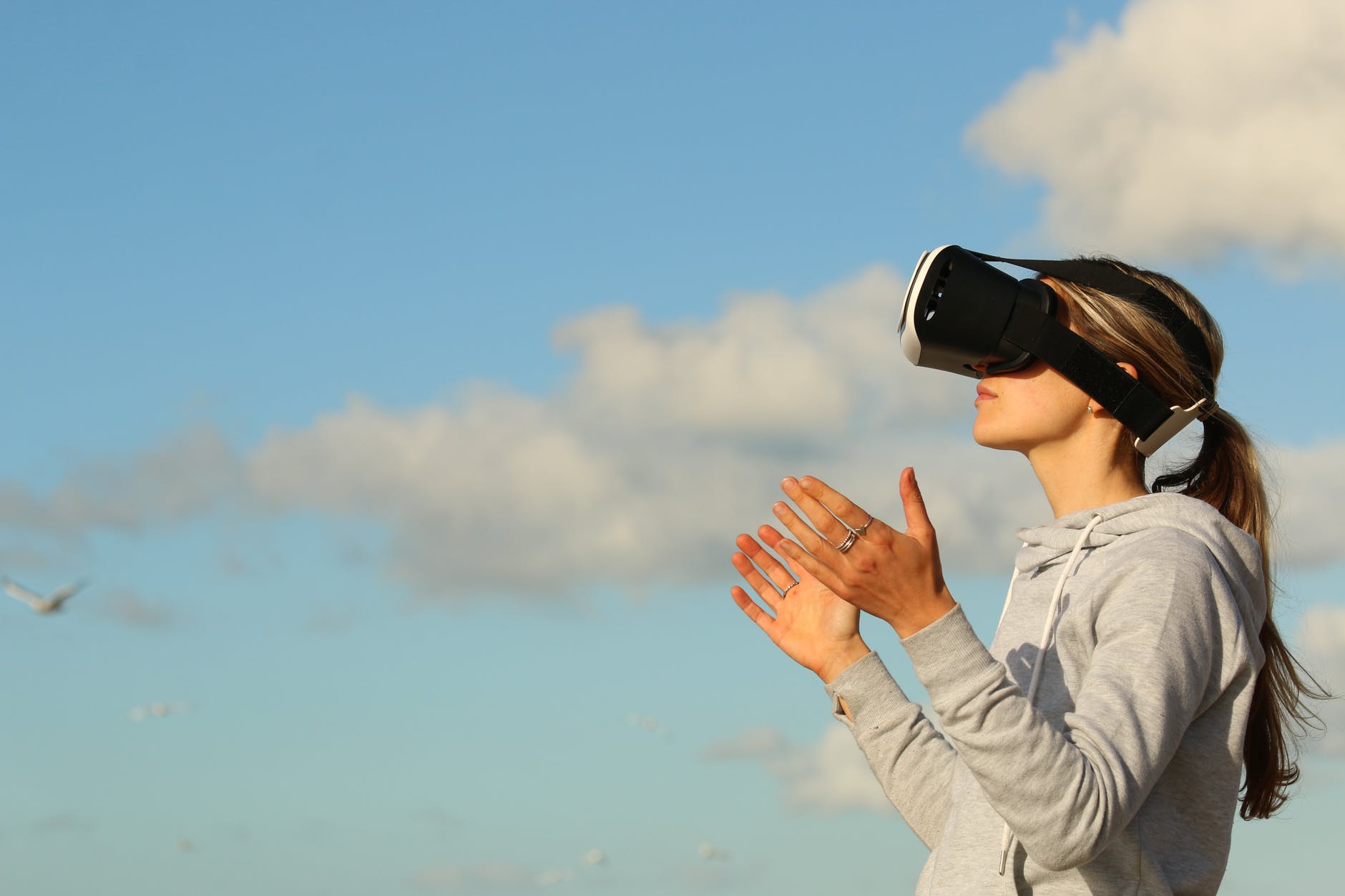
Billionaire Zuckerberg is betting his company’s future on the metaverse but is keen to make it a collaborative project, describing it as an “embodied internet”…
“We believe the metaverse may be the next generation of the internet — combining the physical and digital world in a persistent and immersive manner — and not purely a virtual reality world,” the report says.”
A device-agnostic metaverse accessible via PCs, game consoles, and smartphones could result in a very large ecosystem.”
The metaverse has the potential to further link realms. The embodied aspect is interesting to consider; how much will the offline body move in sync with the online body? How much further will we move beyond guiding an avatar around an online platform with a mouse or keyboard? And what potential is there to truly meld online and offline experiences at the same time?
I wonder how much this embodiment can happen in the metaverse as compared to other technological options. For example, Google Glass and similar options offered the opportunity to overlay data on top of what a person was seeing and experiencing. Or, Pokemon Go put video game characters in an offline map and reality.
The pandemic loosened ties between people: Kids stopped going to school; their parents stopped going to work; parishioners stopped going to church; people stopped gathering, in general. Sociologists think all of this isolation shifted the way we behave. “We’re more likely to break rules when our bonds to society are weakened,” Robert Sampson, a Harvard sociologist who studies social disorder, told me. “When we become untethered, we tend to prioritize our own private interests over those of others or the public.”
The turn-of-the-20th-century scholar Émile Durkheim called this state anomie, or a lack of social norms that leads to lawlessness. “We are moral beings to the extent that we are social beings,” Durkheim wrote. In the past two years, we have stopped being social, and in many cases we have stopped being moral, too.
“We’ve got, I think, a generalized sense that the rules simply don’t apply,” Richard Rosenfeld, a criminologist at the University of Missouri at St. Louis, told me. In some places, he says, police arrested fewer people during the pandemic, and “when enforcement goes down, people tend to relax their commitment to the rules.”
This perspective is interesting to consider alongside the millions who did follow national and local guidelines regarding masking and behavior. A lot of attention has been paid to those refusing to comply but many did; does the weirdness stand out even more because of this?
To take the Durkheim reference further, he thought the breaking of the rules and the subsequent reaction and sanctions could help reinforce the original rules.
I might add to the list of explanations in the article the influence of smartphones and social media. These could matter in multiple ways. First, the weird behavior can easily be recorded by others. People may have been weird in the past but was there such a visible record of that behavior? Second, the people with the weird behavior may be recording and sharing their own behavior. Overall, what may have been more private behavior in the past or actions limited to a relatively small set of people or closely connected set of people are no longer kept from a broader audience.
Author and sociologist Carolyn Chen calls this philosophy “techtopia,” where “people find their highest fulfillment in the utopian workplace.”…
Chen’s research subjects are almost all men, and most are white or Asian. Eighty percent had moved from places outside Silicon Valley, marooned there without the support structures of family, friends or community. Chen describes them as “far from home, alone, young, impressionable.” Work is their only outlet to fill in the “meaning” gap…
While Silicon Valley may be the epicenter of experimental self-improvement (just check out how many tech workers fast or microdose psychedelics to achieve greater clarity or productivity), the “work as religion” philosophy has spread across the country. According to Chen, almost every Fortune 500 company has some kind of religiosity baked into its corporate structure — from inspiring mission statements to charismatic leaders — and many companies have actively gone “spiritual” to drive up the bottom line.
For the past 40 years, the workplace has successfully unseated religious institutions as a primary meaning maker, right after family, according to a recent Pew survey. High-income employees work longer hours than ever and are less likely to consider themselves religious, writes Chen. People who don’t have any religion — “religious nones” — have tripled in the past quarter century. At the same time, corporations have changed their strategies, using new incentive structures like gain sharing and stock options to bring people into the corporate “family.”
Going back to the early days of sociology, is the Silicon Valley marriage of religion and work more like:
Marx’s suggestion that religion is a tool used by the capitalists – who own the means and modes of production – to distract workers from the reality that they are being exploited.
Weber’s idea that religious ideas could transform economic systems; is this less about religion being connected to work and more about religion fundamentally changing work?
Durkheim’s argument that people will no longer need religion as humans embrace a brotherhood of people and progress.
There might be some merit to all of these. If humans are meaning-making creatures, they will continue to make meaning – and ultimate meaning – in the midst of their day-to-day realities. Yet, since we are right in the middle of this transformation, it is not certain that it will necessarily continue. Do American workers like the idea that work is the primary meaning-maker?
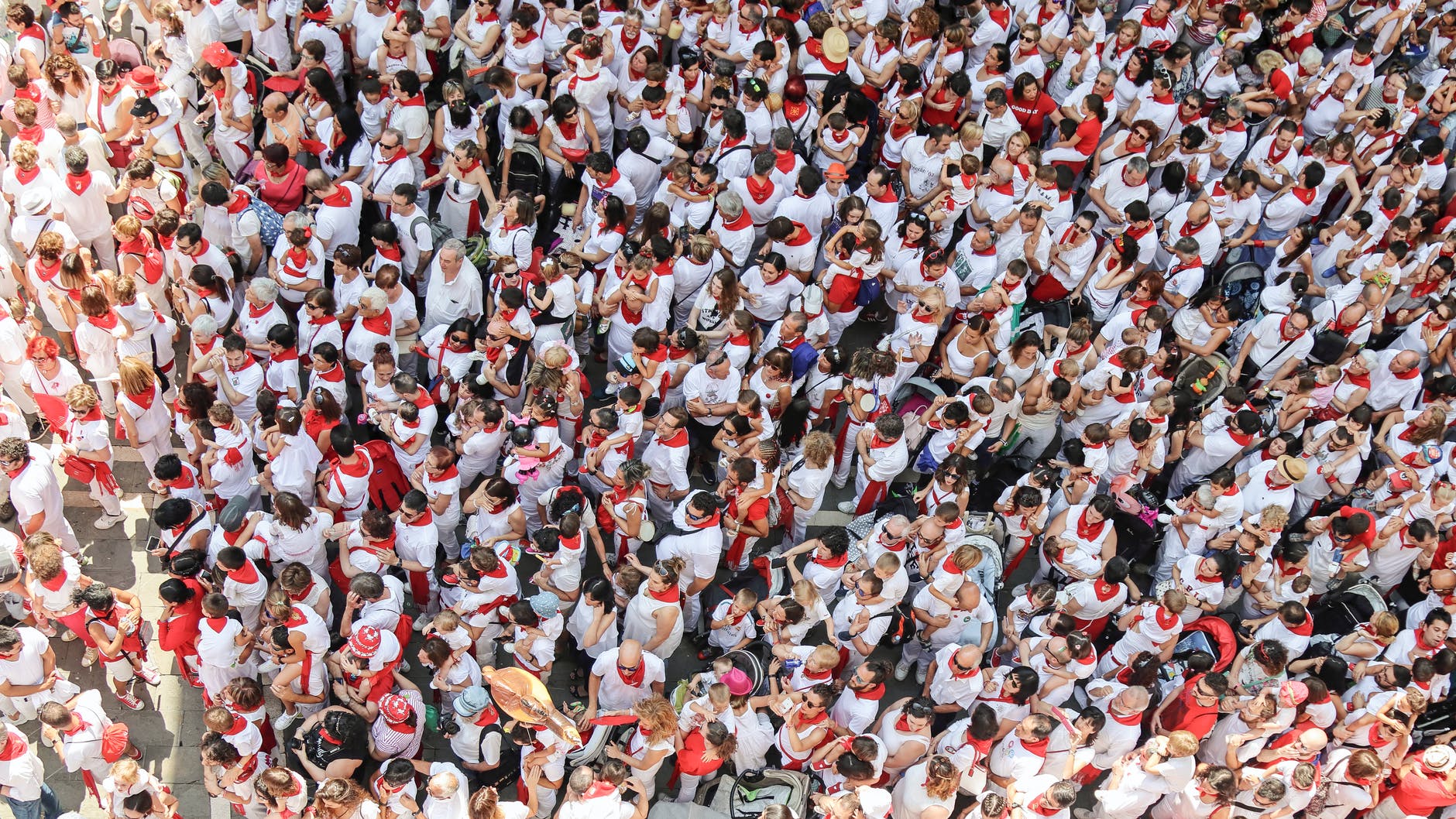
I don’t know what to make of all this, and I doubt if there is anything to be made. But the behavior on display is, if nothing else, a product of a lack of sense. It’s the agitated, aimless buzzing of the type of crowd that gathers in the aftermath of some bewildering catastrophe. Social scientists have a name for this mode of chaos: They call it “milling.” We are all just chattering away in restless and confused excitement as we try to figure out how to think about what’s happening. We want to understand which outcomes are most likely, and whether we might be obligated to help—by giving money or vowing not to share misinformation or learning the entire history of global conflict so as to avoid saying the wrong thing. We are milling.
The word comes from the mid-20th-century American sociologist Herbert Blumer, who was interested in the process by which crowds converge, during moments of uncertainty and restlessness, on common attitudes and actions. As people mill about the public square, those nearby will be drawn into their behavior, Blumer wrote in 1939. “The primary effect of milling is to make the individuals more sensitive and responsive to one another, so that they become increasingly preoccupied with one another and decreasingly responsive to ordinary objects of stimulation.”
These days, we mill online. For a paper published in 2016, a team of researchers from the University of Washington looked at the spread of rumors and erratic chatter on Twitter about the Boston Marathon bombings in the hours after that event. They described this “milling” as “collective work to make sense of an uncertain space” by interpreting, speculating, theorizing, debating, or challenging presented information.
To apply the term to the current moment may be a little sloppy—for a sociologist, milling would be the precursor to meaningful group action—but it gets across, you know, the current mood. We’re emoting, lecturing, correcting, praising, and debunking. We’re offering up dumb stuff that immediately gets swatted down. (We’re getting “ratioed,” as it’s called on Twitter.) We’re being aimless and embarrassing and loud and responding to each other’s weird behavior. “People are kind of struggling to figure out appropriate ways of responding to this really uncertain situation,” Timothy Recuber, an assistant sociology professor at Smith College, told me. Recuber, who is also the author of Consuming Catastrophe: Mass Culture in America’s Decade of Disaster, is an expert on the role that media play in what he calls “unsettled times.” And in these unsettled times, he said, we’re engaged in something like what Blumer had in mind.
The wisdom of crowds as an emergent property in the midst of uncertainty?
I wonder how this milling has changed over time. Specifically, I am thinking about spatial changes in the United States over the last century or so. Milling could work better when people live either in denser areas or small towns. This could lead to having “the public square” described above for people to gather. In a more suburban setting, where a majority of Americans now live, where would milling take place? Walking outside their house or residence might put them in contact with some neighbors but it would take some driving for many to get to a location where people might gather. Go to the shopping mall? The local library? Walmart?
If suburbanization reduced public spaces for gathering and add to this fewer people going to work during COVID-19, the online sphere offers more opportunities. The physical geography matters less when people can enter an online public square from anywhere. Now, there are numerous public squares available online with certain platforms or sites offering different opportunities and population with which to interact.
How effective is this online milling as opposed to milling in a offline location? In the offline public square, there is an embodied experience with people. The online public square is different with fewer cues from other actors and someone has to say/do something to be recognized.
We are far into a world where viewers of television shows can watch season after season of a show. Whether through a streaming service, on DVD, on a DVR, or on-demand, fans can watch everything right in a row. Depending on the length of the series, this can go relatively quickly or stretch out a while. Because of this possibility, I just recently started a list of TV shows where I have seen every episode and most of this has happened in the last ten years.
In contrast, I had two primary options in the past: watch episodes as they aired each week or watch an occasional episode. For the first, I only really remember doing this for a few shows. The most memorable is Lost. We started watching late in Season One and did not miss a weekly episode for years. The show certainly took advantage of this with numerous cliffhangers and important episodes to start and close seasons. For the second option, I saw a number of TV shows through syndication as they worked through their cycles. For example, I am not sure I ever saw Frasier in its prime-time slot but I saw nearly every episode because of the 2+ episodes that there on every night.
The two types of watching are very different. Binge watching allows viewers to take it all in quickly. I can enable mass consumption. Feelings come and turn quickly with changing narrative arcs. The weekly or episodic watch required a certain discipline and memory or the kind of show where one could easily dip in for a few episodes and then tune out for a while. The resolution of stories takes longer.
It will be interesting to see how shows continue to navigate these options: release everything at once or a show at a time? How long can a traditional TV model of shows every week hold on? Or, will we see more hybrid approaches where episodes come out in different batches tied to story lines and times of the year?
But scientists studying the relationship between people and their smartphones also have come up with additional insights in recent years about how people behave when using them, including discovering that people can draw needed comfort by their mere presence.
Individuals hold a deep personal connection with their phones, according to researchers. This leads phone users to express their views more freely when using their phones, often in exaggerated ways, and with more honesty, disclosing personal or sensitive information, for example, compared with laptops or tablets, experts say. They are portable and they have haptic properties that stimulate our sense of touch. And we regard them as much more personal than computers, which are closely associated with work…
“What might be going on? We don’t know, but one theory that makes sense to me is that they represent that we have friends,” he says. “It’s a reminder that we have friends, and knowing we can reach them, even remotely, is comforting. Also, they are very personal devices, more so than any other device, and with us all the time. From that perspective, we see them as an extension of ourselves.”
The phones also serve as a repository for all the details in our lives, from banking and entertainment, to tracking the whereabouts of our children, and getting us from one location to another. “They are the holy grail for convenience,” says Jeni Stolow, a social behavioral scientist and assistant professor at the Temple University college of public health. “It’s someone’s whole world in the palm of the hand. That is really appealing because it can make people feel in control at all times.”
Humans have the capacity to use many different items as tools and accessories to our daily tasks and activities. The smartphone is in a long line of “devices” that extend human possibilities. With the smartphone, someone can soothe themselves, access all sorts of information, and interact with others. It offers tremendous possibilities.
The emphasis here in the rest of the article is the possible effects of having all of this in a smartphone. Is it a “pacifier” or a creator of new problems? New tools bring new problems. And this leads to a pressing question for our era: is the smartphone in the long run a positive for humans? More broadly, we are in the midst of 30 years or so of asking the same question about the Internet: does all this access to people and information improve human life?
It might be hard to answer this question in the middle of an ongoing process. Having research, such as that cited above, can help us understand the effects as well as consider our interaction with the changes. All might be clearer in a decade or two…or even more complicated if we end up further down a path with devices that offer much in terms of both positive and negative possibilities.
Both experiences were disorienting in multiple ways. They required time that I did not necessarily have in my schedule to acquire the new device and set it up in ways consistent with the old devices. Because they are newer machines, they have some new options to consider. I was temporarily without access to each and what they provide access to in parts of the setup.
And the transition process went rather smoothly. Copying over contacts, apps, and files just took some time. I had to tweak a few settings but they now look and operate similarly (with some nice upgrades) to what I was used to before.
These are not just machines. For many daily tasks, they are extensions of my self. They enable my work and embody my work. They are distributed cognition devices – extending my ability to think, reason, and write – and portals to interactions with people and systems. For them to be altered or unavailable, even for a short time, shakes up my day.
Ultimately, I am glad to have the new devices. My daily activities are back on track. Almost all of the wrinkles of adjusting to new machines has happened. And I hope I do not have to do it again for a while.
For more than a year, we’ve been analyzing a massive new data set that we designed to study public behavior on the 500 U.S. Facebook pages that get the most engagement from users. Our research, part of which will be submitted for peer review later this year, aims to better understand the people who spread hate and misinformation on Facebook. We hoped to learn how they use the platform and, crucially, how Facebook responds. Based on prior reporting, we expected it would be ugly. What we found was much worse.
The most alarming aspect of our findings is that people like John, Michelle, and Calvin aren’t merely fringe trolls, or a distraction from what really matters on the platform. They are part of an elite, previously unreported class of users that produce more likes, shares, reactions, comments, and posts than 99 percent of Facebook users in America.
They’re superusers. And because Facebook’s algorithm rewards engagement, these superusers have enormous influence over which posts are seen first in other users’ feeds, and which are never seen at all. Even more shocking is just how nasty most of these hyper-influential users are. The most abusive people on Facebook, it turns out, are given the most power to shape what Facebook is.
This connects to a point I have been considering for a while now: the social media activity we tend to see or hear about is often not representative of society as a whole. It depends who is on different platforms, who uses it regularly or are power users, how algorithms work to highlight particular content, and how it is all experienced by users. A social media trend may not reveal much about broader patterns even as particular conversations, sites, and pockets of activity could reveal much about smaller groups or sections.
More broadly, Facebook says it has the goal of connecting people. How do superusers fit into this? Abusive users might be able to connect people, albeit in specific ways that may not be what people generally hope for when they think of connecting. Is the goal to connect people by boosting “average” engagement rather than the users who post the most? On the flip side, how many users do not engage at all and what might effectively move them into engaging regularly?
Watching dueling online and social media narratives can be quite a disorienting experience. Who is right? What are the facts? Does this story/anecdote/experience reflect and influence broader patterns in society?
It is this last question that interests me as a sociologist who has studied social network site use among emerging adults. How much does online activity reflect daily life among all Americans or people around the world? How much influence does online activity exert?
It is not necessarily reflective of everyone and their experiences. For example, a small segment of users can create a lot of content and drive traffic. Of those who use social media, not everyone engages much, and others do not use social media at all or use other platforms. What happens online is not always generalizable to broader social activity.
Yet, the actors and actions online can have a powerful influence in both the online and offline world. The way material is presented in social media and the Internet – or in any form of media – can influence beliefs and behaviors. Even if many people are not aware of something online or do not find it themselves, it can be important for those who make decisions or those who are following a particular conversation.
This is another reason that we should consider the online and offline realms as overlapping spheres, not separate worlds. Yes, there are some actors who may act very differently online than offline. Yet, even these behaviors are joined together within an individual who is operating in both realms. Online discussions and trends find their way to the offline world as offline activity gets picked up online. Money, power, influence, and beliefs pass back and through the two realms.
Recognizing this does not make it easier to reconcile competing online narratives. But, it does highlight how these are not just meaningless online discussions; they are linked to offline patterns.
Many of us invest hours each day staring at the screens of our televisions and computers and smartphones. Seldom do we go outside on a clear night, away from the lights of the city, and gaze at the dark starry sky, or take walks in the woods unaccompanied by our digital devices. Most of the minutes and hours of each day we spend in temperature-controlled structures of wood, concrete, and steel. With all of its success, our technology has greatly diminished our direct experience with nature. We live mediated lives. We have created a natureless world.
Much is made here of how recent technology like smartphones, computers, and television has cut our connection to nature. But, I wonder about the role of urbanization and, more specifically, the suburbs that supposedly connect people to nature even as they enjoy the conveniences of the modern world.
Of course, the kind of nature found in suburbia was a particular kind. As suburbs expanded, the natural elements disappeared or became more planned. Humans leveled land, constructed roads and buildings, and whizzed by the landscape at speeds relatively unknown in nature. The nature of suburbia was suited to and used for human purposes.
Granted, humans have interacted with and shaped nature for a long time. Yet, the suburbs are relatively new in human history. Even as they promised a connection to nature, they offered a truncated version of nature with relatively little regard for the organisms and ecosystems already present. Might the suburbanites of today be closer to nature if they did not have a smartphone in one hand and a 60-inch TV in front of them? Maybe – but the natureless world of suburbia has been here for a while already.



 Legally Sociable