What allowing “build[ing] more houses on less land” in Austin could lead to

Austin, Texas recently changed its regulations to allow property owners to “build more houses on less land”:

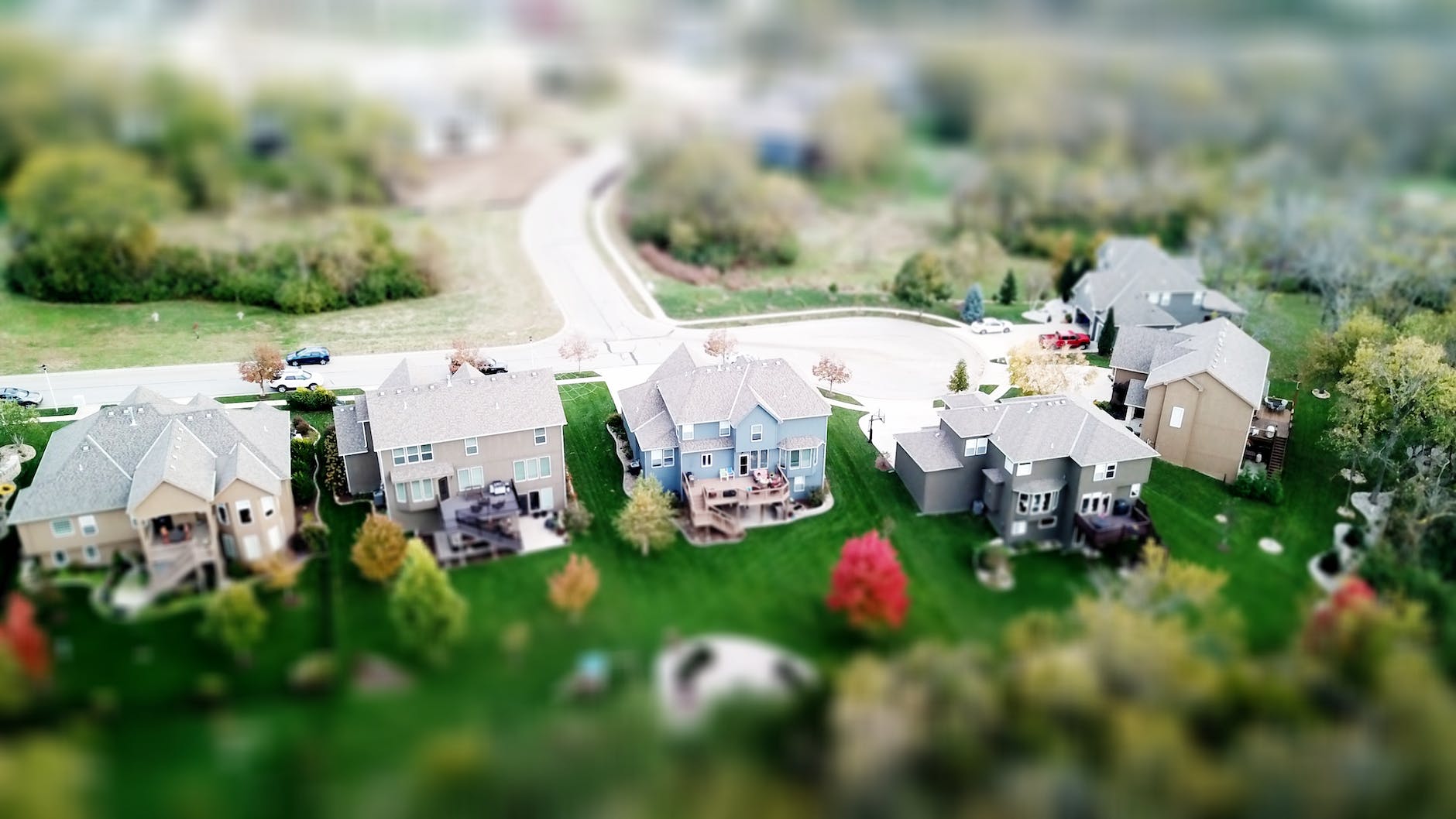
Photo by Abigail Sylvester on Pexels.com

Homeowners now have increased flexibility to build more houses on less land, after the lot size required for a home was reduced from 5,750 square feet to 2,500 via the HOME initiative (Home Options for Middle-income Empowerment). The policy also increases the number of housing structures that can sit on that 2,500 square feet from two to three. 

The debate over these changes continues:

The debate around a policy like this comes down to whether someone believes increased density (more housing for more people on smaller footprints) will help the situation, or will lead to overbuilding, crime, and rental cash grabs. The latter tends to sound a lot like NIMBY talking points more concerned with preserving the charm of longstanding Austin neighborhoods.

Some developers and homeowners feel that the resolution alleviates just a small part of Austin’s building woes, since the zoning codes are still complex and difficult to navigate. Jason Kahle, who owns Small Home Solutions, LLC, says he and his 10 employees are “going to be all over” the changes in a market where it seems everyone with a large-enough lot has considered building a granny pod, mother-in-law suite, or backyard office. 

But being free to build on a smaller lot is not the same as being able to feasibly do it within existing rules, Kahle points out. “There’s a lot of wheels turning at the same time,” he says. “Austin Energy is a challenge. We have protected trees, impervious cover, floor-area ratio rules, the level of detail the city requires on civil engineer plans, the subchapter McMansion ordinance, temp drawings. It’s a lot to deal with.” The McMansion regulations, also known as “Subchapter F” in the city’s housing code, set detailed and strict limits, including height and setbacks from the edges of a lot.

Laura Boas, an Austin physical therapist, is building an “accessory dwelling unit” for her family behind her 1950s-era, 720-square-foot cottage in the Brentwood neighborhood. She’s seen massive 2,500-square-foot homes go up in her area, and her lot is big enough to support additional buildings. Boas lives alone and jokes, “I’m part of the problem.”

It sounds like the goal is to allow for more housing units without changing many existing lots and allowing for smaller lots. This is a different approach than promoting more multi-family housing or larger structures containing more residential units. These changes keep the single-family character and the scale of the neighborhood similar while adding more units and people.

It will be interesting to see if an approach like this solves the problems it was intended to solve. Will the number of new McMansions decrease as property owners pursue other options? Does this add enough units? Does it ease housing affordability? If not, what changes would residents and the city be willing to enact? I hope researchers and policy experts are keeping track of the changes in cities that have enabled similar regulations. This could help determine whether adding ADUs (such as in Portland) is helpful.

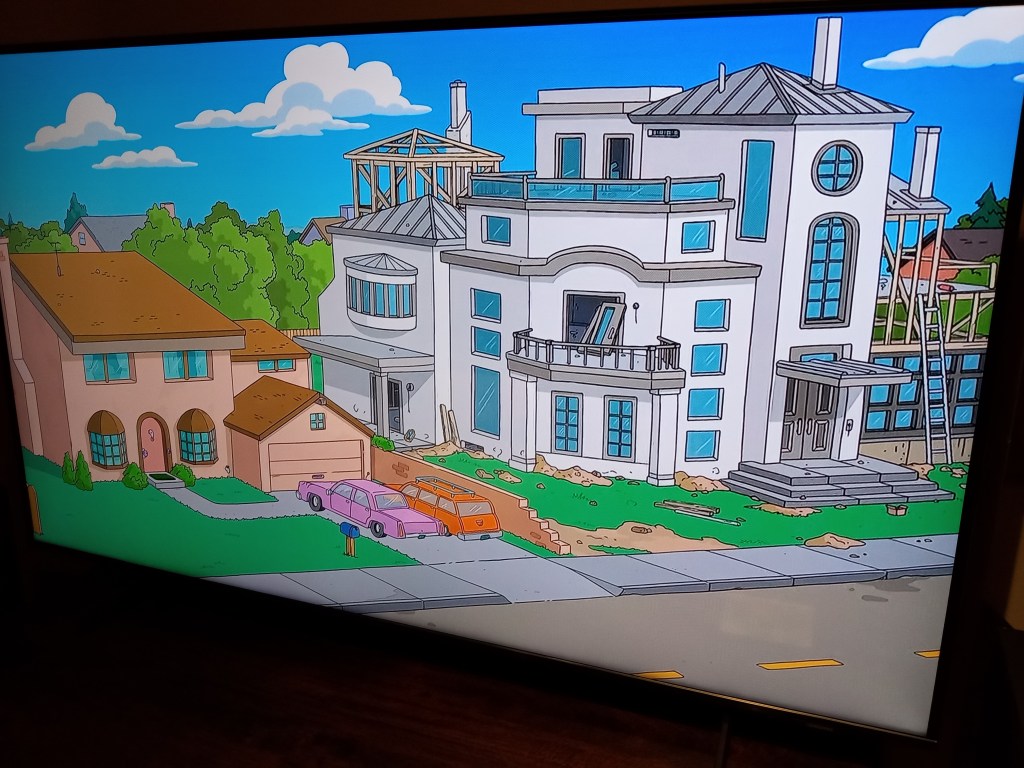
The Simpsons encounter a teardown McMansion

The Simpsons have new neighbors in Season 35 episode 3, “McMansion and Wife.” They get to know each other and enjoy spending time together. But, then the neighbors go from a modest home to a teardown McMansion:

As the new home is under construction, it is called a “reno” and then a “do-over.” Then it turns into a giant home. By my count, the teardown is 3-4 stories, is much bigger in terms of square feet and height as it towers over the Simpsons’ home, and has a mishmash of architectural features. The Simpsons live in a modest suburban home by today’s standards.

This story of a teardown McMansion within an established neighborhood is a common story across the United States. The new home can be considered disruptive by some neighbors even as others might defend the ability of property owners to do what they wish with their home and land and benefit from those changes.

One possible twist this episode briefly explores is the relationship between neighbors in these positions. Can they be friends? Can someone moving into a neighborhood build relationships and soften the blow of tearing down a house and constructing something much bigger on the same spot? Or, do teardowns usually lead to conflict between neighbors?

McMansions and combating climate change

A letter to the editor in California includes McMansions on a list of items that need attention in order to fight climate change:

Photo by Guduru Ajay bhargav on Pexels.com

Wildfires are increasing but McMansion developments are underway in brushland.

McMansions have long been connected to environmental concerns. This includes their presence within sprawling suburbs and neighborhoods where driving is necessary and a lot of land is used. It includes the materials required for each home and yard. It includes the use of resources to heat and light such homes.

The concern expressed above is more specific. McMansions are linked to wildfires and brushland. This suggests these homes are being built in places where they should not be built or in places that are vulnerable to wildfires. If McMansions were not in these locations, wildfires would affect fewer people.

I wonder, however, if McMansion is shorthand here for any larger single-family home. Do expanding metropolitan regions in California and other states have climate implications? When people move to what used to be small towns surrounded by more open land or continue to move out into dry suburban fringes, isn’t this more problematic than large McMansions with bad architecture?

“The modern farmhouse is the millennial answer to the baby boomer McMansion”

Of modern farmhouses and McMansions:

Photo by Erik Mclean on Pexels.com

This post-agrarian look is the defining style of the current era — dominating renovations, new construction and subdivisions in communities with no connection to farming, with interiors that have open concept floor plans, wide plank wood floors, plenty of shiplap, and kitchens with apron sinks and floating shelves made of reclaimed wood. Even multifamily homes are getting the modern farmhouse treatment, falling into the barndominium category, as they embrace vertical siding, gables and tin roofs, giving a folksy nod to apartment complexes…

Modern farmhouse, a contemporary style that bears a passing resemblance to a traditional farmhouse, first entered the American lexicon a decade ago on “Fixer Upper,” the HGTV sensation that catapulted the hosts, Chip and Joanna Gaines, onto the national stage, and persuaded homeowners to decorate their walls with enormous clocks and word art proclaiming the banal — Family! Eat! Coffee!…

The National Association of Home Builders does not track the popularity of the style. But Deryl Patterson, the president of Housing Design Matters, which designs homes for builders, says the look accounts for more than a quarter of her company’s work. “If a builder says, ‘I need three elevations,’ one will always be modern farmhouse,” she said…

Now, at a moment when populism has taken hold amid deep political divisions, the style of the day is one that imagines a romanticized and fantastical agrarian past — a real farmhouse doesn’t have a walk-in shower with a waterfall showerhead or a sliding barn door to hide a well-appointed laundry room with a weathered placard that says “wash and dry.” As the country grapples with existential questions about its identity and its future, the house of choice makes you think about spinning wool into yarn.

Several thoughts come to mind:

-The suggestion here is that housing design trends come in waves. The McMansions of the 1990s and early 2000s have largely come and gone. They are driven by social, cultural, and economic changes. What comes after modern farmhouse? (Just as an example of a housing style that has not had such a large wave, modernist structures have had their proponents for decades and have not caught on in a large way – even if elements end up in new homes today).

-The connection in the headline to McMansions means that homes in this style may not be long-lasting. Is the quality of the modern farmhouse in question? Are they just imitating other homes?

-The nod to an agrarian past is connected to real occupational patterns. For example, in the early 1900s, more than 30% of Americans worked in agriculture. Not so much any longer.

-How much of this is driven by particular real estate owners? The examples in this story involve fairly expensive homes and renovations. HGTV appeals to particular audiences. There are examples in this story of less expensive modern farmhouse items but purchasing a modern farmhouse can require a lot of resources.

We will see how many modern farmhouses are built and/or created and what then happens to them down the road.

Enron, McMansions, and unlikeable villains

The Enron scandal broke in late 2001. And it involved McMansions?

Photo by Bob Price on Pexels.com

The characters in this drama were larger than life in the Texas vein, but they lacked the roguish charm of the wildcatters of old, that quality that could make you forgive all. Yes, there were motorcycle races in the desert and Porsche Carreras and River Oaks McMansions, along with ill-advised love affairs and stiletto-in-the-back corporate intrigue. But in the end the Enron villains weren’t that much fun. They were just rich. And arrogant.

According to another story, Enron executives upgraded their residences in the years prior to the scandal:

Only a few years ago, Skilling, Fastow, and Michael Kopper — Fastow’s lieutenant in the Enron scandal, according to conclusions drawn in the Powers report — all lived within walking distance of one another in the quiet upper-class neighborhood called Southampton Place, which borders Rice University. It is a nice neighborhood, with houses that go for around a half-million dollars, but all on small lots, with alley parking in the back. Skilling lived in a simple, square brick house with his wife and three children. Kopper lived a few blocks away in a cottage he eventually remodeled to have an almost Japanese-style look, the house taupe in color, with a gray roof…

And before all three men — Skilling, Fastow and Kopper — bought new properties, tore down the existing structures, and started building their dream houses. Once again, all in the same neighborhood. The neighborhood where the rich live in Houston. The neighborhood where Lay lives. River Oaks.

So now Skilling resides in a mammoth Mediterranean-style home with a tile roof, and he’s engaged to Rebecca Carter (the one known as Va Voom), who under Skilling was promoted to executive secretary to Enron’s board of directors at a salary of $600,000. Fastow is building something that looks like a country manor, almost Tudor-ish. And Kopper and his partner William Dodson opted for a postmodern abode — boxy, all white and beige and glass and hard angles. A house so close to the Lays’ luxe apartment building that the shadow practically falls across Kopper’s lawn…

Skilling’s house is decorated in a sleek, black-and-white theme, in homage to Enron’s corporate colors. But he hired the Houston-based design team of Michael Galbreth and Jack Massing — who are known as the “Art Guys” — to do his guest quarters.

Several thoughts upon reflecting on this story from the past:

  1. Texas does like its houses bigger and I found in a 2012 published article that McMansions were not treated the same way in the Dallas Morning News compared to the New York Times.
  2. Did Skilling live in a McMansion or a mansion, a home with more square feet and not a mass-produced home within a subdivision?
  3. Does calling his home a McMansion fit better with an image of a corporate villain? The term McMansion is not usually used positively and could hint at the ill-gotten rise of Skilling. Does a more garish McMansion make it easier to dislike a figure?
  4. On a “Lives of the Rich and Infamous Tour B” in the Houston area, you may see “Homes of the leaders of Enron:  Kenneth Lay (1942 – 2006) and Jeffrey Skilling.”

Can McMansions make a whole town the ugliest in its state?

One look at the ugliest communities in each state picks Panama City Beach, Florida because of its McMansions:

Photo by Nur Andi Ravsanjani Gusma on Pexels.com

Panama City Beach, Florida is a resort town full of lots of fun and scenic views. In a very confusing naming twist, there’s also Panama City, Florida which is just right down the road from the resort town. Unfortunately, people don’t think it’s nearly as beautiful or fun as PCB. 

The main complaint of residents, who are in agreement that Panama City isn’t the prettiest place to live, is all of the McMansions that seem to pop up all over the place. They’ve hit a critical mass of boring, tasteless homes and now it’s starting to drag the city down! 

A resort town where the McMansions are the aesthetic problem in the community? This is a community with big hotels, a Ripley’s Believe It or Not, a waterpark, and many of the typical establishments found along roads in the United States.

I wonder if the issue with McMansions is more about (1) changes to existing neighborhoods and/or (2) the McMansions are more visible to residents while the resort areas appeal more to tourists.

Thinking more broadly, in a beach town, how easy is it to fight against McMansions? Being on the water leads to higher real estate prices and more demand.

When living in a suburbia of McMansions is good and when it is not

Here are two different stories involving living among McMansions. Let’s start with a positive take on McMansions from someone who moved from New Zealand to Australia:

Photo by David McBee on Pexels.com

Money and a chance to do something new was my draw to Australia. I picked up a $140,000 IT role in central Melbourne, which was a 40% increase over my New Zealand salary. Pretty much everything here was cheaper at the time, with the comparison of renting out my three bedroom Johnsonville house in New Zealand for slightly less than I rented a five bedroom McMansion in western Melbourne…

In terms of housing we sold our small Johnsonville house in 2021 for $1.3 million, and bought a significantly bigger property with a pool here about 15km from the CBD for $975,000. The value for money was a no-brainer.

The takeaway here is that the McMansion in Australia is larger and cheaper than housing in New Zealand.

Here is a different perspective on McMansions from someone living further out in the suburbs of Texas:

We’re deep in a Texas suburb less than a minute from a major highway. As a semi-city-adapted human, it’s a culture shock. I’m not used to jumping on the freeway for a quick grocery run. Or driving 30 minutes to get a decent breakfast sandwich. On top of that, I’m a black woman with facial piercings and a bunch of tattoos surrounded by white Republicans.

It’s… an adjustment.

I can’t walk anywhere, the traffic sucks, and the lack of small businesses and diversity around here is eerily dystopian. It feels like the walls of Starbucks, Orange Theory, and Olive Garden are closing in on me. The only close-by establishments are big-box stores, chain restaurants, and mega-churches. It’s gentrified in the worst possible way…

I understand the appeal of wide open fields and expansive landscapes, but most people don’t live there. Most people live in towns with overlapping, 5-lane highways and poorly constructed McMansions. They live in towns surrounded by giant HEBs.

In the sprawling American suburbs, McMansions are part of a landscape with limited community, walkability, and local character.

These two experiences highlight two perspectives on McMansions: are they a good deal offering residents the best bang for their buck or are they part of a soulless suburbia dependent on cars and chain establishments? Plenty of Americans align with one side or the other.

In defining a McMansion, does Quicken Loans want people to buy one or not?

The website for Quicken Loans features an article defining a McMansion. Here is the definition:

Photo by Pixabay on Pexels.com

A McMansion is a large, highly ornate house often found in planned communities. This term is sometimes used as a criticism of mass-produced homes that don’t follow strict architectural styles.

They are large homes on small plots of land and can be more prevalent in states like California, New York and Texas. McMansions provide a way for upper-middle-class Americans to inflate their economic status.

McMansions are often generic and made from low-quality materials, so they don’t hold up well over time.

You can compare this definition to my four traits of McMansions.

Here is the “bottom line” in the article:

McMansions get a bad rap and are often referred to in a disapproving manner, but there are advantages to purchasing one. It can be a good way to buy a larger home, and you may be able to live in a nicer neighborhood. However, these houses may also come with high property taxes and can be expensive to maintain, especially if they’re built with low-quality materials.

For a company interested in providing mortgages, does this encourage people to pursue McMansions or not? I suppose providing information is helpful. I imagine all the major mortgage companies have underwritten lots of McMansion mortgages and would like to do more.

If a Quicken Loans customer does not like a McMansion but wants a bigger home that is not a mansion, what kind of home should they go after instead?

The McMansion riches of ’80s TV versus the massive dwellings of today’s Succession

TV depictions of what constitutes a house for the wealthy can change over time:

Photo by Pixabay on Pexels.com

And if the “Succession” audience is smaller, the money is, pointedly, bigger. Rewatched in 2023, the idea of luxury in “Dallas” looks quaint, almost dowdy. The aesthetic is Texan country club; the Ewing homestead, the size of a decent suburban McMansion, is a toolshed next to the Manhattan aeries, Hamptons manors and Italian villas that the Roys flitter among.

Some of this is a matter of modern premium-cable budgets vs. the grind of old-school network-TV production, of course. But it also reflects the changed, distorting nature of modern riches. In 1980, American wealth inequality was still near its postwar lows. Since then, the wealth of the top .01 percent has grown at a rate roughly five times as much as that of the population overall. Today, the very rich are very, very, very richer.

The holdings of Waystar Royco — Hollywood studios, cruise lines, newspapers, amusement parks, a king-making right-wing news channel — make Ewing Oil look like a franchise gas station. We know only vaguely how Logan Roy built his empire, but it was enabled partly by the media-consolidation and antitrust deregulation, beginning in the “Dallas”/Reagan era, that allowed his real-life analogues like Rupert Murdoch to make their own piles.

American homes do broadcast messages about a resident’s status and wealth. McMansions are supposed to signal that the owner can afford a big home in a particular style (even if the imitation of traditional styles are odd).

On the other hand, mansions are even bigger, more extravagant, and can be of better build quality. Having multiple such dwellings extends far beyond the McMansion owner in the suburbs.

Another question: do the super wealthy make use of all that square footage and the features or are these part of a real estate investment? The McMansion owner is also hoping to get a return on their investment but the amount of money involved with extra-large properties is at another level.

Courtesy of Architectural Digest, see more about some of Succession’s dwellings here.

Even chickens can have McMansions

One TikTok user put together a McMansion for chickens:

I believe this best fits McMansion Trait #1 referring to the structure’s size. It could provide a lot of space for a few chickens or house a lot of chickens. It is probably larger than a lot of backyard coops.

At some point the chicken structure becomes too large to be a McMansion. If it is for large-scale operations, does it qualify as a chicken mansion?

It is less clear what the neighbors – human or animal – think about the relative size of this coop, the architectural quality or style of the structure, or the larger social issues a large chicken coop can symbolize.