Convenient to see the end of Pradel’s career as a new era for Naperville

The Naperville Sun/Chicago Tribune ran a long story about Naperville mayor George Pradel stepping down and what this means for Naperville:

Longtime residents and colleagues say Pradel’s style — which he, himself describes as Naperville’s No. 1 cheerleader — suited the suburb well as about 42,000 new residents brought the need for new schools, fire stations and grocery stores during historic growth.

Naperville faces a new era now, as Pradel, 77, prepares to step down after five terms in office in May. His departure leaves one of four mayoral candidates with a new task of leading the nearly built-out city through its next set of challenges, from filling empty storefronts to countering an unwanted reputation as a party town after several high-profile, alcohol-fueled incidents downtown…

Since 1969, Naperville has operated with a council-manager form of government, which uses a full-time city manager to run the community’s day-to-day operations, while the mayor serves as the city’s public face, available to grand marshal parades and have dinner with girl scouts.

It’s an arrangement that Pradel said he’s been grateful for since he won his first election in 1995, a victory that caught him by such surprise that he didn’t even have an acceptance speech ready.

This is the sort of story that can feed the “big leader” narratives of history. But does it really fit here? Pradel was an outgoing character and a cheerleader. He was very visible. He had a long history in Naperville as a police officer. Yet, the story even reminds us that the mayor was a figurehead with the day-to-day work falling to the city manager. Naperville, like many cities its size, has a large professional staff. The city has a number of business and civic leaders who contribute.

This is not intended to downplay the role that figurehead leaders can play. Perceptions matter a lot within and among communities. At the same time, larger-than-life or long-serving leaders can often get the blame or credit for things that they didn’t do. Pradel was mayor over a particular period of time that saw Naperville peak in population (at least at this point without serious efforts to grow up), continue to grow a vibrant downtown, and encounter a few issues including traffic, some crime, and thinking about how to connect disparate parts of the city. Was he responsible for all of this?

This is where a more complex picture of Naperville or other communities can help. Some people indeed have more power and influence. But, communities have more going on than just one person.
Using Chicago as a new big data laboratory

University of Chicago sociologist Robert Park once said that the city was a laboratory. A new venture seeks to use Chicago as just that:

On the heels of the University of Chicago’s $1 million Innovation Challenge for urban policy solutions, today’s announcement that UI Labs (“universities and industries”) will open CityWorks, a private R&D partnership that will be based on Goose Island, sets up the city to be a center for urban studies, technology and innovations. Founding partners Microsoft, Accenture, ComEd and Siemens will operate a bit like angel investors, according to Jason Harris, a spokesman for UI Labs. This project will seek to “level up Chicago as a center for the built environment.” The city’s mix of university and industry partners, government leadership and legacy of architecture and design innovation place it in a perfect position for this kind of incubator, according to Harris.

CityWorks wants to seed 6-8 ideas this year, focused on energy, physical infrastructure, transportation and water and sanitation, Harris says (funding amounts aren’t being released). “Our vision is that we have projects that can use the city as a testbed and try out ideas not being tested in other cities,” he says.

CityWorks will award grants to university and private researchers, with a focus on digital planning and the Internet of Things. Chicago is vying to be an important center for this potentially lucrative field. With the recent introduction of the Array of Things, a cutting-edge system of sensors that researchers and computer scientists are hoping will prove the value of real-time, open-source city data, and the recent opening of Uptake, a Brad Keywell-backed startup looking to bring custom data analytics solutions to businesses, the city is well-positioned to become a leader in the field.

I’ll be interested to see what comes out of this. It sounds like the goal the goal is to use big data collected at the city scale to find solutions to urban business issues. I do wonder if this is primarily about making profits or more about addressing urban social problems.

Some might be surprised to see such a project going forward in Chicago. After all, isn’t it a Rust Belt city struggling with big financial problems and violence? At the same time, this project highlights Chicago as a center of innovation (which requires a particular social context), a place where businesses want to locate, and home to a good amount of human capital (in both research interests and educated workers).

Suburbanites who don’t like proposals for affordable housing in the Twin Cities region

The Metropolitan Council for the Minneapolis-St. Paul region is working on plans for affordable housing but a number of suburbanites are not pleased with where the affordable housing might go:

The Met Council sees a growing problem. Its own newly available data suggest that annual production of affordable housing has dropped by hundreds of units since 2010, even as market-rate housing has rebounded.

An advance peek at the Met Council’s proposed goals, to be released late Monday, shows that communities considered to be prime locations for adding affordable units include upper income suburbs, such as North Oaks and Eden Prairie, and cornfield’s-edge fringe communities such as Minnetrista and Lake Elmo…

The target numbers — released this week for public comment, with adjustments possible from now to July — are part of a once-per-decade planning process that will begin in every city this fall. Each must start to figure out how to accommodate the additional units.

The Met Council is under heavy fire for allegedly pushing too much affordable housing into areas with plenty of it already, intensifying concentrations of poverty and perpetuating racial segregation in the Twin Cities.

It will be interesting to see how this plays out. The region has a history of metropolitanization, a rare occurrence in American cities, as well as an openness to immigrants, yet advancing affordable housing units in middle- to upper-end suburbs may be going too far. As some of the suburbanites in the article note, they moved to these communities to escape issues like this. But, the quality of life concerns they tend to express (good school, low crime, sense of community) seem to be inextricably linked with race/ethnicity and social class. Just a reminder that part of the benefits of having money in the United States is that one can move to such a place that insulates you against interacting with others.

Perhaps the drop in property values in Ferguson could prompt change

The fallout from last year’s events in Ferguson, Missouri continues including this look at the changes in property values:

For the city’s 2014 budget, approximately 20 percent of the city’s revenue came from the city’s courts, and 17 percent came through property taxes. But after a Department of Justice report found the courts were profiting off racial discrimination, the State of Missouri took over to implement reforms. Couple that with rapidly falling property values (which are used to calculate owed taxes) and it seems like key parts of the city’s business plan are falling out from under it…

The average selling price of a home in the city has been on a steady decline since the shooting of Brown last August, according to housing data compiled from MARIS, an information and statistics service for real estate agents. Prior to Brown’s death, the average home sold in 2014 was selling for $66,764. For the last three and a half months of the year, the average home sold for $36,168, a 46 percent decrease.

The trend has continued on through this year, with the average home selling for only $22,951 so far in 2015. Another negative indicator: in the eight and a half months leading up to Brown’s death, the average residential square foot in 2014 was selling for $45.82. In the eight and a half months since Brown’s passing, the average residential square foot in the city has sold for $24.11. That’s about a 47 percent downtick in one of real estate’s core indicators.

In the suburbs, where quality of life (including factors like crime, the quality of the houses, performance of the local schools) is paramount in (1) influencing housing values and buying and selling real estate and (2) building a tax base through attracting businesses and organizations, infamy is not a good thing. But, given the patterns of local treatment of people by police in the area, it is hard to see how this wouldn’t affect housing values and the tax base. When given options across the suburbs of St. Louis, how many homeowners or companies would choose to move to Ferguson? And, if we’re honest, hitting suburbanites where it really matters – property values and their tax base (the double whammy of housing and land values going down while property taxes may need to increase to close the gap) – may be what is needed to prompt change.

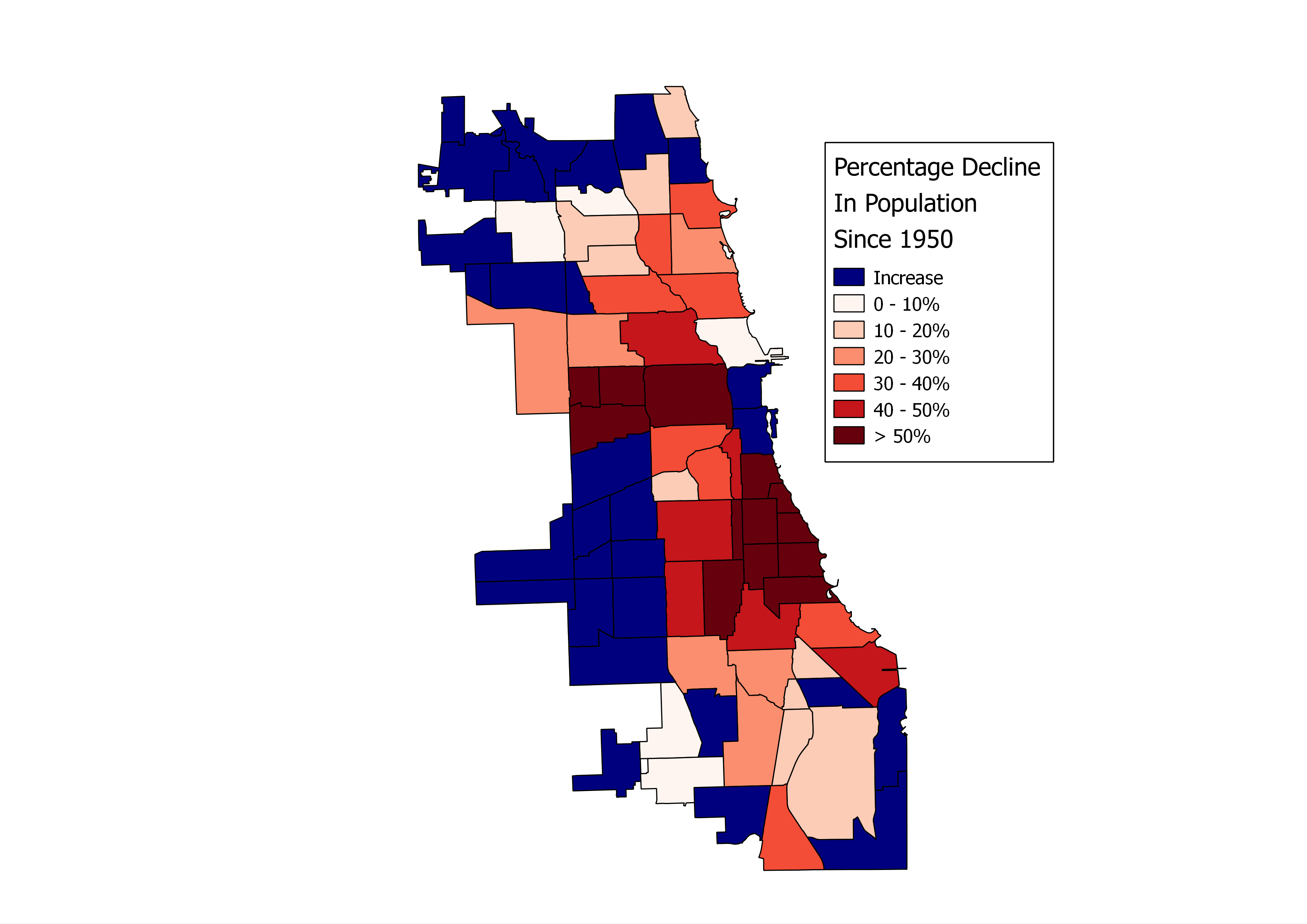
Even affluent Chicago neighborhoods, like Lincoln Park, have lost significant numbers of residents

Rust Belt cities like Chicago have declined in population since the mid-1900s and the population loss is not just limited to poorer neighborhoods:

For a long time, most accounts of Chicago’s lagging population have focused on parts of the South and West Sides where many residents, largely African-American, have decided to decamp for the suburbs or the South in search of better schools, less crime, and more jobs.But the under-appreciated flip side of population loss in those parts of the city is that places that ought to be growing like gangbusters are stagnant, often sitting 25% to 50% below their peak populations. Lakeview, for example, was once home to 124,000 people; its population is now 94,000. North Center is down from nearly 49,000 to under 32,000. West Town, which includes Wicker Park and Bucktown, has fallen from 187,000 to 81,000.

Decline5010

What explains the population loss in even popular neighborhoods? Here is one possible answer:

Since replacing a couple two-flats with a courtyard building is now illegal, developers make money by tearing down an old two-flat and building a luxury two-flat in its place. Or they build a mansion, and the neighborhood actually loses a housing unit. As a result, as a neighborhood becomes more attractive, the city encourages fewer people to live there.

Zoning (theoretically based on improving the neighborhood) plus chasing profits may just lead to population loss. This could be balanced out by approving more high-density housing in a particular area (like the Loop are in specific portions of popular neighborhoods as to limit their effect) but that leads to major changes in two places.

It is still worth noting that the areas that seen an increase in population are either (1) the Loop with a reemphasis on residential construction and (2) community areas on the edges of the city which other lower densities as well as potentially more open land since 1950.

How should the 1995 Chicago heat wave deaths be commemorated?

An arts critics think about how Chicago might remember the deaths of hundreds in the 1995 heat wave:

After all, events that caused far fewer deaths have been the subject of remembrances, designed to honor those who died. July 1995 has yet to make into that civic category, but it deserves a spot. Perchance someone may convene a discussion between those who were involved in that crisis and ponder what was learned (I should note that Klinenberg also charges the media, including the management of this newspaper, with some culpability in the tardiness of the connecting of the dots, while acknowledging some formidable reportage).

More useful, though, might be an artistic response.

A commissioned symphonic piece, perhaps played outdoors. A concert honoring those who died. A dance work. Some stirring poetic words. Some deep collective thoughts from city leaders as to if, or how, the city has changed since then and where there still is work to be done. Some consideration of whether we now do a better job of taking care of each other, whatever the weather outside. It is worth the attention of the city’s artists. And politicians.

“Marking it as a historic event is important,” Egdorf said. “If only to remind people to look after their neighbors.”

Three quick thoughts:

1. Given the demographics of those who died, such a commemoration could also go a long ways toward addressing social divisions such as those involving age, class, and race. Important figures are often commemorated but what about a mass number of average residents?

2. For the social forces that contributed to who died in this particular heat wave, I recommend Heat Wave by sociologist Eric Klinenberg.

3. The idea of having an artistic response to this disaster is an interesting one. We often have solemn commemorations but this presents an opportunity to create something new of tragedy.

Essay on Chicago’s alleys

You aren’t going to find too many erudite essays like this one on the subject of Chicago’s alleys:

Thus, alleys in Chicago, as in most other cities, evolved organically: as a general product of function and construction, but with modulations in dimension, materiality, position, and construction, readily changed to suit the needs of its neighbors and occupants. Fluxing along their entire lengths, they cut a byzantine pattern in the city’s figure ground, contributing to its unmistakable appearance in plan without serving as the primary warp and weft of the fabric…

The results are not always beautiful or orthodox, but they are usually interesting; alleys seen in this light could be conceived as both museums and laboratories for material combinations and adjacencies, methods of assembly and detailing. But in another light, alleys are urban canyons—broken glass, vegetation clinging to the fragile mortar joints, with a single swath of sky above: more products of time and erosion, with human intervention to architectonic formations what glaciers are to geology. Again: raw super-nature registered through a Kantian impression of the sublime…

And consider this: glamour in its modern manifestations is generally assigned to objects and places that are alluring, attractive, and special. Its secondary connotation is less positive; a permutation of Norse and Scottish words that tie it to illusion and obfuscation, spells of the eye meant to conceal true natures. In that vein, is it so difficult to see ordinary as glamour, and alleys as extraordinary? We would do well to keep ourselves open; there may be something truly remarkable lying in plain sight within the gravel and brick.

For those who know cities well, I suspect many of them could tell of places where they found something sublime in the non-glamorous places. Much of the attention paid to major cities focuses on major works (like skylines) while residents and others who take a longer and deeper look see a different side.

I was reminded of Chicago’s alleys recently when showing my class part of Mitchell Duneier’s video supplement to his ethnography Sidewalk. In the film, we see images of the subjects of his research – homeless street vendors – wandering through New York City’s garbage in order to find books, magazines, and other things to sell at their sidewalk tables. There was so much garbage simply piled at the curb, not exactly a glamorous sight. In contrast, alleys allow some of these basic functions to be moved behind buildings and open up sidewalks for more pedestrian and social uses.

When a major city’s tallest structure is a roller coaster

Perhaps this could only happen in Orlando: the city’s tallest structure will soon be a roller coaster.

The Skyscraper aims to live up to its name. When construction of the roller coaster is completed in 2106, it will dominate Orlando’s skyline. At 570 feet, the Skyscraper will loom over the next tallest structure, the Suntrust Center—which is itself only a few dozen feet taller than the Orlando Eye, a 400-foot-tall Ferris wheel opening this spring.

Orlando appears to be one-upping other cities in the global race to build soaring structures that aren’t buildings. Where plenty of cities have built observation wheels (Orlando included), the Theme Park Capital of the World is looking to distinguish itself through a different kind of roller coaster, one whose footprint and height resemble, well, a skyscraper’s.

Developers released new plans last week for the Skyplex, a $300 million entertainment center that will anchored by the Skyscraper. The expanded plans include the Skyfall, a 450-foot tall drop ride (built into the Skyscraper structure) that will itself be taller than the tallest building in downtown Orlando.

Tall buildings may be functional but they are also intended to say something about the city: that it is has a certain level of success and sophistication. A skyline is meant to stand out and provide a lasting and permanent (though it is open to change, people don’t really consider losing major buildings from the skyline) image of a city. So, Orlando seems to be staking its claim to entertainment and amusement, to lasting screams and high speeds. And once you have this tall ride, how do you top it?

Just how much is the Willis Tower worth?

News is that the Willis Tower in Chicago is up for sale and one insider suggests it could go for $1.5 billion:

The owners of the Willis Tower have hired Eastdil Secured to seek a sale, according to an offering book already given to potential buyers. The property’s owners are being advised in the deal by Chicago-based Stephen Livaditis and New York-based Douglas Harmon, senior managing directors at Eastdil, according to the materials…

Chicago is coming off the strongest year of office building sales downtown in seven years. Boosted by low interest rates, a strong real estate appetite for U.S. real estate by domestic and international investors and comparatively higher pricing in coastal cities such as New York and San Francisco, Chicago in 2014 experienced some of its biggest office deals…

Industry newsletter Real Estate Alert, which first reported Willis Tower was being shopped, estimated it could sell for about $1.5 billion. That would be almost $400 for each of the tower’s nearly 3.8 million square feet of office space.

But because of its huge size and unusually broad sources of revenue, experts say Willis Tower’s value is more difficult to pinpoint than a traditional office property.

Sounds like a thriving market right now. Building occupancy is up in recent years and several other large office buildings have sold for high prices in the last year or so.

It would be fascinating to see what happens if the name changes again. How would Chicagoans react? The Willis Tower switchover never completely happened – hard to believe that was over 10 years ago now – so would a new name work? We are not there yet but could be headed toward a world where major buildings consistently change names as they change owners or even develop sponsorship deals to have particular names?

Quick roundup of notable Chicago by drone

Many have seen famous Chicago sights in person or via photography but here are links to some impressive videos of Chicago by drone. The best thing the drone adds to seeing Chicago? Changing the level of sight so as to not just be on the ground or above everything. Now, where is the ultra-impressive promotional video or commercial for Chicago utilizing this technology?