When a major city’s tallest structure is a roller coaster

Perhaps this could only happen in Orlando: the city’s tallest structure will soon be a roller coaster.

The Skyscraper aims to live up to its name. When construction of the roller coaster is completed in 2106, it will dominate Orlando’s skyline. At 570 feet, the Skyscraper will loom over the next tallest structure, the Suntrust Center—which is itself only a few dozen feet taller than the Orlando Eye, a 400-foot-tall Ferris wheel opening this spring.

Orlando appears to be one-upping other cities in the global race to build soaring structures that aren’t buildings. Where plenty of cities have built observation wheels (Orlando included), the Theme Park Capital of the World is looking to distinguish itself through a different kind of roller coaster, one whose footprint and height resemble, well, a skyscraper’s.

Developers released new plans last week for the Skyplex, a $300 million entertainment center that will anchored by the Skyscraper. The expanded plans include the Skyfall, a 450-foot tall drop ride (built into the Skyscraper structure) that will itself be taller than the tallest building in downtown Orlando.

Tall buildings may be functional but they are also intended to say something about the city: that it is has a certain level of success and sophistication. A skyline is meant to stand out and provide a lasting and permanent (though it is open to change, people don’t really consider losing major buildings from the skyline) image of a city. So, Orlando seems to be staking its claim to entertainment and amusement, to lasting screams and high speeds. And once you have this tall ride, how do you top it?

Just how much is the Willis Tower worth?

News is that the Willis Tower in Chicago is up for sale and one insider suggests it could go for $1.5 billion:

The owners of the Willis Tower have hired Eastdil Secured to seek a sale, according to an offering book already given to potential buyers. The property’s owners are being advised in the deal by Chicago-based Stephen Livaditis and New York-based Douglas Harmon, senior managing directors at Eastdil, according to the materials…

Chicago is coming off the strongest year of office building sales downtown in seven years. Boosted by low interest rates, a strong real estate appetite for U.S. real estate by domestic and international investors and comparatively higher pricing in coastal cities such as New York and San Francisco, Chicago in 2014 experienced some of its biggest office deals…

Industry newsletter Real Estate Alert, which first reported Willis Tower was being shopped, estimated it could sell for about $1.5 billion. That would be almost $400 for each of the tower’s nearly 3.8 million square feet of office space.

But because of its huge size and unusually broad sources of revenue, experts say Willis Tower’s value is more difficult to pinpoint than a traditional office property.

Sounds like a thriving market right now. Building occupancy is up in recent years and several other large office buildings have sold for high prices in the last year or so.

It would be fascinating to see what happens if the name changes again. How would Chicagoans react? The Willis Tower switchover never completely happened – hard to believe that was over 10 years ago now – so would a new name work? We are not there yet but could be headed toward a world where major buildings consistently change names as they change owners or even develop sponsorship deals to have particular names?

Quick roundup of notable Chicago by drone

Many have seen famous Chicago sights in person or via photography but here are links to some impressive videos of Chicago by drone. The best thing the drone adds to seeing Chicago? Changing the level of sight so as to not just be on the ground or above everything. Now, where is the ultra-impressive promotional video or commercial for Chicago utilizing this technology?

When Silicon Valley communities have too many tech jobs, new residents

Many communities would love to have a tech company headquarters in town but what happens if that company is Google and it brings many residents and employees?

Google owns or leases about 7.3 million square feet of office space in Mountain View — roughly equivalent to three Empire State Buildings. That includes most of the property around its headquarters on the north side of the city near Highway 101, which cuts the length of the valley, according to Transwestern, a commercial real estate brokerage.

That success has brought Mountain View loads of tax dollars and a 3.3 percent unemployment rate, as well as skyrocketing home prices and intolerable gridlock. Good and bad, tech is responsible for most of it: Technology companies account for 27 percent of the jobs in the Silicon Valley region, compared with 7 percent in California and about 5 percent nationally, according to Moody’s Analytics.

The result is an existential argument that pits residents who want to halt the city’s growth against people who think Mountain View needs to grow up and become a real city.

Mountain View, about 40 miles south of San Francisco, has close to 80,000 people; with its strip-mall thoroughfares and streets of single-family homes, it looks like a sleepy suburb. But since hiring has boomed, the city’s roads swell with commuters during the morning and evening rush.

While this may get extra attention because it involves Google (does that do no evil pledge apply to the communities in which its offices are based?), this is a question that many suburbs face at one point or another. When new developments are proposed, whether commercial, industrial, residential, or something else, how might these change the existing character of the community? Jobs are often seen as good things: they provide employment and the buildings for employees generate property tax dollars, reducing the dependence on residential property taxes. Yet, what if those same jobs lead to new office parks that take up a lot of land, new infrastructure needs such as roads, water and sewer lines, and schools, and an influx of traffic? Or, what if such jobs require tax breaks or special deals for a single business or industry?

Two possible outcomes here (and this is not an exhaustive list):

1. Why aren’t urbanists calling for companies like Google to move to large cities? A lot of the issues with infrastructure and space could be more easily absorbed by a major city. Three Empire State Buildings worth of space is still hard to come by but Granted, this hasn’t gone smoothly recently in San Francisco but developing new land leads to particular challenges, especially in places used to a smaller population.

2. At some point, Google could go the way of other companies and organizations and start making demands to push Mountain View to accept what they want. The end of the article hints at this; if Google brings in a lot of new employees, they could even sway local elections. Could Google hold the suburb hostage to get what it wants?

Play explores idea of a proposed mosque for downtown Naperville

Inspired by reactions to a proposed mosque in Naperville several years ago (and another proposed mosque received opposition), a playwright has put together a script that involves a proposed mosque in downtown Naperville:

Khoury said he’s seen the same response elsewhere, including in unincorporated land near Naperville. The Irshad Learning Center in 2010 took to court its attempt to win DuPage County’s approval of the needed conditional use permit for a worship center on property it owns on 75th Street east of Naper Boulevard, just across the city border.

Neighbors of the 3-acre parcel had ardently opposed the center, voicing concerns about traffic, lighting and noise, with support from the Naperville Tea Patriots and the anti-Islamic organization Act! for America. After a divided County Board in January 2010 denied the request, the matter wound up in federal court, with Irshad claiming its Constitutional guarantees of religious freedom and equal protection had been denied. Northern Illinois District Judge Rebecca Pallmeyer ruled in March 2013 that the county improperly withheld the permit, in part citing the outside groups’ role in the process. The Irshad board is preparing to open the center later this year…

The play centers on a proposal from a ficticious group called Al Ulama, which has prayer space in a Naperville neighborhood but wants to move to headquarters on the actual site of the downtown Naperville Nichols Library, property owned in the play by Truth Lutheran Church. The plan calls for razing the church annex and building a new 100,000-square-foot structure on the same footprint, an Islamic worship site that’s taller than the previous building. In the play a town hall meeting has been scheduled to present the plans…

“The fear really is of Muslims: What’s this going to do to our downtown? Is it going to scare people away?” he said.

While fictional, this does present an intriguing hypothetical. Would any religious group be allowed to utilize valuable downtown land for a religious building? Downtown Naperville is a business and civic center but communities can sometimes protect properties in order to keep them on the tax rolls. There are churches within several blocks of downtown Naperville but I can’t think of any immediately within the business and civic district.

The end of the article says there will be public readings of the play in Naperville in the next month or so. It will be interesting to hear about reactions…

Gentrification limited in Chicago; should worry more about neighborhoods in severe decline

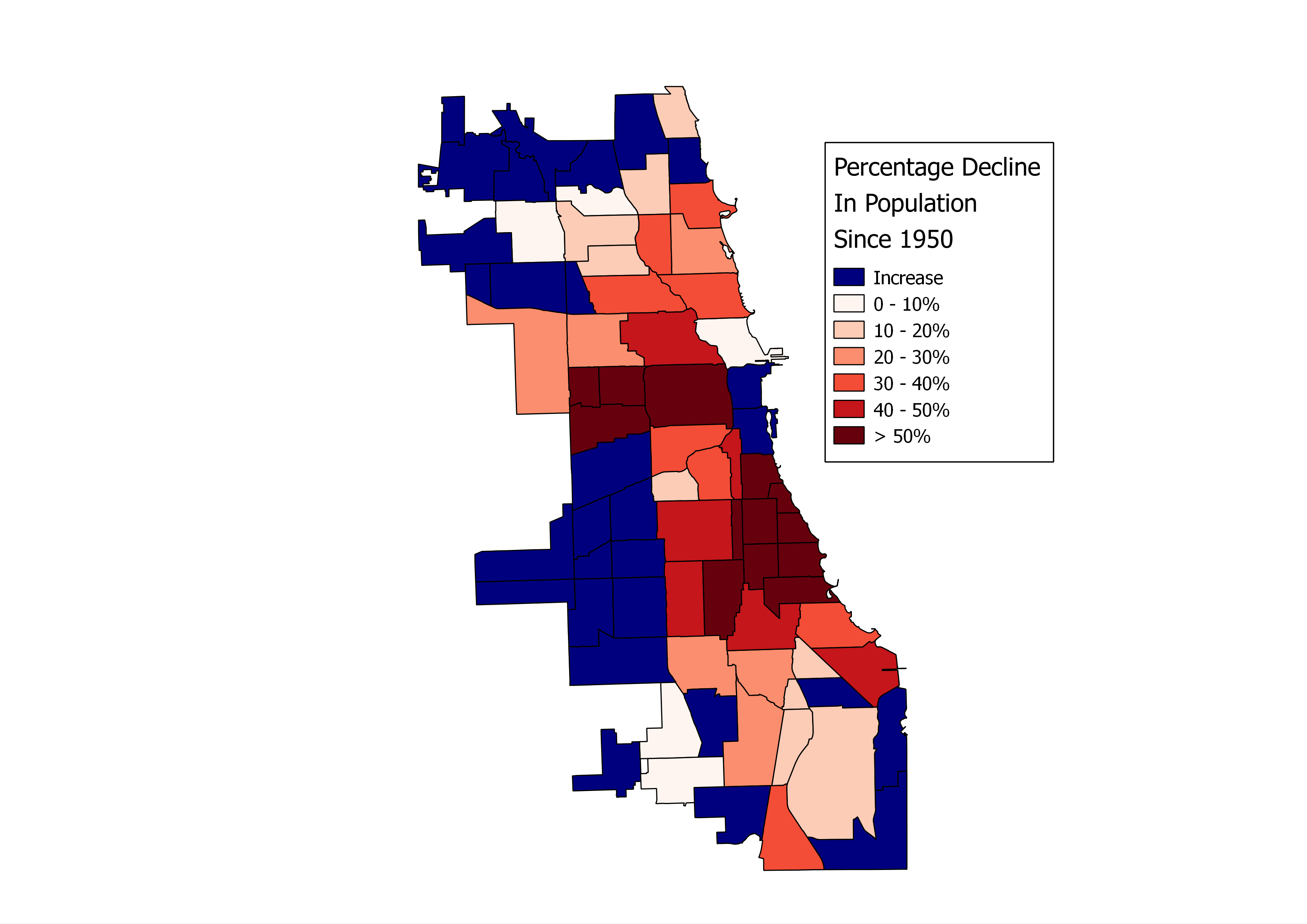
Gentrification may get a lot of attention in big cities but one journalist suggests the more influential issue in Chicago is the number of neighborhoods that have undergone severe declines.

At WBEZ, a Chicago public radio station, our neighborhood bureau reporters produced a package of stories, “There Goes the Neighborhood” (found here) in December, about the changing conditions of neighborhoods in racially segregated Chicago. We partnered with the University of Illinois at Chicago, which created a gentrification index for understanding how to measure neighborhood change in the city, for better or worse. The index measures 13 indicators of neighborhood conditions, including race, income, house values, education, and even the percentage of kids attending private schools. The findings confirmed and challenged some of our own notions, but the main takeaway is that gentrification is not as pervasive throughout Chicago as conventional wisdom might suggest.

Scoring neighborhoods based on the index, Chicago’s 77 neighborhoods were grouped into nine categories ranging from “stable upper/middle class,” meaning index scores remained high since the 1970s, to “severe declines,” meaning those scores dropped significantly since the ’70s. The “gentrification” category captured neighborhoods that had low index scores in the 1970s, but grew significantly higher by 2010. There were only nine neighborhoods that fit that “gentrifying” classification, almost all of them in downtown Chicago (“The Loop”) or just north of it, areas that have been historically white. These places were basically immune to the housing crash, but meanwhile a glut of luxury high rises cast shadows over Lake Michigan.

The category you want to pay attention to, though is “severe decline” — 14 neighborhoods found mostly in South and West Chicago have populations that are, on average, two-thirds African American. Add those to the 12 neighborhoods that have remained in extreme poverty since the ’70s, of which 94.5 percent of residents are African American…

Policymakers, hence, must address the concerns of inequitable development across neighborhoods and income inequality, which are both also national issues. According to a City Observatory report examining urban poverty released last year, the problem over the past four decades is not wealthy whites infiltrating black and Latino neighborhoods with designer Pulaski hatchets and vegan cupcake shops. Governing magazine came to similar conclusions, showing low percentages of gentrified Census tracts in Chicago since 1990.

Gentrification might be the sexy topic but addressing the pressing issues in persistently disadvantaged neighborhoods would likely help more people in the long run. Of course, addressing the issues in poor neighborhoods is complex and not change may not come as quickly as it does through gentrification. Given Chicago’s long history of residential segregation, many of these poor neighborhoods – which are often heavily non-white – are not in any danger of gentrification anytime soon because they are far removed from the edges of wealthier white neighborhoods where good real estate deals or trendy spaces appealing to young, white, creative types might be found.


Interpreting dreams about New York City real estate

At the center of the world, what do dreams about real estate mean? One dream specialist looks into real estate dreams of New Yorkers:

“I dreamt that I found a door in my apartment that lead to this massive extra room no one knew about and suddenly our 300ish-square-foot one bedroom was big! And we didn’t have to move to have kids! Just don’t tell the landlord! I woke up and searched for that door. It did not exist. Dammit, Narnia!”Anne Cutler: The dream image of finding a hidden door that opens into a room one didn’t know was there could be a metaphor for discovering a new aspect of oneself that you didn’t realize existed. In this dream, the expansion of the apartment with the new room could be both literal: room to start a family, and metaphorical: a psychological readiness to have children and expand the family…

“After our first meeting with our broker—which, by the way, was very positive—I had a dream that he was like, “Rebecca, I’m sorry, but we’re going to have to look on Staten Island.” (My parents are assisting with the buying; that’s why I said “we.”) I was very depressed when I woke up. I’m sure the dream interpreter will say I have financial anxiety about buying an apartment but who knows what else this means.”

AC: This dream was most likely triggered by something in her initial meeting with the broker. Possibly the dreamer was trying to manage her expectations about what they could afford. The dreamer is most likely engaged in an internal weighing of her own fantasies about her dream apartment/house versus her fears about how far her finances will go. The dream does have an anxiety component. Given her depressed mood when she woke up, I’ll assume the dreamer doesn’t want to live in Staten Island. But the specifics of why not can only be gleaned from further discussion with the dreamer. The specific images we choose in dreams all have significance. So, in this case, why Staten Island instead of Queens or the Bronx or Brooklyn?

The neuroses of New York City life – perhaps this should have been the focus of a Woody Allen film?

I can’t help but want more data on such a topic:

1. Do New Yorkers dream about real estate more than people in other cities, particularly those in cities with less expensive housing markets?

2. Compared to others, do New Yorkers always want to move up (bigger place, better location, etc.) in their dreams? Given the consumerist nature of American life and what we think real estate signifies about us, is this limited to New Yorkers?

3. Do people have positive dreams about where they live? The examples presented here are more about anxieties dealing with home. Yet, psychologists and others have argued that certain dwellings can be designed to provide a better fit with the resident’s personality.

Quick Review: The Island at the Center of the World

Russell Shorto argues the Dutch colony of New Amsterdam helped kickstart the American mindset and dream even though the city’s history before the English takeover is often ignored. Shorto bases his claims on research in recent decades that involves translating the old Dutch records and revealing the political and social history of the colony. In the end, Americans might see their origins largely in the English colonies but Shorto suggests “it helped set the whole thing [the American experiment] in motion…They reshuffled the categories by which people had long lived, created a society with more open spaces, in which the rungs of the ladder were reachable by nearly everyone.” (317)

Here is what the Dutch colony of New Amsterdam gifted to the United States:

1. Emphasis on trade. Even in its early decades, the city was a hub for shipping in the New World. The English colonies in New England and Virginia both worked through the Dutch port. The protected harbor was important as was its connections to the interior.

2. Giving rights to all the citizens. While the English colonies only had a limited number of freedmen, the Dutch had much broader citizenship rights and this social standing allowed people of all backgrounds to rise up the social ladder. This also involved quite the fight for control over the colony; Shorto describes the efforts of the lawyer Adriaen van der Donck to fight for citizen control rather than the autocratic rule of the Dutch West India Company and their charge Peter Stuyvesant. This did have an interesting side effect in the end. When the English ended up moving in from their colonies in Connecticut, the people of New Amsterdam wanted to be handed over peacefully to the English in order to continue the life of their city and the English largely granted them the continuation of their lives.

3. Religious tolerance. The Netherlands was open to people of different faiths – mainly different Christians – and this continued in their colony. Thus, a number of immigrants ended up in New Amsterdam rather than the much more restrictive English colonies. Other fun fact: those same Puritans who founded Plymouth and its more narrow restrictions had arrived from the Netherlands where the Dutch had offered them religious freedom.

4. Openness to immigrants. With the emphasis on trade, rights, and religious tolerance, New Amsterdam from the beginning was home to people of many backgrounds.

Another large factor in shaping New Amsterdam: the larger political and military conflicts between England and the Netherlands over this period. The two countries fought three wars and the colony’s fate was often caught in the middle.

Overall, an interesting summation of recent research on the early decades of New York City. The English weren’t the only Europeans to help found the United States and the Dutch played an important role in this influential global city.

Paris planning to add millions in the suburbs to its boundaries

Plans for metropolitanization in Paris are well underway:

The new Métropole du Grand Paris, or Metropolis of Greater Paris, will include nearly seven million people, more than triple the population now living in the central city. It will swallow rich suburbs to the west. But it should also provide better access to jobs and to business hubs and, if it really works, a greater sense of belonging for millions of immigrant families who live in poverty and isolation on the city’s southern, northern and eastern fringes. Resources would be redistributed, in particular those dealing with housing. The complexion of Paris would change…

As much as any struggling suburb, this one shows how urban development across decades, even centuries, has failed millions of immigrant families and contributed to what France’s prime minister, Manuel Valls, recently denounced as “territorial, social, ethnic apartheid.” His remark provoked a lot of hand-wringing in France. But, as all sorts of French planners, architects, historians and political scientists point out, a legacy of belonging and exclusion, center and periphery, inside and outside, is baked into the very layout of Paris and of places like Grigny, which has nice old houses and woods but is a de facto warehouse for tens of thousands of mostly poor, disenfranchised Muslims.

In essence, Paris Métropole promises a new regional council to coordinate housing, urban planning and transit for a greater Paris. The idea evolved from a proposal by Nicolas Sarkozy, who as president imagined business hubs and a high-speed train linking them to the city’s airports. That morphed into a more complex rail system serving poorer suburbs.

Pierre Mansat has spent years helping to put the plan together. He said the other morning that taxes on businesses, and, France hopes, billions more from Europe, will pay for Paris Métropole. Who knows whether right-wing and left-wing politicians from suburbs and city neighborhoods will actually cooperate, but Mr. Mansat stressed that “it’s above all about creating a new image of Paris as more inclusive, integrated, fluid.”

This sounds like an interesting confluence of factors. On one hand is inequality in the French suburbs which has been surfacing for quite a while. Urban images are important, if at the least for France’s international reputation and Paris’ thriving tourism, as are aiming to give all residents opportunities for a better life. On the other hand are the practicalities of comprehensively tackling urban issues – like housing and transportation – that require the cooperation of a range of communities. Cities can do a lot on their own but many of their needs are tied to the fate of nearby communities that can either join cities in pursuing common goals or pursue their own.

Of course, the article suggests it isn’t clear how successful the metropolitanization attempt might be. This is a long-term project and it will be interesting to see how other major cities learn from this process.

Teardowns back on the rise in the Chicago area

Teardowns are back in wealthier Chicagoland communities:

Wilmette, for example, saw 48 teardowns last year. That’s way up from the 15 to 20 the North Shore town experienced annually from 2009 to 2011. “We’re almost back to the old average of 50 a year,” says John Adler, Wilmette’s community development director. “And the resurgence is attributable to developers getting involved again on the speculative side—not just people of means building their dream homes.”

Hinsdale, the priciest west suburban housing market, had 60 teardowns last year, versus 47 in 2013, says its community development director, Robert McGinnis. All but six of the single-family homes that started construction there in 2014 replaced teardowns. McGinnis estimates at least half of the new projects are being built on spec, as opposed to being custom-built…

The teardown candidates aren’t just tiny bungalows this time. Developers are targeting larger houses as well, particularly if they sit on coveted property. Antiquated plumbing, the absence of upscale amenities such as media rooms, and the high cost of gut rehabbing (roughly $300 a square foot, versus $200 for new construction) are pushing homes on North Shore lots near the lake into early retirement. Two properties that sold for around $4 million each in 2014—one in Wilmette and one in Winnetka—are on their way to the scrap yard, says Berkshire Hathaway HomeServices KoenigRubloff agent Joseph Nash. Both were on three-quarter-acre lots with private beaches, and the Winnetka house had seven bedrooms—big and nice, but apparently not nice enough.

While there will always be preservationists who bemoan these changes, Boyle says he hasn’t witnessed as much handwringing this time over the evolving neighborhood character in La Grange: “Most people are happy that people are updating homes, because they’re seeing the value increase for their own property.”

I want to know more:

1. Are some people (like the neighbors who get upset about such homes next door) going to be happy that teardown McMansions are back just because they signal a more vibrant housing market? Or, are these teardowns just another sign of the bifurcated market where the wealthy still have money to burn?

2. Do these teardowns today look significantly different than those of the early 2000s? Did builders learn any lessons or has the market shifted dramatically?

3. We might know that the housing market has really returned when teardowns are happening in communities that aren’t the usual suspects like Hinsdale, Naperville, Elmhurst, and the North Shore. Any activity in other suburbs?