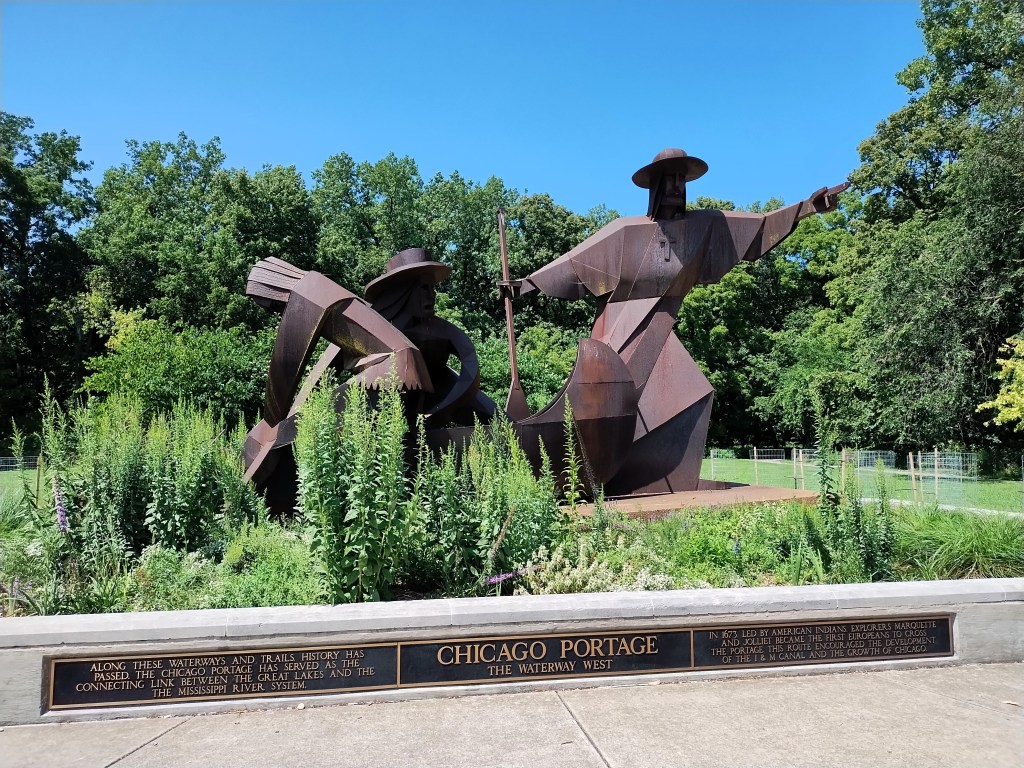
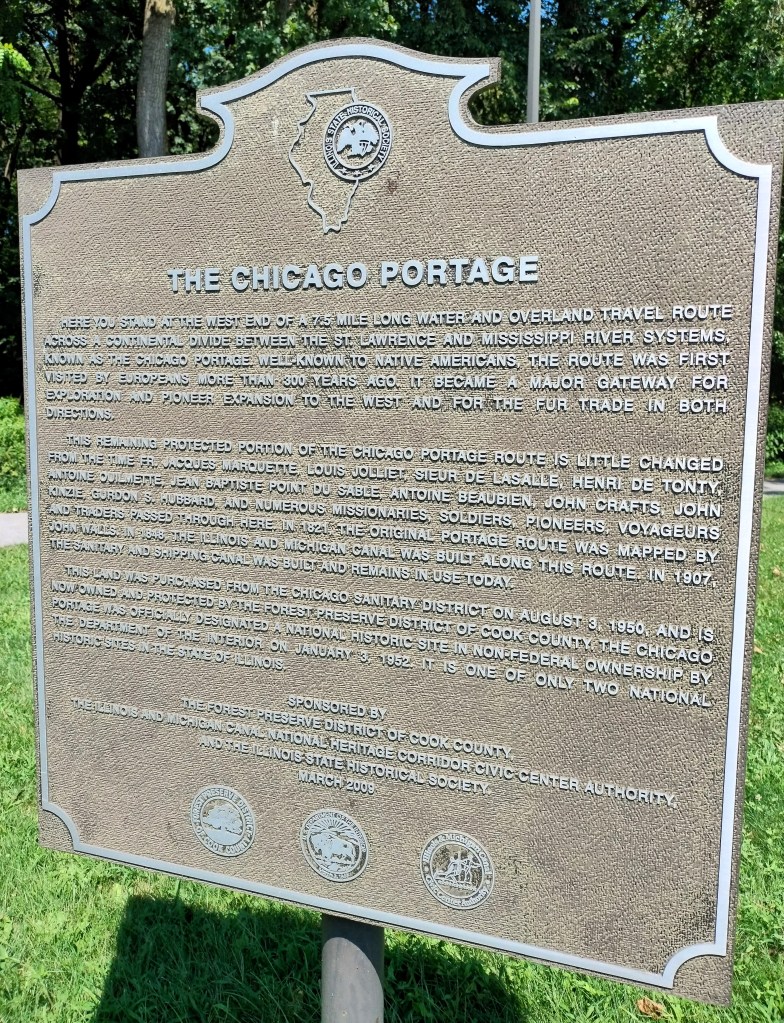
The importance of traveling via water meant that portage sites were important. This site was one of the places where it was easier to move watercraft from the Great Lakes system to the Mississippi River system. It was not the only portage site allowing that connection but it became known and then improved on in the mid-1800s with a canal.
The site now is somewhat obscured off a major local road and close to a major interstate. The area is mostly industrial land with few houses nearby. Chicago is a transportation center but a portage is no longer needed. There are still canal waterways nearby but these have receded in importance to and status in Chicago compared to railroads, highways, and airports. Chicago is still a transportation center but a portage is no longer needed.
Disparities across groups are stark. According to the study, data collected in 2022 showed Chicago’s white families have the highest median net wealth ($210,000), while typical Black families report no wealth ($0). Chicago’s U.S.-born Mexican families have 19% ($40,500) of a typical white family’s wealth, while foreign-born Mexican families have 3% ($6,000) and Puerto Rican families have 11% ($24,000).
As for median asset values, Black families have $20,000, foreign-born Mexican families have $26,000 and white families have $325,500.
The study also found Black families had the lowest estimated rate of home ownership at 34%, while white families had the highest at 72%, reflecting the city’s historic discrimination against people of color through redlining, racial covenants, a lack of checking or savings accounts, and payday lending, where unsecured loans with high interest rates are used as emergency financing that keeps borrowers in a cycle of long-term debt.
The researchers asked people about possible interventions:
“The Color of Wealth in Chicago” study also surveyed people about potential policy proposals for addressing structural economic disparities. Data shows that public support for interventions on local and federal levels would have a meaningful impact on racial wealth inequities. Wealth-building options such as guaranteed income projects, a Medicare for All program, and baby bonds, which are government-issued trust accounts for newborns, garnered support from the bulk of respondents, including families at or above the median net worth.
Wealth matters because it affects all kinds of life chances, including where people live, access to education and medical care, and nearby jobs.
Venture west of Wausau, and you’ll find yourself meandering down a country road that leads to a point of global significance—a point where latitude and longitude find harmony at 45 degrees North and 90 degrees West.
Visualize yourself standing at this exact midpoint, not just in a geographical sense between the North Pole and the Equator, but also between the prime meridian and its direct opposite across the globe…
If you pulled out a map, you’d find yourself at the intersection of some of the world’s most important lines of navigation.
Of the four such points globally, Poniatowski’s slice of longitude and latitude is the only one that’s readily accessible.
The others?
They’re either swimming with the fishes in oceanic depths or hiding in landscapes far less hospitable…
The original marker was a humble signpost in a field, but today, thanks to generous community efforts, there stands a clear path, welcoming benches, and an official marker that stakes its claim in the ground.
While this claim is based on imposing coordinates on the surface of the planet, I wonder how people around the world would answer this question: “What do you consider to be the center of the world?” Would it be major cities, like New York City or Tokyo? Religious sites? Their homes or land? A natural spot?
Or it might be interesting to investigate which places claim to be at the center of things. A place could be at the geographic or social center of a country. Where are the center points of cities or regions? Is it more important to be at the geographic or social center (see this example from the United States)?
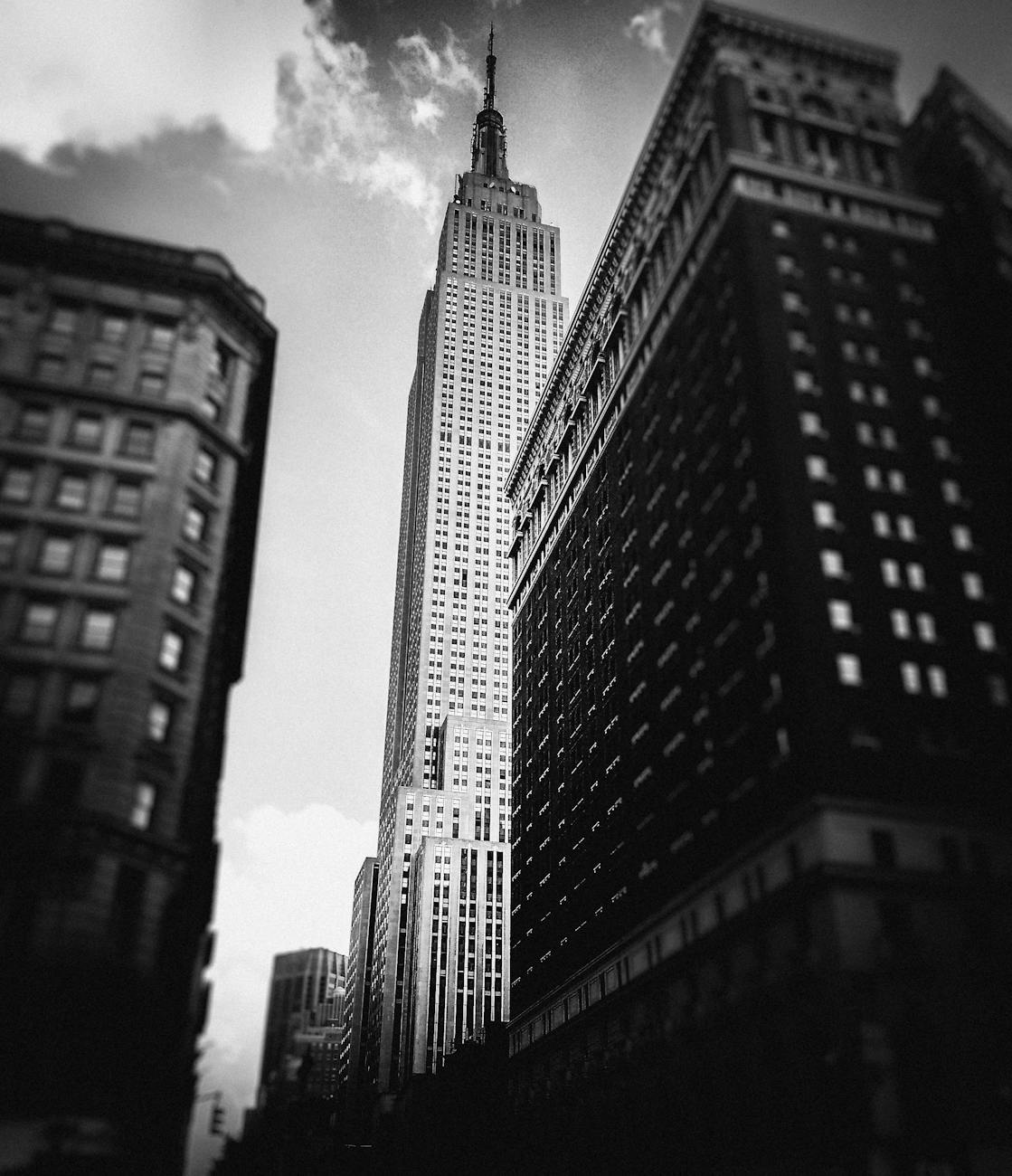
Together, the center becomes a chaotic yet controlled sociological soup: the mix of the mundane with the mighty. Looking down from the Empire State Building, I can see it all.
This reminds me of sociologist Robert Park calling the city a laboratory. Does suggesting it is a soup imply different things about the city?
I wonder if anyone has compiled a large or comprehensive list of metaphors for big cities. Given that they are relatively rare and in human history (a few large cities in the past not withstanding), what are frequent or unique images used to try to understand them? How many metaphors invoke food?
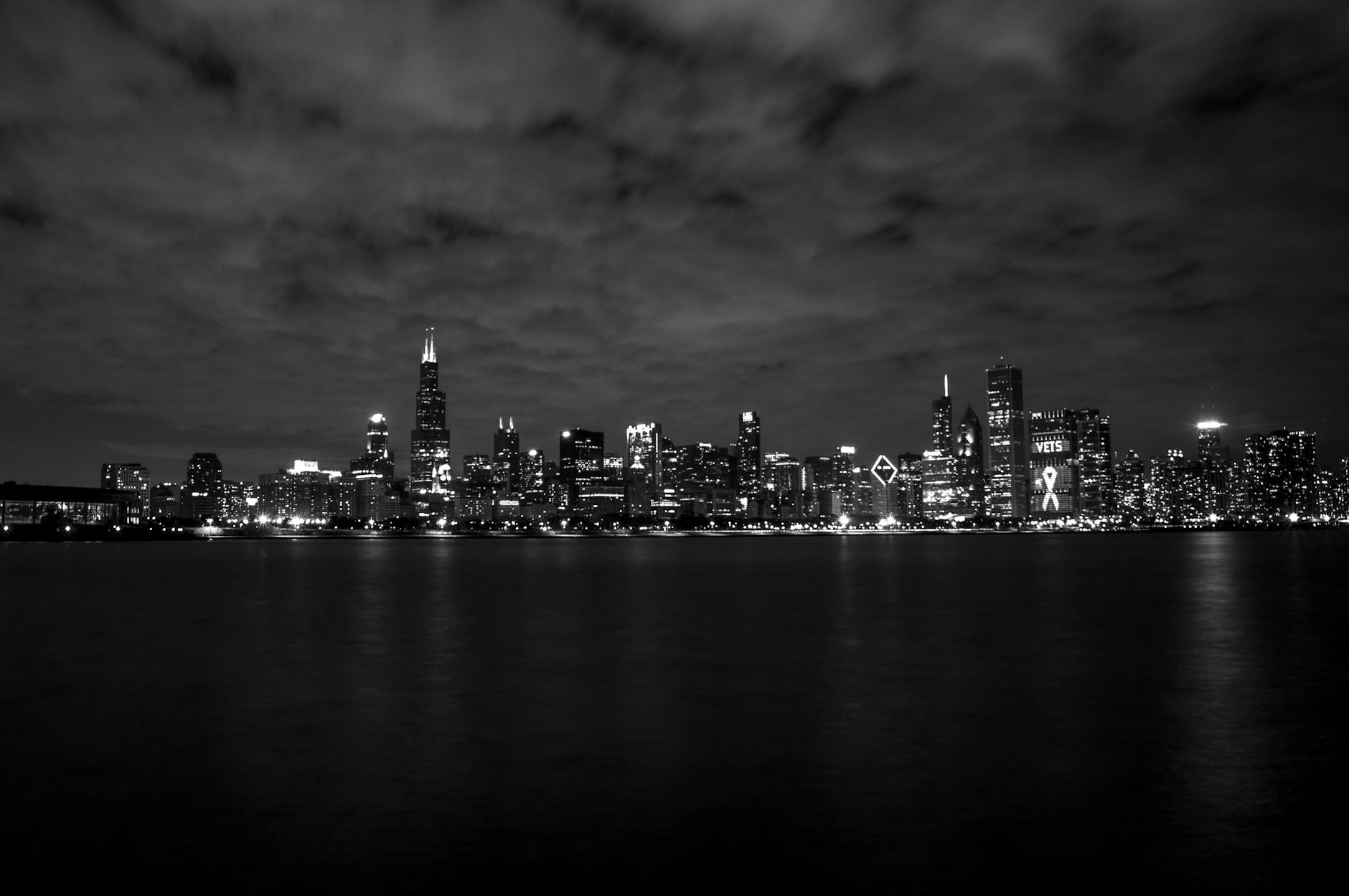
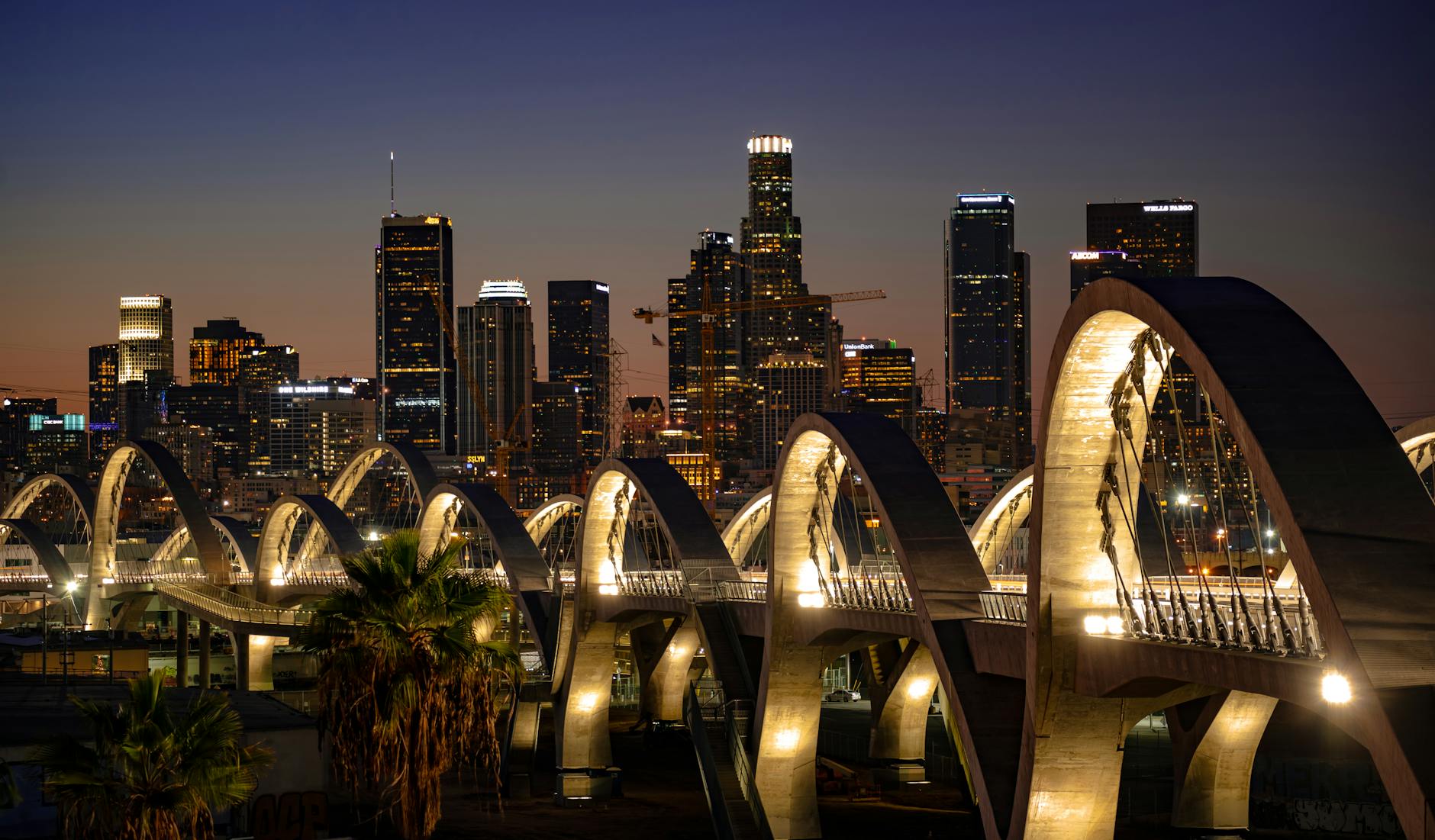
The world’s most beautiful skylines are more than just collections of buildings placed close together: They’re the façades of entire cities, the front doors to many of the earth’s most vibrant metropolises. It’s these man-made horizons that often offer the first impression to visitors and imbue a sense of home to returning locals. But what exactly makes a beautiful skyline? One that is immediately recognizable? Those that are the most harmonious? The cities with the greatest number of individually striking buildings? The answer, is of course, some collection of all of the above. Like when discussing most aesthetic disciplines, visual examples are far more powerful than description will ever be. To that end, AD has rounded up 17 of the world’s most beautiful skylines, covering notable favorites like New York City and Shanghai as well as some lesser-known stunners that deserve more acclaim.
I do not know if it is better to simply make a subjective ranking or to have a pseudo-scientific ranking of weighted factors. As noted above, there are at least a few factors that could be considered. Here is what I might include:
The most tall buildings. Would places with more tall skyscrapers automatically rank higher?
The most lauded buildings. Does this come back to you particular architectural styles? Or the architects connected to them? Or the number of social media images with each building in them?
The setting of the skyline. Does the view of the buildings include water or mountains or another impressive natural feature or other built features (the rankings above mention bridges)?
The age of the skyscrapers. Does it matter if many of the buildings are older or if many are newer?
The tourism connected to the skyline. Do people come to this place to see the skyline? Would someone go out of their way on a visit to try to take in the whole skyline?
The opinions of a range of experts. What do they see as the best skylines? It could be interesting to see who is considered a skyline expert.
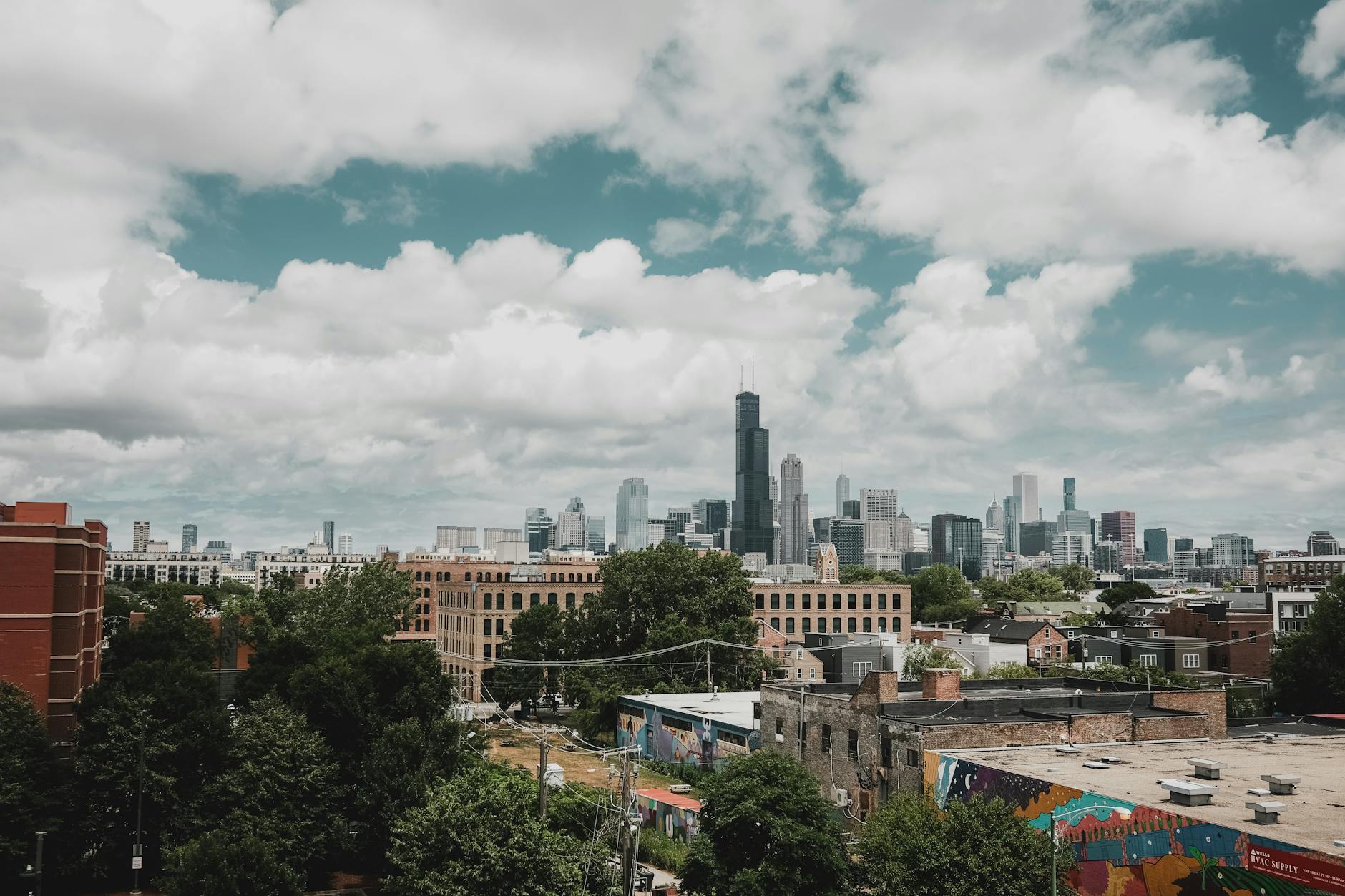
And among these possibilities, Chicago ranks #3. Here is the description:
Hugging the shores of Lake Michigan, Chicago is the third most populated city in the United States. The Midwest metropolis is made famous by many striking supertalls, such as Willis Tower, Vista Tower, and Marina City.
Several factors stand out: a setting on a vast body of water, a large population center, and multiple “striking supertalls.” Does Chicago get more points because of the number of tall buildings or the architects and styles connected to the skyscrapers or the longevity of the skyline or the tourism in the city?
If Chinatown’s ending forces the audience to sit in a feeling of hopelessness, it should also disturb anyone invested in Los Angeles’s future. The history of water in 20th-century California was defined by mammoth feats of engineering and an enduring belief that someone like Mulholland would eventually come along and enable the impossible. Each new dam or aqueduct only guaranteed the arrival of the next one—the population growth allowed by Mulholland’s aqueduct, for example, later resulted in L.A. tapping other water sources, such as the Colorado River. California has had a few good years of rain recently, but the long-term sustainability of the state’s water supply depends on collective conservation efforts: drastically reducing the amount of water used by Big Agriculture, moderating suburban tasks such as watering lawns, regulating the state’s groundwater.
“There is no more water to capture with big projects. There just isn’t. The future is really about much smarter water management,” Stephanie Pincetl, a UCLA professor who specializes in urban policy and the environment, told me. Conservation measures, she argues, are the way forward even if politicians wish they could stump for some grand technological innovation the way their 20th-century predecessors did: “The approach to the 21st century has to be a lot more subtle, a lot more place-based, and a lot more guided by the realization that water is a scarce resource, and so we need to treat it like a scarce resource.”
Finding water in Los Angeles, the Southwest, the West, and the United States more broadly may become more paramount in the coming decades. Which cities and regions would do well in competing for water? Would a lack of water in some places lead to growing populations in places with plenty of water?
While we are at it, why not tell more exciting stories in these categories:
Origin stories of modern places. Take any of the big cities in the United States and put its origin story in a movie or a miniseries. How about the rise of Phoenix?
It would be interesting to popularize more stories about water and other necessary resources in daily life. How about a thrilling tale about concrete? It is hard to imagine modern life without out. Or air conditioning. Can’t have a lot of the global development of the last century without it. Or salt. Where do we get all this salt in our daily lives from?
If Chinatown can entertain and inform about place, why not engage in more storytelling that explains where places have come from and where they might be going?
The Valley is one of the fastest-growing regions in America, where a developer decided to put a city of the future on a piece of virgin desert miles from anything. At night, from the air, the Phoenix metroplex looks like a glittering alien craft that has landed where the Earth is flat and wide enough to host it. The street grids and subdivisions spreading across retired farmland end only when they’re stopped by the borders of a tribal reservation or the dark folds of mountains, some of them surrounded on all sides by sprawl.
Phoenix makes you keenly aware of human artifice—its ingenuity and its fragility. The American lust for new things and new ideas, good and bad ones, is most palpable here in the West, but the dynamo that generates all the microchip factories and battery plants and downtown high-rises and master-planned suburbs runs so high that it suggests its own oblivion. New Yorkers and Chicagoans don’t wonder how long their cities will go on existing, but in Phoenix in August, when the heat has broken 110 degrees for a month straight, the desert golf courses and urban freeways give this civilization an air of impermanence, like a mirage composed of sheer hubris, and a surprising number of inhabitants begin to brood on its disappearance.
Growth keeps coming at a furious pace, despite decades of drought, and despite political extremism that makes every election a crisis threatening violence. Democracy is also a fragile artifice. It depends less on tradition and law than on the shifting contents of individual skulls—belief, virtue, restraint. Its durability under natural and human stress is being put to an intense test in the Valley. And because a vision of vanishing now haunts the whole country, Phoenix is a guide to our future.
Several thoughts in response:
How many Americans know Phoenix is the fifth-largest city in the country – growing from over 106,000 residents in 1950 to over 1.6 million today – and the tenth-largest metropolitan area?
Like many American communities, Phoenix and the region depends on growth. More residents, more business activity, more infrastructure. What happens to Phoenix when/if growth slows? How would a mature region in 50 or 100 years look similar or different?
The environment plays a role in Phoenix and the region. At the same time, Phoenix expanded at a particular point in American history, later than many big cities. How do these two factors intersect?
How would urban sociologists think about Phoenix compared to other American cities and region? Is it more unusual or does it follow similar patterns to other sprawling regions? What marks Phoenix as unique? Do the same social, political, and economic factors propel the region or is there something different going on?
Spencer said she views additional city funding for NCTV17 as an investment into what the station does for the community.
“We think we’re more important and more relevant than ever to Naperville as the fourth largest city and the second largest economic engine (in Illinois),” she said. “We think we provide a really big service. … With a little support from our friends at the city, (we think) we can weather this storm and arrive at port bigger and better than ever.”
What features of Naperville would mark it as such a large economic engine? Its population puts it in the top four communities in Illinois, following Chicago, Aurora, and Joliet. But population alone does not tell the full story. Some more features of Naperville
–Lots of human capital and economic resources among residents: “The region has a civilian labor force of 79,726 with a participation rate of 69.2%. Of individuals 25 to 64 in the Naperville city, IL, 74.0% have a bachelor’s degree or higher which compares with 34.3% in the nation. The median household income in the Naperville city, IL is $127,648 and the median house value is $424,800.”
–Certain job sectors well represented: “The largest sector in the Naperville city, IL is Health Care and Social Assistance, employing 12,989 workers. The next largest sectors in the region are Professional, Scientific, and Technical Services (12,897 workers) and Retail Trade (8,375). High location quotients (LQs) indicate sectors in which a region has high concentrations of employment compared to the national average. The sectors with the largest LQs in the region are Professional, Scientific, and Technical Services (LQ = 2.22), Utilities (2.08), and Management of Companies and Enterprises (2.05).”
–Lots of office space available: “The office market in Naperville, IL incorporates 10,451,396 square feet of office space across 56 buildings that are at least 25,000 square feet in size.”
In a state dominated by Chicago, it is noteworthy to be second in line as an economic engine. I wonder what other Illinois communities are trumpeting their economic prowess and how many of them are suburbs.
Since April, Naperville has made the grade in 2024 for being among the Top 100 Best Places to Live in the U.S. as determined by the publication “Livability; Safest Cities in America,” per the home security review site Safewise; Top Destinations for a “White Picket Fence” Lifestyle, from DatingNews.com; and Best Cities for Naked Gardening, from online platform LawnStarter…
Naperville earned a LivScore of 862 out of 1,000. There were only a handful of cities that received a higher score than Naperville on the 2024 ranking. Those were Carmel and Fishers in Indiana, Cary in North Carolina and Columbia in Maryland…
Last month, the site released its 10th annual safest cities report and placed Naperville in the No. 12 spot…
Naperville came in at No. 30. Several other Illinois cities also proved to be up to the bare snuff, with Chicago ranking No.11, followed by Evanston at No. 13, Elgin at No. 17, Schaumburg at No. 23 and Arlington Heights at No. 25.
On Tuesday, the site released its 2024 lists for Best Places to Live in America. And for the first time ever, Naperville came out on top of the some 230 cities evaluated in this year’s rankings.
It was also named the No. 1 U.S. city to raise a family and the city with the best public schools.
Three things strike me about these rankings and sources:
Naperville is at the top of some lists and not others. There are thousands of communities in the United States.
There is a proliferation of rankings of communities. Why? I would guess it is due to the easier access to data about communities plus the rankings drive clicks and impressions.
With the growing number of rankings, will communities list all of them? Will Naperville claim all three of these?
Growth is good in the United States for cities and metropolitan regions. But, the changes that come with growth is not always viewed fondly by the people already there. The most recent example: Nashville.
Remacia Smith watches her children play in a grassy park by the Cumberland River, not far from where software giant Oracle said last week it would base its new headquarters. It is bittersweet—her hometown is thriving, but it has reached a point where it no longer works for her…
“There are pain points of this growth,” said Kate Webster, a 35-year-old real-estate agent who has lived in Nashville for 14 years. “But at the end of the day, I’d rather live in a city that is growing than one that is declining.”…
The region needs to focus on improving transit options and traffic flow, and on more housing options, Gaughan said. Many neighborhoods need to rezone for construction that allows more people to live there, he said.
John Michael Morgan, a lifelong resident of the area, said he remembers when Nashville’s prospects weren’t so hot. The growth is exciting, he said, but he worries about Nashville losing some of its personality.
“Nashville’s always been a big town that felt like a small town,” said Morgan, who is 44 years old. “Now we’re a big town that feels like a big town.”.
Change can be hard for residents of a community. They are used to the way things were. They may have moved there for particular features of the community.
Increased population growth tends to lead to more construction, higher housing prices, more traffic, and different streetscapes.
However, the United States tends to treat growth as a good thing. What community wants to stagnate or decrease in terms of population and business activity? How many people want to be in an undesirable community?
At some point, the growth in Nashville will level out and that will offer an opportunity to assess what has changed. Is the city and metropolitan region now a different place? What has fundamentally (and perhaps unalterably) changed?






 Legally Sociable