Naperville as “the second largest economic engine (in Illinois)”

The last paragraph of a story about NCTV in Naperville hints at the economic activity in the suburb:

Photo by Karolina Grabowska on Pexels.com

Spencer said she views additional city funding for NCTV17 as an investment into what the station does for the community.

“We think we’re more important and more relevant than ever to Naperville as the fourth largest city and the second largest economic engine (in Illinois),” she said. “We think we provide a really big service. … With a little support from our friends at the city, (we think) we can weather this storm and arrive at port bigger and better than ever.”

What features of Naperville would mark it as such a large economic engine? Its population puts it in the top four communities in Illinois, following Chicago, Aurora, and Joliet. But population alone does not tell the full story. Some more features of Naperville

Lots of human capital and economic resources among residents: “The region has a civilian labor force of 79,726 with a participation rate of 69.2%. Of individuals 25 to 64 in the Naperville city, IL, 74.0% have a bachelor’s degree or higher which compares with 34.3% in the nation. The median household income in the Naperville city, IL is $127,648 and the median house value is $424,800.”

Nearly 80,000 jobs in the suburb.

Certain job sectors well represented: “The largest sector in the Naperville city, IL is Health Care and Social Assistance, employing 12,989 workers. The next largest sectors in the region are Professional, Scientific, and Technical Services (12,897 workers) and Retail Trade (8,375). High location quotients (LQs) indicate sectors in which a region has high concentrations of employment compared to the national average. The sectors with the largest LQs in the region are Professional, Scientific, and Technical Services (LQ = 2.22), Utilities (2.08), and Management of Companies and Enterprises (2.05).”

Lots of office space available: “The office market in Naperville, IL incorporates 10,451,396 square feet of office space across 56 buildings that are at least 25,000 square feet in size.”

-A vibrant downtown.

Lots of awards from different outlets.

Billions of dollars each year in retail sales.

-Multiple corporate headquarters in the city.

-Part of the I-88 corporate corridor, access to multiple major highways, and close to two major airports and Chicago.

As I put together this list, Naperville indeed sounds like an edge city.

In a state dominated by Chicago, it is noteworthy to be second in line as an economic engine. I wonder what other Illinois communities are trumpeting their economic prowess and how many of them are suburbs.

Naperville continues to rank highly, even for gardening

Recent rankings of cities or communities by different sources continue to include Naperville:

Photo by Lisa Fotios on Pexels.com

Since April, Naperville has made the grade in 2024 for being among the Top 100 Best Places to Live in the U.S. as determined by the publication “Livability; Safest Cities in America,” per the home security review site Safewise; Top Destinations for a “White Picket Fence” Lifestyle, from DatingNews.com; and Best Cities for Naked Gardening, from online platform LawnStarter…

Naperville earned a LivScore of 862 out of 1,000. There were only a handful of cities that received a higher score than Naperville on the 2024 ranking. Those were Carmel and Fishers in Indiana, Cary in North Carolina and Columbia in Maryland…

Last month, the site released its 10th annual safest cities report and placed Naperville in the No. 12 spot…

Naperville came in at No. 30. Several other Illinois cities also proved to be up to the bare snuff, with Chicago ranking No.11, followed by Evanston at No. 13, Elgin at No. 17, Schaumburg at No. 23 and Arlington Heights at No. 25.

Add these to the March 2024 ranking as Niche’s best place to live:

On Tuesday, the site released its 2024 lists for Best Places to Live in America. And for the first time ever, Naperville came out on top of the some 230 cities evaluated in this year’s rankings.

It was also named the No. 1 U.S. city to raise a family and the city with the best public schools.

Three things strike me about these rankings and sources:

  1. Naperville is at the top of some lists and not others. There are thousands of communities in the United States.
  2. There is a proliferation of rankings of communities. Why? I would guess it is due to the easier access to data about communities plus the rankings drive clicks and impressions.
  3. With the growing number of rankings, will communities list all of them? Will Naperville claim all three of these?

In other words, we are a long ways from Naperville ranking as the #2 place to live according to Money in 2006.

Cities and metro areas like growth – but do not necessarily like the changes it brings

Growth is good in the United States for cities and metropolitan regions. But, the changes that come with growth is not always viewed fondly by the people already there. The most recent example: Nashville.

Photo by Isaac Loredo Vargas on Pexels.com

Remacia Smith watches her children play in a grassy park by the Cumberland River, not far from where software giant Oracle said last week it would base its new headquarters. It is bittersweet—her hometown is thriving, but it has reached a point where it no longer works for her…

“There are pain points of this growth,” said Kate Webster, a 35-year-old real-estate agent who has lived in Nashville for 14 years. “But at the end of the day, I’d rather live in a city that is growing than one that is declining.”…

The region needs to focus on improving transit options and traffic flow, and on more housing options, Gaughan said. Many neighborhoods need to rezone for construction that allows more people to live there, he said.

John Michael Morgan, a lifelong resident of the area, said he remembers when Nashville’s prospects weren’t so hot. The growth is exciting, he said, but he worries about Nashville losing some of its personality.

“Nashville’s always been a big town that felt like a small town,” said Morgan, who is 44 years old. “Now we’re a big town that feels like a big town.”.

Change can be hard for residents of a community. They are used to the way things were. They may have moved there for particular features of the community.

Increased population growth tends to lead to more construction, higher housing prices, more traffic, and different streetscapes.

However, the United States tends to treat growth as a good thing. What community wants to stagnate or decrease in terms of population and business activity? How many people want to be in an undesirable community?

At some point, the growth in Nashville will level out and that will offer an opportunity to assess what has changed. Is the city and metropolitan region now a different place? What has fundamentally (and perhaps unalterably) changed?

The cultural contributions of Chicago right now

In an editorial, the Chicago Tribune highlights current cultural contributions from the city in which they operate:

Photo by Chait Goli on Pexels.com

Flyover is a fabulous new $40 million attraction at Navy Pier that used sophisticated drones to create an experience landing somewhere between an IMAX movie and a virtual roller-coaster. It makes you feel l as if you are flying like a bird over Sweet Home Chicago and thus experiencing it anew. The ride-movie hybrid, created here by Pursuit, part of the Arizona-based Viad Corp., has been doing boffo business and was just added to the lineup at the company’s Las Vegas operation. That means international tourists headed to Sin City now can visit Chicago, at least virtually. The beauty of Chicago also is coming to Flyovers in Vancouver and Reykjavík, Iceland, where we’ll bet they don’t take our city’s grandeur for granted as so many of us do here.

“The Bear” has been tantalizing neighborhoods all over the city as it has filmed its third season. This Hulu show, in many ways a love letter to Chicago and its innovative artists and hospitality workers, is approaching a tipping point of popularity. If it retains its quality, which seems like a good bet, it will bring yet more attention to the city and maybe even spark the kind of spin-off tourist appeal that shows such as “Friends” and “Sex in the City” have brought to New York City for years.

Chicago is all over Broadway, too, right now. One of the surprise hits of the Broadway season, “The Heart of Rock and Roll,” a droll jukebox musical featuring the songs of Huey Lewis and the News, is set almost entirely at Chicago’s venerable Drake Hotel during the 1980s. That’s thanks to a writer, Jonathan A. Abrams, who grew up in the north suburbs and has peppered his show with accurate local references from Dick Butkus on down. “Illinoise,” which began at Chicago Shakespeare Theater and moved to Broadway, has its audiences staring at the word “Chicago” on its backdrop for the entire show. Plenty of them are posting it on social media.

Add to that the coming Democratic National Convention and the attendant media exposure, and Chicago will be making a lot of news this summer and well beyond.

An interesting collection to highlight: a tourist attraction, a television show, theater productions, and a political convention.

Chicago is, of course, a world class global city. Figuring out what cities rank highly includes culture, among other factors. In the United States, Chicago lags behind New York and Los Angeles in terms of population and prestige and there are cities coming up behind it (Toronto? Houston?). How much influential culture needs to occur and/or be noticed in Chicago?

Setting The Matrix in Chicago – sort of

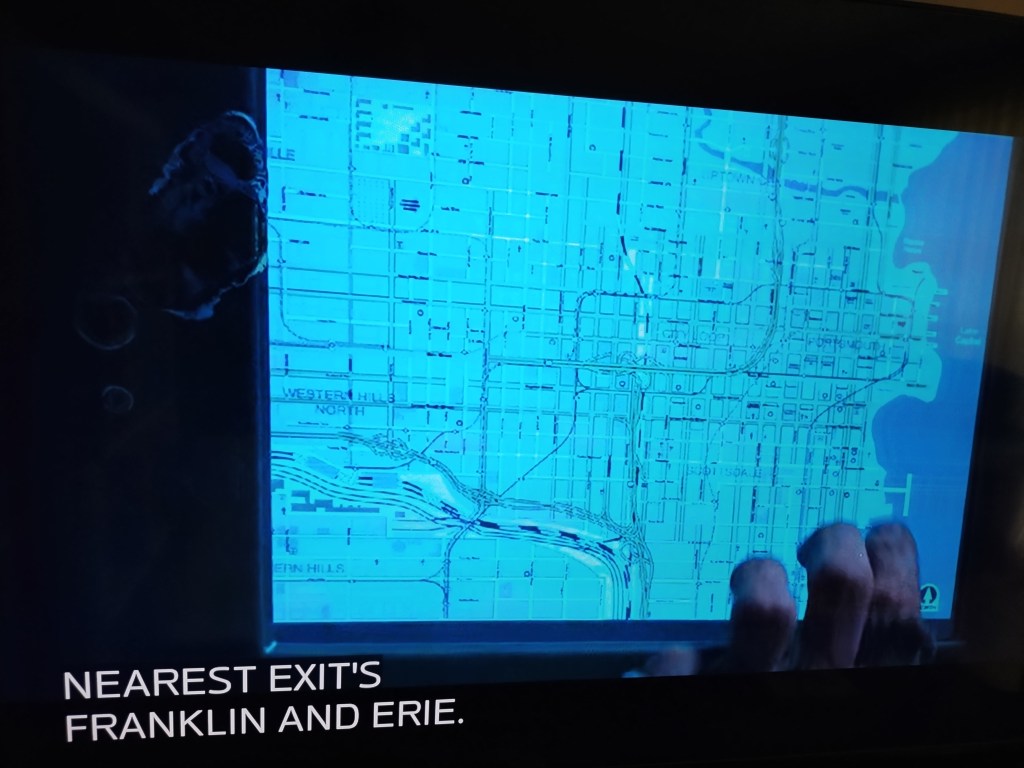
While recently rewatching The Matrix, I noticed multiple references to Chicago streets. And then there is a map in the second half of the film:

Looking closely, this is not exactly Chicago. But, the waterfront kind of looks like Chicago, there is a neighborhood on the map marked “City Loop,” the city has a river, and things do appear to converge in the district next to the waterfront.

Why the resemblance? One source suggests this is deliberate in the depiction of Mega City:

Early drafts of the screenplay identified the city as Chicago, and most of the street and landmark names referenced in the films are from Chicago,[4] such as Wabash and Lake, Franklin and Erie, State Street, Balbo Drive, Cumberland Ave, the Adams Street Bridge and the Loop Train.[5] Some street names, such as Paterson Pass and Wu Ping Ave., are derived from names of production staff.

In a brief screenshot of the first movie, wherein Tank zooms in a map on the screen to give Cypher directions to the telephone, the map of the city shows a coastline similar to that of Chicago’s Lake Michigan Coastline.

The creators have connections to Chicago:

Sure, most of the trilogy’s urban scenes were shot in Sydney, and close watchers of the first movie can spot several Sydney landmark buildings. But creators Larry and Andy Wachowski were raised in Chicago and drop at least five references in the first script…

The Wachowskis attended Whitney Young High School and spent two years in small liberal arts colleges before they each dropped out and started a construction business. Then the quirky film resume began to take shape.

This is not unusual in today’s filming of movies and shows: creators are from certain places, scenes may be shot in a variety of places, and the name of the place in the film or show may or may not align with the places that are depicted on screen. In The Matrix, a combination of modern cities produce a soulless but recognizable setting.

Chicago as a laboratory – for residential segregation?

A quote discussing a new documentary about residential segregation in Chicago reminded me of imagery used by sociologist Robert Park about seeing a city as a laboratory for study:

Photo by Karl Solano on Pexels.com

“This documentary really shows that Chicago is not just a place where segregation happened, but in some ways the intellectual and bureaucratic headquarters for thinking about how to carry it out,” Brown said. “It was a real brain trust in Chicago starting at the very turn of the 20th century, thinking about the problems that Blacks posed for real estate values and coming up with different ways of thinking about that as salesmen from the realtor point of view, as an intellectual problem being studied at UChicago, and the way the different neighborhood associations were also trying out different ways of keeping Blacks out of their neighborhoods.”

In other words, at official, neighborhood, and organizational levels, Chicago worked out how to practice residential segregation. Over the years, Chicago has ranked high on measures of residential segregation. A quick visual of the situation – such as a dot map showing race and ethnicity of residents – shows the differences in residences in Chicago today. And did other places follow the lead of Chicago?

I look forward to seeing this documentary.

Slowed condo construction in downtown Chicago

Who was going to buy all those expensive condos going up in downtown Chicago? The condo building pace has slowed significantly:

Photo by Pixabay on Pexels.com

For the first time in years, there are no new large condo projects under construction in downtown Chicago.

Roughly 2,500 condos have been developed downtown since 2015 as multiple towers were constructed, and about 600 of those units are still available, said Gail Lissner, managing director for Integra Realty Resources.

But the high cost of construction and high interest rates, which are discouraging luxury home sales, have brought large-scale condo construction to an end, Lissner said…

Apartment developers can better handle high construction costs because downtown renters, many needing quick housing after starting new jobs, fill up new rental units much faster than buyers, who typically need to make far bigger commitments, especially with interest rates so high…

Most of the condos built in recent years are large, ultra-luxury homes, with multimillion-dollar price tags and more than 2,000 square feet, Lissner said. Those can be tough sells, especially since according to brokers the downtown is now attracting fewer upper-income empty nesters from the suburbs, who often seek homes easier to maintain.

This is cast as the result of the current economic and housing market conditions. There are fewer buyers because of higher mortgage interest rates.

How much of this is possibly due to less interest from people to move to Chicago? With the city slowly losing residents, is there still the same latent market for downtown condos? If market conditions were better, would there be robust demand for new condos?

Tracking the construction and filling of apartments could help answer this. How many new apartments are available and how demand is there for those? Any chance existing condo buildings will go the rental route?

Leave It to Beaver’s downtown and Skokie, Illinois

Television shows may use a variety of settings to film scenes. Given my research on suburbs depicted on television, this example struck me as it combines a famous suburban show and a Chicago suburb:

A variety of websites back up this claim (IMDB, blog). The first home in the show, what I describe as having “two stories, a one-car garage, three bedrooms, and at least two bathrooms (Bennett 1996),” was on a Universal Studios backlot. The show is often held up as an exemplar of suburban-set TV shows in the postwar era yet I noted that it “ran six seasons but never cracked the top 30” most popular TV shows.

As a fictitious show set in an unnamed community, it is interesting to consider why Skokie might have been chosen. Was there existing footage that could be used? Did someone connected to the show or studio have a personal connection to Skokie? Did Skokie represent the experiences of American suburbs at this time? Would someone watching the show then or now see this scene and connect to particular places?

Here is a similar view from Google Street View in August 2019:

The sort of construction on the right – what looks like mixed-use four-story buildings – is common in suburban downtowns where they hope that increased numbers of downtown residents will patronize local businesses and restaurants in addition to those who want to visit such locations. These streetscapes have often replaced one- to two-story structures such as those in the top image.

A shopping mall left for walkers, a few stores, and future plans

I recently visited a nearly empty shopping mall in a nearby suburb. The suburb just recently bought more of the property in the hopes of redeveloping the mall into something more productive for the community. On this visit, here is part of what I saw in the mall:

On this winter day, there were at least a few people walking laps around the mall. Others sat in the empty food court. Security walked around.

The directory was about 5-6 years old. At that point, the mall still had a lot of retailers.

In the background of the image, you can see the Sears sign. Almost all of the anchor stores are long gone. Most storefronts are empty. The movie theater is shuttered.

The decline of this mall did not happen immediately. Combine online shopping, lots of shopping options in the Chicago region, and COVID-19 and you get a nearly empty mall. And it will take years to redevelop the property and incorporate the new elements into the community.

The most important sporting event in the world will take place…in an American suburb

The World Cup final in 2026 will be played in East Rutherford, New Jersey:

Photo by Riccardo on Pexels.com

The 2026 World Cup final will be held at MetLife Stadium in East Rutherford, New Jersey, on July 19, world soccer governing body FIFA announced on Sunday…

“It’s going to be a special World Cup,” Berhalter said after the announcement was made. “To have the final in New York, New Jersey is a dream come true for me. Being from that area, and I’m sure for most people from that area, it’s an area with a rich tradition of soccer and producing players.

“To think about when I was little, going to watch the [New York] Cosmos and them selling out Giants Stadium, and now this stadium is going to host a World Cup final. It’s really special.”

MetLife Stadium is home to the New York Giants and Jets who play in suburban New Jersey. The stadium is about 9 miles northwest of Times Square and about 13 miles northwest of Wall Street. When the Super Bowl was played here in early 2014, I assume more TV shots and attention was paid to New York City rather than the New Jersey suburbs.

It might also be worth noting that the 1994 World Cup final, the only one in the United States thus far, also occurred in the suburbs:

In 1994, the United States played two of its group-stage matches at the Rose Bowl in Pasadena, California, and the other at the Silverdome in Detroit. The Rose Bowl also hosted the final that year — with Brazil topping Italy in a penalty shootout — and again in 1999 for the Women’s World Cup, when the United States beat China, also on penalties.

Set in Pasadena, the Rose Bowl is roughly 11 miles northeast of downtown Los Angeles. This region is famously sprawling – and the 2028 Summer Olympics will take advantage of the full region for all of the events.

All the talk of soccer taking off among kids in the American suburbs may find its peak in this experience.