Can a movie that says something about suburbia be set in a place that is only sort of a suburb?

The name of the new movie Holland refers to the community in west Michigan. Numerous reviews note that the film says something about the suburbs. A few examples: first, from Variety:

Through it all, Macfadyen seems suspiciously good-natured, which merely encourages us to guess what he might be hiding. The “Succession” star brings a disconcerting Kevin Spacey-like energy to his performance, which reinforces the connection some might detect between “Holland” and 1999’s “American Beauty” — another movie about the toxic black mold that thrives just beneath the veneer of suburban perfection.

Second, from Roger-Ebert.com.

Kidman does her best to be the MVP of “Holland,” imbuing Nancy with just enough Midwestern nicety to make her memorable. Nancy is the kind of woman who wants to be a perfect wife and mother but also wants some mystery in her life and responds to the attraction of the handsome new teacher at her school. She’s a suburban shark, always swimming to a nearly impossible objective of keeping her pristine reputation in the community, holding her family together, and having a fling with Dave. While she doesn’t make any bad choices, there’s a version of “Holland” that lets Kidman loose, turning the temperature up on this character’s emotions in a manner that Cave feels tentative to do.

Third, from Mashable.com:

Watching Kidman play a happy homemaker in a pretty suburban town might swiftly recall Frank Oz’s underrated 2004 comedy remake of The Stepford Wives, which Kidman starred in.

You get the idea: the setting and the plot add up o a film that seems to say something about the American suburbs. This is familiar ground in American movies (as well as novels, TV shows, songs, and other cultural works)

But is Holland, Michigan a suburb? Here is what Wikipedia says:

The city spans the Ottawa/Allegan county line, with 9.08 sq mi (23.52 km2) in Ottawa and the remaining 8.13 sq mi (21.06 km2) in Allegan. Holland is the largest city in both Ottawa and Allegan counties. The Ottawa County portion is part of the Grand Rapids metropolitan area, while the Allegan County portion anchors the Holland micropolitan statistical area, which is coextensive with Allegan County. The city is part of the larger Grand Rapids–Wyoming combined statistical area.

Since metropolitan areas have boundaries based on counties, it seems that part of the city is part of the suburbs of Grand Rapids, a city of nearly 200,000 people and a metropolitan area of over 1 million people. But a good portion of the city, home to over 37,000 residents, is also its own smaller urban area.

Do the people of Holland see themselves as suburbanites? How many commute to Grand Rapids and other parts of the region? Are there cultural and historical ties to Grand Rapids?

None of this may matter for putting together a film. Filming scenes in downtown Holland or within neighborhoods in the community may look suburban. How many people watching really want to have authentic places that match what is being described? (For example, once I have seen a few studio backlots, it is hard to unsee them.) If the movie is about the suburbs, who is to say it isn’t?

Chicago rents up at three times the rate of median household income in 2+ decades

The cost of renting in Chicago has increased in recent years:

Photo by Max Vakhtbovycn on Pexels.com

After adjusting for inflation, Chicago’s median household income grew by just 9% from 2000 to 2023. Meanwhile, the city’s median cost for rent and utilities grew by 28%, roughly three times faster, according to a WBEZ analysis of census data.

This particularly affects lower-income residents:

Like Robinson, about 129,000 renter households in Chicago — roughly one-fifth of the citywide total — make between $2,000 and $4,000 a month, according to a WBEZ analysis. About 30% of those households are spending a majority of their income on rent and utilities…

Twenty-five years ago, a majority of the apartments in a dozen neighborhoods would have been affordable for someone making about half the city’s median income, like Robinson. They would have included North Lawndale, South Lawndale, the Lower West Side, the Near South Side, Douglas, Grand Boulevard, Washington Park and Woodlawn. Now, a majority of the rents in those eight neighborhoods are completely out of her reach. For example, after adjusting for inflation, the median rent in the Near South Side community has nearly quadrupled since 2000.

And the causes?

New apartment construction fell off dramatically in the late 2000s, in the early years of the subprime mortgage lending crisis and the Great Recession. “A number of single-family home builders [and] a number of multifamily developers left the sector all together,” Hermann said. “Less housing was built for more than a decade than we’ve seen pretty much ever.”…

The city is also losing housing — in particular, older two- to four-unit apartments that have historically offered more affordable rents for families.

Can leaders – political, business, real estate, etc. – address this issue? Building more units overall could help. Offering more incentives for affordable housing could help. Promoting and incentivizing development throughout the city – and not just areas where developers see the potential for a lot of profit – could help. Can housing be a leading issue to tackle?

Big cities face numerous issues but housing is a foundational concern. Residents need quality housing at prices they can afford. Not having such housing can affect all areas of life, including people’s hope for what their future can be. It can lead to people leaving (hinted at by the end of the article) and limit who can move in. And if the affordable housing shortage continues, the number of units needed only increases.

Even as there appeared there might be some energy in mid-2024 to address housing concerns at a national level, communities need to keep at this and make sure there is affordable housing on the way.

A home with an “Anytown, USA” sign

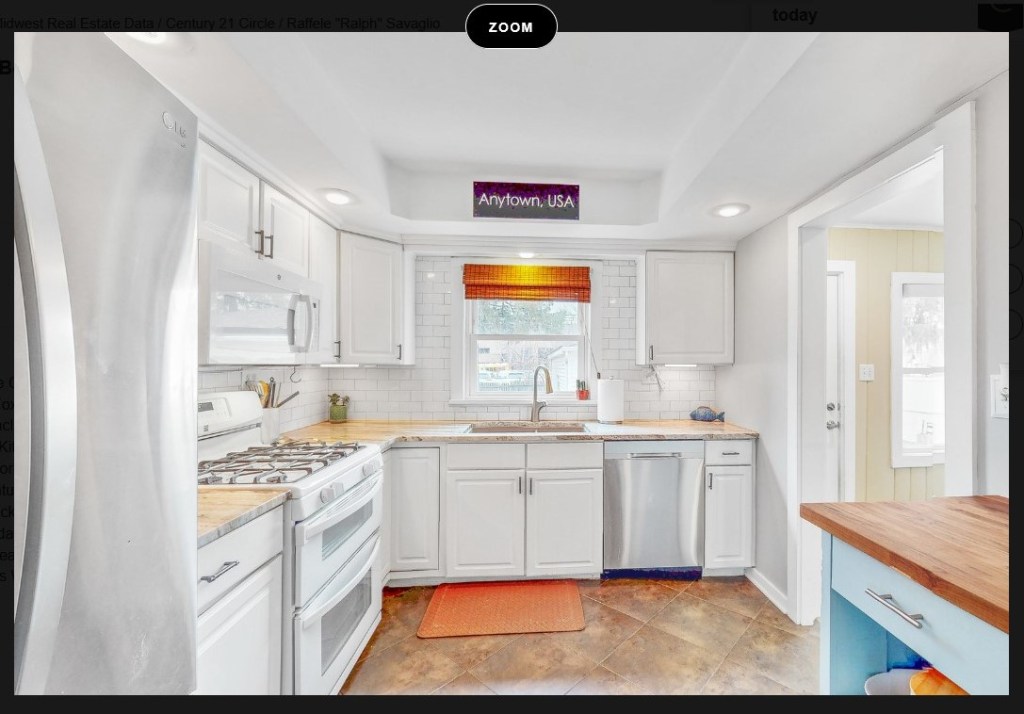
I recently saw a real estate listing for a suburban house that had an interesting sign in the kitchen. Above the sink was a sign for “Anytown, USA.”

It is a nice enough kitchen but why have such a sign? Is it meant to appeal to buyers from anywhere? Is it a comment on the placelessness of the suburbs? Was it a gift to the resident and they needed to display it somewhere?

In contrast, a homeowner might display markers of their local community. Instead of “Anytown,” there could be hints of the specific place in which the home is located. Perhaps a map or a poster for a local event or group or an object that could only be acquired or experienced in that community.

Perhaps the sign is in reference to some cultural work? Maybe there is a connection to a 2005 documentary about a New Jersey community or a 2009 film about the Iraq War or a 2021 children’s music album.

Another option: the sign is an AI generated image to provide some decoration for the home.

Now I am intrigued: how many people display “Anytown, USA” signs in their homes? Where can I buy home? Can someone outfit an entire home with a phrase used as a placeholder?

The Chicago Tribune on the side of suburban commuters

An editorial in the Chicago Tribune details some of the issues commuters to Chicago face:

Photo by Cameron Casey on Pexels.com

But hope and optimism have their limits, even among the heartiest suburbanite, who likely saw the news about the Kennedy construction delay debacle and felt put upon and frustrated — but not surprised. After all, suburban commuters are just supposed to take it. Still, this one stings…

It’s not just the roads where suburban commuters get a rough deal — they’re constantly on guard against Metra fare hikes. Fares increased last year, and now Metra is threatening fare hikes again — plus service cuts — as the agency stares down the proverbial fiscal cliff. 

So the suburban commuter faces tortuous traffic on the highways, higher prices and worse service on the trains — yet the city wants them back downtown to buy their $20 lunches and restore the Loop’s economy. Businesses want the suburban commuter back downtown to occupy vast commercial office spaces to justify the rent. And everyone wants them to boost foot traffic, creating safety in numbers and making everyone feel a little safer walking to the office…

But the city often lacks warmth for the people trekking downtown. Not too long ago, the mayor of Chicago floated weaponizing taxes on suburbanites to extract more tax revenue via a Metra “city surcharge” and a “commuter tax” as a way to “make the suburbs … pay their fair share.” See above — they’re already paying a lot to get downtown. 

A hostile relationship between the city and the suburbs is no good. Suburban willingness to come to work downtown is a direct reflection on the city’s health. Is it safe? Is it clean? Is the restaurant scene thriving? If so, people will hop on the Metra and gladly make the trip. The more suburbanites, the better.

Four thoughts in response:

  1. What exactly would “warmth” for suburbanites look like?
  2. What about the many commuters in the region who go suburb to suburb? Are their trips easier?
  3. Do suburbanites need the city more or does the city need suburbanites more?
  4. Contrary to the zero-sum game assumption in #2 above, would it be better to think of suburban commuters and city residents as part of a larger metropolitan area? Better transportation options could be good for city and suburbs as could economic opportunities for both cities and suburbs.

Immigration enforcement operations taking place in cities – and suburbs

It is easy to find headlines regarding cities and U.S. Immigration and Customs Enforcement raids. But, reading a number of these stories shows these are also happening in suburbs. This one story detailing locations across the United States includes these suburbs:

Dallas, Texas, its eastern suburbs, and Lake Ray Hubbard by NASA Johnson is licensed under CC-BY-NC-ND 2.0

-Tucker, Georgia

-Irving, Arlington, and Collin County in Texas

-Federal Way, Washington

-Wilsonville, Oregon

Or see this story of operations in Chicago area suburbs.

These are suburbs of major metropolitan areas. Cities may be the target of particular political ire but there is less recognition that many people who come to the United States live in suburbs (or rural areas).

And how will suburbs respond to these federal efforts? When migrants were sent to suburbs of Chicago in 2023 from other locations in the United States, few suburban communities were interested in having them stay (see posts here, here, and here). A number of big cities have announced how they will respond but there are thousands of suburbs in the United States.

Trying to portray early 1920s New York City accurately

A discussion of The Great Gatsby includes portions about trying to accurately show life in New York City:

Photo by Ramil Ugot on Pexels.com

Between Manhattan and West Egg, where Jay Gatsby and Nick Carraway live, spreads the “valley of ashes,” “a fantastic farm where ashes grow like wheat into ridges and hills and grotesque gardens; where ashes take the forms of houses and chimneys and rising smoke and, finally, with a transcendent effort, of men who move dimly and already crumbling through the powdery air”. Fitzgerald’s valley of ashes tips its hat to TS Eliot’s The Waste Land, but it was also a feature of New York at the time. The Ash Dumps were mountainous piles of ash up to 90ft high, a malodorous stretch of swampland in which coal ash, cinders, garbage, and human waste had been dumped. Lone figures wandered the desolate heaps searching for treasure or anything they could sell – a perfect image of a nation squandering its promise in search of a buck.

Most of the novel’s memorable details function in the same way, as realistic features of New York in 1922, and as symbols that fuse social satire with the novel’s metaphysical meanings. Gatsby is peppered with familiar symbols: the valley of ashes, the green light, the eyes of Dr Eckleburg that are mistaken for the eyes of God. It’s a novel that understands how signs can expand our capacity for thought. Gatsby’s green light has become one of the most famous images in literature, standing for Gatsby’s envy of the Buchanans’ world and his desire to attain it. It suggests his and his nation’s aspirationalism, their faith in renewal, in the fresh hope of starting over – and their drive for the colour of American money…

Hollywood routinely helps itself to any details from the 1920s that let it gesture toward the jazz age. Baz Luhrmann’s 2013 film adaptation of Gatsby features Prada dresses in silhouettes that were not worn until around 1928. This may sound like pedantic quibbling – what’s six years in Hollywood time? But, socially and culturally, the 1920s ended in a very different place from where they began: the styles of 1922 were far closer to those of 1919 than to those of 1929.

Luhrmann’s Broadway is thronged with yellow taxis – but New York taxis were not uniformly yellow in the early 1920s. There were also red taxis, blue taxis, checkered taxis, and by the summer of 1923, lavender taxis, like the one Myrtle Wilson selects after letting four others pass by. Lavender taxis were known for being expensive and could seem pretentious, an impression heightened by their violent colour scheme: “cerise and lavender taxis with red and green checkers”. A night out in Prohibition New York, it was said, “begins in a bierstube [beer hall] and ends in a purple taxi”. Myrtle Wilson, with her violent affectations and social climbing, would naturally choose a lavender taxi.

These deadening clichés distort our view of Gatsby in important ways. They keep us from registering how rich and strange and alien its world is: the New York of Gatsby lures us in because it is a surreal and surprising city, without a trite yellow cab in sight – but a lavender one is waiting for those who care to notice. All these carefully chosen details also suggest a world beyond the merely mimetic – what John Updike once called the ability of language to be “worked into a supernatural, supermimetic bliss”. The reason everyone who reads Gatsby wants to join the fun has far less to do with our ideas of what a jazz-age party looked like than with the vital strangeness of Fitzgerald’s writing. The lavender taxi is hyper-realistic, but it is also surrealistic, capturing the phantasmagorical qualities of Gatsby’s New York.

Trying to remember the past of familiar places can be difficult. Images and narratives about New York City are so widespread and pervasive that they can be hard to counter. Was Times Square always that way? What about Harlem or Brooklyn?

Cultural works that try to do this can add to the difficulty. Did they portray things correctly? What sources are they drawing on? How many people engaged with that cultural work (whether it was accurate or not)?

Are there sites devoted to pointing people to correct depictions of places in the past and telling them which ones to avoid? For example, this article points out that Fitzgerald captures some unique features of early 1920s New York while the 2013 film does not. If I wanted to know more about New York as it was, should I watch the Godfather or find other sources?

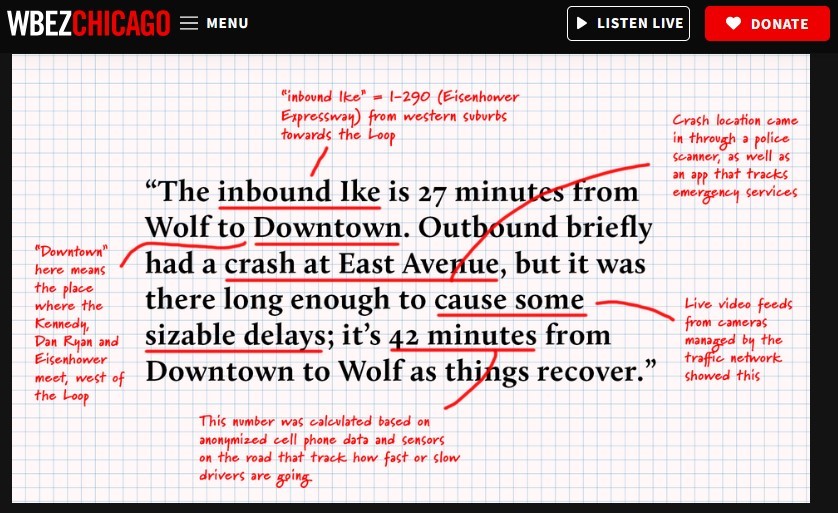
Where “downtown” is in Chicago traffic reports

Listen to or watch or read Chicago traffic reports and “downtown” is likely to come up. Here is what that refers to:

In Chicago, the downtown is like it is in the many big cities: it is the central business district, marked by skyscrapers and business activity. Downtown and the Loop – marked by mass transit lines – are pretty synonymous. The Loop is one of the city’s 77 community areas that have been defined for decades.

But the downtown referenced above is outside the Loop. It is across the Chicago River. It is marked not by financial matters but by the convergence of highways. It arose on top of existing neighborhoods. This is technically the Jane Byrne Interchange, a busy location where people are driving in and out of the city. Depending on traffic, it can take a while to get from this location to downtown.

While they are not the same place, this sounds very American: the center of the city is actually where the most vehicles meet. As so much day-to-day life involves driving, perhaps this is downtown for many.

Washington, DC is the city with the most single-person households

More Americans are living alone and one city leads the way:

Photo by Pixabay on Pexels.com

An April study by the Chamber of Commerce, a real estate research company, named D.C. the loneliest city in America, based on Census Bureau data showing that 48.6 percent of households in the city consist of just one person, the highest share of any city with a population of at least 150,000. Nationwide, the study said, solo living has increased as people wait longer for marriage and children, and the covid pandemic accelerated the trend.

Three thoughts (and questions) in response:

  1. It is interesting that the original study framed this as about “loneliness.” Does this match with the experiences of the residents who may choose to live in a single-person household?
  2. If the problem is indeed loneliness, then the solution presented here involves co-housing opportunities. Who are these housing opportunities available to and who are they not available to? Who will end up living in these spaces?
  3. Is there a tipping point where the percent of single-person household has particular effects on local community life? Washington is at the top of the list but it is very close to the number 2 city (Birmingham).

For more on this broader trend among Americans of living alone, I remember enjoying reading Going Solo by sociologist Eric Klinenberg.

How many of the Chicago Christmas movies actually take place in the Chicago suburbs?

I do not spend a lot of time watching Christmas movies but I know at least a few of the Christmas movies said to involve Chicago are more about the Chicago suburbs. Some evidence…

Photo by Vishal Shah on Pexels.com

Here is one recent overview of Chicago Christmas movies that references their settings:

“Home Alone” is set in a fictionalized version of Winnetka, Illinois. “National Lampoon’s Christmas Vacation” takes place in an unnamed suburb outside of Chicago. “The Santa Clause” is set in Lakeside, Illinois. “Christmas With the Kranks” happens in Riverside, Illinois. “Fred Claus,” “The Christmas Chronicles,” “Office Christmas Party,” “While You Were Sleeping,” “A Bad Moms Christmas,” and the early scenes of “A Christmas Story Christmas” take place in downtown Chicago.

“The Polar Express” is initially set in Grand Rapids, Michigan (based on the inclusion of several historic local buildings familiar to the original book’s author). Still, its North Pole sequences are modeled after the Pullman Factory in Chicago.

Many additional films also connect to the greater Midwest. “A Christmas Story” takes place in Northwestern Indiana. “Jingle All The Way” is set in Minneapolis. The Barbara Stanwyck and Fred MacMurray classic “Remember The Night” starts in New York City and moves to Indiana for the holidays.

Another list of “The 11 best holiday films set in Chicago, ranked” includes several films in the city and several in the suburbs (including the top two on the list).

A third list of “Best Chicago Christmas Films” includes a number set in suburbia.

    Claiming some of these Christmas movies are Chicago movies is like Chicagoland residents claiming to be from Chicago.

    The (American) city of bridges?

    Pittsburgh has a lot of bridges:

    Smaller versions can even serve as bike racks:

    According to a few sources (here and here), Pittsburgh might claim the most bridges in the United States. Other people disagree (such as here).

    All communities have features that they regard as unique or noteworthy. Bridges are an interesting choice: beyond having a lot of them, they are easy to see and are necessary for transportation.

    Like in many matters, it may depend on measurement for claiming this civic title: what counts as a bridge?