The start of municipal budget issues due to COVID-19? The case of Chicago

COVID-19 has disrupted a lot of life in the United States and it will have consequences for municipal budgets. Here is how Chicago mayor Lori Lightfoot describes the fiscal impact:
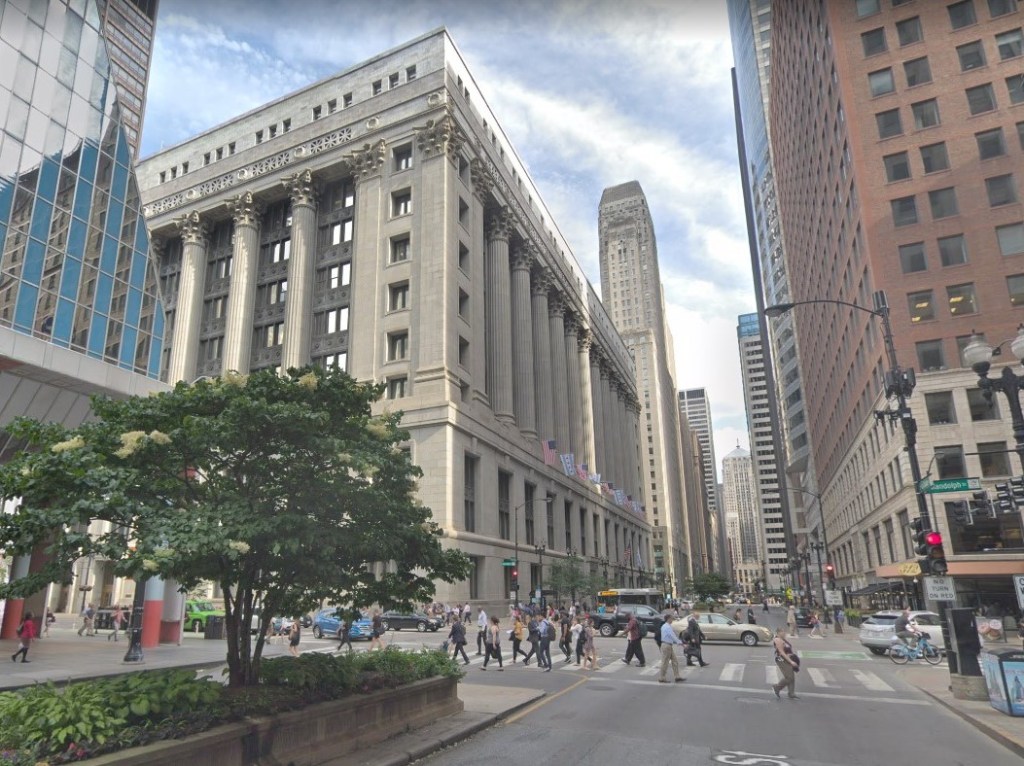
Google Street View of Chicago City Hall, June 2018

Citing the “catastrophic collapse of our local and national economy” because of COVID-19 and damage to local businesses from civil unrest, Mayor Lori Lightfoot on Monday laid out a $1.2 billion shortfall for what she called Chicago’s “pandemic budget” in 2021…

The ongoing coronavirus crisis has also spiked the 2020 budget shortfall to nearly $800 million, Lightfoot said. She said that deficit would be filled using relief funds and other unspecified aid from the federal government, in addition to debt refinancing, and borrowing…

In laying out the 2021 shortfall, Lightfoot cited dire numbers — more than 900,000 Chicago-area residents filed for unemployment since the start of the pandemic, while personal services, hospitality and tourism industries “are still seeing a fraction of their typical revenues and some businesses have sadly closed with no hope of coming back.”…

The bad news has seemed inevitable for months, as tax receipts plummeted with large parts of the economy shut down and spending in Chicago by tourists and conventioneers cratered throughout the summer because of the pandemic.

Chicago has its own particular challenges but the COVID-19 shortfall is one that many communities in the United States, big and small, will experience. Local governments tend to want to diversify their tax base so that they are drawing tax revenues from multiple sources. COVID-19 interrupts or limits a number of these streams: money from visitors (who stay in hotels, visit sites, eat), sales tax revenues (derived from businesses from residents and visitors, who are affected by employment and travel opportunities), and property tax revenue (could be affected if people are moving in or out affecting demand plus whether residents and landlords are able to pay their bills). Furthermore, right now this is posed as an issue for the current budget; what is the effect for months or years down the road as cities and communities try to rebound and/or continue to battle COVID-19?

Closing these COVID-19 shortfalls will provide unique opportunities for politicians. This article suggests all options are on the table; yet, I am sure most, if not all of the politicians involved, have particular budget options they would not consider. Many municipal governments will hope there are extra resources available from above, perhaps from the county, state, and federal governments. Yet, all levels of government are likely to feel the impact of COVID-19. And with the current discord between the White House and big city leaders, it is hard to imagine what a palatable plan for the federal government and municipal governments to work together would look like. Could this/should this be a major issue on the November 2020 campaign trail as multiple levels of government look to address COVID effects?
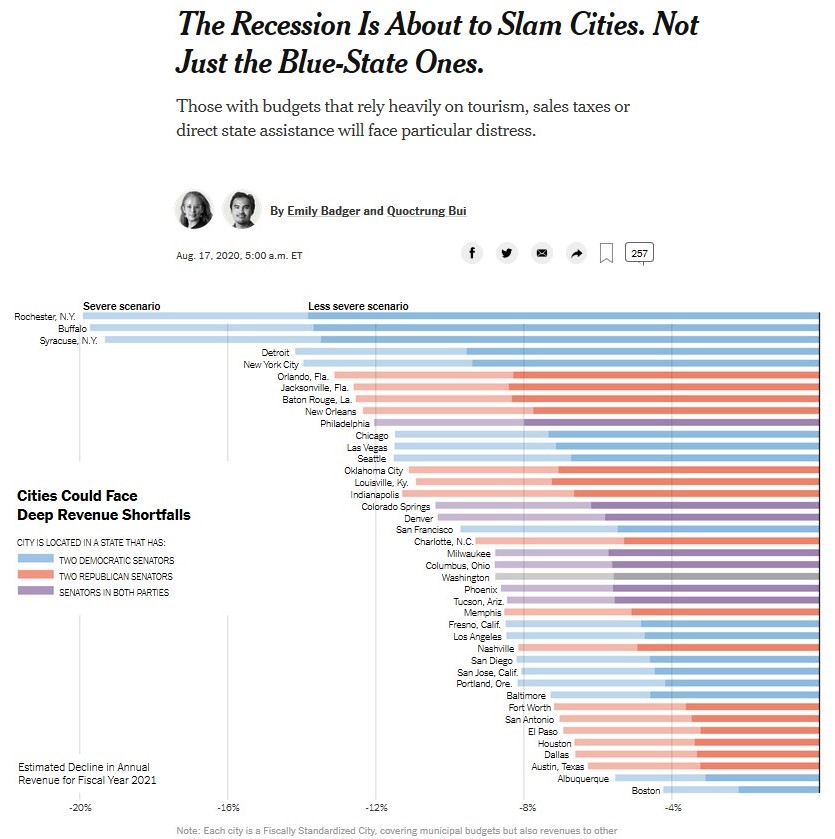
The coming budget reckoning for big cities

A new analysis suggests particular big cities will suffer losses in tax revenues due to COVID-19:

Describing the study results more:

What matters more in this pandemic moment is how a city generates money: Those highly dependent on tourism, on direct state aid or on volatile sales taxes will hurt the most. Cities like Boston, which rely heavily on the most stable revenue, property taxes, are in the strongest position — for now.

The estimates, to be published in the National Tax Journal by Mr. Chernick, David Copeland at Georgia State University and Andrew Reschovsky at the University of Wisconsin, are based on the mix of local revenue sources, the importance of state aid and the composition of jobs and wages in each city. The researchers predict average revenue shortfalls in the 2021 fiscal year of about 5.5 percent in a less severe scenario, or 9 percent in a more severe one.

Tax revenues can come from a variety of sources. Like recommendations for individual investors to diversify their portfolio, municipalities can benefit from a broad tax base that is not too reliant on any one sector. As the analysis suggests, relying on one single source can cause problems when that area experiences a downturn. (At the same time, creating such a robust and resilient local economy might be very difficult to do given historical patterns, current conditions, and competition in the future.)

The color coding of the graph above is interesting in that it implies that there are a number of cities that Republicans should care about helping. I wonder how this will play out: even as Republican senators would want more municipal tax revenues, it does not necessarily mean that they are pro-city or would want to go out of their way to provide funding. Are Republicans more in favor of seeing the fate of cities and suburbs as tied together when their cities are at risk?

President Trump suggests suburbs can exclude and exercise local control

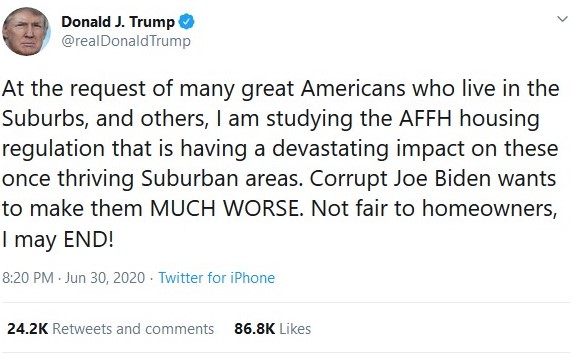
In a June 30th tweet, President Trump expressed disagreement with policies enacted under President Obama involving desegregating housing:

TrumpSuburbsTweetJun3020

President Donald Trump on Tuesday said he would reverse a federal rule that promotes fair housing and sets desegregation as a national priority. The policy is known as Affirmatively Furthering Fair Housing, or AFFH; it’s a provision of the Fair Housing Act of 1968, signed into law a week after the assassination of Martin Luther King Jr.

“At the request of many great Americans who live in the Suburbs, and others,” Trump tweeted, “I am studying the AFFH housing regulation that is having a devastating impact on these once thriving Suburban areas. Corrupt Joe Biden wants to make them MUCH WORSE. Not fair to homeowners, I may END!”

Trump was specifically aiming at an Obama rule about how to finally implement the policy, a mandate (on paper only) for more than 50 years due to federal reluctance to address racial segregation. It might come as a surprise to the president, but his administration has already tackled this policy: The White House took steps starting in 2018 to gut the rule by arguing that it was too burdensome—not because desegregation would have a “devastating impact” on suburban America.

As he’s done time and time again, Trump said the quiet part out loud. The U.S. Department of Housing and Urban Development has taken numerous steps to undermine key rules and policies that promote desegregation as a requirement for jurisdictions that receive federal housing dollars. But under Housing Secretary Ben Carson, the agency has carefully framed those revisions in procedural terms—namely as ways to reduce the paperwork load for housing authorities. In his tweet, Trump essentially admitted that there’s a different motive: Eliminating the rule will reduce the pressure on local governments to provide space and opportunity for Black families in affluent white neighborhoods.

Several thoughts:

1. The suburbs were built in part on exclusion – by race/ethnicity and social class – as well as on local control where suburbanites could avoid regulation from outside parties.

2. This continues conservative opposition to President Obama’s policies regarding cities and suburbs and might give hope to those who hoped President Trump would inaugurate a new wave of suburban development.

3. As the article notes, Trump has not said much else recently about housing or suburbs. It is not an easy national policy issue to address and Democrats have not spent much time on the issue in this election cycle. Yet, Trump’s tweet fits with other things he has said about law and order, racial issues, and cities. If I had to guess, he is trying to win over some suburban voters by suggesting he would allow suburbanites to dictate their own community’s fate. Whether he has the ability to appeal to suburban voters by November given his approach and positions is something to watch.

4. I’m on the record saying addressing issues of race in the United States requires addressing residential segregation. Even as suburbs as a whole have become more diverse by race and class, this does not necessarily mean opportunities in wealthier suburbs are available to all or even many.

Some suburbanites do not like more explicit divisiveness or racism

With the 2020 presidential election riding on the suburbs, some suburban voters do not like the rhetoric and policies of President Trump:

young frustrated woman screaming with closed eyes

Photo by Andrea Piacquadio on Pexels.com

From North Carolina to Pennsylvania to Arizona, interviews this week with more than two dozen suburban voters in critical swing states revealed abhorrence for Trump’s growing efforts to fuel white resentment with inflammatory rhetoric on race and cultural heritage. The discomfort was palpable even among voters who also dislike the recent toppling of Confederate statues or who say they agree with some of Trump’s policies.

As the president increasingly stakes his candidacy on a message of “law and order,” casting himself as a bulwark against “angry mobs” and “thugs,‘’ there are signs that he is alienating voters in bedroom communities who approach the debate over racial justice with a far more nuanced perspective than the president does.

The disconnect is especially pronounced in the swing state suburbs like Cornelius — traditionally a conservative-leaning area — and along the Main Line outside Philadelphia, where some educated white voters, including some former Trump supporters, are repelled by the president’s divisive rhetoric…

While Trump won suburban areas overall by 4 percentage points in 2016, according to exit polls, white college-educated suburban women have rapidly moved away from his Republican Party, and they helped deliver the House of Representatives to the Democrats in 2018. And now, as some polling shows Trump facing competitive races even in deep-red states, he cannot afford to lose all of those voters again.

What could be behind this discomfort among some suburban voters? A few possible answers:

  1. Suburbanites do not often like open conflict or confrontation in their personal interactions with fellow suburbanites. This could also apply to contentious social issues. If a candidate, party, or figure is openly combative, this may be too much for suburbanites who prefer more polite, refined discourse. Suburbanites have a particular status to protect, particularly those with education, good jobs, and homes.
  2. Suburbia has changed quite a bit in recent decades. Suburbanites themselves, particularly in middle suburbs (stuck between the exurban Republican voters and the inner-ring suburb Democratic votersthe exurban Republican voters and the inner-ring suburb Democratic voters), may have changed views of the world. Perhaps more well-off suburbanites than before do now care about race.
  3. Perhaps this is all still unclear or undecided months out from the election. Some suburbanites are caught in the middle and right now do not like Trump’s approach. If the economy picks up and COVID-19 winds down, will these same voters show less concern about polarizing views? If social movements, which are now in the suburbs too, wane, will this make it easier to support Trump?

Which way these voters go could indeed help decide the 2020 election. Among other things, it will be interesting to see how the candidates pitch themselves to middle suburbia (even as they balance pitches to other groups).

Remember the suburban voters in 2020

As COVID-19 and police brutality pushed the 2020 presidential election off the front pages for months, recent poll data suggests suburban voters are breaking one way in national polls:

And while Trump has an edge with rural voters, Biden crushes him in the suburbs – which often decide how swing states swing.

Fifty per cent of suburban registered voters told the pollster they planned to vote for Biden, while 36 per cent said they’d vote for Trump.

And in Texas metropolitan areas:

A Quinnipiac University survey released last week found Trump leading Biden by 1 point in Texas. Trump leads by 2.2 points in the RealClearPolitics average.

Texas Republicans are primarily worried about their standing in the suburbs, where women and independents have steadily gravitated away from the GOP since Trump took office.

Republican support has eroded in the areas surrounding Houston, Dallas, Austin and San Antonio, four of the nation’s largest and fastest growing metro areas. Democrats defeated longtime GOP incumbents in Houston and Dallas in 2018.

More background on trying to find a suburban “silent majority”:

The suburbs — not the red, but sparsely populated rural areas of the country most often associated with Trump — are where Trump found the majority of his support in 2016. Yet it was in the suburbs that Democrats built their House majority two years ago in a dramatic midterm repudiation of the Republican president.

Now, Trump’s approach to the violence and unrest that have gripped the nation’s big cities seems calibrated toward winning back those places, in the hopes that voters will recoil at the current images of chaos and looting — as they did in the late 1960s — and look to the White House for stability…

Five months before the general election, according to national polls, the political landscape for Trump is bleak. But there is a clear window of opportunity: Trump remains popular in rural America, and he won the suburbs by 4 percentage points in 2016 — largely on the backs of non-college-educated whites.

There are millions more potential voters where those came from — people who fit in Trump’s demographic sweet spot but did not vote. They live in rural and exurban areas, but also in working class suburbs like Macomb County, outside Detroit. They are who Republicans are referring to when they talk about a new “silent majority” — the kind of potential voters who, even if disgusted by police violence, are not joining in protest.

This probably bears repeating: the American suburbs of today are not solely populated by wealthy, white, conservative voters. This is the era of complex suburbia where different racial and ethnic groups as well as varied social classes live throughout metropolitan regions.

Relatively little media coverage has examined how COVID-19 or police brutality has affected suburbs or how suburbanites feel about all the change. While just over 50% of Americans live in suburbs, coverage emphasized urban areas. And what do suburbanites think when they see these images of urban life, policing, and protest that they may or not understand on an experiential or deeper level?

Suburban police and promoting a better future for youth

On Instagram, Congresswomen Alexandria Ocasio-Cortez connected defunding the police to what suburbs do instead:

AOCPoliceandSuburbs

A few thoughts:

1. According to sociologists and other scholars who have studied American suburbs over the last century, an overriding concern in suburbs is to protect families and let children flourish. The assumption is that suburban life – with its lower density, single-family homes, more space, better schools, lower crime – will benefit children in the long run.

2. At the same time, suburbs are also based on exclusion. For decades, only white people – and certain ones at that – were allowed in many suburbs. While this is officially off-limits today, it can be accomplished in other ways such as through exclusionary zoning, drawing school district boundaries, and through police.

3. Police can and have reinforced the race and class based exclusion in suburbs. This could range from sundown towns to watching fire bombings in Cicero, Illinois to harassing motorists, residents, and protestors in Ferguson, Missouri. Wealthier suburban residents generally do not want to involve the police in their conflicts but they can and do at times.

4. Many suburbs offer limited social services. The expectation is that residents will have the resources to provide for themselves or that corporations and local charities will provide.

5. Many suburbs like having their own police department. This allows them to retain local control, important for #2 and #3 above.

6. For an academic study of how this works in wealthier suburbia, I recommend America’s Safest City: Delinquency and Modernity in Suburbia. From the book description:

Adolescents, parents, teachers, coaches and officials, he concludes, are able in this suburban setting to recognize teens’ need for ongoing sources of trust, empathy, and identity in a multitude of social settings, allowing them to become what Singer terms ‘relationally modern’ individuals better equipped to deal with the trials and tribulations of modern life

Suburban municipalities to take own actions regarding COVID-19?

As different government bodies look to act in response to the spread of COVID-19, I was struck by the number of large cities and states that are acting (including the state in which I live). At the same time, I wonder: how are suburban communities responding?

A few thoughts:

-Many suburban communities have limited capabilities and cannot do a whole lot. They may have limited budgets, a relatively small number of employees, and not much power to compel action. Still, decisions to close public spaces – such as libraries, city/village/town halls, community centers – matter to the everyday lives of lots of people.

-Yet, some bigger suburbs in the United States are as large as small big cities. Their actions can be very consequential and they have more budget room to address issues. At this point, the news has primarily focused on the biggest cities in the United States but this matters for numerous other communities over 100,000 people (to use an arbitrary cut-off point for a larger community).

Americans tend to like local control and government but at the speed that a virus can spread and across political boundaries, individual actions across hundreds of American suburbs might not add up to much. Hence, people look to the state and federal level to mobilize resources and direct action.

-What is the role of metropolitan regions in all of this? The City of Chicago can act and affect millions of residents and workers but there are roughly seven million more people in the region. Counties can act and affect more residents. But, then the next level of action regarding COVID-19 seems to be at the state level. Are metropolitan regions working together or is the general lack of metropolitan cooperation revealed again in a time of crisis?

Is Washington D.C. the center of the United States?

I recently heard a promo for a news show that claimed it was going to broadcast from the center of the United States: Washington D.C. Here are a few ways to think about the center of the United States:

-Washington D.C. makes the most sense in terms of government. With the federal government based here and the number of federal employees in the region, Washington D.C. could claim to be the center. (It is the sixth largest metropolitan region in the country and may claim to the current second city.)

-New York City makes the most sense in terms of population size and global influence. The New York City region has the most people by over six million and is a global center for finance, media, the arts, and more. (Yet, it is on the coast in the Northeast region with a particular culture.)

-The center of population has steadily moved west. According to the Census, it is now in Texas County, Missouri. By definition: “The mean center of population is determined as the place where an imaginary, flat, weightless and rigid map of the United States would balance perfectly if all residents were of identical weight.”

-The geographic center of the United States depends on whether it is just for the 48 contiguous states or for all fifty states. If just the contiguous states, the location is just northwest of Lebanon, Kansas. If for all fifty states, it is north of Belle Fourche, South Dakota.

-Is it possible to measure a cultural center? New York could lay claim to this as could Los Angeles (Hollywood, sprawl) while Chicagoans might hold to the claim that it is the most American of cities. Cleveland, San Francisco, New York, or New Orleans? Are the coasts more representative of America or the Heartland? Perhaps particular locations are less important and common spaces like McDonald’s or Walmart or local government meetings or religious congregations or local libraries are more indicative of the center of the United States.

If Washington D.C. is now the center of the United States, does it provide a hint that national politics has come to dominate American discourse and self-understanding?

Argument: Westchester County and affordable housing better off without federal government involvement

The headline summarizes the argument: “Team Trump just called a halt to the Obama-era war on the American suburbs.”

But the big win came last month, when — based on Westchester’s experience and expertise from groups like Americans for Limited Government — the Trump administration replaced Team Obama’s AFFH regulation with its own.

Gone is the federal mandate dictating the modeling of communities based on statistical formulas. Restored to local officials is the power that gives them the flexibility to weigh real-world factors in making housing decisions. Restored, too, is the prosecution of bad actors by the courts — not bureaucrats — under the Fair Housing Act.

And builders are now more likely to build affordable housing, since the attached strings have been removed.

The Democratic candidates for president didn’t get the memo. They continue to support radical, divisive and failed housing policies aimed at abolishing single-family residential zoning. And they’d use billions of our tax dollars to local communities — and the threat of lawsuits — to get their way.

The United States needs affordable housing. By replacing social engineering with common sense, guarded by strong nondiscrimination laws, the country is now better positioned to meet that need — and that’s a victory for everyone.

See more on the exclusionary zoning and housing in Westchester County: more recently under the Obama administration, in the 1970s, and the affordable housing issue in the county.

Conservatives claimed the Obama administration wanted to push Americans away from suburbs and into cities. This claim of social engineering tends to ignore the social engineering of suburbs, with plenty of federal government help, toward whiter and single-family home communities.

More broadly, this gets at a fundamental difference between liberals and conservatives. Liberals will argue that government intervention is needed regarding housing. As noted above, this might start with more serious enforcement of housing laws already on the books. But, this would not necessarily tackle the harder issues of residential segregation or exclusionary zoning, These issues would require communities across metropolitan regions to provide cheaper housing so that certain communities do not carry the burden. The conservative argument is different: the government needs to get out of housing and should let local governments make the decisions that would best serve their residents. Builders and developers will be empowered to construct cheaper housing with fewer regulations. Or, perhaps neither party really wants single-family home suburbia.

I have argued before that free markets for housing will not work. When given the opportunity, wealthier communities will not build cheaper housing as they would prefer to remain more exclusive. Recent efforts in California suggest it will take a lot even at the state level to promote more affordable housing. Plus, major political party candidates do not seem too keen to tackle housing. Americans may not like the idea of the federal government weighing in on local development decision but in many metropolitan regions the preference for local control is not moving the logjam of needed affordable housing.

Font sizes, randomly ordered names, and an uncertain Iowa poll

Ahead of the Iowa caucuses yesterday, the Des Moines Register had to cancel a final poll just ahead of the voting due to problems with administering the survey:

Sources told several news outlets that they figured out the whole problem was due to an issue with font size. Specifically, one operator working at the call center used for the poll enlarged the font size on their computer screen of the script that included candidates’ names and it appears Buttigieg’s name was cut out from the list of options. After every call the list of candidates’ names is reordered randomly so it isn’t clear whether other candidates may have been affected as well but the organizers were not able to figure out whether it was an isolated incident. “We are unable to know how many times this might have happened, because we don’t know how long that monitor was in that setting,” a source told Politico. “Because we do not know for certain—and may not ever be able to know for certain—we don’t have confidence to release the poll.”…

In their official statements announcing the decision to nix the poll, the organizers did not mention the font issue, focusing instead on the need to maintain the integrity of the survey. “Today, a respondent raised an issue with the way the survey was administered, which could have compromised the results of the poll. It appears a candidate’s name was omitted in at least one interview in which the respondent was asked to name their preferred candidate,” Register executive editor Carol Hunter said in a statement. “While this appears to be isolated to one surveyor, we cannot confirm that with certainty. Therefore, the partners made the difficult decision to not to move forward with releasing the Iowa Poll.” CNN also issued a statement saying that the decision was made as part of their “aim to uphold the highest standards of survey research.”

This provides some insight into how these polls are conducted. The process can include call centers, randomly ordered names, and a system in place so that the administrators of the poll can feel confident in the results (even as there is always a margin of error). If there is a problem in the system, the opinions of those polled may not match what the data says. Will the future processes not allow individual callers to change the font size?

More broadly, a move like this could provide more transparency and ultimately trust regarding political polling. The industry faces a number of challenges. Would revealing this particular issue cause people to wonder how often this happens or reassure them that pollsters are concerned about good data?

At the same time, it appears that the unreported numbers still had an influence:

Indeed, the numbers widely circulating aren’t that different from last month’s edition of the same poll, or some other recent polls. But to other people, both journalists and operatives, milling around the lobby of the Des Moines Marriott Sunday night, the impact had been obvious.

Here are what some reporters told me about how the poll affected their work:

• One reporter for a major newspaper told me they inserted a few paragraphs into a story to anticipate results predicted by the poll.

• A reporter for another major national outlet said they covered an Elizabeth Warren event in part because she looked strong in the secret poll.

• Another outlet had been trying to figure out whether Amy Klobuchar was surging; the poll, which looked similar to other recent polling, steered coverage away from that conclusion.

• “You can’t help it affecting how you’re thinking,” said another reporter.

asdf