The data above appears to follow the patterns from the last few elections. Cities go for Democrats. Rural areas and exurbs go for Republicans. The suburbs are contested ground. The splits are bigger in the table above: 9% advantage for Trump in small city or rural areas, 23% advantage for Biden in cities. And the suburbs are close with just a 3% gap.
Going even further, the suburbs of the true battleground states may be home to the truly important voters. In this election, the residents outside Atlanta, Charlotte, Raleigh-Durham, Cleveland, Columbus, Cincinnati, Pittsburgh, Philadelphia, Detroit, Grand Rapids, Milwaukee, Minneapolis, Phoenix and more might have just decided the election. That national 3% difference might not seem like much but it could matter a lot when state races are tight.
I am sure there will be more fine-grained analysis of the suburban vote by itself as well in comparisons to other demographic factors that influenced vote totals. But, this early data seems to suggest suburban voters will continue to be important in coming elections.
I watched briefly a number of election night broadcasts last night. One conclusion I came to: there is way too much data to fit on a television screen. And if you want more of the data, you need the Internet, not television.
The different broadcasts tried similar variations: flipping back and forth between a set of anchors and pundits at desks and analysts at a smart board showing election results from different states and locations. They have done this for enough election nights that the process is pretty established.
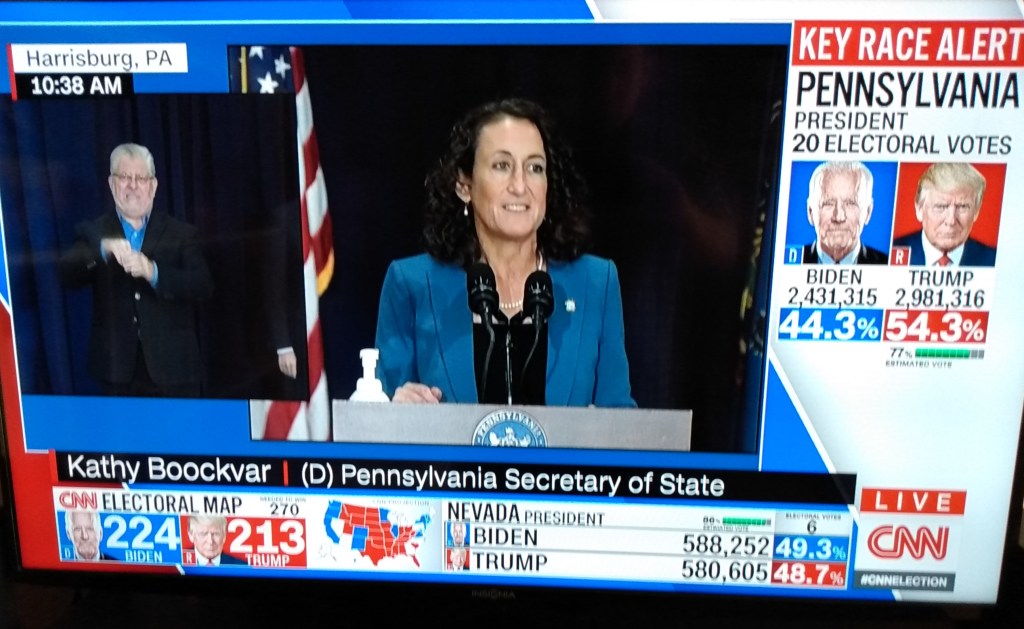
While they do this, there is often a lot of data on the screen. This could include: a map of the United States with states shaded; a chryon at the bottom with scrolling news; another panel at the bottom flipping through results from different races; and people talking, sometimes in connection to the data on the screen and sometimes. If the analyst at the smart board is on the screen, there is another set of maps to consider.
CNN broadcast, November 4, 2020
This is a lot to take in and it might not be enough. The broadcasts try to balance all of the levels of government – from the presidential race to congressional districts – and are flipping back and forth. I appreciated seeing the more simple approach of PBS which went with a lot less data on the screen, bigger images of the talking heads, and simple summary graphics of the winners.
But, if you want the data, the television broadcast does not cut it. Numerous websites offered single pages where one could monitor all of the major races in real-time. Want to keep up on both local and national races? Have two pages open. Want reaction? Add social media in a third window. Use multiple Internet-connected devices including smartphones, tablets, and computers (and maybe Internet-enabled televisions).
On one page, readers could see multiple presentations of data plus explanations. Want to scroll through in 10 seconds and see the headlines? Fine. Want to spend 5 minutes analyzing the various graphics? That works. Want to click on all the links for the metholodogy and commentary? A reader could do that too.
The one big advantage television offers is that it offers commentary and faces in real-time plus the potential for live coverage from the scene (such as images of gatherings for candidates) and feeling like the viewer is present when major announcements are made. The Internet has approximations of this – lively social media accounts, live blogs – but it is not the same feeling. (Of course, when you have more than ten live election night broadcasts available on your television, the audience will be pretty split there as well.) Elections are not just about data for many; they also include emotions, presence, and the potential for important memories.
Given these differences in media, I did what I am guessing many did last night: I consumed both television and Internet/social media coverage. Neither are perfect for the task. I had to go to sleep eventually. And whoever can figure out how to combine the best elements of both for election nights may do very well for themselves.
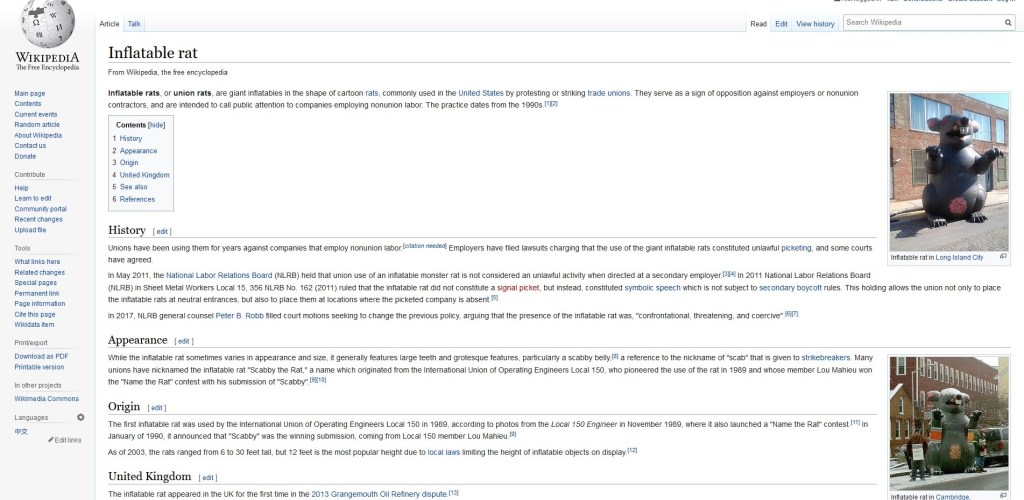
Scabby is a giant inflatable rodent, up to 25 feet tall, with angry red eyes, exceptionally prominent front teeth and sharp claws. Created some 30 years ago in Chicago, it’s a favorite device of unions trying to draw attention to their grievances, and it works. “Before, you could drive by and see six guys with picket signs and probably never notice them,” James Allen, president of District Council 1 of the International Union of Bricklayers, told the Tribune last year. Scabby is harder to miss…
But the NLRB’s general counsel, appointed by Donald Trump, is not smiling. Peter Robb, previously a management lawyer, “hates the rat,” one unidentified senior NRLB official told Bloomberg Law. At his direction, the agency is trying to eradicate Scabby.
The effort isn’t likely to succeed. Under Barack Obama, the NLRB ruled that putting this huge air-filled mascot outside the entrance of a hospital, accompanied by a union member holding a leaflet, was a form of free expression protected by the First Amendment…
“The rat balloon itself was symbolic speech,” said the board. “It certainly drew attention to the union’s grievance and cast aspersions on (the nonunion employer), but we perceive nothing in the location, size or features of the balloon that were likely to frighten those entering the hospital, disturb patients or their families, or otherwise interfere with the business of the hospital.”
Read a little more on how Scabby was developed in the Chicago area in this 2018 blog post.
Having seen Scabby in action several times, there at least three reasons the symbol works:
No one wants to be associated with a rat. Even if there are people who like rats as pets, they are not viewed as cuddly or likeable creatures in the same way that many others animals are. A rat is a negative symbol, a reminder of urban squalor or dishonorable behavior.
The size of Scabby and the particular look is not pleasant. This is not just a rat on a sign that is a cartoonish figure; this is a large inflatable that towers over the sidewalk. The eyes are red, teeth are showing, front legs are out. This is not a pleasant figure to look at.
Putting #1 and #2 together, organizations or employers would not like the connotation of the inflatable rat nor the presence of it in front of what they hope to present as a welcoming or pleasant place of business or activity.
This means Scabby could help attract attention to a labor cause. As noted in the story above, it is a visceral image that grabs the attention of people passing by. Without such a large symbol, it could take a lot more work to garner attention including larger pickets or significant media attention. Whether the prolonged presence of Scabby leads to a better outcome for the union or employees is another matter.
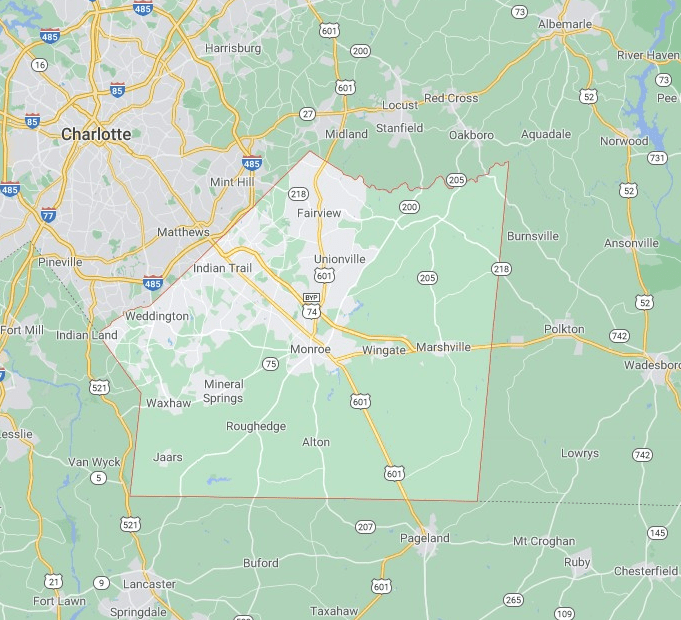
Union County is what one scholar terms a “countrypolitan” place: Under federal government designations, it lies within a metropolitan area, but it also has a strong rural and agricultural history. For the most part, it doesn’t look like a cookie-cutter suburb, nor is it impoverished. In fact, Union is North Carolina’s wealthiest county, according to the Census Bureau. There are places like it around the United States. They are distinct from rural areas, which are mostly Republican, and cities, which are heavily Democratic; many voters in these places are neither die-hard Trump fans nor urban liberals. That makes them pivotal counties, in 2020 and in the future.
Everyone agrees that Union County is changing. The question is how it’s changing, and how fast. There’s no doubt that Republicans will carry the county up and down the ticket this year—Carter, ensconced at East Frank, was the last Democratic presidential candidate to win here, back in 1980—but the GOP’s overall success in the state will hinge largely on how big a margin it is able to run up in exurban counties such as this one. Democrats’ control of inner-ring suburbs continues to strengthen, and the future of the Republican Party nationally depends on keeping firm control over places like Union County…
The reason Union County is changing is simple math. When Helms was born, about 4,000 people lived in Monroe. Today, nearly 36,000 do. Since 1990, the overall county population has almost tripled, from about 84,000 to roughly 240,000. As I traveled around the county, I began to notice something peculiar: Virtually everyone I talked with was a transplant. Some of them had moved only recently, and others had been around for 10 years, or 20…
“Union County when Jesse was in the Senate was a very rural county,” Wrenn says. “Now it’s got a big chunk of suburban in it. If the long-term trends continue, the Republicans are going to have to find a way to compete in the suburbs. It can be done, but you just have to change your whole way of thinking.”
The temptation in such stories about suburban voters is to look at counties and communities and just see political change. And it sounds like Union County has had its share comparing before the Civil Rights Era, after, and today.
The basic explanation for this recent change is new residents. The population has grown and new residents, not as familiar with the ways of Union County, have moved in. What was once a small population with low density is now much larger and in bigger cities and towns.
But, is this all that has changed: new people moved in and they came with some new political views? I suspect there is more going on here that both contributes to the political change and also exists outside of it. Here are a few possible factors at play:
The decline of agriculture, particularly family-owned farms and opportunities, could be at play here. As farming becomes more difficult or less desirable for subsequent generations, the land can be sold off and be turned into subdivisions. This is a significant change in land use as well as who lives there: farmers and those connected to agriculture versus middle-class suburbanites.
Connected to #2, the economic landscape has changed tremendously in the last half-century or so, moving away not just from agriculture but also manufacturing and moving more toward retail, services, and a knowledge economy. Union County and many other locations in the United States are still trying to adapt to these large shifts that affect employment, tax bases, and local businesses.
Numerous local institutions have likely had to adjust in light of growing populations. Schools need more space for kids. Local governments need to provide more services (and they might now have larger tax bases to draw on) and local officials are addressing new issues. Established churches now compete with new congregations. In sum, the civic and social institutions that may have existed for decades in roughly the same form now need to adapt. This can present challenges in any community.
In sum, this is not just about politics. A shift toward a suburban lifestyle in Union County has many consequences and politics may just be one of them.
The Democrat presidential primary for 2020 contained occasional talk of housing on the campaign trail or in debates. But, leading up to Election Day 2020, there has been little attention paid to housing. A few notes on this:
Some broader campaign themes could be related to housing: talking about the middle-class, taxes, providing opportunities for more Americans. But, these typically do not directly address housing even if it may be implied (such as being middle-class includes the ability to own a home, often in the suburbs).
COVID-19 has had a direct effect on a number of areas. While there has been much said about jobs and the economy, the connection to housing is missing. For many, employment status directly affects housing status and there have been moratoriums regarding rent and evictions. Yet, the primary focus is on the direct means of making money (jobs, stock market, etc.) rather than what many hope their earnings translate into (a nice residence to own or rent in a good neighborhood). Additionally, the housing and real estate industry contribute to the broader economy but little has been said about activity here outside of some people are leaving cities.
We just started being puzzled about it. We did things like code the amount of traffic on a given street, and we thought maybe people on a street with high traffic would be more likely to put up signs. But you find out that those people wanted to let other people know where they stand- that it wasn’t just about catching the eye of passing traffic [to try to get out the vote for a candidate]. We found out that there’s a combination of expressive and communicative motives…
One of the things that was really clear from our studies is that signs are really important to people who display them. They’re emotionally invested in these dynamics and are more likely than people who don’t put up signs to say that it’s a good thing, or a reasonable thing, for neighborhoods to be doing.
I also think this is why we hear about these stories of theft and vandalism-people going to extremes around signs. At least seemingly, in news reports, it can accelerate fast, from people putting up signs to some kind of an altercation, a police report, a fight on the street. I think it’s because people view it as a real affront when someone messes with their expression of self…
You really notice, when you’re walking around, those places where signs are battling one another. But when we did spatial analysis to look at the clustering of signs systematically, in a way that would cut through those strong anecdotal impressions, we found that, really, there wasn’t much evidence of the intermingling of signs-the famous Sign Wars, where there’s a Biden sign at one house and a Trump sign next to it. Really, it was more about like-minded clustering: pockets of Biden supporters signaling to one another, pockets of Trump supporters signaling to one another. More solidarity than outright conflict.
I appreciate the systematic approach for a phenomenon that lends itself to anecdotes. This is how social science can be really helpful: many people have experiences with or have seen yard signs but unless researchers approach the issue in a rigorous way, it is hard to know what exactly is going on.
For example, I regularly walk in two different places in my suburb and I have been keeping an eye on yard signs. At least in the areas I walk, the signs are primarily in favor of one party in the national election while local election signs are more varied. Furthermore, the number of people who have signs is still pretty limited even in a heated political climate. But, just based on my walks, I do not know if what I am seeing match my suburb as a whole let alone communities across the United States. And unless I interact in some way with the people with (and without) yard signs, I have little idea of what is motivating them.
I wonder how the behavior of putting out political yard signs relates to other political behavior. If a political yard sign is expressive, how much does this carry over to other parts of life? Are these the people who are most active in local political activity? Are they the most partisan? Are they the ones always bringing up politics at family gatherings or among friends?
I would also be curious to how this relates to social class and particular neighborhoods. Lawns, in some places, are sacred: they should be green, free of weeds and leaves. Property values are important in many places. Political signs might mess up particular aesthetics or introduce the idea of conflict when suburbanites just want to leave each other alone.
For decades, an area’s population per square mile has been a reliable indicator of its political tilt. Denser areas vote Democratic, less dense areas vote Republican. The correlation between density and voting has been getting stronger, as people began to sort themselves by ethnicity, education, personality, income and lifestyle.
The pattern is so reliable it can quantified, averaged and applied to most American cities. At around 800 households per square mile, the blue of Democratic areas starts to bleed into red Republican neighborhoods.
A purple ring — call it the flip zone — emerges through the suburbs…
In Dallas, the purple ring through the suburbs was 18.7 miles in 2016 out from city hall, at an average of 714 households per square mile. The border runs close to AT&T Stadium in Arlington, where the Dallas Cowboys play. Arlington is a so-called boomburb that morphed through new construction from a suburb to a city of 400,000.
A few thoughts on the potential role of density. First, an additional graphic (see below) works with the last paragraph cited above to draw concentric circles a city. This, however, suggests density is linear as one moves further out from the city. In general, this may be true but it would be interesting to see how pockets of higher density suburbs at different distances from the city affect these patterns.
Second, Is it density that predicts these outcomes or factors related to density? A third chart in the story looks at the population demographics at different densities and shows differences. Does the density come first or the population changes? The analysis here suggests a relationship or correlation but it is not clear whether this analysis accounts for other possible factors.
In the larger picture, what do Americans think about having these “flip zones” or middle suburbs be the current political battleground? For example, one current argument about getting rid of the electoral college suggests certain parts of the country should not a disproportionate sway over other more populous parts of the country. Right now, these middle suburbanites, particularly in swing states, have the influence and both parties want their votes. Are the interests of these suburban voters the interests of the entire country?
Ahead of the presidential debate last night, my Statistics class came up with a short list of guidelines for making sense of the statistics that were sure to be deployed in the discussion. Here is my memory of those strategies:
How was the statistic obtained (sample, questions asked, etc.)?
Is the number unreasonable or too good/too bad to be true?
How is the statistic utilized in an argument or what are the implications of the statistic?
These are good general tips for approaching any statistic utilized in the public realm. Asking good questions about data helps us move beyond accepting all numbers because they are numbers or rejecting all numbers because they can be manipulated. Some statistics are better than others and some are deployed more effectively than others.
But, after watching the debate, I wonder if these strategies make much sense in our particular political situation. Numbers were indeed used by both candidates. This suggests they still have some value. But, it would be easy for a viewer to leave thinking that statistics are not trustworthy. If every number can be debated – methods, actual figures, implications – depending on political view or if every number can be answered with another number that may or may not be related, what numbers can be trusted? President Trump throws out unverified numbers, challenges other numbers, and looks for numbers that boost him.
Truthiness is tearing apart our country, and I don’t mean the argument over who came up with the word …
It used to be, everyone was entitled to their own opinion, but not their own facts. But that’s not the case anymore. Facts matter not at all. Perception is everything. It’s certainty. People love the President [George W. Bush] because he’s certain of his choices as a leader, even if the facts that back him up don’t seem to exist. It’s the fact that he’s certain that is very appealing to a certain section of the country. I really feel a dichotomy in the American populace. What is important? What you want to be true, or what is true? …
Truthiness is ‘What I say is right, and [nothing] anyone else says could possibly be true.’ It’s not only that I feel it to be true, but that I feel it to be true. There’s not only an emotional quality, but there’s a selfish quality.
Combine numbers with ideology and what statistics mean can change dramatically.
This does not necessarily mean a debate based solely on numbers would lead to clearer answers. I recall some debate exchanges in previous years where candidates argued they each had studies to back up their side. In that instance, what is a viewer to decide (probably not having read any of the studies)? Or, if science is politicized, where do numbers fit? Or, there might be instances where a good portion of the electorate thinks statistics based arguments are not appropriate compared to other lines of reasoning. And the issue may not be that people or candidates are innumerate; indeed, they may know numbers all too well and seek to exploit how they are used.
Trump’s chances for a second term rest heavily on being able to maintain the margins he won by in 2016, particularly in suburban areas. He plans to campaign outside Toledo on Monday, as liberal Supreme Court Justice Ruth Bader Ginsburg’s death stokes questions of whether the sudden court vacancy would energize more suburban voters who support abortion rights or social conservatives in small-town and rural areas who oppose them.
Republican lawmakers and strategists in Ohio say they are seeing research that shows a near-uniform drop in support from his 2016 totals across every suburban region of the state…
There is less debate in other states. Pennsylvania Republicans say across the longtime GOP stronghold of Chester County west of Philadelphia, for instance, Trump has slipped as far as he has in Ohio’s suburbs, though in more populous towns and in a state he carried by fewer than 45,000 votes…
A central question is whether Trump can, as his campaign predicts, spur even more support than in 2016 from rural voters in Pennsylvania, Michigan and Wisconsin.
These suburban locations in the Midwest are an interesting mix of prosperity and problems. They are located within Rust Belt states where changing economic conditions, particularly the loss of manufacturing jobs, have threatened what were once growing, prosperous states. On the other hand, many of these suburban voters are in relatively good position compared to others in their metropolitan region or their state.
As Trump courts rural voters, population change in rural America is more complex than just saying the rural population is declining. See this 2019 research:
Our research provides clear evidence of depopulation across a broad swatch of rural America. Depopulation seemingly is now built into the demographic fabric of some parts of rural America—a result of chronic outmigration among young adults of reproductive age, along with population aging and high mortality rates. Yet, depopulation is far from universal. Many rural regions continue to grow, often rapidly, including exurban areas just beyond the metropolitan suburban fringe, and high-amenity recreational and retirement areas. These counties are likely to hold their own demographically in the future. The situation is much different for the depopulating rural counties caught in a downward spiral of population loss.
The suburbs are not typically considered hot spots for protest activity. Yet, in the Chicago region, in the past few weeks several suburban rallies have taken place in support of a return to school. The latest one on Monday in Barrington:
Holding signs like “Schools not screens” and “Stop playing politics, start playing ball,” more than 200 parents and students in Barrington Area Unit District 220 took part in a rally Monday evening asking the district to allow in-person schooling and sports…
A survey conducted by the district earlier this summer showed 70% of parents wanted their children in school, he pointed out. “So why are they not in school?” he said, getting applause and cheering from the crowd.
As students across the Western suburbs begin the school year with remote learning, hundreds of parents and students rallied in a downtown Wheaton park Tuesday night to demand a total return to classrooms and sports…
The gathering in Wheaton’s Memorial Park drew participants from as far away as Mokena and Orland Park, Western Springs and Huntley.
Along with students, some teachers and coaches, parents at the rally made the case for reopening classrooms, arguing that the loss of social interaction in schools hurts their children’s emotional, mental and social well-being.
Do we know if there is a recent (last five years or so) increase in suburban rallies and protests? We would need to have a baseline of collective activity over time and then compare. If there is an increase, it might be due to multiple factors: increasing diversity in suburbs and changing communities as well as ongoing battles for suburban voters.