Suburbanites in wealthier areas are not all wealthy and can be Democrats and identify as working-class

The recent victory of Alexandria Ocasio-Cortez in New York’s 14th House District has led some to question her background:

Ocasio-Cortez was born in 1989 to parents Sergio Ocasio-Roman, who was born in New York City, and mother Blanca Ocasio-Cortez, a native of Puerto Rico.

Her father, who tragically died from lung cancer in 2008, was an architect and the CEO of Kirschenbaum & Ocasio-Roman Architects, PC, which focused on remodeling and renovations…

Initially, the young family lived in Parkchester, a planned community of 171 mid-rise brick buildings in the Bronx.

When she was about five, Ocasio-Cortez’s family moved to the house in Westchester County, a detail that the bio omits.

The timing of the move is confirmed in a New York Times interview with mother Blanca Ocasio-Cortez, but the report does not address the discrepancy.

The home, a single-story with a finished basement, most recently sold for $355,000 in 2016. The median annual income in the area is $116,741, compared to the median annual income of $48,315 in Parkchester’s zip code, according to the latest Census data…

Her father’s death came amid the financial crisis and he left no will, putting their home on the brink of foreclosure, she has said.

The house was sold and Ocasio-Cortez now lives in the same Bronx apartment where she lived until age five.

I do not know all the details of Ocasio-Cortez’s background. The goal of the article above seems to be to suggest she is not quite the person she presents herself as and instead grew up in relatively privileged settings. Yet, her own descriptions are not necessarily out of character with what actually is taking place in suburbs today:

  1. Not everyone who lives in the suburbs is wealthy or even middle-class. Westchester County is historically a wealthy county outside of New York City. Yet, like many suburban counties that have experienced increased populations of poorer residents and non-white residents, there is more variety in social class and race and ethnicity in Westchester County than people might think. According to the Census, the county is only 53.4% white alone, 24.9% Latino, and 16.5% black. The median household income is over $86,000 but 10.0% of residents live in poverty. In other words, not everyone in Westchester County is a wealthy white person and some residents are more working-class (by certain measures or by self-identification).
  2. A common argument in the postwar suburban boom was that residents of cities would move to the suburbs and become staunch Republicans. This may have been true in some locations, particularly wealthier suburbs. However, the suburbs are now more diverse politically with numerous political battles depending on suburban voters. Suburbs closer to cities now lean toward Democrats while suburbs further out lean toward Republicans. Good numbers of American suburbanites are Democrats.

In other words, suburbs are now often diverse. Long-standing understandings of wealthier and whiter counties, whether Westchester County or DuPage County, might take time to change.

“A Visual History [of race and ethnicity] in the U.S. Census”

Ariel Aberg-Riger argues in a visual history that the United States Census is implicated in matters of race and ethnicity. From the beginning of the piece:

VisualHistoryofUSCensusBeginning

Numbers are never just numbers: they must be conceptualized and then operationalized, they are collected via particular methods, and then given meaning by politicians, scholars, journalists, and the public. Even a simple count is not so easy, particularly when much is on the line for numerous groups.

Suburban residential segregation and ongoing effects on voting and prejudice

A long New York TImes op-ed summarizes the findings of the 2017 book The Space Between Us by political scientist Ryan Enos:

Enos then looked at results from 124,034 precincts, almost every precinct in the United States. Again:

“A white voter in the least-segregated metropolitan area was 10 percentage points more likely to vote for Obama than a white voter in the most-segregated area.”…

These voting patterns, according to Enos, reflect what might be called a self-reinforcing cycle of prejudice.

“Prejudice may have helped cause segregation, but then the segregation helped cause even more prejudice.”

In other words, it is not just problematic that people of different racial/ethnic groups and social classes choose to (possible more often for whites and those with more financial resources) or are pushed to live in different places from each other. The residential segregation then has a feedback loop where those differences reinforced by spatial arrangements are perpetuated and perhaps even amplified.

As more of the op-ed explains, simply putting people together (such as suggested by Allport’s contact hypothesis or in the train experiment described in the essay) is not a silver bullet for forging relationships, networks, and reduced prejudices. Even as attitudes toward other groups have improved over time, what would push wealthier whites to sacrifice or put themselves into uncomfortable positions when they do not have to?

Invoking (a different kind of) blight to take land for Foxconn

The term “blight” is more likely to conjure up images of slums and urban decay (example of Detroit) than farmland and single-family homes. Yet, the Wisconsin village of Mount Pleasant earlier this week invoked blight to take land for a planned Foxconn facility:

Trustees voted 6-1 to declare as a blighted area some 2,800 acres of open farmland and a few dozen homes, all of it earmarked for Foxconn and the development expected to spring up around the planned electronics factory. Trustee Gary Feest was the lone dissenter, and one of only two board members to speak before the vote…

Still, holdouts remain — people who believe the 140 percent of market value the village has offered is unfair when owners of larger tracts of farmland were paid several times the pre-Foxconn price such property was bringing…

As proponents have in the past, DeGroot emphasized not the eminent-domain power the blighted-area designation gives the village, but rather the financial advantages the measure confers. Communities with plans such as the one Mount Pleasant just approved can finance the redevelopment by issuing bonds exempt from both state and federal taxes, which DeGroot said could save the village millions of dollars…

In taking its action Monday, the village is using a section of state law that broadly defines blighted areas. Besides the commonly understood definitions of blight — dilapidated housing, overcrowding, high crime — the statute says an area can be deemed blighted if it is predominantly open and, for any reason, “substantially impairs or arrests the sound growth of the community.”

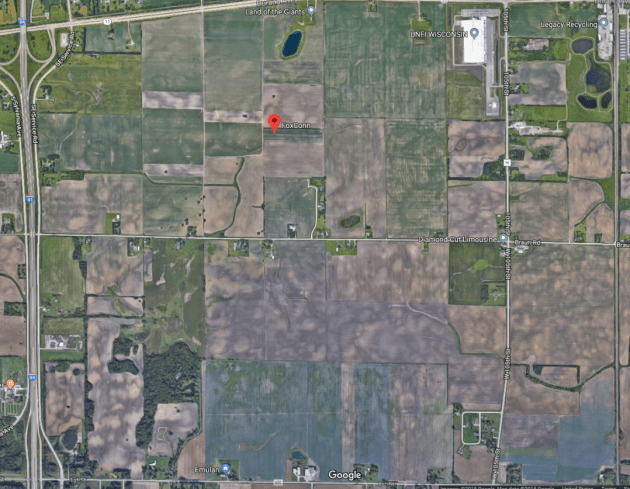
Here is the Google Maps satellite image of the Foxconn location (according to news reports). All the farmland is clearly visible.

Google Maps satellite image of Foxconn site

Taking land for a sizable or notable project like this is not always easy. The argument that this is good for the community will not strike all land owners as consonant with their property rights. And there may be some irony later in this story involving property rights. A Democratic gubernatorial candidate will be protesting the use of eminent domain as part of his larger concerns about the project. When Republicans are characterized as supporting both big business and property rights, which one wins? And are Democrats pro-property rights?

While Wisconsin has a slightly different definition of blight, this could be compared to urban renewal plans of the mid-twentieth century that used similar reasoning to mark certain properties as blighted. In both cases, officials and developers have a redevelopment plan for the land that is billed as an improvement for the community. In this case, the trade-off is largely open land for increased local tax revenue and a significant number of jobs. With the urban renewal plans of decades ago, history was not kind to some of the proposals as redevelopment could clear affordable housing units, target minority communities, and accelerate suburbanization (in the cases of highways constructed right through urban neighborhoods). Even without declaring some land as blighted, a project this size could be viewed by some as a significant change to the character of the community. “As many as 13,000 jobs” may sound good but this will affect local traffic, housing, and civic services. I would guess that following up with the community in five, ten, or twenty years could relay both intended and unintended changes if all or most goes as planned with the Foxconn facility.


Why I’m skeptical housing will become a national political issue

Even as affordable housing is a concern in a number of places in the United States, there is little national political discussion of the issue:

Franzini is joined in this quest by a curious cast of fellow travelers who are committed to raising the political profile of the American housing dilemma. As home prices creep up everywhere from established tech hubs to traditionally inexpensive cities like Boise and Nashville—and as homelessness reaches epidemic proportions on the West Coast—a number of organizations from a diverse array of sectors have recently formed to push for housing policy changes at the highest levels of government. They’re frustrated by the lack of engagement on housing that national political leaders are offering. And they’re finding that, at least for the moment, the first order of business is just educating people about the seriousness of the issue.

Here are four reasons why I believe it will be very tough to have a national political discussion, let alone pressure for the federal government to act, regarding housing:

  1. Housing is local. Americans would like local governments to handle the issue as they prefer, particularly those with more resources, to live in places that can limit others of lesser status from moving in. Residents and smaller governments argue that they should not be forced to build housing that current residents do not desire or give money to less deserving people for housing.
  2. Americans historically do not have much appetite for significant federal involvement in public or subsidized housing even as they like socialized mortgages for single-family homes.
  3. The housing industry has significant influence, from the National Association of Home Builders to the National Association of Realtors, due to the importance of the housing industry for the American economy and particular American ideals about what kinds of housing are preferred. Affordable or cheaper housing might generate fewer profits.
  4. Opponents to federal action will argue that Americans can have cheaper housing if they (a) are willing to move to metro areas that have cheaper housing (and plenty of them exist) and (b) truly take on the local power brokers that usually do not want the working and middle classes to access their wealthier neighborhoods. These arguments are plausible enough (though with issues) for a number of participants in the discussion.

A number of these reasons involve ideas about what should be part of the American Dream as well as perceptions about who can access it (so it involves race and social class).

Polarization: California housing bill does not make it out of committee

It is unclear how California intends to move forward in providing cheaper housing to residents after a YIMBY (“yes in my backyard”) housing bill did not make it out of committee earlier this week:

On Tuesday night, legislators killed SB 827, which would have allowed the construction of apartment buildings up to five stories tall near every high-frequency mass transit stop in the state.

SB 827 sparked a spirited debate about how the state should address its housing crisis. Its lead sponsor, State Senator Scott Wiener, argued that wresting zoning decisions away from local municipalities and forcing communities to build more densely near transit was the best way to both ease housing affordability in cities like San Francisco and help the state hit its ambitious environmental goals. Supporters of the bill—dubbed YIMBYs, for “Yes In My Backyard”—took on residents from wealthier, single-family home neighborhoods, who deployed the traditional NIMBY argument that the bill imperiled neighborhood character and would lead to traffic and parking woes.

The NIMBY side had some surprising allies, among them the Sierra Club and advocates for “Public Housing in My Backyard,” or PHIMBYs, who argued that the law would enrich developers and exacerbate gentrification in low-income minority neighborhoods…

Wiener also acknowledged how ambitious the bill was, and said he was “heartened by the conversation it has started.” Indeed, the bill was much-discussed nationwide. Vox’s Matthew Yglesias called SB 827 “one of the most important ideas in American politics today,” and the Boston Globe’s Dante Ramos said the bill could be “the biggest environmental boon, the best job creator, and the greatest strike against inequality that anyone’s proposed in the United States in decades.”

There are plenty of polarizing issues in America today but few would divide people so deeply than the issue of housing. There are several reasons for this:

  1. It is closely connected to race in the United States. While legally discriminating based on race or ethnicity in housing has been illegal for 50 years, residential segregation by race and ethnicity is alive and well.
  2. It is closely connected to social class in the United States. Those with resources do not want to live near those without resources. This can disrupt groups that commonly stick together, such as Democrats who might generally be more in favor of affordable housing but not necessarily when it means providing more housing in wealthier areas.
  3. Some of these polarizing issues are more abstract for many people but housing is an everyday issue that affects who you interact with, school districts, what kids see as normal, communities, parks, safety, and property values. Those who have choices about where they can move typically want those places to stay “nice.”

If California cannot figure this out at a state level, are there other states that can step up and provide affordable housing?

(Of course, the state level may not be the best level at which to address this. However, if it is left to municipalities, the wealthier ones will simply opt out and leave the issue for other communities to address.)

Win political office with low turnout in municipal elections

Even large cities have problems with voter turnout in municipal elections:

Voter turnout in local elections has always been low, and it’s gotten worse in recent decades, studies of voting behavior in municipal elections have shown. In most of the biggest U.S. cities, fewer than one-third of eligible voters turned out in the most recent municipal elections. And according to data culled by researchers at Portland State University, those who do cast ballots in major cities tend to be significantly older than the general population, a factor that might weigh against women and candidates from diverse backgrounds.

My impression of elected officials in suburbs is that a good number get into local elections because they care deeply about an issue. With low turnout, relatively small communities, and a lack of formal political parties (many smaller municipal elections are supposedly non-partisan), it does not take a lot of resources to run for local office.

Of course, some of these variables are different at the big city level: often dominated by partisan politics, a larger need for significant sums of money, and a need to woo tens of thousands of voters. Still, it is notable that the leaders of some of the most important cities in the world can be voted in with votes from a relatively small number of citizens. These local leaders may not be able to easily move into national positions yet their decisions affect residents on a daily basis in a way that more abstract and further removed national politics cannot.

The Chicago Tribune in 1968 and conservatives today: sociologists excuse rioters

In an overview of Martin Luther King Jr.’s final months, the Chicago Tribune quotes its own take on urban riots:

King’s opponents saw his proposed march as an invitation to rioting. In the 1960s, one inner city after another had exploded in deadly and destructive riots. King explained the violence with a metaphor: “A riot is the language of the unheard.”

The Tribune rejected that argument in a Jan. 21, 1968, editorial: “Every time there is a riot in the streets you can count on a flock of sociologists rushing forward to excuse the rioters.” King’s “nonviolence,” the Tribune added, “is designed to goad others into violence.”

Simultaneously, King was under attack by a younger generation of black militants who rejected his pacifist philosophy as weak. Their conclusion was echoed by Adam Clayton Powell Jr. “I don’t call for violence or riots, but the day of Martin Luther King has come to an end,” said Powell, a longtime U.S. congressman from New York.

Lest the Tribune let this idea of sociologists excusing riots be swept into the dustbin of history, this idea exists in recent years as well. In 2013, the conservative Canadian Prime Minister said we should not “commit sociology” when addressing terrorism. Conservative columnist George Will used a similar phrase in 2012 when discussing the shooting in Aurora, Colorado. Of course, explaining social phenomena is not the same as excusing or condoning it.

Now that I have seen this sort of explanation multiple times, it is clearly less about sociology and how social science works and more about political ideology. Sociologists, by a wide majority, are liberals. Those who tend to disparage sociology in public phrases like these are conservatives. The implication is that sociologists and liberals are willing to allow violence and disorder if it serves a particular political end. And, this may have just enough of a grain of truth to be a repeatable claim.

Suburban voters could give Democrats House majority

The hopes the Democrats have to recapture the House depend on suburban voters:

In the last two weeks, Democrats scored an upset in southwest Pennsylvania and dominated the voting in the Republican suburbs outside Chicago. President Donald Trump, who never won over suburbia, continues to get poor marks from the educated, upper income Americans who often call it home. After Democratic victories in state legislative contests in Virginia and special elections across the country — even a stunning Senate election in Republican-dominated Alabama — Republicans have plenty of reason to worry that commuter country may be their undoing in the fight for control of the House in November’s midterm elections…

Democrats need to pick up 23 seats to take the majority — a task made particularly challenging by the way House districts currently are drawn to favor Republicans. Still, any House majority is built on suburban success.

Republicans control most rural and small-town districts, where Trump finds his strongest political support. Democrats dominate districts anchored in big cities, where Trump opposition is fiercest. The party in charge will be the one that wins the battle in between, where the electorate often is the sort of ideological and demographic mix that defines a two-party battleground…

Democrats’ target list starts with nearly two dozen Republican-held seats where Hillary Clinton bested Trump in 2016. The list is heavy on seats in California and the northeast — suburbs outside Philadelphia and New York — corners of Democratic-leaning states where Trump didn’t win over wealthier, moderate Republicans. Now the GOP fears that those weaknesses are spreading further from big-city centers and also into suburban districts around mid-size and smaller metropolitan areas.

While the narrative in this election cycle will certainly involve Trump, there is more going on with suburban voters. The voters in many suburbs can be persuaded by a different party every election cycle. This is partly due to the changing nature of suburbs where there are now more diverse populations and changing economic conditions. The suburbs have many people who want to protect their own interests as well as ensure a good future for their children. Still, suburbanites closer to cities will tend to vote Democrat and those further out will tend to vote Republican.

Comparing “Trickle-Down America” (urban) and “Stagnant America” (rural)

Recent comments from Hillary Clinton praising American “places that are optimistic, diverse, dynamic, moving forward” leads to this comparison between “trickle-down” and “stagnant” Americas:

Over the past 40 or so years, the U.S. has been fragmenting into two parallel societies, which I’ll call Trickle-Down America and Stagnant America. Each one looks upon the other with suspicion and hostility. Trickle-Down America is the America of our biggest metropolitan areas, and it is defined by comparatively high levels of density, diversity, and economic inequality. Importantly, the richest people in Trickle-Down America are typically white, while the service-sector workers who enable them to work longer hours are disproportionately brown and black. Stagnant America can be found in rural regions, small cities and towns, and outer suburbs across the country. This America is largely white and relatively equal, though it too is scarred by poverty, particularly among Hispanics and blacks. America’s most and least educated workers are concentrated in Trickle-Down America, while Stagnant America is home to most of America’s working- and middle-class white voters.

Is Trickle-Down America morally superior to Stagnant America? A good starting point is to reflect on the sources of Trickle-Down America’s wealth. In New York City, my hometown, the local economy has long been dominated by the financial-services sector, which has grown mightily in recent decades. Has the financialization of the U.S. economy been an unadulterated good for the country as a whole? There are many thoughtful people who’d argue otherwise. Indeed, some argue that rents flowing to the financial sector have badly distorted the U.S. economy, and have contributed to the devastation of tradeable sector employment in Stagnant America. Corporations headquartered in America’s cosmopolitan cities have profited immensely from the emergence of a globalized division of labor. Yet many of these same multinationals have pioneered tax-avoidance strategies that have made it harder for the federal government to compensate those who’ve lost out with globalization, all while deploying their considerable influence to get the U.S. government to pressure other countries to adopt intellectual-property protections that serve their interests. And then there is the federal government itself, and its vast, growing army of private administrative proxies—contractors, non-profits dependent on public subsidies, and the like—that has helped make Washington, D.C., and its environs one of the country’s most affluent and educated regions. It’s hard to disentangle exactly how much of Trickle-Down America’s success relative to Stagnant America is a product of straightforward rent-seeking. I certainly doubt that it accounts for all of it, or even most. But surely it accounts for some, and that should give Trickle-Down America’s champions pause.

One important thing to keep in mind is that Trickle-Down America is, overall, characterized by more stringent land-use limits than Stagnant America. These limits have raised housing costs in affluent coastal regions, which has redounded to the benefit of incumbent homeowners. Yet high housing costs have deterred inward domestic migration while driving out large numbers of working-and middle-class residents…

For now, though, Trickle-Down America’s affluent professionals find themselves in a sweet spot, which surely accounts for some of Clinton’s triumphalism. The food is better. Beautiful old houses are being renovated everywhere you turn. An abundance of low-wage immigrant labor adds diversity and dynamism to cosmopolitan cities, yet the noncitizen working class isn’t in a position to press for a more egalitarian social order—one that could prove discomfiting for local elites. Best of all, opposition to Trump is helping to obscure simmering discontent over Trickle-Down America’s business model.

This is a different way of categorizing the stark urban and rural political divides of recent years. Yet, it also highlights a key issue simmering within the leading cities and metropolitan areas that are so important to American life: who really benefits in the major cities? Are the high levels of innovation, growth, development, and cultural excitement accessible to all urban residents or do the spoils disproportionately go to the top?Inequality cuts across multiple strata of society. Certainly there are stark differences within cities as well as between urban and rural areas. I’ll add a third area that complicates the story above (though these are likely lumped in with the Trickle-Down America segment): the inequality present in American suburbs. Even as the majority of Americans live in suburbs and seem to have achieved the American Dream of suburban life, life outcomes can differ dramatically across suburban communities.

What makes this suburban inequality more interesting for the realm of politics is how is affects voting: areas generally closer to the big city or with demographics more like the big city vote Democrat and wealthier communities and areas further out in regions vote Republicans. Will these same sort of voting cleavages arise in rural areas in cities as various inequalities receive more attention?