An abandoned large development in LA turns into graffiti canvas

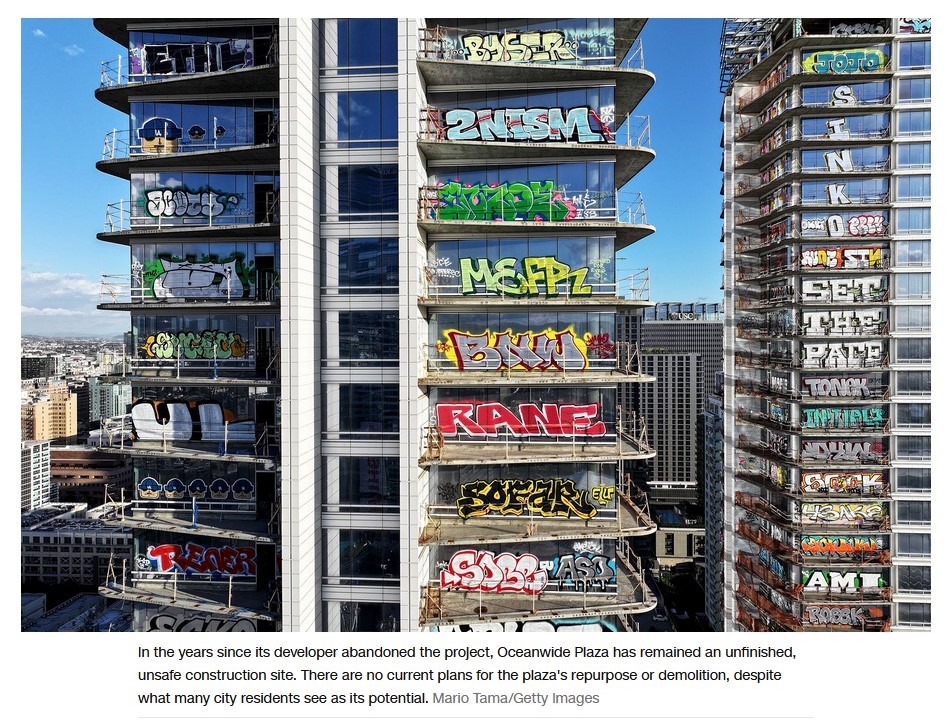
A large development in Los Angeles that has gone unfinished now goes by the name “Graffiti Towers” to nearby residents:

https://www.cnn.com/2024/04/10/style/graffiti-oceanwide-plaza-los-angeles-skyscrapers/index.html

Climbing up abandoned, unfinishedfloors and tightrope walking across balcony ledges, backpacks clanging with cans of alkyd and acrylic, a collective of Los Angeles graffiti artists have transformed their craft beyond urban aesthetics to champion community issues.

Their choice of canvas: Oceanwide Plaza in Downtown LA. Occupying over a full square city block, the plaza was imagined as a vast mixed-use building project, offering city residents over 500 lavish condominiums, a five-star hotel, retail spaces, restaurants and a private 2-acre park.

However, construction on the $1 billion project, which began in 2015, was shelved after the Chinese-backed contractor Oceanwide Holdingsran out of funding in 2019 — and it has lain unfinished ever since…

Transformed in part into an art installation, Oceanwide became an opportunity for the graffiti artists to leave a message to the city below, and a call-out to policy makers who leave buildings to rot…

“People forget that people live here. People own businesses here and they don’t want to have to spend the time and money to clean it up,” said Blair Besten, executive director of the Historic Core of Downtown Los Angeles, an organization which works to improve the quality of life in downtown neighborhoods. The Historic Core prioritizes street sweeping, trash collection — and graffiti removal.

This article showcases the multiple sides of an ongoing public debate about graffiti: is it a response to difficult social and economic conditions? Is it art? Is it criminal behavior that should be punished?

At the same time, how is there such a large abandoned project in Los Angeles? What can a municipality do to finish the development or pursue another use?

Put these two ideas together: are there cities willing to have large-scale platforms for graffiti in or near their downtowns? If graffiti and its place in society is multi-faceted, how might Los Angeles or other large cities incorporate it or work with graffiti artists?


Searching for the one answer: social media use among young adults, injuries among baseball pitchers

American society often likes one solution to solve an important problem. How many times do we hear that a particular political candidate or a specific product or a change to the educational system could change society for the better?

Photo by Polina Tankilevitch on Pexels.com

Two recent examples of this approach have popped up:

  1. Is social media use among young adults the reason for all sorts of social ills? If we could curb or regulate this use – or perhaps even allow no use – then all sorts of outcomes would improve.
  2. Why are so many baseball pitchers suffering major injuries? If we could find the single cause, more talented pitchers could continue to practice their craft.

Our world is complex. In many situations, multiple factors contribute to issues and multiple solutions could help address the issues. Studying the problem could reveal that some factors matter more than others or discussions about remediation could show that some solutions are easier to pursue or enact. Successfully intervening in the issue may help the situation – and not eliminate the issue entirely.

Actors in these two fields will continue to debate cause(s) and solution(s). There is much riding on these discussions and resulting actions.

Slowed condo construction in downtown Chicago

Who was going to buy all those expensive condos going up in downtown Chicago? The condo building pace has slowed significantly:

Photo by Pixabay on Pexels.com

For the first time in years, there are no new large condo projects under construction in downtown Chicago.

Roughly 2,500 condos have been developed downtown since 2015 as multiple towers were constructed, and about 600 of those units are still available, said Gail Lissner, managing director for Integra Realty Resources.

But the high cost of construction and high interest rates, which are discouraging luxury home sales, have brought large-scale condo construction to an end, Lissner said…

Apartment developers can better handle high construction costs because downtown renters, many needing quick housing after starting new jobs, fill up new rental units much faster than buyers, who typically need to make far bigger commitments, especially with interest rates so high…

Most of the condos built in recent years are large, ultra-luxury homes, with multimillion-dollar price tags and more than 2,000 square feet, Lissner said. Those can be tough sells, especially since according to brokers the downtown is now attracting fewer upper-income empty nesters from the suburbs, who often seek homes easier to maintain.

This is cast as the result of the current economic and housing market conditions. There are fewer buyers because of higher mortgage interest rates.

How much of this is possibly due to less interest from people to move to Chicago? With the city slowly losing residents, is there still the same latent market for downtown condos? If market conditions were better, would there be robust demand for new condos?

Tracking the construction and filling of apartments could help answer this. How many new apartments are available and how demand is there for those? Any chance existing condo buildings will go the rental route?

How much sales tax revenue a mid-sized suburban shopping mall might generate

After the purchase of a local shopping mall by a suburban community, a news article highlights how much sales tax money the mall once brought into the suburb:

Bloomingdale officials faced a similar scenario with Stratford Square, which once brought in $20 million a year in sales tax, but now is mostly empty. The village bought the mall this year for almost $9 million after filing for condemnation against the owner, Namdar Realty Group, as the property fell into disuse.

According to the FY 24 budget of the Village of Bloomingdale, they had $41 million in tax revenue. If the mall once brought in $20 million in sales tax revenue, that is a big change for a suburban community. Because the mall has declined over time, they have had time to adjust to the decreasing sales tax revenue. Still, that is a large amount.

What are the odds that the new land uses generate that amount of money? Given the state of retailers and brick and mortar establishments, this might be difficult. And there appears to be less demand for suburban office space. A mixed use setting, popular in suburban redevelopments (one example not too far away), could sustain some business and office activity. Residential development could provide more housing options but also require some different city services.

This reminds me of the long-term process redevelopment can often be. From the peak of the shopping mall to what the new development might look like, decades could pass. In the meantime, the community has changed and social and economic life has changed.

Flower centerpieces and sacred places

During a recent day of learning and good conversation, I enjoyed this centerpiece:

Where does one find flowers arranged around religious buildings? It makes total sense for a meeting of Partners for Sacred Places.

Robert Brenneman and I argued in Building Faith that religious buildings shape religious experiences and communities. I know nothing about centerpieces but perhaps they could have a similar effect. In a pleasant hotel meeting space with numerous round tables, the centerpieces might play multiple roles: (1) highlighting the topic at hand; (2) providing a focal point in the middle of a table that is difficult to talk across in a crowded room; and (3) providing beauty in a formal setting.

Buildings and physical settings can be purely functional. Imagine the same setting above with no tablecloth and no centerpiece. Yet, that bare bones approach is also influential. Perhaps it communicates efficiency and informality. Perhaps it reflects the resources available. The absence of decoration or “extras” could be highly intentional to promote a different message regarding beliefs and practices.

I am grateful for those with the skills and gifts to design and carry out these additions to our places.

An American downtown with multiple traffic circles

On a recent visit to Sarasota, Florida, I discovered multiple traffic circles on a major roadway (US-41):

I was not there at the busiest time of the day but it seemed that all the traffic was flowing fine through the roundabout. The biggest issue I could imagine for drivers is getting into the correct lane for where the driver wants to exit the traffic circle. For example, in the image above, to go straight, the driver could be in either lane but to go left or right, one has to pick the correct lane and then exit appropriately.

These were not the only traffic circles spotted in western Florida. I saw several under construction, both on existing roadways and along new roadways. The more constructed, the more familiar drivers will be with them.

One big advantage of these is that traffic can often keep moving rather than the stopping required by stop signs or traffic lights. If the driver has yielded, there is no need to stop if the coast is clear.

I do not know which American communities have more traffic circles than others but this could be an interesting way for places to distinguish themselves from others.

Learning about American housing through The Sims

Playing The Sims may just offer a few lessons about housing in the United States:

Photo by Monstera Production on Pexels.com

The Sims felt like a trial run for adulthood, exploring how you’d make use of your future autonomy. Much of this validated the importance of personal space: how to lay out a room, how to choose a sofa that balanced aesthetics and comfort, how to make a house a home…

The official trailer for The Sims 4: For Rent emphasizes the potential of “multiunit life,” promising “ample opportunity … [for] eavesdropping, snooping, or even breaking and entering”—a description that instantly evoked memories of my worst roommates…

Inevitably, a lot has changed. The peaceful suburb I remembered from childhood has been replaced by elaborate “worlds” that I can (effortfully, via a loading screen) switch between to grow my property portfolios. The Sims 4 is more immersive and finely drawn, visually, than the original was, but it’s also more involved: It took me a whole afternoon to create my first Sim and set her up in her “hovel.”…

But soon my frustration (as Edith) with Jazz’s requests started to outweigh my commitment to being the Only Good Landlord. Every notification from the rental instantly provoked my impatience. Not the damn tenant again! The slow, clunky transition within the game between Edith’s home and the rental only added to my frustration and my creeping sense of Jazz as a burden. Why did this guy need so much of Edith’s energy?

With For Rent, The Sims has perhaps moved too far toward reflecting brutal reality, forcing players to choose between being on one side or the other of an often fractious and all-too-familiar power imbalance. As a child, I was drawn to The Sims as a role-play for adulthood, a world of expansive promise and possibility; playing For Rent, I was reminded, depressingly, of how the game is rigged.

The Sims is a game, a product intended to provide enjoyment for players. Can one gamify the rental experience in the United States?

More broadly, The Sims puts a home – owned or rented – at the center of the experience. The United States has a long history of celebrating the single-family home. Renting may be common in some places but it can also be treated with suspicion in other places. Players of the game can make their own choices but they are limited by what is possible in the game as well as what is possible in our society.

Anyone able to offer an analysis of housing, landlords, and properties in general across the Will Wright creations? Simcity offered a particular take as did SimTower – has this changed noticeably over the years? Are there any video games that do a different or better job of portraying property and renting?

Food insecurity in the suburban land of plenty

If the suburbs are supposedly the realization of the American Dream, why are at least a few suburban residents short on food?

Photo by Lukas on Pexels.com

Visits to suburban food pantries have surged over the past two years, exceeding previous record highs set during the pandemic.

Schaumburg Township’s pantry experienced 33.3% increase in client visits between the fiscal year that ended in February 2023 and the one that ended in February 2024, from 9,809 visits to 13,079…

The Greater Chicago Food Depository, which supplies more than 800 food pantries in Cook County, has seen similar growth in most suburban areas, Communications Director Man-Yee Lee said.

Such numbers hint at the growth of complex suburbia where more suburban residents experience poverty or have lower incomes. Schaumburg Township overall might have a relatively high household median income – $83,909 in the 2020 Census – but that obscures that there are many households with less. With higher housing costs and food prices, the need for food goes up.

I would be interested in hearing more about coordinated efforts to address food insecurity in suburbs. I am sure there are a good number of food pantries, whether provided by local government bodies, local congregations, or other groups. But, this can provide a hodge podge of opportunities that are available at different times and places. Are there regional efforts to address food issues? Is this an issue that might be reduced significantly with higher-paying jobs? Would more affordable housing make it easier to obtain food?

What the millions of Americans might remember about the suburbs in which they grew up

What will the tens of millions of those raised in the American suburbs remember about those places? Here is one example:

Photo by Nout Gons on Pexels.com

I haven’t lived in Ypsilanti since I was 17, decamping first to a college campus north of Chicago, then to Chicago proper, then to Washington, D.C., where I’ve lived for more than 10 years. Yet at the risk of being one of the “apologists for the ubiquitous highway crud” whom Kunstler derides in his book, I must say that even after all this time, I feel at home in a strip mall. It is familiar; it is my heritage. At least once a year, the winds blow in from the Midwest, and I cannot rest until I make a pilgrimage to an Olive Garden. If home is “nowhere,” and nowhere has spread almost everywhere, then many places can remind you of home…

Of course, people do crave specificity in the places they’re from, even in suburbia. I think the particular passion people have for those slightly more regional chains—Californians and In-N-Out Burger, southerners and Waffle Houseis evidence of that. No one wants to feel like they’re from nowhere. But life happens where you are, and if where you are is a strip mall by a highway on-ramp, well, you work with what you’ve got…

Is Taco Bell a gaudy restaurant that serves cheap sodium bombs that all taste basically the same and bear only a passing resemblance to actual Mexican cuisine? Definitely. But I’ll always love it, not just because I think it’s delicious but because that’s where my high-school friends and I would go to pick up sacks of 99-cent bean burritos to bring back for dinner when drama rehearsal was scheduled to run late. So Taco Bell bean burritos, to me, taste like staying at school until 9 p.m. and trying to do homework on the side of the stage between scenes, like the intense friendships of a ragtag group of teens figuring out who they are by pretending to be other people…

The feeling that your past is coherently tied to your present and your future is called “self-continuity,” and Routledge’s research shows that nostalgia facilitates it. So feeling nostalgic for the landscapes of suburbia doesn’t necessarily mean I think that’s the best way to design a community—it’s just part of my story. My soft spot for Olive Garden’s huge portions of mediocre fettuccine alfredo is just the vessel for the things I actually value: the feeling of belonging to a place and its people, the comforts of accumulated memories that adhere to spaces.

The memories referenced here primarily deal with common experiences and corporate chains. The suburbs do have plenty of these.

But, I also assume plenty of suburbanites would remember other things that are a little more place specific. Their home and possibly a yard. A specific school. A park. Perhaps also a McDonald’s or an Olive Garden or a TJ Maxx but a specific one or two they went to regularly. The same relationships that overlapped with chains also operated in specific places.

On one hand, the suburbs share common features. Structured around single-family homes and driving, the suburban lifestyle is a particular one. On the other hand, cities and rural areas also share common characteristics. Whether the suburbs are more conformist, patterned, dull, wasteful, and/or nowhere places compared to other places is up for interpretation and debate. James Howard Kunstler has argued this for years as have many other critics of the suburbs. Yet, plenty of Americans claim to like suburbs and the lifestyle there. (And policies and ideologies have supported suburban life for decades.)

What is more clear that at least a few generations of Americans have now been shaped by growing up in the suburbs. As adults, they have choices about whether to stay in suburbs or what kind of suburbs they might want to live in. Some have chosen other settings and many have continued to live in suburbs. How they remember these choices and experiences can differ.

Want goods delivered quickly? There are numerous local impacts

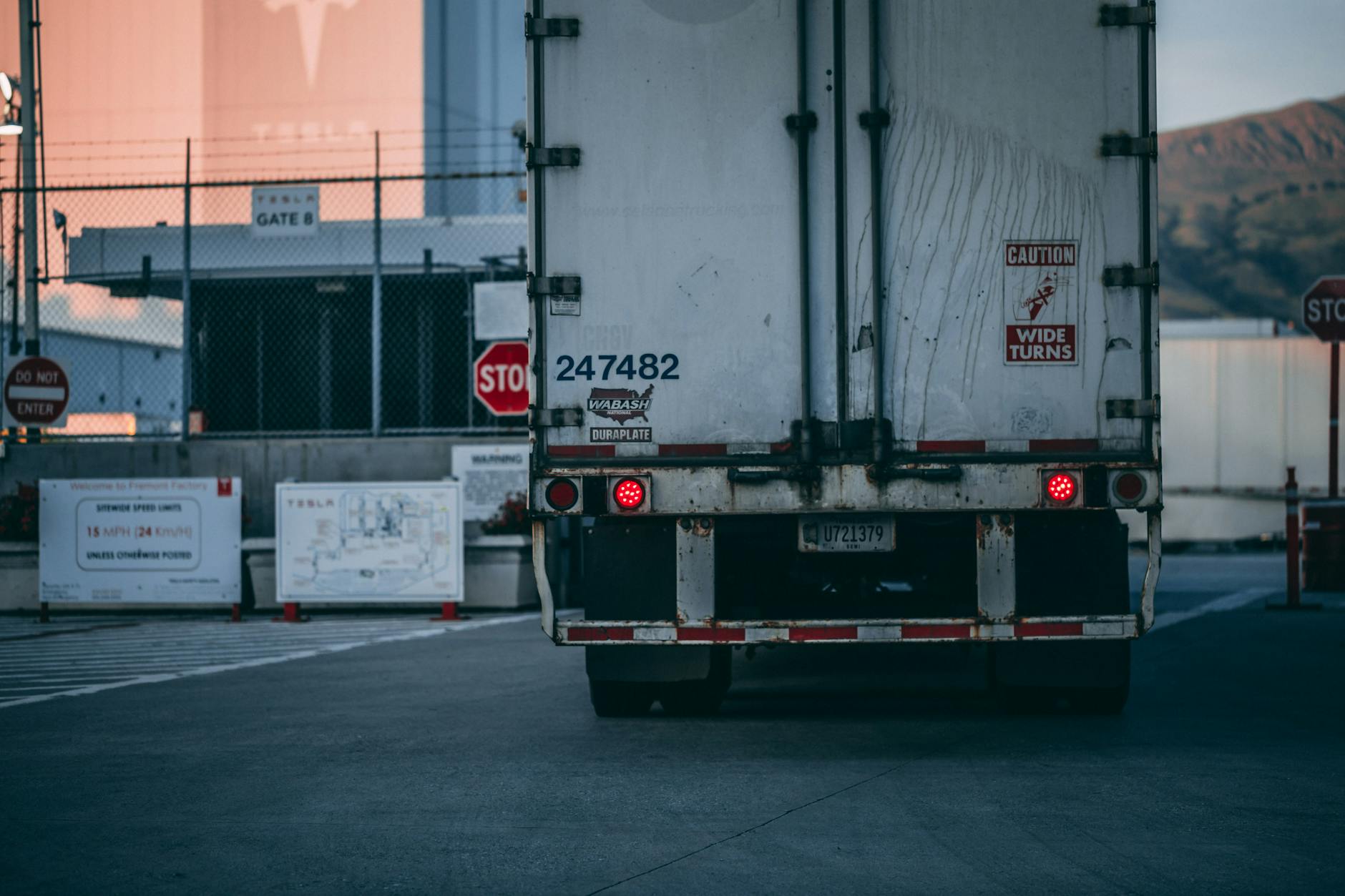
An overview of warehouse construction in southwest Chicago and southwest suburbs highlights a current conundrum in American life: people want cheap goods delivered quickly to their home or business. But, making this happen has consequences for neighborhoods and communities. Here is how the article ends:

Photo by Craig Adderley on Pexels.com

Whatever the outcome, Archer Heights and Joliet already illustrate one of the stark lessons of Chicago’s warehouse boom — that Americans can’t expect to enjoy the benefits of rapid, ever-growing freight shipments without paying for the necessary infrastructure and without encountering increasingly sophisticated demands from the towns being smothered by trucks.

Some of the listed negative consequences of all this trucking and shipping: traffic, noise, air pollution, extra stress on roads, and industrial neighbors for residents.

The primary positive consequences for a community: money from the land use and local jobs. The indirect consequence for many inside and outside the community: goods get to them faster.

Is it worth it? Would it work better to have giant shipping and trucking zones outside metropolitan areas where the pollution and noise and traffic could be minimized for nearby communities? This would require both foresight and resources. It reminds me of airports that are now surrounded by development or other major necessary infrastructure that is now folded into metropolitan landscapes.

Could one city or region figure this out? Imagine a special trucking and train zone outside of the metro region. The transportation actors get some tax breaks to locate there. The revenues from the land use are shared throughout the metropolitan region. Some current facilities are relocated to the new area.

Trucking may be essential to the American economy but it does not necessarily have to conflict with goals local residents and leaders have for their communities. It would require acting creatively and quickly to move shipping facilities away from people.