Finding the price and usage at which to not own a car

Two researchers crunched the numbers and have some thoughts about when you should not own a car:

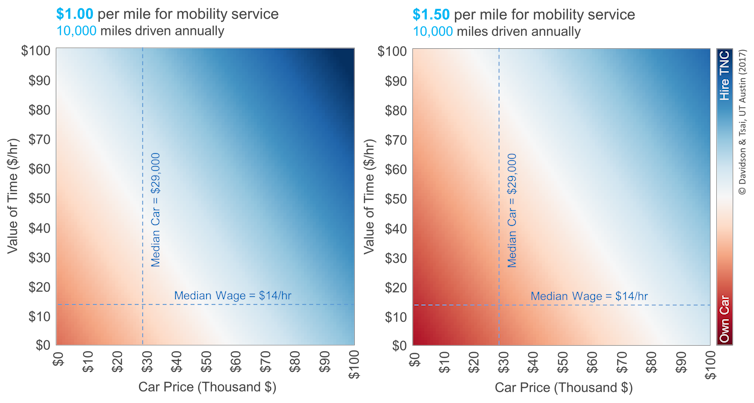
The decision for owning a vehicle or using mobility services is unique to every individual. If you purchase a highly efficient vehicle for less than $25,000 and drive it more than 15,000 miles per year until it falls apart, then you should definitely own a car if your goal is to save money.

But, if you drive less than 10,000 miles per year, face long waits in traffic, or place a high value on your time that would otherwise be spent driving, our calculations show that mobility services might be the cheaper option. Geography can also play a role—it’s not a coincidence that there have historically been so many taxi cabs in New York City, where the high cost of parking and slow pace of traffic consume time and money.

As noted before on this blog, owning a car can be a substantial part of middle-class expenses. With their physical layout, the sprawling suburbs probably then do not make much sense for not having a car. Yet, those denser suburbs for the older millennials and companies hip to them may be the true spots where suburbanites can ditch their cars. A combination of walkability, some mass transit, and car sharing in these denser suburbs could be enough to push people toward limiting car ownership.

On the other hand, perhaps driverless cars will render this all moot within a short amount of time. Within ten or twenty years, few of us will even need to own a vehicle if we just buy into a car sharing option.

Traffic deaths increased in 2016

Explaining the rise in traffic deaths in the last two years may be difficult to explain:

Cars may be safer than ever, but 37,461 people died on American roads that year, a 5.6 percent hike over 2015. While fatalities have dramatically declined in recent decades, this is the second straight year the number has risen. It’s too early to say why, exactly, this is happening. Researchers will need much more time with the data to figure that out. But here’s a hypothesis: It’s the economy, (crash) dummy.

“People drive more in a good economy,” says Chuck Farmer, who oversees research at the Insurance Institute for Highway Safety. “They drive to different places and for different reasons. There’s a difference between going out to a party in the middle of the night in an unfamiliar area and driving to work—that nighttime driving to a party is more risky.”…

Researchers have long known that driving deaths rise and dive with the economy and income growth. People with jobs have more reason to be on the road than the unemployed. But this increase can’t be pinned on the fact of more driving, the stats indicate. Even adjusted for miles traveled, fatalities have ticked up by 2.6 percent over 2015. You can still blame the economy, because people aren’t just driving more. They’re driving differently. Better economic condition give them the flexibility to drive for social reasons. There might be more bar visits (and drinking) and trips along unfamiliar roads (with extra time spent looking at a map on a phone).

The DOT numbers seem to confirm that drivers involved in traffic deaths were doing different things behind the wheel last year. The feds say the number people who died while not wearing seat belts climbed 4.6 percent, and that drunk driving fatalities rose 1.7 percent. Contrary to what you might expect, the numbers show distracted driving deaths dropped slightly, but experts caution against putting too much faith in such info. The numbers are based on police reports. They’re reflections of what cops are seeing at crash sites, but also of what’s in the zeitgeist at the time. It could be that first responders weren’t, for example, looking out for distracted driving last year because it wasn’t in the news as often.

Official statistics do not provide all the information we might want. In this case, the figure of interest to many will simply be the total number of deaths. Is an increase over two years enough to prompt rapid action? If so, I would imagine the regulatory structures regarding driverless cars might attract some attention. Or, do car deaths continue to be the costs we pay for having lifestyles built around driving?

The same LA bridges in many car commercials

One interesting set of locations is fairly common in car commercials: bridges in Los Angeles. This is not what you might expect: how many people know that bridges are even necessary in Los Angeles? (The Los Angeles River does exist.) This has a long history: a 2004 New York Times story suggests the presence of production companies in southern California plus good weather leads to many shoots in Los Angeles.

One of the past bridge locations was the Sixth Street Viaduct which closed in 2016:

According to Film L.A., the organization that helps the film industry book municipal locations, over 80 movies, television shows, music videos, and commercials are shot on or underneath the Sixth Street Viaduct each year. That’s partially because of the bridge’s swooping metal arches, perched on an art-deco concrete platform; and partially because of the river underneath and that access tunnel: if you want to film something set in Los Angeles that makes reference to the city’s automotive culture, or if you’re just looking for a place to shoot a car chase that’s cheaper and more available than a clogged freeway, the channelized, concretized bed of the Los Angeles River is your best choice.

Except that the bridge officially no longer functions that way, as of last week. It’s going away completely. And the river? It’s on its way to becoming a river again.

Here is a short montage of the bridge being taken down alongside iconic images from films.

The Fourth Street Bridge is also home to a number of shoots and features Art Deco columns as well as views of the downtown skyline. Here is a Google Street View image:

FourthStreetLosAngeles

Are viewers of car commercials more likely to purchase a vehicle if it is shown in Los Angeles compared to other settings? Los Angeles has its own aesthetic which may or may not match with many other places. (In urban sociology, Los Angeles is often held up as the prime example of decentralization. Yet, it also does have a downtown as well as numerous other scenic sites such as the hills behind the city.) In the Chicago television market, we see some car commercials shot in Chicago. Might this help viewers envision themselves driving a new car when they see it in a familiar location? It would be more difficult to do this for all of the metropolitan markets in the United States.

Here are some other common car commercial locations with several more in the Los Angeles area.

Adding a “highway cap” to make highway expansion more palatable

Several recent urban highway expansion projects include a new twist: putting some green space around and over the new highway.

Wheeler didn’t hesitate to acknowledge that adding lanes never helps congestion, thanks to the principle of induced demand. Instead, what he emphasized about the project is its progressive window-dressing: its cap. A few blocks of the highway would be lowered below grade and planted with a bit of Chia fuzz, with a new bike-ped crossing on one of the sides. This is the grid “restoration” of which the mayor speaks—essentially, a minor diminishment of a roaring, stinking concrete channel that will roar and stink all the more with this added capacity.

Highway caps are an ever-more common feature of 21st century urban highway projects, and this project sounds a lot like some others we’ve heard of recently—namely, the Colorado DOT project that promises to triple I-70’s footprint through two of Denver’s last working-class neighborhoods and cover a small section with a park. The project has been mired in controversy for years, with lawsuits and pleas to the governor to halt it on environmental and social justice grounds.

Ironically, the 800 square-foot “cap park” proposed for the Denver boondoggle stemmed from early community advocates who pushed back against CDOT’s original plans to simply widen the existing elevated structure. The introduction of the cap a few years ago was heralded as a victory by some residents of the neighborhoods, which have been passed over for local investments for years. But the I-70 project, with its attractive grassy mask, has since been corralled into a suite of plans to redevelop huge swaths of the affected neighborhoods.

Now, the fear of displacement, underscored by the property-value increases that highway cap parks can bring, has driven many longtime Denverites to bitterly oppose the construction. “I just hope my kids will get to play there,” said one local mom who regretted ever advocating for the project, which a Denver public policy expert compared to “old-fashioned 1950s slum-clearance.”

Parks can only do so much to cover up that highways take up a lot of space, bring noise and traffic, and can either help contribute to disinvestment or gentrification.

This sounds like greenwashing. It can take many forms in trying to beautify or distract from uglier elements of the built environment. Does a few bushes in planters in the parking lot really transform the setting and allow a visitor to escape into nature? This is the subject of part of James Kunstler’s TED talk “The Tragedy of the Suburbs” – with roughly 8:00 minutes remaining – where he dissects such parking lot plantings. Even expanding the size of the nature area, such as park in these examples, may not be enough if the surrounding land use is even more sizable.

Unusually successful experiment: the CTA Yellow Line

The CTA Yellow Line to Skokie was constructed in the 1960s and quickly became a success:

The proposed transit test brought together a unique trio: a federal agency looking to improve transit, a city rail system experimenting with expansion, and a suburb grabbing at the chance to maintain a rail connection to the city. Funding for the concept was split between the three parties—$349,217 came from the Department of Housing and Development, $1,837,415 from the CTA, and $37,193 from the village of Skokie. At the conclusion of a two-year test, the parties would figure out next steps…

After one day, the CTA logged 3,959 riders, and almost immediately added weekend hours. By early 1965, 6,000 riders a day rode the Swift (the CTA estimated that the service removed 1,000 cars a day from the highway). The CTA logged more than 3.5 million rides during the two year test period, and by 1967, the passenger load had grown 170 percent from already-high 1964 numbers, hitting a record high that year of 8,150 riders a day. Chairman DeMent told the Chicago Tribune that it was “a perfect example of how good rapid transit can induce motorists to leave their cars at home.” Not only did the service prove itself, it made a profit of $216,717 on revenues of just under $800,000 in its first two years of operation. At one point, the Feds actually asked for $250,000 of their funding back.

This success didn’t necessarily lead to much change across metropolitan areas:

In short, the experiment wasn’t replicated. As some writers at the time noted, other Chicago suburbs could have set up similar lines, and even had the abandoned rail lines to do it; the Chicago, Aurora, and Elgin Railroad, which ran through western suburbs such as Wheaton and Glen Ellyn, lay dormant beginning in 1961 (to be fair, the line was eventually turned into the Prairie Path, a wildly successful rails-to-trails conversion). In the late ‘60s, Skokie voters rejected a bid to apply for a federal transportation improvement project.

Perhaps most importantly, during a period of highway expansion and urban renewal, the money wasn’t there, and additional capital for building such systems from scratch was hard to come by. Just look at the 1967 federal transportation budget. Of the $5.35 billion spent, only $160 million, or 3 percent, went to transit. As Joe Asher, a writer for Railway Age, wrote in 1968, “the streets and highways of U.S. cities suffer arteriosclerosis, the urban population chokes on auto exhaust, and one downtown after another gets chopped up to make room for new spaghetti-bowls of highways.”

It is hard to convince suburbanites to use mass transit unless it has significant advantages compared to driving. The Yellow Line to Skokie seems to offer such advantages: a relatively short ride with Skokie right outside the city, a big parking lot, and a fast train. But, could this work further out from the city? What if the train was a slower commuter train or a bus? Or, if parking was hard to find in the suburban lot?

Rather than seeing the Yellow Line as a model to follow, perhaps it is difficult to replicate. That does not mean cities shouldn’t attempt similar efforts – we have a good sense of what building more highways leads to – but they should be realistic about what is possible.

CT suburb considering fines for “distracted walking”

The suburb of Stamford, Connecticut is considering penalizing those walking under the influence of phones:

Texting or even talking on an electronic device may soon be illegal in Stamford if a proposal to outlaw ‘distracted walking’ is approved…

“They’re oblivious to cars,” Stamford City representative, John Zelinsky said.

Zelinsky said the Pedestrian Safety Ordinance is modeled after one approved in Honolulu late last month, and would carry a $30 fine if police catch you in the act.

Such behavior can be dangerous for both users and others on the sidewalks and streets. Yet, legislating distractedness out of walking, bicycling, and driving is a tricky business. Does walking and talking with someone count as distracted walking? Is it okay to suddenly stop right in the middle of a busy sidewalk to take a phone call?

I have long wondered about implementing traffic regulations on busy sidewalks (see a story from England about this). Sidewalks are public spaces but also important conduits for foot traffic and some kinds of vehicles. Overcrowding can occur; see the recent example of Manhattan. And how people use the sidewalks can vary dramatically with use ranging from running and powerwalking to strolling to standing or sitting for conversation.

Bus ridership down in America

Fewer Americans – 13% – are riding buses compared to ten years ago.

I’ve argued before that Americans perceive mass transit options as having different statuses. For those with more resources, trains and subways are preferable. If those are not easily accessible or the person has reached a certain status in life, driving is a must.

At the same time, bus service is relatively cheap for cities and communities to provide. Because American cities are often planned around cars and have spent decades trying to efficiently move vehicles around, adding or subtracting buses to adjust service levels is doable. In contrast, constructing new trains or subways can be incredibly costly and require years of work. It may be that in the long run trains and subways are better options to plan around but that requires a long-term commitment.


Rhode Island signs give cost, time under construction data

For over a year, Rhode Island has posted interesting signs in roadway construction areas:

Along with the name of the project, the signs note its estimated cost, the expected completion time, and a stoplight-style red, yellow and green dot system to show whether the project is “on-time and on-budget.”

“RIDOT believes the signs provide accountability and transparency by keeping the public aware of the status of the projects and helps keep the Department’s [project management] staff responsible for delivering them on time and on budget,” wrote DOT spokesman Charles St. Martin in an email…

Projects scheduled to finish on or before their expected completion date get green dots on their RhodeWorks signs. Projects that are behind schedule by six months or less get yellow dots on their signs and projects more than six months late get red dots.

There are no yellow dots on the budget side. Projects are either on budget and green or over budget and red.

Given how easy it is for infrastructure projects to go over time and over budget, this is an interesting approach. At the least, it provides the driver – the taxpayer – some idea of whether the project is meeting several key goals. However, as the article notes, it is less clear how this public information than translates into change in completing projects. Perhaps future signs should include additional information:

-The cost to everyone for the extra time and money involved (if the project is indeed over budget and past its intended completion date). Think of the business lost and the time wasted in traffic.

-Changes to the infrastructure process as a result of what was learned in this particular project.

-The punishment meted out to contractors and/or government officials for not meeting the goals.

I wonder if one incentive of making this data public is to overinflate cost and completion estimates so as to avoid public scrutiny through the signs.

A downside of private streets: who exactly owns it?

There is a dispute about the ownership of a wealthy private street in San Francisco:

Tina Lam and Michael Cheng of San Jose said that in 2015 they were looking at parcels being auctioned online by San Francisco’s tax office when they saw a description of “this odd property in a great location.”

“Part of Pacific Heights, the right location, land in a good neighborhood. We took a chance,” Cheng told the San Jose Mercury News. He said they bought the land sight-unseen, beating out 73 other bidders and dropping $90,000 for the street and its common areas…

The Presidio Homeowners Association, which has maintained the space since 1905, blames a wrong address for the misdirected tax bills at $14 a year, bound for an accountant who had not worked for the association since the 1980s. The debt grew to $994, and the street was sold to recoup additional fees and penalties.

But the association did not know the back taxes threatened ownership of the street, the suit against Lam said. No notices were posted on the street, and no one on Presidio Terrace knew it changed hands until May 2017, when an investor representing Lam asked whether the association wanted to buy it back, according to the suit.

Is an odd case like this enough to suggest that having private streets is a bad idea in the first place? While the municipality does not have to pay the same costs to maintain the infrastructure, it seems like the private street is often an attempt by wealthier residents – whether homeowners or firms – to control their settings. And then there is a compelling reason for local government to make a claim to the street, there is a fight from the owners who felt that this property was theirs.

Another danger of at-grade RR crossings: bike crashes

One at-grade railroad crossing in Knoxville, Tennessee illustrates the danger such crossings can present to bicyclists:

As many riders know from painful experience, crossing rails embedded in the street is a treacherous undertaking on a bike. There are at least 100,000 at-grade rail crossings in the U.S., not counting city trams and streetcars (which are also notorious for taking down cyclists). But it’s tough to gather data on how many crashes they cause because so few are communicated to the authorities. “The work I looked at, we saw people getting hauled off on ambulances and other things, but very, very few police crash reports,” says Cherry. “There’s a lot of rail infrastructure throughout Tennessee, and I can only imagine how many unreported crashes are occurring statewide or even nationwide.”

That’s part of what motivated Cherry and company to conduct what they call the nation’s first “empirical analysis of rail-grade crossings and single-bicycle crashes.” To them, the problem wasn’t with the cyclists. It was with the roadway design and the fact nobody knows, scientifically speaking, the best way to bike over railroad tracks….

Most experienced riders know the ideal way to do it: As the folks at Bicycling say, cross at a 90-degree angle. That’s the “gold standard” many infrastructure designers strive for. But in cases when the crossing has gaps running in different directions, it might be best to pedal through at 45 degrees. Of course, all this is more complicated when metal tracks are wet, a situation that can turn even a savvy cyclist into a hollering missile directed fast into the pavement…

After pondering a 90-degree crossing that would cost $200,000, partly due to the route being near a river and needing retaining walls, the city and the railroad company settled on a cheaper, roughly 60-degree “jughandle” detour on the side of the street where people were tumbling into traffic. “The total cost was $5,000 for all of that, which is unbelievable, really,” Cherry says. “This has been years in the making, with probably hundreds of crashes there, and it took $5,000 worth of in-house crew time and materials.” (The city later made the path on the other side, located on a greenway, angled to about 60 degrees.)

In addition to bicycles, at-grade crossings are notoriously dangerous for cars and pedestrians. All would do well to pay extra attention when crossing these, even if they are familiar or rarely involve trains. For example, there are several crossings I can think of within a ten mile radius that involve either extra bumpiness, steep approaches, or multiple train lines crossed at once.

While the solution above for bicyclists seems pretty simple, the long-term goal of reducing the number of such crossings is an expensive proposition. It is costly to build bridges and underpasses since in addition to the typical costs of building a bridge or underpass, a solution requires using more land (I recall a proposal to build an overpass in downtown Wheaton that would have obliterated a good portion of the downtown just to provide the necessary ramps) and it can be expensive to construct something while still allowing traffic through (even if roads are closed, trains have a much harder time finding alternative routes).