Here is data on how people in the United States got to work in 2021:
Over two-thirds of workers drove alone. This is the case even with some Americans working from home.
The percent of Americans either driving with someone or taking mass transit is low. Estimating from this data, fewer than 11% travel to work among others.
Commuting is primarily a solo task in the United States. This has all sorts of implications ranging from traffic and congestion on roads, environmental concerns, time use, land use, social interactions, and more.
A new list ranks the wealthiest cities in the world by the number of the wealthiest residents. Do the wealthy in suburbs count? For New York City, the top city on the list, they appear not to:
The Big Apple is home to 345,600 millionaires, including 737 centi-millionaires (with wealth of USD 100 million or more) and 59 dollar billionaires. New York is the financial center of the USA and the wealthiest city in the world by several measures. It is also home to the world’s two largest stock exchanges by market cap (the Dow Jones and NASDAQ). Perhaps most notably, total private wealth held by the city’s residents exceeds USD 3 trillion — higher than the total private wealth held in most major G20 countries…
It should be noted that there are several affluent commuter towns located just outside New York City that also contain a large amount of top-tier wealth. Notables include: Greenwich, Great Neck, Sands Point and Old Westbury. If these towns were included in our New York City figures, then billionaire numbers in the combined city would exceed 120.
The San Francisco listing, #3, includes a broader set of communities:
The San Francisco Bay area — encompassing the city of San Francisco and Silicon Valley — is home to 276,400 millionaires, including 623 centi-millionaires and 62 billionaires. Home to a large number of tech billionaires, Silicon Valley includes affluent towns such as Atherton and Los Altos Hills. This area has been steadily moving up the list of millionaire hubs over the past decade and we expect it to reach the top spot by 2040.
Los Angeles, #6, also includes suburbs:
This area is home to 192,400 resident millionaires, with 393 centi-millionaires and 34 billionaires. Our figures for this area include wealth held in the city of Los Angeles, as well as nearby Malibu, Beverly Hills, Laguna Beach, Newport Beach, and Santa Monica. Key industries include entertainment, IT, retail, and transport.
And the methodology suggests there are six cities on the list where the city is defined more broadly.
There could be a variety of reasons for looking at wealthy residents just in cities or also including metropolitan regions. Depending on setting these different boundaries, how much might it change the rankings?
Media stories and/or reports can be counted in multiple ways. Count articles, headlines, the number of words written, social media posts, time spent on it during television broadcasts. Look at where and when stories are reported or not; does it lead the news or come later? Is it buried on a webpage or a newspaper page? How many resources are devoted to the topic could involve looking at how many reporters are on a story or the length of stories and reports.
But, this measurement question is complicated by the issue of knowing when the coverage is enough or not. My sense of most of the Internet arguments about this is that one political side feels for one reason or another that a story is not getting sufficient attention. Would an accurate count or measurement of coverage be convincing? What is an appropriate level of coverage depends on who is asking.
Additionally, the media has its own logics and pressures regarding what stories it covers and how it displays them. Not everything can be the top headline. Resources for covering the news are limited.
This might just be a perfect kind of argument for our politicized and fragmented current age. For those who really care about an issue, no level of media coverage might be enough. For those who are less interested or less aware, they might not care or know what they are missing. Media sources will provide information but not so do necessarily evenly across all news stories. And social media, the Internet, and politics provides space to express concern or outrage about the coverage or lack thereof.
What happens when the needs of a church for a larger parsonage converge with the interests present in a district of older single-family homes where teardown McMansions occur? Here is a case from the Buckhead neighborhood of Atlanta:
The 81-year-old house at 3210 West Shadowlawn Ave. is listed as contributing to the Alberta Drive-Mathieson Drive-West Shadowlawn Avenue Historic District, which was added to the National Register of Historic Places in 2015. But that does not prevent demolition and the property has no City historic protections. The church claims the house is “uninhabitable” and can’t meet its mother organization’s requirements for large parsonages…
The historic district application was filed with the National Park Service in 2014 by the Georgia Historic Preservation Division. The filing says the neighborhoods are historically significant as part of a building boom that followed a 1907 trolley line extension on Peachtree, and for its wealth of intact architecture dating from the 1910s through the 1960s. West Shadowlawn, the filing says, was named for a subdivision called Shadow Lawn, which started construction in 1922. The filing includes a photo of the house at 3210. The main church property is not included in the historic district.
Rev. Bill Britt, the church’s senior minister, told the DRC that the plan is to build a parsonage as a home for a member of its clergy who currently rents elsewhere in the city. The existing one-story house would be replaced with a larger, two-story version…
Project architect Brandon Ingram noted that many houses on the street date to the period of the 1920s through 1940s. He said the church wanted the new parsonage to be be “respectful” of that aesthetic and look “a little bit more vintage” rather than “some giant Buckhead McMansion.”
This sounds like a typical teardown situation: there is an older property in a desirable single-family home neighborhood that needs some work. It does not have modern features or the size of new homes today. A property owner wants to tear it down and build a new home. Some in the community want to preserve the old home and worry that a new home changes the local character. Some in the community want property owners to have the right to do what they want with their property and be able to reap the benefits of what might come along.
Does it change the situation if it is a local church that wants to pursue the teardown? The church will likely profit from a teardown – increased property value, a newer home – but it is also a community or non-profit actor and not just a private owner. The church has been around a long time and the parsonage may not change hands for a long time. The intended use is for church staff.
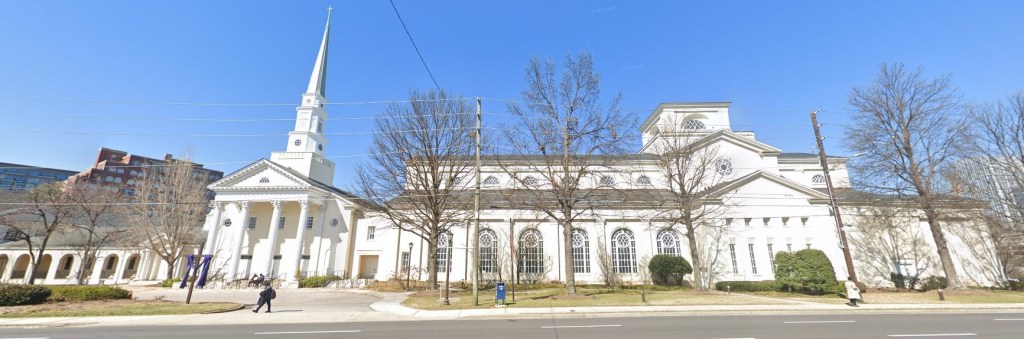
Is a church that is a long-term member of the community less likely to construct a McMansion and instead lean more toward the existing architecture of the neighborhood? Trying to picture a McMansion nearby a historic looking church building – see image below – does not work as well as imagining a McMansion near a newer megachurch in the sprawling suburbs.
Google Street View of Peachtree Road United Methodist Church
If religious congregations are in the business of building McMansions, there may be an interesting story to tell.
Last August, Dunkin’ opened its first “digital” location on Beacon Street in Boston. There are no cashiers, replaced by touchscreens and mobile ordering, and no seats or tables.
Dunkin’ is far from alone. Name a fast-food restaurant and the odds are the company has recently developed a branch without any restaurant at all. Chipotle’s first “Digital Kitchen,” which opened in upstate New York in 2020, has no dining room. A branch that opened last year in the Cleveland suburbs doesn’t even let customers inside the store. This summer, Taco Bell opened something it calls Taco Bell Defy, which is not a restaurant at all but a purple taco tollbooth powered by QR code readers and dumbwaiters that bring the food down from a second-story kitchen. The operation is, by most accounts, astoundingly efficient. Wingstop’s “restaurant of the future” doesn’t have seats or take cash.
What’s driving this trend? Partly savings on real estate and labor. But mostly it’s a response to consumer preference. Pushed by pandemic restrictions and pulled by the increasing ease of mobile transactions, customers have rushed into drive-thrus, delivery, and mobile ordering. Even with coronavirus fears in most Americans’ rear-view mirror, Chipotle’s in-restaurant sales now account for just a third of its business. At Panera, which opened its first to-go-only locations this summer, that figure is under 20 percent…
Like the parallel remote-work phenomenon, the rise of what McDonald’s calls the Three D’s—digital, drive-thru, and delivery—may reflect an ongoing social atomization as the shared spaces that emptied out during the pandemic are slow to fill back up, to the point that walk-up, dine-in customers like me are no longer the focus, and might even be a nuisance. Often lauded as a vital “third space” for seniors, teenagers, and families in communities that lack friendly public spaces, McDonald’s unveiled a concept store in 2020 that has no seating at all.
If those who used to eat inside these restaurants cannot do this, where will they go instead? This could lead to an uptick in eating restaurant food at home. This is a different kind of experience, more private with the diner have much more control over lighting, screens, sound, and more. It is much harder to fix wrong orders or to get more food. The restaurant experience might be limited to only larger outlays of money and specific foods in particular locations.
I heard about the idea of a mind palace years ago but this recent description reminded me of the interesting idea of putting a physical place into one’s brain:
The most popular technique to improve memory is the method of loci, also known as the mind palace (or memory palace). This ancient Greco-Roman technique can help you improve your memory in ways you never thought possible.
Greek and Roman orators memorized lengthy speeches by building structures (such as a palace) inside their imagination. They would then strategically place each word or idea they needed to remember in a specific location inside their mind palace. They could then later mentally retrace their steps and recall the details when they needed them.
This practice might then lead to physical changes in the brain structure:
Using MRI scans, researchers could see that mnemonic training elicited changes within the brain’s network. They also saw discernable differences in connectivity patterns that weren’t present in participants without training.
This reminds me of the idea of “distributed cognition” where humans use external devices to record information. Think of a notepad or a voice memo on a phone. The information is moved from the brain in acknowledgment that we cannot remember everything.
While the mind palace does not put the information outside the brain, it imports a device in which to record the information. It encodes it in the abstract concept of a building. Humans know what it is like to walk through buildings and/or follow directions to a desired goal. The conceptualized building is not real but it holds the information within the brain in a way that makes it easier to recall.
Physical structures do not just exist in a material reality, subject to construction, erosion, and other forces. They can live in our minds in ways that mean not just the information stored in them stays but also likely the buildings themselves live on there.
How might this be interpreted? Here is what came right before the data:
Although the rules have been relaxed and tightened over the years, the secondary mortgage market in the U.S. requires condo buildings to maintain a certain level of owner-occupied units in order to fund mortgages for buyers purchasing in those properties. If buyers can’t get mortgages easily for a condo unit, they will look elsewhere. That can depress prices for the entire property. (Over the years, the percentage of allowable units that may be rented has fluctuated from 50 to 80%. Fannie Mae’s current rate of allowed rentals in a condo building is 50%. )
Also, renters may be wonderful people but they don’t always make great neighbors. They may not take care of the overall property as carefully as a unit owner would, and the length of their tenancy tends to be shorter than the amount of time a unit owner lives in a home they own.
Are renters less desirable because too many rental units can affect property values and renters may not care for the residence and they do not stay as long? Having seen such arguments in my research on suburban settings, there are both perceptions about renters and systems regarding properties that contribute to the overall preference for homeownership. Renting may be necessary for some and/or for a time and/or in particular markets, but Americans overall privilege owners who in contrast to the sentiments above presumably stay longer, care more for their properties, and promote higher property values.
The rise of Big Data—the vast digital output of daily life, including data Google and Facebook collect from their users and convert into advertising dollars—is now a matter of national security, according to some policymakers. The fear is that China is vacuuming up data about the U.S. and its citizens not just to steal secrets from U.S. companies or to influence citizens but also to build the foundation of technological hegemony in the not-too-distant future. Data—lots of it, the more the better—has, along with the rise of artificial intelligence, taken on strategic importance…
Broad fears of technological hegemony may be overblown, some policy experts say. And harsh measures against China could alienate allies and trigger a rash of similarly harsh measures by counties abroad toward U.S. tech firms.
In any case, the U.S. is in an exceedingly weak position to lead a moral crusade for the sanctity of data. The concept of harvesting clicks, text, internet addresses and other data from unsuspecting citizens and exploiting them for commercial and national-security ends was invented in the halls of the National Security Agency, the CIA and the tech startups of Silicon Valley. Facebook (now Meta), Google, Amazon, Microsoft and Apple currently lead a vast industry based on trading and compiling user data. Taking measures to protect the data of American citizens from the ravages of Silicon Valley would go a long way to protecting them from China, too. Any measures directed solely against China would likely be ineffective because vast troves of consumer data would still be available for purchase on secondary data markets…
Whatever the case, some suggest the world is already moving inexorably towards a bipolar digital world—a move that will only accelerate as the burgeoning race for AI dominance between China and America picks up steam.
So data becomes just another area in which powerful nations fight? Does the data with all of its potential and pitfalls simply become a national instrument of power?
There could be other options here. However, it might be hard to know whether these are preferable compared to states wanting to control big data.
In the hands of users. Move data toward consumers and individuals rather than in the hands or accessed by nations and corporations.
In the hands of corporations. They often generate and collect a lot of this data and then operate across nations and contexts.
In the hands of some other neutral actors. They may not exist yet or have much power but could they in the future?
This bears watching because this could go well or not and would have wide consequences either way.
As more people pour into metropolises—urban populations are projected to double in the next three decades, according to the World Bank—scientists like Bousselot are investigating how designers and planners can ruralize cities, greening roofs, and empty lots. The concept is known as “rurbanization,” and it could have all kinds of knock-on benefits for ballooning populations, from beautifying blocks to producing food more locally. It dispenses with the “city versus country” binary and instead blends the two in deliberate, meaningful ways. “You don’t have to set this up as a dichotomy between urban and rural, really,” says Bousselot. “What we should probably focus on is resilience overall.”…
But while rurbanization has enticing benefits, it has some inherent challenges, namely the cost of building farms in cities—whether on rooftops or at ground level. Urban real estate is much more expensive than rural land, so community gardeners are up against investors trying to turn empty spaces into money—and even against affordable developments aimed at alleviating the severe housing crises in many cities. And while rooftop real estate is less competitive, you can’t just slap a bunch of crops on a roof—those projects require engineering to account for the extra weight and moisture of the soil.
But the beauty of rurbanization is that agriculture and buildings don’t have to compete for space. Urban land is limited, which means that high-yielding, fast-growing, space-efficient crops work great, says Anastasia Cole Plakias, cofounder and chief impact officer of Brooklyn Grange, which operates the world’s largest rooftop soil farms. “That said, we approach the design of our own urban farms, as well as those we build for clients, with the consideration of the unique character of the community in which we’re building it,” says Plakias. “Urban farms should nourish urban communities, and the properties valued by one community might vary from another even in the same city.”
The primary dividing line referenced here is the presence of agriculture: this happens in rural areas, not so in cities. Bring agriculture to denser population centers, and important lines are crossed.
Maybe? Adding agriculture may or may not affect some of the key features of cities and rural areas: population, population density, land use (not just agriculture), amenities, and ways of life.
Perhaps this is more of an experiment that is just starting up. What are the effects of introducing significant amounts of agriculture plots in major American cities?
The plans revealed Tuesday by the Bears call for a multipurpose entertainment district anchored by a stadium that could host the Super Bowl, college football playoffs and college basketball Final Four, with an adjoining commercial/retail and housing district. While cautioning that the long-term vision for the entire property is a work in progress, the team said the site could include restaurants, offices, a hotel, fitness center, parks and open spaces.
The team’s open letter provided a series of economic projections, saying the large-scale redevelopment would provide “considerable” economic benefits to Cook County, the region and state.
For instance, construction would create more than 48,000 jobs, result in $9.4 billion in economic impact in the region, and provide $3.9 billion in labor income to workers, the team said.
The development would generate $16 million in annual tax revenue for the village, $9.8 million for the county and $51.3 million for the state, according to the Bears.
Yes, a stadium is necessary for football but teams now want to develop more land and generate additional revenues adjacent to the sports playing surface. If they help generate such development and/or retain an ownership stake in the surrounding development, this can both bring in significant annual revenue and further boost the value of their franchise.
This also follows on-trend development ideas where a mixed-use property helps ensure a regular flow of activity. Instead of separating land uses in different places, putting them all together can create synergy and additional revenues.
Another way to think about it is that a lot of sports teams are in the land development business. How exactly this fits with a goal of fielding a winning team might get complicated.








 Legally Sociable