Defining rigor in a college course

A discussion continues of what makes for a “rigorous” college course:

Photo by ICSA on Pexels.com

Here’s how Kevin Gannon draws the distinction. Courses can be difficult intellectually; they can be difficult logistically. Professors sometimes conflate the two, imagining that content and policies move together. But they need not, says Gannon, who directs the teaching center at Grand View University, where he is also a professor of history…

From this vantage point, flexible course policies might not be at odds with demanding rigor, as the terms of the debate are often delineated. But intellectual rigor turns out to be tricky to pin down…

Instead, the faculty developers think that professors often rely on the wrong information as evidence they’ve achieved rigor. Grading on a bell curve, they argue, doesn’t prove a course is rigorous. It compares students with their classmates, but doesn’t demonstrate what they know or learned. Neither does assigning a lot of work: There’s no strong correlation between learning and the quantity of information taken in or repeated back. Yet much of the evidence of rigor comes down to either grades or time on task…

Despite the many biases found in course evaluations, Sonal Khullar, an art historian who is an associate professor of South Asian studies at Penn, has found they can provide useful evidence that she’s hit the mark on rigor. Khullar was surprised to hear grades, assignments, and standards held up as key evidence of rigor. “I measure it by their own standards,” Khullar says. The goal isn’t for students to hit some benchmark she has set; it’s for them to improve…

Most professors aim to both support and challenge their students. It’s just that some of them think the standard structures of higher ed work toward those goals— and others aren’t so sure.

I am consistently surprised as a college instructor about how much could be in each class I teach. Regardless of the subject, there is always more we could get to or worth through. As noted in this article, a question about rigor can be expressed as the difference between covering content and applying that content or developing depth with that content. There can often be much knowledge to share and work with but applying and utilizing the knowledge is key. Thinking about Bloom’s Taxonomy can help guide classroom efforts.

I clearly remember how I experienced this as a K-12 and college student: the instructors who had high expectations but also provided the encouragement and the resources necessary to reach for those expectations.

Populations – national or local – can grow or decline through births, deaths, and immigration

While the focus here is on the United States as a whole, this is also worth considering at the community level:

Photo by Skitterphoto on Pexels.com

A country grows or shrinks in three ways: immigration, deaths, and births. America’s declining fertility rate often gets the headline treatment. Journalists are obsessed with the question of why Americans aren’t having more babies. And because I’m a journalist, be assured that we’ll do the baby thing in a moment. But it’s the other two factors—death and immigration—that are overwhelmingly responsible for the collapse in U.S. population growth…

As recently as 2016, net immigration to the United States exceeded 1 million people. But immigration has since collapsed by about 75 percent, falling below 250,000 last year. Immigration fell by more than half in almost all of the hot spots for foreign-born migrants, including New York, Miami, Los Angeles, and San Francisco…

The implications of permanently slumped population growth are wide-ranging. Shrinking populations produce stagnant economies. Stagnant economies create wonky cultural knock-on effects, like a zero-sum mentality that ironically makes it harder to pursue pro-growth policies. (For example, people in slow-growth regions might be fearful of immigrants because they seem to represent a threat to scarce business opportunities, even though immigration represents these places’ best chance to grow their population and economy.) The sector-by-sector implications of declining population would also get very wonky very fast. Higher education is already fighting for its life in the age of remote school and rising tuition costs. Imagine what happens if, following the historically large Millennial cohort, every subsequent U.S. generation gets smaller and smaller until the end of time, slowly starving many colleges of the revenue they’ve come to expect.

Even if you’re of the dubious opinion that the U.S. would be better off with a smaller population, American demographic policy is bad for Americans who are alive right now. We are a nation where families have fewer kids than they want; where Americans die of violence, drugs, accidents, and illness at higher rates than similarly rich countries; and where geniuses who want to found new job-creating companies are forced to do so in other countries, which get all the benefits of higher productivity, higher tax revenue, and better jobs.

This matters for communities and cities in at least a few ways:

  1. The “growth is good” model in the United States assumes continued population growth. This is good for status as well as for other things (see #2).
  2. When populations are growing, the incoming revenues help pay for existing infrastructure and services as well as suggest money will be there in the future. In contrast, stagnant or declining populations can require cuts or reductions.
  3. The role of immigration cannot be understated and it affects population as well as demographics and local economics. For example, Chicago would have likely had more population loss over recent decades without immigrants coming to the city.

It will be particularly interesting to see what happens if more major population centers experience relatively little or no population growth while a few continue to grow rapidly. Does this change the balance of power and status among places?

Residents, local leaders oppose a plan to redevelop a struggling suburban mall with 560 apartments and several businesses

Charlestowne Mall in St. Charles, Illinois has struggled in recent years (earlier posts here and here). Yet, when a developer proposed adding 500 apartments to the property, residents and local leaders did not like the idea:

Google Street View

Plans were to raze the majority of the largely vacant mall to make way for 560 apartments and townhouses, a hotel, new restaurants and retail spaces along East Main Street…

“It’s a good plan but the question is, is this the best use of space?” 2nd Ward Alderman Ryan Bongard said at the meeting. “In speaking with constituents, they don’t want to see 500 apartments.”

On Friday, St. Charles Mayor Lora Vitek confirmed the developers have pulled out of the project. The partnership of S.R. Jacobson Development Corporation and Lormax Stern Development Company LLC had previously entered into a purchase agreement for the former Charlestowne Mall property with current owners The Krausz Companies LLC.

In December 2017, Krausz closed Charlestowne’s interior shops and enclosed mall space at the center. Anchors Von Maur and Classic Cinemas Charlestowne 18 remains…

“That’s the overwhelming comment that I have heard through the city council,” Vitek said. “And I do believe that we can try to accomplish that. We shouldn’t settle. We’ve got a lot going for us. We know there needs to be more people here and we’re going to bring residential, but there needs to be a balance over there, too. The east side is very important to our town, but we do want to see the right fit.”

On one hand, I can understand this common suburban concern: if you eliminate commercial property and rezone it for other uses, will you ever get the same amount of money in tax revenues from the property? A successful shopping mall or entertainment area brings in sales tax revenue in addition to paying property taxes.

On the other hand, this particular shopping mall has languished for years. Shopping malls in general face big issues and many will not survive. There are only so many suburban entertainment districts that will work. A willing developer wants to build a mix of residences and businesses and it is not enough?

Here is my guess about what scuttled this project: suburbanites do not often like the idea of hundreds of apartments, particularly when they are located in a community that sees itself as full of nice single-family homes. Apartment dwellers are looked at with suspicion. Apartments threaten the single-family home nature of the community as they can increase traffic, bring more kids to local schools, and threaten local property values. Even expensive apartments are not desirable in large numbers.

As St. Charles does not “settle” for this kind of proposal, what better option will come along?

Imagining St. Louis as the capital of the US

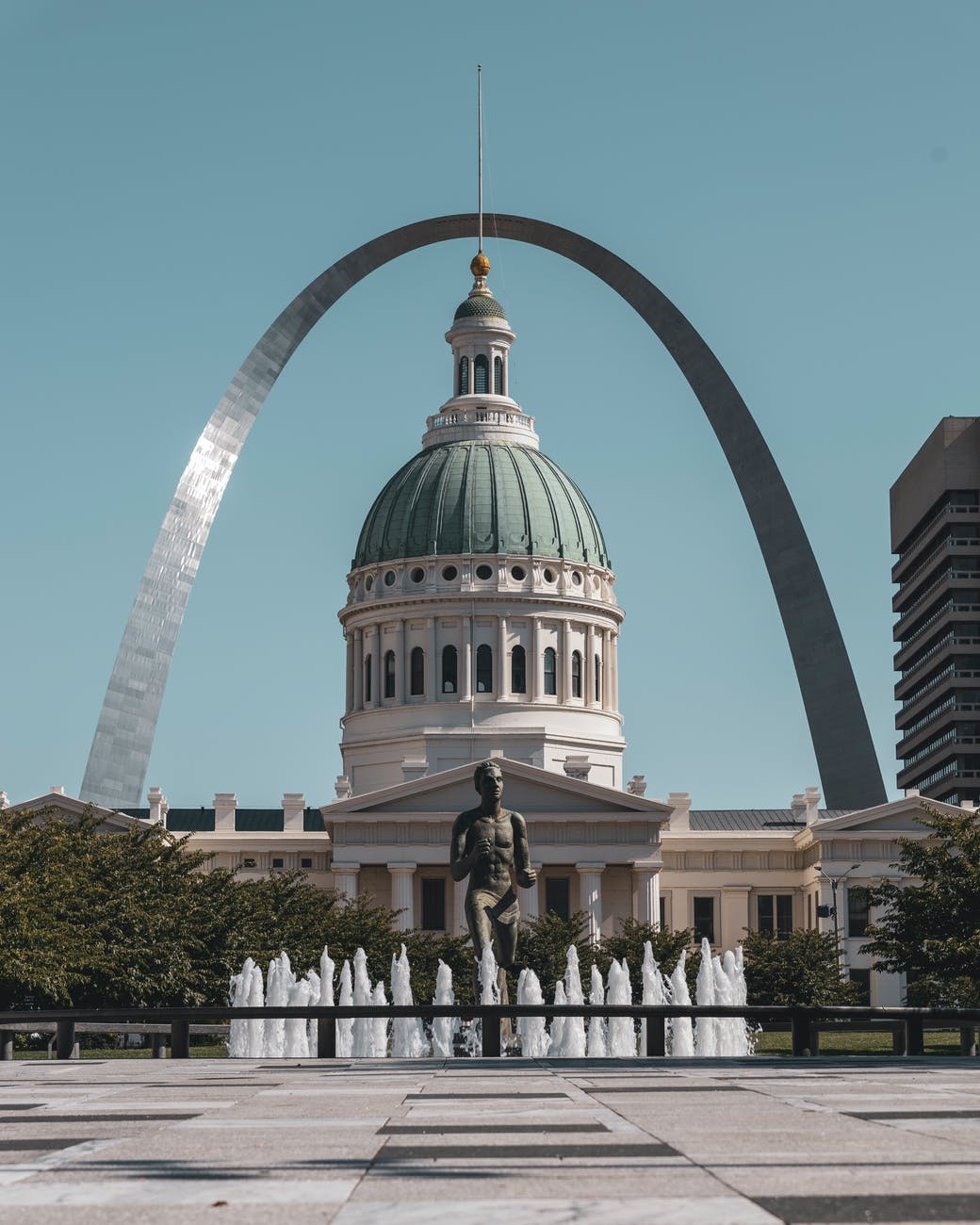
It is fascinating to consider (1) a different capital in the United States in the center of the country and (2) a different center to the Midwest:

Photo by Nick Haynes on Pexels.com

In some ways, Arenson says, St. Louis was at the heart of these questions. Geographically, it was located where North, South and West came together. It had been a slave state, but had not seceded. It was central to many railroad lines. And it was growing at a remarkable place—it would rise from the country’s 24th most populous city in 1840 to the fourth biggest in 1870.

No one was more convinced of the importance of St. Louis than local businessman and booster Logan Uriah Reavis. Reavis was a remarkable man, with a remarkable appearance. He wore a long, messy red beard and walked bent over a cane due to a childhood illness. Born in Illinois in 1831, he failed in his early career as a schoolteacher “when the students ridiculed him ceaselessly,” according to Arenson’s book. In 1866, he arrived in St. Louis intent on starting a newspaper and elevating the image of his adopted hometown.

Reavis wasn’t the first to suggest the city as a new capital for the nation. In 1846, St. Louis newspapers claimed that the move would be necessary to govern a country that grew significantly in size after the end of the Mexican-American War. But Reavis may have been the most outspoken supporter of the cause. He presciently envisioned a United States stretching not just out to California but up to Alaska and down to the Gulf of Mexico. And he saw St. Louis as the obvious place for the government of this mega-United States: “the great vitalizing heart of the Republic.” In contrast, he wrote, Washington was a “distant place on the outskirts of the country, with little power or prestige.”…

In response, between 1867 and 1868, three House representatives from the Midwest proposed resolutions to move the capitol toward the middle of the country. As historian and educational publisher Donald Lankiewicz writes for History Net, the first two of these stalled in the Ways and Means committee. But a third, introduced by Wisconsin Representative Herbert Paine in February 1868, came to a vote on the floor. Eastern congressmen saw the proposal to move the seat of government to somewhere in the “Valley of the Mississippi” as a joke. But it shocked them with the amount of support it received, ultimately failing by a vote of just 77 to 97.

This story sounds very American: local boosters combined with an expanding frontier and disorder after the Civil War to produce a vision for a new capital in a booming city. Even though this did not come to fruition, it sounds like there was a short window in which is could have happened. And then what would have happened to Washington, D.C., one of the most important cities today?

I also cannot help but contrast this to the fate of St. Louis after this era. I recently showed my urban sociology class the documentary The Pruitt-Igoe Myth. This documentary puts the infamous public housing project in the context of a city that peaked in population in 1950, lost residents in white flight, and is racially segregated. Add this to the competition with Chicago for the center of the Midwest and St. Louis might be a great story of a city that did not live up to its lofty dreams.

What happens to an athlete’s McMansion when they go to a new team?

Quarterback Matt Ryan is now a member of the Indianapolis Colts after a trade from the Atlanta Falcons. What happens now to Ryan’s suburban McMansion outside Atlanta?

At the least, Ryan can enjoy lounging outside his large dwelling by a ping-pong table and think about handing it off to Jonathan Taylor?

I wonder what the market is for large houses of former athletes. I know of some high profile houses in the Chicago region where pro athletes sell their homes to other athletes who are coming to town. Some big houses, such as Michael Jordan’s mansion, languish for years.

From what I saw, Ryan’s home is not a mansion or a megamansion. Because it is more of a McMansion, it likely will find a buyer in a growing metropolitan region among those with resources to purchase such homes and who like such homes. Perhaps it might depend on how much football the house reflects; for example, see former Bears coach Matt Nagy’s house listing.

Of course, it will also be interesting to see where Ryan settles in the Indianapolis region. Will he settle in the wealthy suburban communities of Carmel or Fishers where I would guess some McMansions can be found?

Americans overestimate the size of smaller groups, underestimate the size of larger groups

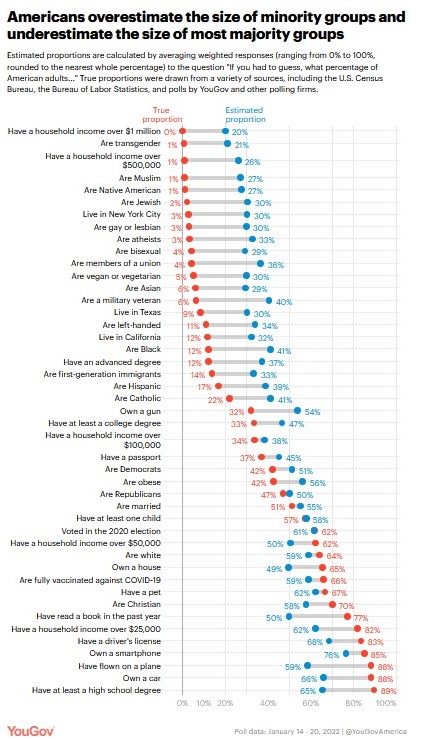
Recent YouGov survey data shows Americans have a hard time estimating the population of a number of groups:

When people’s average perceptions of group sizes are compared to actual population estimates, an intriguing pattern emerges: Americans tend to vastly overestimate the size of minority groups. This holds for sexual minorities, including the proportion of gays and lesbians (estimate: 30%, true: 3%), bisexuals (estimate: 29%, true: 4%), and people who are transgender (estimate: 21%, true: 0.6%).

It also applies to religious minorities, such as Muslim Americans (estimate: 27%, true: 1%) and Jewish Americans (estimate: 30%, true: 2%). And we find the same sorts of overestimates for racial and ethnic minorities, such as Native Americans (estimate: 27%, true: 1%), Asian Americans (estimate: 29%, true: 6%), and Black Americans (estimate: 41%, true: 12%)…

A parallel pattern emerges when we look at estimates of majority groups: People tend to underestimate rather than overestimate their size relative to their actual share of the adult population. For instance, we find that people underestimate the proportion of American adults who are Christian (estimate: 58%, true: 70%) and the proportion who have at least a high school degree (estimate: 65%, true: 89%)…

Misperceptions of the size of minority groups have been identified in prior surveys, which observers have often attributed to social causes: fear of out-groups, lack of personal exposure, or portrayals in the media. Yet consistent with prior research, we find that the tendency to misestimate the size of demographic groups is actually one instance of a broader tendency to overestimate small proportions and underestimate large ones, regardless of the topic. 

I wonder how much this might be connected to a general sense of innumeracy. Big numbers can be difficult to understand and the United States has over 330,000,000 residents. Percentages and absolute numbers regarding certain groups are not always provided. I am more familiar with some of these percentages and numbers because my work requires it but it does not come up in all fields or settings.

Additionally, where would this information be taught or regularly shared? Civics classes alongside information about government structures and national history? Math classes as examples of relevant information? On television programs or in print materials? At political events or sports games? I would be interesting in making all of this more publicly visible so not just those who read the Statistical Abstract of the United States or have Census.gov as a top bookmark know this information.

Planning for the metaverse libertarian urban paradise

The quest for a free online city continue with the help of a prominent architectural firm:

Photo by Andrea Piacquadio on Pexels.com

Zaha Hadid Architects (ZHA) has revealed renderings of the “cyber-urban” Liberland metaverse, a small virtual city made of futuristic, curving buildings in the architectural style that made the late architect’s firm famous. When complete, it will offer users the ability to traverse the hub as an avatar, and feature a city hall, collaborative working spaces, shops, business incubators, and a gallery for NFT art shows. The community it hopes to foster will have a focus on self-governance as well as fewer rules and regulations.

Those ideals are based on the so-called Free Republic of Liberland, a real-life micronation founded by Czech politician Vit Jedlicka in 2015 with a goal to implement small government libertarian values. Wedged between Serbia and Croatia, the 2.7-mile territory, which is larger than the Vatican and Monaco, is a disputed land and claimed by neither country. Since its founding, no one has moved to Liberland, which lacks any infrastructure, nor has construction started in earnest. But it does have 7,000 approved residents and 700,000 applications, according to Jedlicka, who told CNN in an email. The micronation also has a national flag, anthem and currency — the cryptocurrency Liberland merit…

Though many metaverse concepts have been born out of video game aesthetics — Mark Zuckerberg’s concept for a Metaverse, for example, looks similar to Nintendo Wii’s avatar design — the digital architecture of Liberland is meant to be more grounded in reality. The buildings, while hyper-futuristic, are similar to the glossy look of typical architectural renderings. But they were made with parametric design — a method that employs algorithms to create complex forms…

But while many online forums and social media companies have had to grapple with how much to moderate their users, with sites like Reddit having to move away from their ideals of unmitigated free speech as their user base ballooned, Liberland will start out as an exclusive space and expand slowly, in order to keep its community in check. Jedlicka confirmed that Liberland citizens and residents will have first access.

This combines several ideas with their own fan bases – the metaverse, libertarianism and small government, this architectural style – and tries to put them together in once place. I wonder if this hints at a fragmented metaverse where people of different interests and community ties come together in a few settings but they do not go elsewhere.

It is also worth noting that while this is only a online place, it is not disconnected from the offline realm in multiple ways. First, the online realm tries to imitate the offline with its use of space, buildings, and architecture. Second, those who operate in the online realm still have physical bodies and interactions outside of Liberland. This will be billed as new and exciting because it is in the metaverse…but physical matter still matters in multiple ways for this new community.

The importance of the globe’s five biggest forests

A new book outlines the outsized role of the five remaining big forests in the world:

Photo by thiago japyassu on Pexels.com

All forests can help, but large forests are of supreme importance for the climate. The five largest ones left—the megaforests—include boreal forests in Russia and North America, and the tropical forests in the Amazon, Congo, and New Guinea. Intact forests are 20 percent of the tropical total and store 40 percent of the aboveground forest carbon in the low latitudes. New research led by Sean Maxwell, of the University of Queensland, and 11 collaborators suggests that the carbon benefit of intact tropical forests is six times greater than the Intergovernmental Panel on Climate Change and others have estimated to date. That’s because in the years after a big forest is broken up by roads or farms, its edges dry out and winds whistle through, blowing over big trees. Fires invade it more readily, and overhunting eliminates animals that disperse seeds. And on top of all the carbon vaporized from the space actually deforested, over the next several decades the climate will be stuck with 14 metric tons of extra carbon per acre that the lost tropical forests would have absorbed had they remained standing…

This experiment began in 1979. It ended up with five plots measuring two and a half acres, four at 25 acres, and two covering 250 acres. Matching control plots in continuous forest were also established. By 2002, the project had produced a simple answer about fragmentation: Large intact areas are very important, the larger the better. Even the 250-acre reserves were too small for forest-interior bird species, half of which vacated these patches in less than 15 years. The edges were hotter and drier, with great mats of desiccated leaves from trees either dying or losing foliage to wind. There were more vines, thicker undergrowth, and fewer mushrooms.

Species that need continuous tree cover decamped. Black spider monkeys, for example, who move fast through large areas of forest eating fruit from widely spaced trees, abandoned all the forest fragments immediately. They stayed in nearby continuous forest. Howler monkeys, by contrast, are leaf eaters and not particularly choosy. They remained in all the fragments. The white-plumed antbird, so named for the spiky crest between its eyes, could not persist in the fragments. Antbirds follow raiding ant armies and eat the bugs flushed out by the lethal column. Though 250 acres is sufficient territory for one ant colony, each colony marches only about a week per month. So, to avoid going hungry for weeks at a time, the white-plumed antbirds need to follow several colonies on a rotating basis. The 250-acre fragments were at least three times too small for the birds. No antbirds means no antbird droppings, which deprives shimmering blue-and-black skipper butterflies their sustenance. They left too…

Big forests are a linchpin in a planetary system. They are vivid stages for stories about energy and matter that we describe severally with our physical, biological, and chemical sciences, but are really a single story whose intricacies and meaning we don’t fully understand. Orchid bees make Brazil nuts, feed agoutis, take carbon from the air, breathe water back into it, make clouds that make rain a hundred miles away that feeds a stream, where a catfish, having migrated from the mouth of the Amazon, is caught by an otter or by a person, surrendering its protein to enliven the woods. The bee makes all these things, and these things make the bee.

One takeaway from this research: the way trees and nature are often treated in urban and suburban settings does not fully grapple with the larger impact of trees and forests. Isolated pockets of green are not necessarily bad but there is a difference in scale between those possibilities in more densely settled locations and large unbroken forests.

Another interesting aspect to consider is the human interaction with these large forests. Coming off reading the The Dawn of Everything, the shift to agriculture and living in larger cities in metropolitan areas did really create a divide between certain natural settings where humans could thrive and what became the settings for much of human activity.

This book also reminded me of this January 2022 piece on a man who has explored the old growth forests of New England and how much this differs from many contemporary experiences with trees and forests.

“60 Minutes” on the 4+ million housing units needed in the United States

This past Sunday, 60 Minutes addressed the sizable need for housing throughout the United States:

Photo by Max Vakhtbovych on Pexels.com

Daryl Fairweather: We are not building enough housing for everybody who needs a place to live. We built fewer homes in the 2010s than in any decade going back to the 1960s, and at the same time millennials are the biggest generation and they’re entering into home-buying age. Millennials aren’t living in their parents’ basement any more or shacking up with roommates, they want a place of their own, and we didn’t build any housing for them in the last decade because we are still so traumatized by the last housing crisis. We didn’t put any investment into housing…

Daryl Fairweather: The government has estimated that we are short about 4 million homes in this country, and that number is likely growing, especially since the pandemic.

In my opinion, the emphasis in the rest of the segment on institutional buyers is a weird way to go given the numbers cited above. If we need over 4 million housing units, it seems like more of this falls on developers, builders, and communities to open up opportunities for new housing for millennials and others who really want it.

I wonder how much of this now works like it seems to in the auto industry. Auto makers have shifted to making trucks and SUVs because there is demand and a higher profit margin. These vehicles are not greener but there is a lot of money to be made. Is the same true of starter homes? Smaller units simply do not bring in as much money as a larger house with more amenities. And, if builders and developers have to go through a significant process to purchase land, get approval, and go through construction, wouldn’t they want more money at the end?

I think we should ask about the civic responsibility of those who can approve homes and/or build homes. Don’t we need more housing? Shouldn’t this be a shared responsibility across actors? Why are so many Americans willing to get into their particular housing unit and then shut the door to those who want a similar opportunity?

Quick Review: Can’t Get You Out of My Head

The six part documentary Can’t Get You Out of My Head: An Emotional History of the Modern World captures well the foreboding and confusion of our current moment at the beginning of the third decade of the twenty-first century. Here are a few thoughts on what I found to be a thought-provoking and interesting watch:

  1. The general premise is that the freedom, prosperity, and joy that was supposed to come with the ascension of liberal democracy and individualism at the end of the twentieth century did not come. Indeed, it may have led to new and more troubling questions. The sweep of history is limited to roughly the last 100 years but there is a lot to consider over the six episodes. Even if you do not agree with the argument, there are a number of threads and points of information that may be new and/or have not always been put together in such ways.
  2. The construction of the documentary adds to the foreboding as its intersperses multiple threads across different countries, montages of images set to generally upbeat pop music, and a dark instrumental soundtrack.
  3. That this work is not from an American point of view and includes important actors from around the globe is very important. There were things I had not known before. I know the American perspective on the world is very biased and yet my daily reading is almost exclusively in this realm. At the same time, the documentary is still from an Anglo perspective and it would be worthwhile to hear form voices elsewhere on what is chooses to say and show and what it does not address.
  4. Just as an example of one of the important questions raised: what happens if a democratic people elect or support an undemocratic leader? More specifically, what do the cultural and political elites do in such a moment? In the current populist period, this is a real conundrum.
  5. One thing I appreciate is the interest in thinking across contexts and time. I would argue we need more work that tries to pull together multiple strands from around the globe across big chunks of time. Put this documentary series next to Graeber and Wengrow’s The Dawn of Everything and there may be some patterns worth considering.

While I finished watching this several months ago, the title is correct: I cannot get some of the ideas and images out of my head.