Hot rental market in Phoenix and supplying enough housing

In an article about a large and expanding encampment of the homeless in Phoenix, here are some details about how rental prices in the city have shot up:
Photo by Justin Nealey on Pexels.com

“People say, ‘Are you surprised?’ And I say, ‘No, not really, because all of the housing forces in Phoenix and Maricopa County have been working against us for years,’” said Human Services Campus Executive Director Amy Schwabenlender, who works in the area with the encampment, sometimes referred to as “the Zone.” “We’ve had ongoing population increases in Phoenix and Maricopa County. We haven’t had housing production at all income levels keep up and meet that increase in population.”

Real estate investors are pouring cash into Phoenix and driving up prices. Rents there have spiked 25.6% over the past year, compared to a 15.9% increase in the U.S. from January 2021 to January 2022, according to data analyzed by Zillow. (Other popular Sun Belt cities like Miami and Tampa have also seen dizzyingly fast increases in rent.) Vacancy rates in Phoenix, or the availability of places for people to rent, are also at their lowest in 50 years, according to the Arizona Republic

While much of the rest of the article focuses on addressing housing for the homeless, this sounds like a bigger issue. This is an area with a growing population: Phoenix is now the fifth-largest city in the US and had a little over 100,000 residents in 1950 before experiencing double-digit percentage population growth in all but one decade since. Housing opportunities, particularly in rentals, have not kept up. American sprawl often produces a lot of single-family homes but necessarily cheaper houses or multi-family units for those who cannot secure a sizable mortgage.

What can Phoenix and surrounding communities do? Addressing housing in the United States is a difficult task. It will take concerted effort across communities for years. It may not be popular. But, it is essential for ensuring housing for all who need it.

It would be great to have an example of a city and region in the Sun Belt – roughly Virginia to southern California – that has successfully addressed this even as they have experienced significant growth in recent decades. I do not know if there is a great example, outside of some places not becoming too popular such that it raises demand and housing prices.
Save the farm from turning into McMansions by writing a song

Tennessee’s 11th state song – “I’ll Leave My Heart in Tennessee” – was inspired by a threat of McMansions in a Nashville suburb. According to the writer of the song:

Photo by adanvdo on Pexels.com

So, I sold the farm and horses and moved into the beautiful suburb of Brentwood where I was on only an acre of land. It was great but not me, as I grew up in a rural area and loved the farm. I so missed walking the land.

In 2004, when I wrote the song, the only bucolic land in Brentwood was a 250-acre farm called Green Pastures on the corner of Franklin Road and Concord, owned by the Turner family (Dollar General/etc). They boarded horses there and a friend ended up bequeathing me a gorgeous six-year -old paint mare and said he would pay for its care if I got it ready to ride for his daughter someday. It was a beautiful compromise to living in the suburb yet having a masterpiece of a farm three miles down the road. Everyone there just loved it, and it was a close group of people who boarded there. Many said it was what kept them sane going through divorces or cancer, etc. Horses really are healing creatures…. especially when you don’t have to pay for them! It was such a gift to go out there and ride on the property or just hang out there with the horses and boarders. It was a family.

Well, at one point, developers (‘damn those developers they’re cold and heartless’) got the ear of the Turners and they were going to sell it off to put up what we called McMansions…. the LAST thing Brentwood needed. It went so far as to have a huge sign with the plans and everything. The barn family was of course heartbroken. So, I said, ‘Let’s at least try and see if we can have them save at least part of the property.’ I suggested we put a digital scrapbook together with each boarder having two pages of pictures and what the place meant to them. Underneath I put the song I’ll Leave My Heart In Tennessee. We gave it to the Turners and were told they cried when they watched it. I’m not saying my idea was the only reason they decided to stop the development, but I do think it may have been the catalyst/last straw to validate what a unique place they had.

They helped SO many people PLUS just driving by and looking at the property was uplifting to anyone with eyes! It staved off the development for over 10 years. A few years ago, they decided to stop the boarding business, but the property still remains today. I don’t know what their plans are for it. I worked with a grass roots group called Save The Brentwood Green Space for a while who put up an idea for the city of Brentwood to buy the property, but the citizens took a look at the $50 million price tag and got spooked. I would assume the price NOW would be over $100 million so they lost a deal!”

Today I learned Tennessee has 11 state songs (!!).

At the same time, this could be a story from many states and metropolitan regions: the farmland once common is quickly turning into houses. Not just any houses; big houses with dubious architectural quality (i.e. McMansions). The farm will be gone and replaced with supposedly impressive yet private homes.

How often does such a scenario lead to writing a popular song? Not often. Instead, neighbors and residents might quietly seethe. They could show up at local meetings and make their displeasure known. Some might even move away to find a different plot of land still near farms or open space.

As far as I can tell in watching performances of the song on Youtube, the song decries “progress” and sprawl but does not specifically call out McMansions…

Fewer people out and about in cities in 2020 so more people were victims of crime?

A working paper tries to put crime in the recent context of fewer people moving around cities in 2020:

Photo by Nout Gons on Pexels.com

Each of these metrics basically reports the same thing: A huge and prolonged decrease in the total number of hours people spent out and about in the American city. This decline peaked in April 2020, but urbanites stayed sedentary throughout the year, relative to 2019.

For crime data, the duo used statistics from New York, Los Angeles, and Chicago, which enabled them to sort for violent crime that occurred in public—a category that included streets, parks, alleyways, commercial establishments, and offices.

The results: From March to December, 2020, public violence in the three cities was 19 percent lower than it had been in 2019. But when put into the context of how little Americans left the house that year, that data takes on a different significance. In April, for example, violent street crime fell by 30 percent—but the risk of being a victim of such a crime rose by almost 40 percent. A similar pattern held for the whole year: Even as street crime fell, the risk of being a victim of a crime rose between 15 and 30 percent over the previous year, depending on which measure of “outdoor activity” was used. In short, if you spent time in public, you were more likely to be robbed or assaulted in public in 2020 than in 2019.

For what it’s worth, that risk remained very, very small: 12 violent crimes per million outdoor hours, or more than 80,000 safely-spent outdoor hours for each violent crime.

This is an interesting way to think about perceptions of crime: even if fewer crimes were committed, they might feel like more if there was less activity. This reminds me of some of the images going around from the early days of the COVID-19 pandemic of empty streets and cities. Once busy places simply did not have people. How did this affect perceptions of safety in public settings?

Would the same idea apply to media reporting on crime: because of a lack of other public activity (beyond COVID-19), did crime receive more attention even if there were fewer crimes? Perceptions of crime might be more important than the actual statistics themselves. Americans can be fearful even as numbers go down.

Sociology and “milling” online

When unusual or bad events occur, how do people respond? They go online to try to make sense of it all:

Photo by San Fermin Pamplona on Pexels.com

I don’t know what to make of all this, and I doubt if there is anything to be made. But the behavior on display is, if nothing else, a product of a lack of sense. It’s the agitated, aimless buzzing of the type of crowd that gathers in the aftermath of some bewildering catastrophe. Social scientists have a name for this mode of chaos: They call it “milling.” We are all just chattering away in restless and confused excitement as we try to figure out how to think about what’s happening. We want to understand which outcomes are most likely, and whether we might be obligated to help—by giving money or vowing not to share misinformation or learning the entire history of global conflict so as to avoid saying the wrong thing. We are milling.

The word comes from the mid-20th-century American sociologist Herbert Blumer, who was interested in the process by which crowds converge, during moments of uncertainty and restlessness, on common attitudes and actions. As people mill about the public square, those nearby will be drawn into their behavior, Blumer wrote in 1939. “The primary effect of milling is to make the individuals more sensitive and responsive to one another, so that they become increasingly preoccupied with one another and decreasingly responsive to ordinary objects of stimulation.”

These days, we mill online. For a paper published in 2016, a team of researchers from the University of Washington looked at the spread of rumors and erratic chatter on Twitter about the Boston Marathon bombings in the hours after that event. They described this “milling” as “collective work to make sense of an uncertain space” by interpreting, speculating, theorizing, debating, or challenging presented information.

To apply the term to the current moment may be a little sloppy—for a sociologist, milling would be the precursor to meaningful group action—but it gets across, you know, the current mood. We’re emoting, lecturing, correcting, praising, and debunking. We’re offering up dumb stuff that immediately gets swatted down. (We’re getting “ratioed,” as it’s called on Twitter.) We’re being aimless and embarrassing and loud and responding to each other’s weird behavior. “People are kind of struggling to figure out appropriate ways of responding to this really uncertain situation,” Timothy Recuber, an assistant sociology professor at Smith College, told me. Recuber, who is also the author of Consuming Catastrophe: Mass Culture in America’s Decade of Disaster, is an expert on the role that media play in what he calls “unsettled times.” And in these unsettled times, he said, we’re engaged in something like what Blumer had in mind.

The wisdom of crowds as an emergent property in the midst of uncertainty?

I wonder how this milling has changed over time. Specifically, I am thinking about spatial changes in the United States over the last century or so. Milling could work better when people live either in denser areas or small towns. This could lead to having “the public square” described above for people to gather. In a more suburban setting, where a majority of Americans now live, where would milling take place? Walking outside their house or residence might put them in contact with some neighbors but it would take some driving for many to get to a location where people might gather. Go to the shopping mall? The local library? Walmart?

If suburbanization reduced public spaces for gathering and add to this fewer people going to work during COVID-19, the online sphere offers more opportunities. The physical geography matters less when people can enter an online public square from anywhere. Now, there are numerous public squares available online with certain platforms or sites offering different opportunities and population with which to interact.

How effective is this online milling as opposed to milling in a offline location? In the offline public square, there is an embodied experience with people. The online public square is different with fewer cues from other actors and someone has to say/do something to be recognized.

The wait for a weekly TV show versus binge watching a show quickly

We are far into a world where viewers of television shows can watch season after season of a show. Whether through a streaming service, on DVD, on a DVR, or on-demand, fans can watch everything right in a row. Depending on the length of the series, this can go relatively quickly or stretch out a while. Because of this possibility, I just recently started a list of TV shows where I have seen every episode and most of this has happened in the last ten years.

Photo by JESHOOTS.com on Pexels.com

In contrast, I had two primary options in the past: watch episodes as they aired each week or watch an occasional episode. For the first, I only really remember doing this for a few shows. The most memorable is Lost. We started watching late in Season One and did not miss a weekly episode for years. The show certainly took advantage of this with numerous cliffhangers and important episodes to start and close seasons. For the second option, I saw a number of TV shows through syndication as they worked through their cycles. For example, I am not sure I ever saw Frasier in its prime-time slot but I saw nearly every episode because of the 2+ episodes that there on every night.

The two types of watching are very different. Binge watching allows viewers to take it all in quickly. I can enable mass consumption. Feelings come and turn quickly with changing narrative arcs. The weekly or episodic watch required a certain discipline and memory or the kind of show where one could easily dip in for a few episodes and then tune out for a while. The resolution of stories takes longer.

It will be interesting to see how shows continue to navigate these options: release everything at once or a show at a time? How long can a traditional TV model of shows every week hold on? Or, will we see more hybrid approaches where episodes come out in different batches tied to story lines and times of the year?

Argument regarding the three freedoms humans gave up for agriculture, cities, and “civilization”

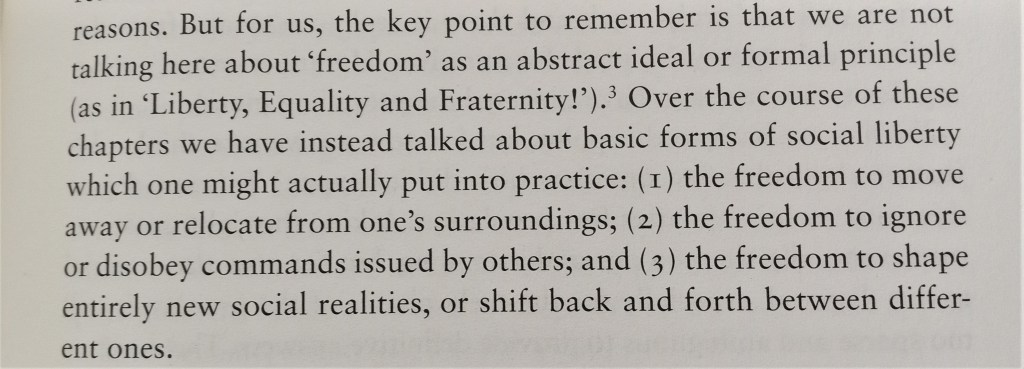
I recently finished reading The Dawn of Everything: A New History of Humanity by anthropologists David Graeber and David Wengrow. I highly recommend the book for its argument about how evidence from recent decades disrupts the common idea that people moved from hunter-gatherers to agriculture and cities and “civilization.” The reason I put civilization in quotes has to do with the argument they make regarding the freedoms humans used to have:

If we do not have these freedoms today what went wrong? The argument and the evidence is worth considering.

Selling homes with an image of a large pantry with basic shelves

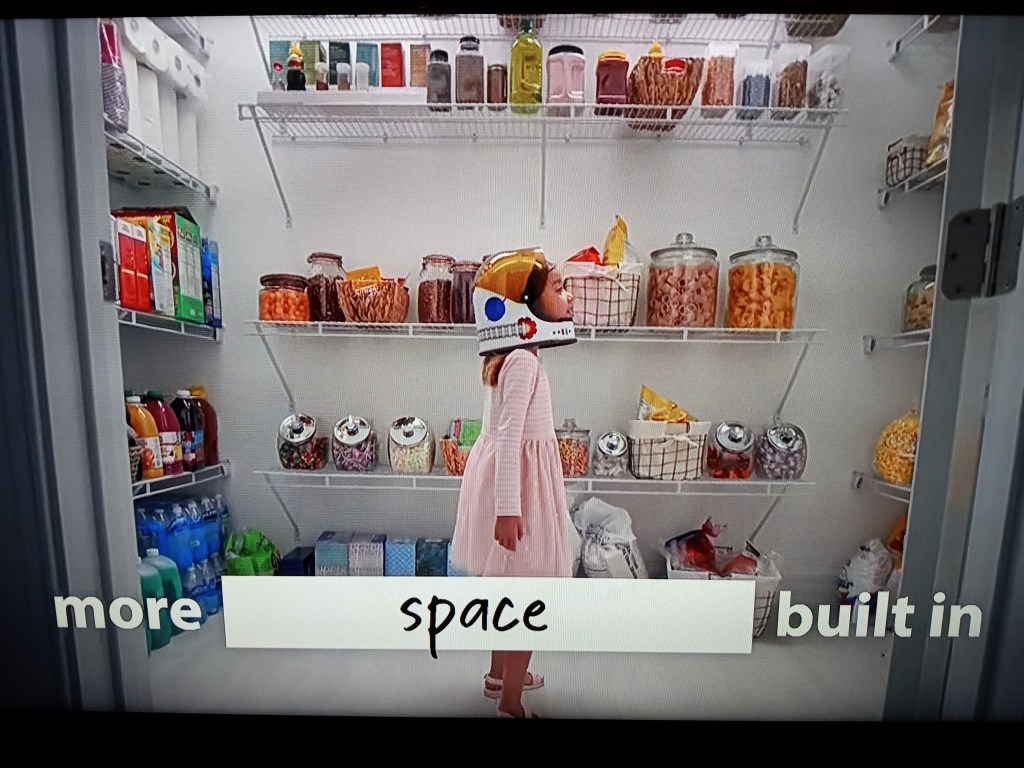
A commercial from Pulte Homes touts unique features in the houses they build. For example, they have large pantries:

The pantry is large, the stuff on the shelves is well-organized, and the shelves themselves are…mediocre. Builder-grade. Why show off such a large pantry with basic shelves?

Perhaps this accurately reflects the shelves Pulte includes in its homes. This kind of shelves might be found in closets throughout many new homes in the United States. They are usable shelves, after all. If the first homeowner wants something more complicated, they have plenty of options ranging from Ikea designs to those who can custom-fit shelves and all sort of options.

Or, perhaps I am only supposed to notice the space in the pantry. The girl has so much room to move. There are so many shelves. The Costco shopper has somewhere to put all of their bulk purchases.

Even with these explanations, I find it a strange image. I see the space…and the shelves.

McMansions as part of a world ruined by climate change

A new art exhibit includes McMansions in the imagery of a world after the negative effects of climate change:

Photo by Andrew Beatson on Pexels.com

When Josh Kline debuted his “Climate Change” series at the 2019 Whitney Biennial, the slick sci-fi work looked a little smug. The New York-based artist, who at 43 has pieces in the collections of the Whitney Museum of American Art, the Guggenheim and the Museum of Modern Art, is known as a political fantasist with a dyspeptic view of life under capitalism. A recent series of dirty, resin-soaked American flags shaped into televisions, for example, is meant to critique Fox News.

Even so, Kline’s apocalyptic vision of warming seas for the biennial had outdone itself for corporate-chic confidence: a series of 12 greyscale photos of emblems of U.S. power — San Francisco skyscrapers, the front desk of Twitter’s headquarters, a statue of Ronald Reagan — partly submerged in water in plexiglass cases and lit with medicinal ambers and greens. Pumps recirculated the water over the prints, erasing them slowly, like the washer in a darkroom or a hotel water feature or, maybe, liberal tears. The message was propagandistically clear: climate change is real; the water is rising; turn back the tide while you still can.

Now, three of these flooded works appear at LAXART, a nonprofit project space in Los Angeles, as part of Kline’s new exhibition, “Adaptation.” In this setting, they seem less declarative, more hunkered down. The relentless combination of time and trickling water soaks the photographs with an aura of romantic decline. A Silicon Valley McMansion’s peaked roof peers through a curtain of cloudy fluid in “Luxury Home, Los Altos Hills.” A white patch of blight creeps up from the bottom of “Deck, Rosewood Sand Hill Hotel, Menlo Park.” In “432 Park Avenue, Manhattan,” which depicts a supertall residential tower that may be more an investment storehouse than an actual home, a little scummy foam jiggles on the water’s surface.

Kline’s earnest warnings about the effects of climate change are still blunt — the immediate greed of energy and tech and lifestyle companies will still doom our civilization, if not the world, to a watery end. (In fact, the artist doubles down: the back room also features “Consumer Fragility Meltdown,” 2019, a soy wax model of two commercial buildings slumping and sweating on a heated steel table.) But as each image breaks apart, Kline’s message also erodes. Ambivalence creeps through the gaps. Then, when the emulsion has been rinsed away, the print is replaced and the cycle begins again.

McMansions are often connected to climate change and concerns about the environment. This can happen in two ways. McMansions themselves are the problem: they take up a lot of land, they require a lot of resources to build and maintain, and they exist in part due to a sprawling, car-dependent social arrangement.

The second way of linking McMansions and climate change is to use the symbol of McMansions as indicating larger concerns about sprawl, pollution, land use, and environmental destruction. McMansions are an easy target for an era in the United States revolving around consumption, the use of resources, and limited action regarding consequences. It is less about the individual dwellings than it is about an ethos or an era without regard for environmental consequences.

Put that McMansion in Silicon Valley and perhaps the symbol is even more potent: in a time of technological and lifestyle changes, people lived in these environmentally destructive homes in one of the wealthiest and most influential parts of the United States.

Chicago suburbs continue the fight against railroad mergers they say will negatively impact their communities

This started years ago in response to the purchase of the Elgin, Joliet & Eastern Railway and continues now as eight Chicago suburbs challenge the potential merger of the Canadian Pacific and the Kansas City Southern railroads:

Photo by Brett Sayles on Pexels.com

Bartlett, Bensenville, Elgin, Itasca, Hanover Park, Roselle, Wood Dale and Schaumburg formed the Coalition to Stop CPKC last week in a bid to convince the board that the merger would bring so many additional trains to the Milwaukee West Line that it would dramatically alter life in their communities…

The merger would create the first single-line rail network linking the U.S., Canada and Mexico. The railroads filed the merger application in October.

Each of the eight suburbs conducted evaluations and determined what mitigations would be needed to protect their residents and businesses from the increase in freight traffic. Pileski said Roselle alone would need at least $30 million to create pathways and modify roads to get around the freight trains.

The coalition filing says the potential price tag for mitigations in all eight suburbs could reach $9.5 billion, and negate any benefit to the railroads.

Railroad traffic in many suburbs is viewed negatively due to an increase in blocked crossings or waiting for trains, more noise and pollution, and a disruption to a quiet suburban life. On the other hand, rail traffic helps deliver a lot of goods, can be more efficient than other shipping options, and might limit traffic – train or on roads – elsewhere.

In the larger picture of the Surface Transportation Board, where do the concerns of these 8 suburbs fit with other concerns or advantages regarding this potential merger?

In a region built in part on railroad transportation and that continues to see tremendous amounts of railroad freight traffic, it will be worth watching this outcome.

Smartphones as objects providing comfort

Research suggests using a smartphone helps comfort adults:

Photo by Polina Zimmerman on Pexels.com

But scientists studying the relationship between people and their smartphones also have come up with additional insights in recent years about how people behave when using them, including discovering that people can draw needed comfort by their mere presence.

Individuals hold a deep personal connection with their phones, according to researchers. This leads phone users to express their views more freely when using their phones, often in exaggerated ways, and with more honesty, disclosing personal or sensitive information, for example, compared with laptops or tablets, experts say. They are portable and they have haptic properties that stimulate our sense of touch. And we regard them as much more personal than computers, which are closely associated with work…

“What might be going on? We don’t know, but one theory that makes sense to me is that they represent that we have friends,” he says. “It’s a reminder that we have friends, and knowing we can reach them, even remotely, is comforting. Also, they are very personal devices, more so than any other device, and with us all the time. From that perspective, we see them as an extension of ourselves.”

The phones also serve as a repository for all the details in our lives, from banking and entertainment, to tracking the whereabouts of our children, and getting us from one location to another. “They are the holy grail for convenience,” says Jeni Stolow, a social behavioral scientist and assistant professor at the Temple University college of public health. “It’s someone’s whole world in the palm of the hand. That is really appealing because it can make people feel in control at all times.”

Humans have the capacity to use many different items as tools and accessories to our daily tasks and activities. The smartphone is in a long line of “devices” that extend human possibilities. With the smartphone, someone can soothe themselves, access all sorts of information, and interact with others. It offers tremendous possibilities.

The emphasis here in the rest of the article is the possible effects of having all of this in a smartphone. Is it a “pacifier” or a creator of new problems? New tools bring new problems. And this leads to a pressing question for our era: is the smartphone in the long run a positive for humans? More broadly, we are in the midst of 30 years or so of asking the same question about the Internet: does all this access to people and information improve human life?

It might be hard to answer this question in the middle of an ongoing process. Having research, such as that cited above, can help us understand the effects as well as consider our interaction with the changes. All might be clearer in a decade or two…or even more complicated if we end up further down a path with devices that offer much in terms of both positive and negative possibilities.