Deaths and COVID-19 by groups, communities in Cook County

COVID-19 is big in its effects but I am surprised we have not seen more coverage all over the place about who specifically is affected more within regions and big cities. WBEZ looks at recent data in Cook County, Illinois:

Photo by Griffin Wooldridge on Pexels.com

In the earliest weeks of the pandemic, Chicago’s Black residents were dying of COVID-19 at alarming rates. More recently, in the few weeks since the arrival of the omicron variant, Black Chicagoans are again dying at much higher rates than their Asian, Latino and white counterparts, shows a WBEZ analysis of data on COVID-19 related deaths from the Cook County Medical Examiner’s Office.

Since Dec. 7, 2021, the date when the state’s first omicron case was found in Chicago, the city’s Black residents are dying at rates four times higher than Asians, three times higher than Latinos and nearly two times higher than white residents, according to WBEZ’s analysis. A total of 97 Black Chicagoans died of COVID-19 during the seven-day period ending Jan. 9, 2022 — more than at any point since May 11, 2020.

Black Chicagoans aren’t the only demographic that has been particularly vulnerable since the arrival of omicron. Older suburban Cook County residents have also seen their seven-day COVID-19 death totals reach levels not witnessed in more than a year. According to WBEZ’s analysis, a total of 181 suburban Cook County residents 60 years and older died from COVID-19 during the week ending Jan. 9, 2022. That’s the highest seven-day total for that group since Dec. 24, 2020…

While several communities on Chicago’s South and West sides have been hit hard by COVID-19, the pandemic’s death toll has also weighed heavily in various parts of suburban Cook County. WBEZ’s analysis finds some of the county’s highest COVID-19 death rates in parts of northwest suburban Niles, Norridge and Lincolnwood, southwest suburban Palos Heights, Chicago Ridge, Oak Lawn and Bridgeview; and south suburban Hazel Crest, Markham, Harvey, Robbins and Country Club Hills.

I am sure there are already and will continue to be many academic studies that examine these differences. Even as COVID-19 has impacted many, the impacts of COVID-19 are not distributed evenly. It arrived at a time of inequality, including in health outcomes and experiences, and it exacerbated issues.

At least in the Chicago area, data on this topic is available online. For example, I have tried to keep track of the disparate effects of COVID-19 in DuPage County where there are significant differences across racial and ethnic groups, age groups, and communities (earlier post here).

Familiar story: suburb that looks like paradise but is not, The Villages edition

The Florida community The Villages has roughly 80,000 residents living northeast of Orlando. Is it paradise or a sinister place?

Photo by Sebastian Voortman on Pexels.com

For the residents, it’s one of the most successful experiments ever undertaken in creating a community from scratch…

But critics say there’s something not quite right about The Villages, a sprawling suburb an hour’s drive north of Orlando in Florida…

She likened The Villages to Jim Carrey film The Truman Show about a flawless but ultimately fake town.

The filmmaker has now produced a documentary about the world of The Villages called The Bubble which has its Australian premiere at this month’s Sydney Antenna documentary film festival

Days for its residents are crammed with exhausting rounds of golf, cardio drumming, belly dancing and cheerleading lessons, even synchronised golf cart displays. And day drinking – lots and lots of day drinking…

The company that runs The Villages were none too keen on Ms Blankenbyl and her film crew’s presence.

On one hand, this is a familiar suburban story told for decades: the suburbs present themselves as the place for happy and successful family life. They aim to be green, quiet, and friendly. But, are they really? When a crime is committed, this might be a crack in the facade. Or, family life is not what it seems. Or, the community is built on the basis of exclusion and who is not welcome and/or present. There are plenty of real-life examples of this plus numerous films, novels, and stories that explore these themes.

On the other hand, The Villages appears to have some unique features that might set it apart from typical suburban experiences. It is a 55+ community which changes the entire social structure. The American suburbs broadly are built around protecting children and providing them room to thrive and succeed. It is in Florida so there is warmth and sun in levels that many suburbs cannot match. It is relatively new with a limited history and set of traditions and practices plus a particular architectural and natural approach that still looks new.

Is it a bubble? Many middle to upper-class suburbs might be accused of this. Is it different than many suburbs? Just by its population composition, yes. I look forward to seeing this documentary and thinking about it more.

California, other places moving forward with bans or restrictions on gas-powered leaf blowers

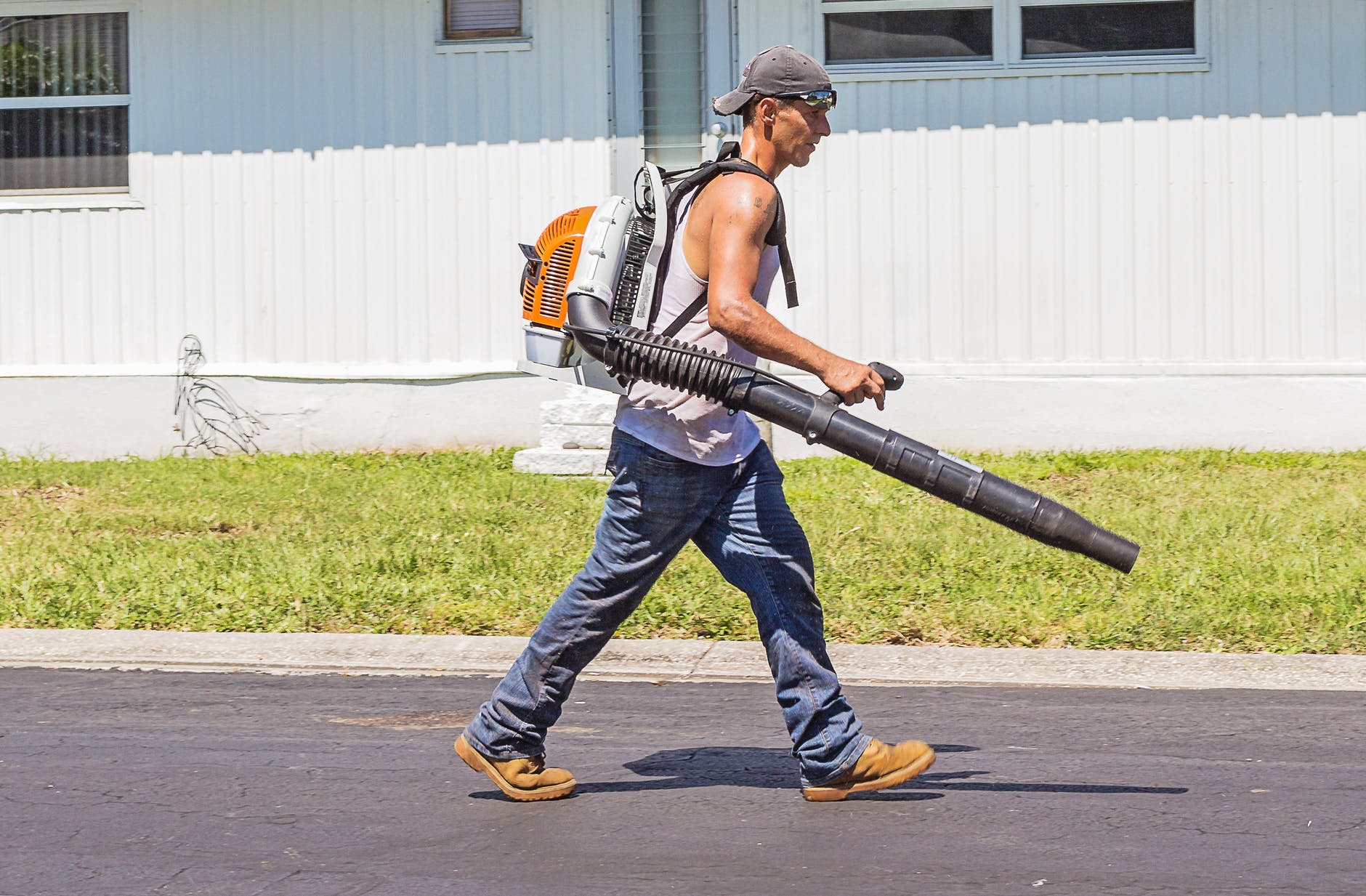
More communities across the United States are banning or restricting gas-powered leaf blowers:

Photo by Pixabay on Pexels.com

But addressing the noise pollution they cause wasn’t the main reason behind the legislation. Small off-road engines, or SOREs, are a significant source of greenhouse gas emissions, causing spikes in asthma in workers who operate them.

“Today, operating the best-selling commercial lawn mower for one hour emits as much smog-forming pollution as driving the best-selling 2017 passenger car, a Toyota Camry, about 300 miles — approximately the distance from Los Angeles to Las Vegas,” the California Air Resources Board said in a recent fact sheet. “For the best-selling commercial leaf blower, one hour of operation emits smog-forming pollution comparable to driving a 2017 Toyota Camry about 1,100 miles, or approximately the distance from Los Angeles to Denver.”…

Hundreds of cities and towns in the U.S., including Washington, D.C.; Burlington, Vt.; Houston; Palm Beach, Fla.; Aspen, Colo.; and Highland Park, Ill., have enacted restrictions on the use of leaf blowers. Among those restrictions: forbidding gas-powered units, imposing decibel limits and limiting what days one can use them…

On Wednesday, the Boston City Council agreed to consider a resolution that would outlaw gas-powered SOREs. Kenzie Block, a city councilor representing the Fenway, Mission Hill, Back Bay, Bay Village and Beacon Hill neighborhoods, said the main impetus for the ban was health-related.

Noise, health, pollution, and gas use and I could see why this shift toward equipment with other power sources would appeal to many places.

Where is the power equipment lobby with a response? As noted elsewhere in the article, gas-powered equipment could provide power and other opportunities. Or, do companies who manufacture equipment still see enough of a market in other communities and/or are excited to sell lots of people new equipment that they would not otherwise have to buy?

The ripple effects of this on American lawns are interesting to consider. Would battery or electricity powered equipment encourage people to tend to their yards more or not?

“Gloom” and suburban women ahead of 2022 elections

Focus groups convened by a set of Democratic groups suggests suburban women are not feeling good about what is happening in Washington, D.C.:

Photo by Alex Hussein on Pexels.com

Earlier this week, 10 women from across the country met on Zoom and talked for two hours as part of a focus group on politics. All of the women were white, lived in the suburbs and had been identified as swing voters. One was a mother from Iowa who owns a small business. Another teaches special education in Florida. And there was a school bus driver from Pennsylvania….

Democrats need support from suburban women if they want to keep their House and Senate majorities in November. The women in the focus group didn’t necessarily dislike Biden. They supported the infrastructure law and opposed measures that restrict voting access. They applauded Biden for his hot-mic moment — the one when he muttered a disparaging remark about a Fox News reporter. They disliked Trump, and they were disgusted with those who attacked the Capitol on Jan. 6.

Despite all of that, they weren’t eager to vote for Democrats in the midterm elections in November…

“It’s absolutely essential that by Election Day, these suburban women are looking at Washington and seeing it as a place that can get things done,” said Meredith Kelly, a Democratic strategist.

There is a lot of time until November elections but the pattern is clear for the national political parties: appeal to suburban voters, particularly those who have voted for Republicans and Democrats in their past and need some motivation to go one way or another.

My sense is that historically Joe Biden has been a politician who has successfully made this appeal. Throughout his career, Biden has talked about the middle-class and providing opportunities for people to provide for themselves and their families.

But, Biden is now operating in a particular context. Suburban politics have some new wrinkles – school board elections, mask mandates – and some long-standing concerns: protect property values and a way of life, ensure success for children, enable local government to serve and adjust to local conditions.

Perhaps neither party has to have a wave of suburban voters in their favor but rather (1) get the right suburban voters in the closest races that matter the most for the Senate and House and/or (2) drive up voter turnout for their side. As I live in a district that is somewhat mixed politically, I will be watching how appeals are made and how they work.

The presence of mobile homes in the Chicago area

Remembering a small mobile home community not too far from the suburban home in which I grew up, I was interested to see numbers on how many mobile homes are in the Chicago region and read about the experiences of people living in mobile homes:

Yes, we do! It turns out hundreds of families live in Chicago’s only trailer park, Harbor Point Estates, which is in the far southeast corner of the city. It sits along the shores of Wolf Lake in the Hegewisch neighborhood, just off 134th Street. The community is so close to Indiana you can fly a kite there, a property manager says.

And beyond the city’s borders, there’s another 18,000 mobile homes in the seven-county metro area, according to estimates by regional planners. Mobile home communities are squeezed between expressways and plopped down in exurban cornfields, from the North Shore to Peotone…

Curious City got a question about trailer parks from a listener interested in affordable homeownership. “What is life like in Chicagoland trailer parks?” the listener wanted to know.

So we visited manufactured housing communities in Chicago, Blue Island and Des Plaines to ask residents that question. And we met people with a whole range of experiences. We found some who had moved to the trailer park as a way to make ends meet. We found families looking for peace and safety and a quiet place to raise their kids. We found residents who liked the trailer park because they could live near extended family — adult siblings, cousins — and others who’d adopted neighbors as extended family. We found people living in their familiar mobile home deep into old age. We found folks looking for a foothold to the American Dream.

Many suburban communities and urban neighborhoods would not want or approve mobile homes. As communities tend to prefer development (if they prefer any new development) that matches or exceeds the prices and styles of existing residences, mobile homes can be hard to find in metropolitan regions.

This also reminds me of sociologist Matthew Desmond’s findings about urban mobile home communities in Evicted. Such communities do exist, their landlords can and do make money, and residents in mobile home communities can face a number of issues.

Yet, because of their cost, they can be a housing option for many. Looking to address affordable housing in the Chicago region? Mobile homes could be part of a comprehensive answer.

(Bonus: the title of my published study on religious zoning in Chicago suburban contexts refers to someone saying that would prefer mobile homes nearby rather than a possible Islamic Center.)

Explaining why there is not a flood of McMansion construction

Houses are in short supply, housing prices are up, there is money to be made. Why are more McMansions not under construction?

Photo by Michael Tuszynski on Pexels.com

With houses selling for so much, you’d think there would be a big incentive for developers to throw up new units, which they can do quite quickly. I still remember driving around New Jersey during the McMansion boom and being amazed at how quickly houses went up. Why aren’t the developers rushing in now?

In correspondence, my old M.I.T. classmate and economist Charles Steindel pointed me to the likely answer: It’s the supply chain, stupid.

This makes sense given current conditions: an increased cost in materials plus difficulty acquiring materials might translate into fewer profits in building McMansions.

I do wonder if there are additional factors at work. A few quick ideas:

  1. McMansions have an established reputation. There are still plenty of people who will buy one but there is also a clear connotation about the home when this specific term is used. Hence, “luxury homes” instead.
  2. How much land is available and how many communities would welcome them? It is one thing to have teardown McMansions in desirable communities and neighborhoods and another to build McMansions on the sprawling edges of suburbia.
  3. There is more money to be made in even larger houses. Why build McMansions when there are enough customers for even larger and/or more opulent homes? Perhaps the money in McMansions comes at a sizable building scale while the per lot/house profits on even more expensive homes is preferred.

McMansions are not going away as they are an established part of the American housing stock. But, it will be worth watching how many new ones are constructed, where, and by whom.

The suburbs as the test market for delivering prescription medicine via drone

As firms test delivery via drone, one suburb in North Caroline will soon experience how using drones to deliver prescription medicine could work:

Photo by Darrel Und on Pexels.com

Zipline, a leading drone operator, will begin delivering prescription medicines to patients’ homes in a suburb of Charlotte, North Carolina, this year, helping usher in the long-anticipated era of routine drone drops.

Why it matters: Battery-operated drones could satisfy our demand for “instant delivery” in less than 15 minutes, while easing traffic congestion, improving safety and helping the environment…

The trial, which awaits the FAA’s nod, will take place in and around Kannapolis, North Carolina, where Zipline has a distribution center serving nearby hospitals…

A big milestone will occur in a few months when Wing begins drone deliveries in Dallas, its first major metropolitan service area, starting with Walgreens.

Even as this article makes clear that this is already happening in other places, the suburban potential is intriguing for several reasons:

  1. If drones can deliver a lot of goods in suburbia, could this help unlock the hold of driving on suburbia or does it enable people to live even further apart?
  2. How do drones fit in a suburban landscape devoted to private property and proximity to nature? Drones could theoretically be quieter and less obvious than other options yet this could be considered intrusive in a new use of local airspace. Could some local governments ban their use?
  3. I wonder this about delivery possibilities now: how close do distribution centers or drone centers need to be to residential neighborhoods to enable same-day or quicker delivery? Residents like the idea of quicker delivery but having warehouses and distribution centers closer to homes has some limits.

It sounds like these drone deliveries are going to happen and they have the potential to impact suburban life in small – and maybe larger? – ways.

Perhaps celebrity-led affordable housing is not the answer

Actor Brad Pitt created a foundation that built 109 affordable housing units in New Orleans after Hurricane Katrina. According to one observer, the project has not gone well:

Photo by Ave Calvar Martinez on Pexels.com

Brad Pitt’s Make It Right Foundation built 109 eye-catching and affordable homes in New Orleans for a community where many people were displaced by damage wrought by Hurricane Katrina in 2005. Now this housing development is in disarray. The vast majority of the recently constructed homes are riddled with construction-related problems that have led to mold, termites, rotting wood, flooding and other woes.

At least six are boarded up and abandoned. Many residents have filed lawsuits that are still pending. That is, a nonprofit that built houses with input from Frank Gehry and other prominent architects amid much fanfare for survivors of one disaster then ushered in another disaster…

Brad Pitt, who took credit for launching this organization in 2007 and often served as its public face in subsequent years, was still listed as a board member as of 2018.

Pitt’s lawyers argued that he could not be sued over the housing development’s failings, but a judge ruled in 2019 that the movie star would remain a defendant because of his role as Make It Right’s founder and chief fundraiser.

Housing, plus the decades of policies and history undergirding it in particular locations and in the broader sense, is difficult to address.

This proposed solution is one employed in many American sectors. A celebrity comes in and lends their name and resources to a project. I think I showed a class a documentary Pitt narrated about efforts to rebuild in the Lower Ninth Ward.

What happens in the end because of the efforts of the celebrity? Here, the outcome does not sound good: the homes are in disrepair and court cases are pending. The homes that were intended to help are their own problem.

To repeat, tackling affordable housing, even with the help of a megastar, is no easy task.

Purchase your home to live in it…and consider its long-term investment potential

In a story about how to buy a home amid a hot housing market, one expert offers this advice:

Photo by Kindel Media on Pexels.com

Herbert recommended a different way of thinking about the timing of buying a house, one that I found much more comforting. “You ought to be making this as a housing decision and not an investment decision,” he said. If you’re buying a house, he advised, it should be because you want to live in it for at least five years, and ideally many more – which also will mean that even if prices fluctuate, you have a better chance of your investment appreciating over time. “The longer you stay in the house, the [less] your timing in this particular house-price cycle [will] matter,” he said.

This quote interested me for two reasons. First, Herbert says this is about buying a house and staying long term. Sure, the housing market might be crazy right now but a buyer should be thinking about living in the space for a while. But, then the advice pivots a bit to noting how this long-term view can pay off financially. The particular financial circumstances at purchase will fade away if the price of the home increases.

That financial considerations matter as people consider home purchases is certainly true. At the same time, the shift from seeing a home as a place for long-term living to primarily a financial investment is on display here. There are features about homeownership that Americans tend to like – you own the property, there is often some outdoor space, it is more private, it is a marker of success, and so on – that transcend financial conditions. Houses are more than just the dollar signs attached to them…right?

Perhaps it would take an extended period of a cooler housing market and other positive economic stability for houses to not just be financial investments. Or, the costs of homeownership in many places are already at a point where homes can only be viewed as financial objects.

The arguments for and against banning zoning for only single-family homes

The single-family home is very important in the United States and this is enshrined in land use policy and zoning. Because of this, there is a move in multiple communities to ban single-family home zoning and this has prompted debate over the change:

Photo by David McBee on Pexels.com

Originally introduced in Berkeley, Calif., in 1916 as a means of preventing a black-owned dance hall from opening, single-family zoning became increasingly popular — though divorced from its explicitly racist origins — as more Amercans moved to sprawling suburban cities across the country. Today, many of the country’s major urban areas reserve 75 percent or more of their residential land exclusively for stand-alone, one-family homes.

Recently, lawmakers in blue states and cities have moved to roll back zoning rules in hopes of spurring more development. Minneapolis became the first major city to ban single-family zoning in 2019. That same year, Oregon passed a similar law statewide. Perhaps the most significant change came in California where the median home price is estimated to exceed $800,000. A new law that eliminates single-family zoning across the entire state went into effect on Jan. 1. None of these reforms make it illegal or even more difficult to build a stand-alone house, they simply remove barriers that prevent any other type of dwelling from being built.

Advocates for eliminating single-family zoning say it’s the most important step toward addressing the housing shortage, since any other programs to spur more development would be moot if there’s no land to legally build on. Supporters say eliminating what they often refer to exclusionary zoning would have wide-ranging benefits beyond just creating more housing stock, including reducing racial segregation and closing the racial wealth gap, boosting job opportunities in urban areas and reducing climate impacts created by suburban sprawl.

Many conservative opponents of these reforms, including former President Donald Trump, have portrayed them as a “war on the suburbs” that would bring big-city problems to quiet communities while doing little to address the underlying causes of the housing shortage. Some argue that financial incentives, not coercive new laws, are the best way to spur development.

A lot of pro-housing advocates also have doubts about how much of an impact zoning reforms on their own will make. They argue that most of the new laws are riddled with exceptions that limit their scope and few also address the long list of other ways that local governments can prevent dense housing from being built — like minimum lot sizes and parking requirements. Some on the left make the case that the only way to increase housing supply at the pace that’s necessary is through strict mandates that require cities to build a certain number of housing units and impose heavy financial penalties on those that don’t.

This would be a hard change to make and capitalize on in many communities. Housing policy in the United States is difficult to change and is rooted in a long history, cultural narratives about success, exclusionary practices, and local governments and other government actors. Yet, even discussion of such a change at least highlights the need in many places to think more about housing and how it could be more accessible to many.

As about any policy possibilities in the United States, I now wonder if what would work best in this situation is for several different kinds of communities across the country to ban single-family zoning and see what happens. What changes in the community? How do residents and newcomers experience it? How does it affect housing values? Does it significantly alter the character of the community? And if there are success stories – which could range from limited noticeable change (that it does not lead to negative outcomes or the end of the suburbs might be good enough) to positive outcomes – then other communities could observe and consider the option.