As the United States marks the 20th anniversary of the attacks on September 11, 2001, it also provides a reminder that the events happened a while ago. American society and the world were different then. Here are a few scattered thoughts on how this passage of time influences how Americans view that day.
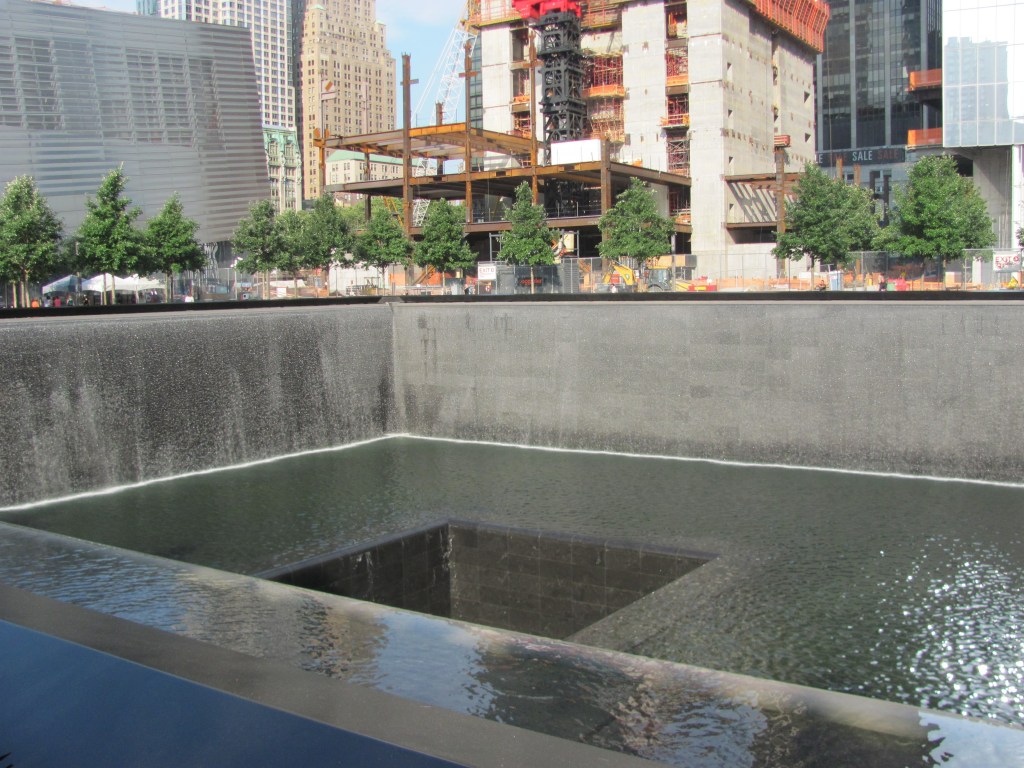
The Ground Zero Memorial in July 2012
-I saw a statistic that roughly 1/4 of Americans alive today were not alive on September 11, 2001. I have been aware of this for at least a few years as the college students I teach were either very young or not yet alive then. To a significant number of Americans, 9/11 is history.
-So much has happened since then that makes it all seem like a different era. The response to the attacks kicked off the War on Terror and the consequences are still being felt (see recent events in Afghanistan). Political polarization increased. The housing bubble burst and more economic instability seems present. Two presidents served their time in office and did so in very different ways.
-The commemorations often stress the quick coming together for rescue and cleanup efforts alongside the expressions of unity among members of Congress and Americans. This did not last long.
-We now have official memorials in numerous locations, including at the sites of the attacks and in communities around the country. Will these be altered or viewed differently as years go by?
Future commemorations will face these issues even more. The United States is not new to such change – how D-Day and Pearl Harbor are marked differs with the increasing age of those alive at the time and World War II might seem like eons ago, the memory of the Civil War has been a conflict for over a century – but subsequent decisions and events could solidify or change 9/11 narratives in ways that might be hard to predict.
On a recent walk down a nearby street, an older man stopped, pointed at the sign pictured below, and said, “It should say: Don’t be a jerk and pick up after your pet.” I made a startled quick response and continued on my walk.
The sign is very polite. It includes both “please” and “thank you.” The politeness is hard to miss in multiple ways: the polite words are at the top and bottom in a different font and the signs are all throughout the neighborhood.
At the same time, the niceties cannot cover up several unpleasant aspects of this sign. The polite words surround a command (“pick up after your pet”). The sign references poop. Finally, the need for the signs suggests not everyone follows these rules.
Would the sign be more effective if it did away with the politeness? Is the potential offender of this request going to be swayed by the politeness? There are other options for the sign. It could include no polite phrases. It could reference consequences, such as fines. It could appeal to shared norms (example: “keep our neighborhood clean”).
The politeness of the sign might be more about the people putting it up and upholding these guidelines. They want to reference a community atmosphere where people collectively care for the environment. Pronouncing a command does not seem to be as bad when couched in polite terms.
The comment of the man who talked to me hints at the ongoing issue at hand: a polite sign may not produce the desired outcome. But, if signs become more pointed or punitive, all semblance of peaceful neighborhood life might disappear.
I recently read two histories of a similar time period and both texts addressed the North American aspects of the Seven Years’ War. However, the texts had very different lengths. One book was over 700 pages and included many details. The other book included a summary of the same war in 11 pages. Which was the better read?
Much of this answer depends on what I hoped to accomplish in my reading. Months ago, I had stumbled onto the Wikipedia page for the Seven Years’ War and realized I knew relatively little about it. The North American branch of this conflict involved relatively few troops yet had very important implications for the subsequent history of the United States. I searched out some recommendations on notable academic histories that addressed this period and received a few books from my library. I wanted to know more and now I had options.
I enjoyed reading the 700+ page book. Did I need all the details in my life? Probably not, but much of what I read was fascinating and provided insights that shorter summaries could not. I am glad that I read all of this so that at least at one point in life I could say I tried to take in all of this knowledge.
The 11 page summary was also interesting and well-written. It also took much less time. I recognized the high points of the conflict from the much longer narrative. These high points made a lot more sense given all the details I had read not too long before.
In the academic world, we run into these sorts of issues all the time: how much knowledge do I need to proceed? Would a one page summary be sufficient or should I devote years to studying this? We publish different length materials, ranging from encyclopedia entries and shorter notes to longer articles and books. One cannot read and study everything so we must be judicious in what we spend our time on. Yet, the joys of diving deeply into material is one of the best parts of study and research.
Having read both texts, I am still in favor of reading the much longer text. I may go years before reading anything on the Seven Years’ War and the longer text gave me plenty to consider. I had the time to spend on it and I may not make the same decision regarding another subject area given different circumstances. But, for two weeks this summer, reading a lot about the Seven Years’ War was a good decision.
The suburbs have always been competitive political territory, but they have taken on a different significance with urban and rural voters spinning further and further away from one another. Last December, a top Democratic operative laid out for me one way of thinking about the party’s future: Had Democrats just rented the suburbs under Trump, or do they own them? The suburbs’ highly educated, middle-class, family-oriented, moderate, predominantly white, and (in terms of actual swing votes) mostly women voters may be ready to stick with the Democratic Party for the long haul. But just in case, McAuliffe and his fellow Democrats are doing their best to make sure that the former president is still a part of this year’s elections.
The battle for suburban voters continues (most recent posts on the topic here and here).
While Trump is the focus here, this seems to continue a pattern employed by both parties in recent years: tie local or state issues to who the parties think are disliked national figures. Democrats want to tie Republicans to Trump, Republicans want to tie Democrats to Nancy Pelosi. While these national figures might have some influence over more local contexts, there are also important local issues to consider.
The cleanliness of Tokyo, the diversity of New York and the social services of Stockholm: Billionaire Marc Lore has outlined his vision for a 5-million-person “new city in America” and appointed a world-famous architect to design it…
The former Walmart executive last week unveiled plans for Telosa, a sustainable metropolis that he hopes to create, from scratch, in the American desert. The ambitious 150,000-acre proposal promises eco-friendly architecture, sustainable energy production and a purportedly drought-resistant water system. A so-called “15-minute city design” will allow residents to access their workplaces, schools and amenities within a quarter-hour commute of their homes…
The first phase of construction, which would accommodate 50,000 residents across 1,500 acres, comes with an estimated cost of $25 billion. The whole project would be expected to exceed $400 billion, with the city reaching its target population of 5 million within 40 years…
On Telosa’s official website, Lore explains that he was inspired by American economist and social theorist Henry George. The investor cites capitalism’s “significant flaws,” attributing many of them to “the land ownership model that America was built on.”
From what I read here, I would say the odds are low that this comes close to the proposed population. Playing Simcity is one thing; building a large city from scratch and with such a master plan is difficult to pull off in the United States. At the same time, having a good plan and incorporating the latest ideas could help avoid problems later that cities face as they age (such as with infrastructure). Taking the best of older cities and adding more recent ideas could break through the problem of updating existing communities.
One factor I could see in favor of this plan is a significant public-private partnership developed with a state or a local government. The United States has a long history of public-private partnerships to address public goods. Imagine a state or county or public agency that is looking for a unique opportunity or a way to generate economic activity. Starting a new city with multiple funding sources could help provide jobs, residences, and a new sense of community. This could be the “garden city” of the twenty-first century on a grander scale compared to the smaller American efforts in the twentieth century.
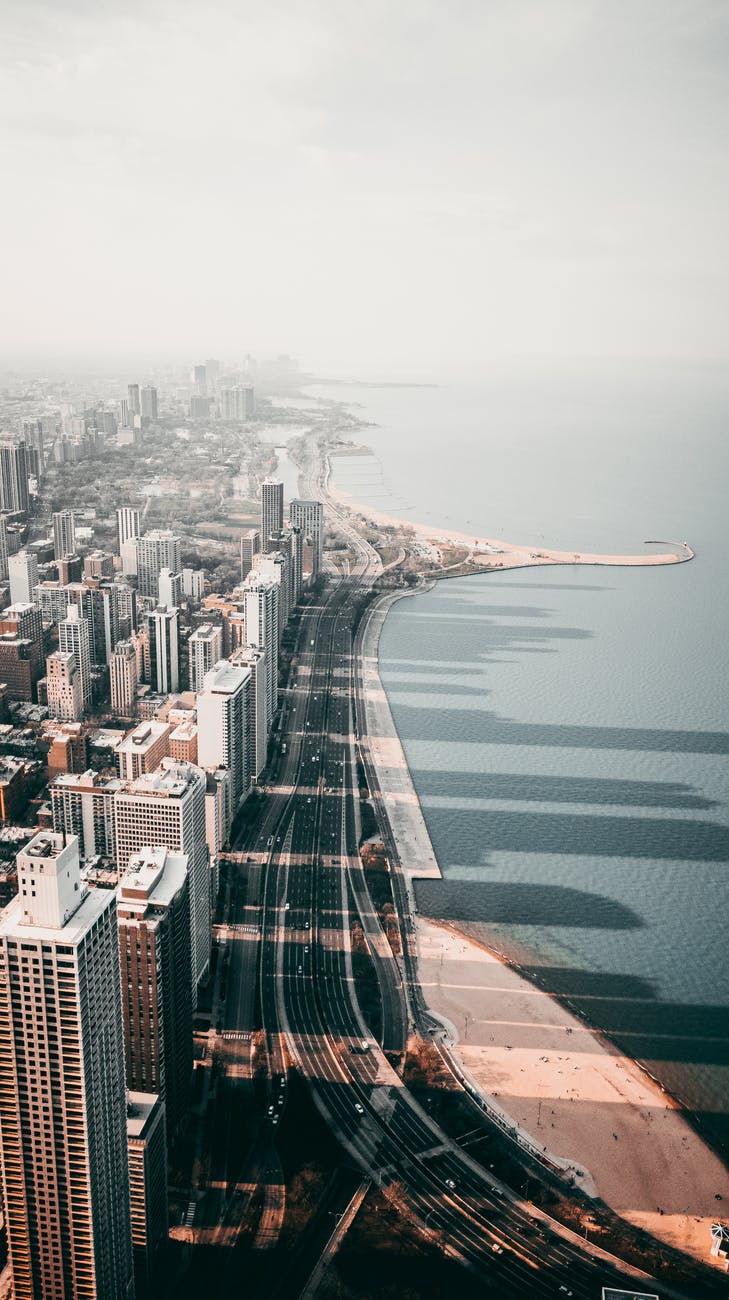
But Chicago’s density is declining, and some of the city’s most prominent neighborhoods have actually started to lose residents. Lincoln Par, once home to 102,000 people, barely housed 70,000 in 2020. Lakeview, once holding 124,000, was at 103,050 around the same time. North Center had decreased from 48,000 to 35,114, and nearby community such as West Town and Bucktown had similar fallen in scale.
These neighborhoods are becoming more expensive, and much of this de-densification may be due to a “spreading out” of sorts; wealthier people are moving in and are able to afford more space.
But there’s more to it than that. Previously, when a neighborhood in Chicago was in demand, builders capitalized, and the housing stock swelled. Chicago’s zoning laws, however, have changed, and while they allow for high-rise development in various downtown areas, they prohibit this same approach in neighborhoods. One thing is for sure, though: No matter how strict the zoning ode is in residential areas, single-family homes are pretty much always allowed.
One theory, termed “The homevoter hypothesis,” speculates that this is due to the control that homeowners have on urban development. Their interests have the most influence on local aldermen and, therefore, residential development. The good of the community and the city is not a factor in their agenda, which instead focuses on home value growth, and how to wield zoning changes in order to achieve it.
The argument seems to make sense: those who want to live in more well-off Chicago neighborhoods bring resources and an interest in larger homes. This could mean converting structures to single-family homes or tearing down older structures and starting over from scratch. If there is indeed an increase in larger single-family homes in Chicago, there should be data to support this. Anecdotally, my occasional travels in some of these neighborhoods suggests a good number of new homes nestled between two-flats and three-flats.
Additionally, there may be other forces at work that could also be leading to de-densification in Chicago neighborhoods:
Chicago residents are leaving neighborhoods faster than people want to come in, regardless of what housing stock is available. The population is down in a number of neighborhoods across the city.
The demand for new housing is higher in locations in and around the Loop because of the concentration of jobs and cultural opportunities plus the activity of developers. While Chicago has been known as a city of neighborhoods for a long time, the neighborhoods might not be as hot as the center.
Developers and builders also want these new single-family homes because they can make a lot of money on each property.
Put all of this together and the new Chicago McMansions represent a change to numerous streets and neighborhoods.
In a sociological story, you can imagine yourself being almost anyone. Instead of terrible, evil character and good people, where you just identify with the good ones – which is the classic Hollywood narrative, which is also most of human narrative, you have the good one, the bad one – it’s more like a complicated mythology where you can imagine yourself being any one of those characters, even the ones that do the terrible things, you can see yourself doing it.
The second sign of a sociological story, for me, is when nobody has plot armor because it’s the setting that’s carrying the story, with lots of people, but it doesn’t rely on one person dying or not dying. For six seasons, you have a very institution sociology, very interesting. It’s like The Wire. People can die, but the story is still gripping because it’s sociological…
They took a great story that was going to be how power corrupts, which clearly was the story, and in the end, they made the dragon lady snap just because she heard the church bells or something. [laughs] That’s not a good sociological story.
The key to the explanation above seems to be that a institution or a social group or a particular moment is the focus of the story, not a particular character or two. By shifting the narrative away from the actions and/or thoughts of a certain person, the story can be about the social setting.
Since it is hard to imagine compelling stories without any focus on individual characters, perhaps this dichotomy between a psychological and sociological story is more like a continuum. On the psychological side, I could think of stories like Crime and Punishment where so much is about what is going on in one person’s head. On the sociological side is The Wire or War and Peace where the focus is more on the setting and the larger social and historical factors at play.
With this said, I would love to have a list of sociological stories in various genres and mediums. This could be useful to share with students and to explore on my own.
New York had its first climate-related wake-up call nine years ago, when Hurricane Sandy brought a storm surge that flooded low-lying areas and, yes, subway stations. Since then, the city has spent almost $20 million on climate-proofing the city, according to the Mayor’s Office of Resiliency. But some of that funding went to solving a different problem than the one presented by Ida: water coming from the rivers. This week, all the wet stuff fell from the sky, threatening even areas above sea level…
Now, after years of updates, 60 percent of New York City has a combined sewer system, which uses a single pipe to carry both wastewater and stormwater to treatment plants. During heavy rainstorms, the system can get quickly overwhelmed. The detritus of city living—trash, plants, general gunk—clogs drains, further gumming up the works. “So if you get a really big kahuna like this, I don’t think it really has a shot at draining that out fast enough to avoid flooding,” says Farnham.
The city has worked to separate those combined sewer systems and to clear clogged drains, especially when storms threaten. It has raised and in some cases eliminated subway grates, which were built to allow fresh air to flow down to dank underground spaces but which now look like holes to let more water in. In some places, the MTA constructed flood-proof doors, which can close when the water gets too close.
More generally, cities like New York can create more green infrastructure to help with their water problems—basically, less pavement and more dirt. You might, for instance, create roadside green spaces where water can percolate before moving into stormwater drains, removing trash and pollution in the process. Los Angeles has been doing this to catch rainwater. “This is a long-term thing,” says Horodniceanu. Retrofitting cities to deal with what’s coming, and what’s already come, will take gobs of one of the scarcest resources of all: much more funding.
As cities expand and change, fixing the infrastructure already there to incorporate new technologies and grow the capacity is a difficult task. How disruptive will the efforts be? How much will it cost? It could be much easier in the long run to anticipate these issues way ahead of time and proactively make changes rather than only act after a major issue is exposed.
Water is particularly destructive as much of modern life depends on the fact that water will be excluded from the system. Residences, businesses, mass transit, electronics must be dry to function well. If there is an overwhelming storm or a breach of the water defenses, water can quickly wreak havoc both in the short-term and long-term. Cities require a lot of things to go right to properly go about their business but water can quickly disrupt this operation.
The recent events in New York City and New Orleans also remind me of the planning that can go into highways and parking lots: they can be constructed with peak use in mind. The parking lot needs to be large enough to handle the biggest crowds, hence the shopping mall parking lots that can handle Thanksgiving weekend shopping but are not fully used throughout the rest of the year. Or, the highway that needs more and more lanes to handle rush hour traffic while there are many hours when that capacity is not needed. Sewers need to handle really big storms or events. But, in each case, can the largest need be forecast correctly? Adding lanes to roads can increase the traffic. Right-sizing parking lots can be tricky. And planning for the rare storm is hard, particularly if conditions are changing. Similarly, people will not be happy in these cases if there is not enough capacity and there will be calls to fix the problem afterward.
The 1971 pilot of All in the Familyincluded Michael, son-in-law of Archie Bunker and a college student, as a main character. After the first commercial break, Michael and Archie go at it about Michael’s study of sociology (with some input from Gloria, Michael’s wife and Archie’s daughter):
Michael: What do you want from me anyway? I don’t have time to do anything. I’m studying six hours, I’m in class six hours. You know it’s not easy going to college, it’s hard work.
Archie: For you it’s like building the pyramids. I’ll tell you it’s all that sociology and studying that welfare stuff. I don’t call that no hard work.
Gloria: Oh Daddy, leave him alone. I think it’s beautiful that Michael wants to help the underprivileged.
Archie: Listen, if he wants to help the underprivileged let him start with himself. He’s got no brains, he’s got no ambitions, if that ain’t underprivileged, I don’t know what is.
On one side, sociology is the discipline of a younger generation interested in social change and improving society. Sociology can help the disadvantaged and provide for the better distribution of resources.
On the other side, sociology is a waste of time. It is a liberal enterprise composed of people who should themselves focus on working hard and not stirring up trouble.
Fifty years later, are these two reactions to sociology common? Given that sociology does not always get much attention on television or among the general public, have we advanced much in our public understanding of sociology?
This is the focus of the opening stages of my Introduction to Sociology courses: how does sociology view the world? What are its methods and theories? What do we hope to see? This takes more time than television sitcoms can provide.
Highlights include transitioning to clean and renewable energy, incentivizing energy efficiency, developing a plan for electric vehicle infrastructure, increasing public transportation use and recycling efforts, and focusing on the maintenance of natural resources.
Other objectives include a 4% annual reduction in waste, energy use and vehicle miles driven in conjunction with an increase in tree planting to help decrease greenhouse gases by 4% each year.
One of the recent steps taken by the city was hiring Ben Mjolsness as Naperville’s first sustainability coordinator. Mjolsness on Tuesday talked about the many options and incentives residents have with energy efficiency and recycling.
Councilman Patrick Kelly said he looked forward to showcasing Naperville as a front-runner in sustainability.
Many communities will be pursuing such plans in coming years. But, the particular context of Naperville is interesting to consider for multiple reasons:
It is a large and wealthy suburb. It has the resources to pursue this.
Naperville likes to be a leader among suburbs and this may help further this status in coming years.
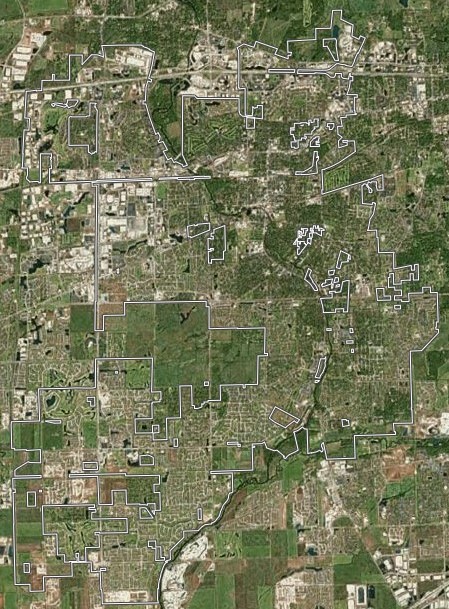
Sixty years ago or even forty years ago, Naperville was much smaller in population and had a smaller footprint in land use. Today, it has nearly 150,000 people and roughly 39 square miles of land with much of this involving single-family homes.
In one sense, the growth patterns that helped make the Naperville of today possible – explosive growth in the postwar era built around homes and driving – also make pursuing sustainability more difficult. Take the reducing the miles driven goal from above. Some residents of Naperville could do this but many are in subdivisions whose roads then feed to large arterial roads. This does not work as well for biking (and the weather in the area may not help). Additionally, the sprawl makes mass transit more difficult. In the past, Naperville has tried buses in the community but they do not get much use (even as the train stations are some of the busiest with commuters going toward Chicago). The best way for Naperville to achieve this goal may be to encourage local businesses to allow employees to work from home, thus limiting commuting needs.
Not mentioned in the news article above (it could be in the report) is the density of the community. One way to improve sustainability in the long run is to have denser housing, particularly near locations where other forms of transportation other than driving are possible. This could be in and around the downtown. It could be in different nodes around the community where there are jobs or where it would be possible to pursue transit-oriented development. As a bonus, denser housing might also provide more opportunities for affordable housing. Naperville has thought about these options in the past but they are not always popular given the single-family home character of the community.
As Naperville pursues sustainability, some actions will be relatively painless given what the community can do. Other conversations about long-term changes or how to address sprawl might take much longer for a consensus to emerge.







 Legally Sociable