Air conditioning and a “homogenized standard of comfort”

In an interview, the author of a new book on the development of air conditioning describes the rise of new comfort standards:

Photo by Sergei Akulich on Pexels.com

Before air conditioning really took off in the home, there was a really different sense of what we would call personal comfort, and something that I really argue in the book is that what we’ve come to think of as personal comfort, and specifically, thermal comfort, has changed. What I argue in the book is that it’s really in part a cultural construction.

Now, I want to be really careful that people don’t hear that I’m saying that it’s entirely a construction. Yes, when we get too hot or too cold, then we can die, for sure. But what’s really interesting to me is that there’s a lot of evidence to show that before air conditioning began at the beginning of the twentieth century, people weren’t really hungry for air conditioning.

There was this greater sense that you could deal with the heat. I put that really carefully, because I don’t want to say that they suffered through it. Certainly there were heat waves and summers that got too hot. But there was a real sense that you could manage the heat through analog ways, like sleeping outside, sleeping in parks, or designing buildings that incorporate passive cooling. The thing that really disturbed me was that through the twentieth century, we really kind of forgot all that, because we didn’t need that knowledge anymore because we had air conditioning. So modernist architecture began to kind of ignore the outside conditions, because you could construct whatever conditions you wanted inside.

I think the question that nobody really asked all along is, is this good for everyone? Should we have a homogenized standard of comfort? Nobody really asked that question. And there’s a lot of people that find that the kind of American model of an office or American model of comfort is not comfortable, both in the United States, and in other places.

Air conditioning made a lot of modern life possible. This includes the modern office with hundreds of workers in a single building and in new arrangements. It includes the expansive McMansions and large single-family homes of suburbia. The increasing population of the American Sun Belt is possible due to inside cooling.

But, as noted above, it does lead to new standards of comfort at the individual and collective level. How much heat is too much before air conditioning is needed? Is airflow an important factor when designing homes and buildings or does it not matter much because of what can be done with machines? Collectively, are we willing to pollute more because we have certain expectations about how we should feel?

The biggest backlash I have seen to this is the concerns expressed by many about temperatures within office buildings. Because different people experience the standard temperatures differently, there are expectations about how people should adjust to those standards, and most workers have no control over the temperature for everyone, these can be difficult situations. But, this does not generally lead to a call for no air conditioning whatsoever; it usually leads to a call for a different temperature.

If limiting air conditioning use is a goal, how would it work to move people to different comfort levels? Workplaces could be a good place to start as people can spend a good chunk of the day there.
Losing friends when moving from the city to the suburbs

When people move from the city to the suburbs, do they lose their friends in the city? Here is one recent example from an advice column:

Photo by Ketut Subiyanto on Pexels.com

Q. Not urban, not yet suburban: One of my best friends just informed me, after I called him out on avoiding me for weeks, that because I am moving from the city where we both live to suburbia, he is no longer “feeling the friendship” and wants to end it. The TL;DR is that he has an enormous fear of being abandoned, and I think proactively decided to abandon me so I couldn’t do it to him—except that I had no intention of abandoning him, and was caught completely off guard.

He is single; I’m married with a preschooler, who adores him, by the way, and will definitely notice the lack of his presence—and he talked about how now I could be a “suburban mom” and forget all about my city friends. He gaslit me, making it sound like I had told him I wouldn’t miss him, wouldn’t come visit the city ever again (I’m moving 20 miles and a direct train ride away; it’s hardly a hardship to come see friends!), and because he doesn’t have a car and can’t come see me, there was no point to staying friends at the same level we have been. I never said or even came close to any of this! I admit that I’ve been talking a lot about my move very positively—it really does feel like a fresh start to me, having a home and yard after living in 750 sq. ft. apartment for the pandemic with a toddler—but he claims I’m just too happy about leaving the city and he loves the city so much that we can’t be friends the same way.

I’m so angry at him right now that I can’t see past any of this to consider contacting him again, but to not contact him would mean that he’s right, I moved away and abandoned him. But…is this a friendship worth salvaging? And if so, how? This all feels like so much bull to me. We’re in our 40s, by the way!

A: I can very much imagine getting a letter here from a single man saying, “One of my best friends moved from the city to the suburbs and all she talks about is countertops and lawn care and finding a nanny and it’s so boring and I just don’t feel like we connect anymore and don’t know if we’ll ever see each other again.” I would probably tell him to make an effort to talk about things that interest him, to give you a little space to be excited about your new life, to be deliberate about making plans together, and to hold off on declaring the friendship dead until trying these things.

But instead, he just cut you off. To me, that’s a sign of being a bit immature, selfish, and inflexible—and that he only valued you for the way you fit into his current life rather than who you are. If you don’t feel like contacting him, don’t—after all, he’s basically ended the friendship without your input. But maybe, like you said, this is just a tantrum over feeling abandoned. If once you get settled, you decide you’re still thinking about him and want to be the bigger person (and the person who rides the train to meet for dinner), tell him you miss him and offer to meet up somewhere convenient to him. If he accepts, you can feel out whether you enjoy the new iteration of your friendship and what it takes to maintain it. If he declines, you have your answer and you can live your suburban life in peace.

There are multiple factors at work here:

  1. Even in an era of social media, video calls, and the Internet, proximity matters for friendships and relationships. Being further away makes it more difficult to get together. Twenty miles from city to suburb is not insurmountable but it is not necessarily easy depending on transportation and traffic. People can often form relationships with neighbors, people at work, and others they see regularly at groups and places even as they have the option to date and meet people through apps.
  2. Suburban life is often focused on different things than urban life. The priorities can be different. Here is my list of why Americans love suburbs: single-family homes, family life and children, race and exclusion, middle-class utopia, cars and driving, local government and local control, and closer to nature. This leads to an everyday experience centered on private homes and family lives, driving, limited diversity and cultural opportunities compared to many cities, and distance from the big city. This could be contrasted with what residents of cities often say they value: being close to activity and cultural opportunities, more people around, less driving, and more diverse populations. Life in the suburbs and cities can look very different, though some of the things people like in each kind of place can be found in the other.
  3. Possibly losing a close friend is hard. Social media makes it possible to hang on to relationships for a long time without much interaction but that is not the same as regular, in-person interaction.
  4. Individual preferences and actions. The letter above speaks to a particular situation between two people even as it hints at broader patterns (#1-3 in the factors above).

Can city/suburbs relationships work? Yes. Does it have particular obstacles? Maybe. Do people like it when their friends move away? No.

“Soccer moms” replaced by “mad moms” in current California gubernatorial race?

According to one grassroots leader, the California gubernatorial recall election has been driven by “mad moms”:

Photo by Pixabay on Pexels.com

Now, as recall ballots are dropping in mailboxes, children are returning to school amid heated battles over mask mandates and skyrocketing cases of the highly transmissible Delta variant. Leaders of the effort to remove Newsom for office are confident that women, exasperated by the effect of Newsom’s policies on their children, are the reason they will prevail.

“It’s gas on the fire,” said Anne Hyde Dunsmore, campaign manager for Rescue California, one of the main recall groups. “The whole time, it’s probably the single biggest ingredient in the campaign, in our success.”

Newsom “didn’t understand mad moms, which are the same as soccer moms,” Dunsmore said, referring to the pivotal group of suburban female voters. “Don’t piss off mommy.”

Newsom and his allies agree that these women are critical, but they point to polling that shows that well over a majority of the state’s women approve Newsom’s handling of the pandemic. If these women turn out, they will be a major factor in helping the governor retain his job.

Multiple recent election cycles have included efforts to sway suburban women. These two labels seem particularly aimed at suburban women, not all women in California or the United States. The two major political parties both think they can convince enough suburban women to care about their priority issues under the right conditions (examples here and here) and the suburbs are the spaces where elections are won or lost.

The shift from the “soccer moms” label that goes back decades to “mad moms” in mid-2021 could be worth examining further. In the label itself, soccer moms referred to driving kids to and from local practices. They cared about the future of their children and their communities. Mad moms suggests women are fed up with what is happening and/or what the future might hold for their families and communities. Especially in 2021, anger can be a powerful mobilizing force in politics.

Presumably, the mad moms are conservative women who want different political outcomes. For the women of California who disagree with their perspective, what is an apt moniker for the other side?

Bringing a South Side Chicago home to the middle of an entertainment spectacle

The listening party Kanye West hosted at Chicago’s Soldier Field last week featured at the center of the set a replica of the home of his mother on the city’s South Side:

As noted in the review, the addition of the cross to the front of the home helped it look like a church. However, outside of that, it looks like a fairly standard house: long and skinny to fit a city lot, a bay window in the front, a second story with pitched roofs all the way back, nondescript siding.

That the single-family house was at the center of a spectacle – slow moving vehicles, other music stars, people in masks and costumes on the front steps, thousands of people listening in the stands – hints at the role of the home in the creative process. How many important American cultural works emerge from such dwellings? Once stars are established, we do not associate them with such humble dwellings but rather with large Hollywood mansions or opulent condos in the biggest cities. Or, we might think of artists as connected to particular places, whether specific neighborhoods or cities or suburbia at large. Kanye has noted connections to Chicago but this home says less about Chicago as a place than it does about more private activity, home life, and the importance of West’s mother. Even as we are not invited to see inside the important home – imagine it being constructed in such a way to open for the audience with emphasis on certain rooms, activities, or symbols – we get the sense that the home mattered.

The Chair is about a unique role and some bigger issues facing higher education

The Chair follows a new English Department chair as she navigates crises and pressure from administrators and faculty. On one hand, it is about a unique academic position where the department chair is caught between the interests of the institution and the interests of faculty. On the other hand, the six episode season considers some of the large issues facing higher education in 2021. These include:

Photo by Lisa on Pexels.com

-Hiring, retaining, promoting, and celebrating female faculty and faculty of color.

-Responding to student interests amid faculty and institutional expertise and will that might or might not line up with those interests. This can come out in discussions about attracting students and majors or whether programs and faculty are contributing to or harming the school’s brand.

-The personal lives of faculty juggling family, teaching, research, and other commitments.

-Generational change within departments and institutions.

-Addressing social change, new ideas, and controversies when expertise takes time to develop and research cycles are long.

These may not be new questions in academia but relatively few television shows, movies, or other cultural products grapple with issues in what might seem to outsiders to be a strange world.

Lightning strikes one Chicago building each year more than any other in the country

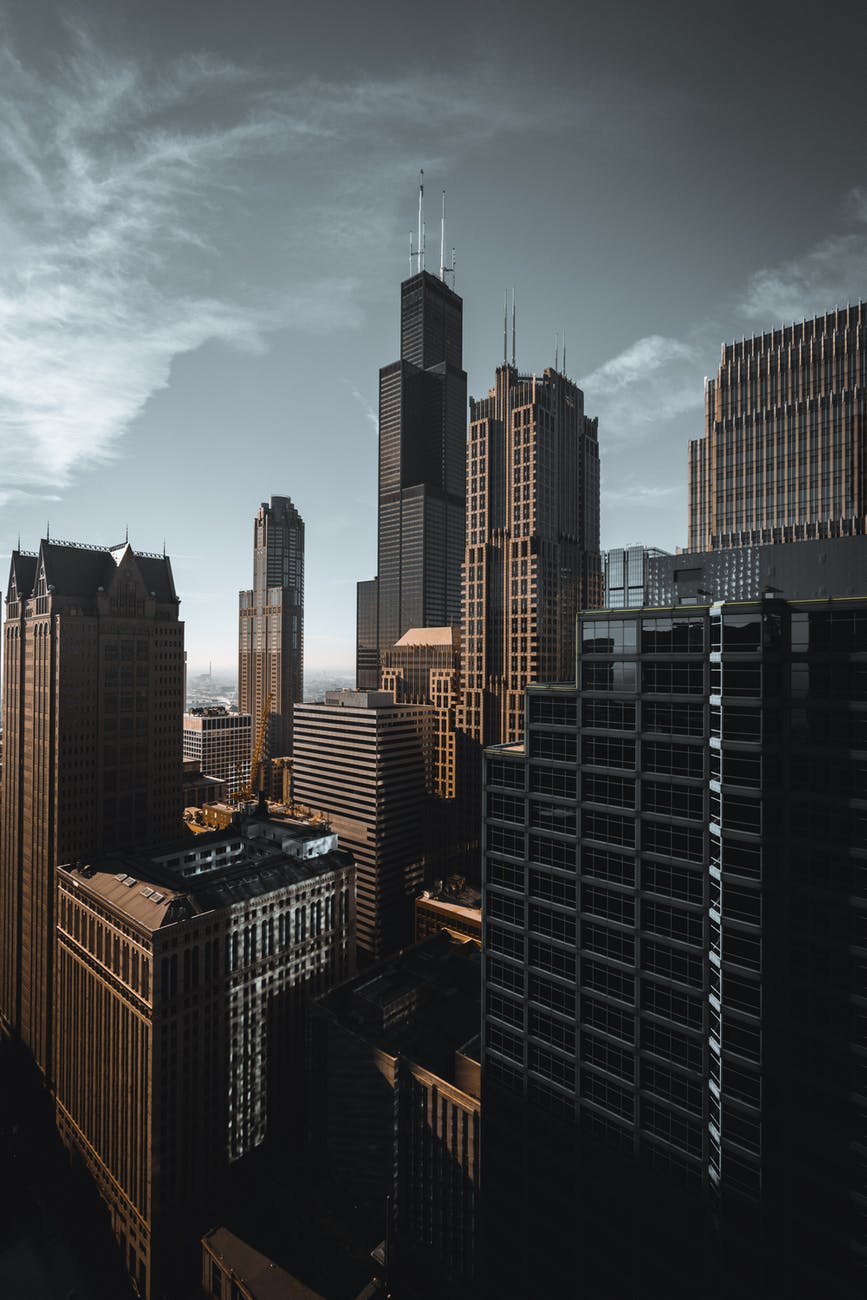
Tall skyscrapers are not just good at defining a skyline and providing status for a city; they attract lightning, some more than others.

Photo by Cameron Casey on Pexels.com

By a wide margin, three skyscrapers in the East stood out for repeated lightning strikes between the years 2015 and 2020. At 1,776 feet tall, the tallest building in the U.S., One World Trade Center in New York City, was struck 189 times between 2015 and 2020, but it wasn’t the most frequently hit building in the nation…

Yet the Big Apple isn’t the U.S. city with the most frequently struck building. That distinction goes to the Willis Tower in Chicago, which ranks third in the U.S. for height, towering at 1,451 feet above the Windy City. That skyscraper was hit with 250 lightning strikes between 2015 and 2020, making it Thor’s favorite target, so to speak.

Why Willis and not World Trade? Lightning strikes vary based on building height, material, and suppression systems. Chris Vagasky, a meteorologist for Vaisala, told AccuWeather that location may be to blame as well.

“Chicago gets more lightning in an average year than New York City,” Vagasky said. “So when you stick a tall building in a place with a higher lightning density, it’s more likely to be struck than a tall building in a place with a lower lightning density. Willis Tower is only slightly shorter than One World Trade, by about 35 feet.”

This is a timely write-up given the number of storms the Chicago area has experienced in the last week or so. With summer heat and humidity in a humid continental climate, big dark clouds and rain have swept over the Chicago region.

The pictures that capture lightning striking the Willis Tower highlight the height of the building above the rest of the (impressive) Chicago skyline. Additionally, they also show the resilience of the structures – explained elsewhere in the article as large Faraday cages – in the midst of a natural phenomena that can be quite destructive.

What does it mean if the suburb of Naperville is the first US community to have two Amazon Fresh locations?

Signs point to a second Amazon Fresh store in Naperville and if it comes to reality, the suburb will be the only community in the country with two locations.

Photo by Sagar Soneji on Pexels.com

All signs point to a second Amazon Fresh grocery store opening soon in Naperville.

While city officials haven’t been notified of definitive plans for the site at 1351 E. Ogden Ave., Naperville Director of Communications Linda LaCloche said Amazon Fresh recently applied for a liquor license at the location. An opening date is unknown, but the building is currently being renovated and looks similar to the city’s other Amazon Fresh location on Route 59.

Naperville would become the first city in the country with two Amazon Fresh grocery stores…

According to Amazon’s website, there are only four Amazon Fresh locations in Illinois. In addition to Naperville, there are stores in Bloomingdale, Oak Lawn and Schaumburg.

Naperville may not be the only two store location for long and being the first means something. What is so attractive about Naperville as a location? Here are a few possible reasons:

-It is a wealthy and large community: over 148,000 residents with a median household income of nearly $126,000 (both 2019 estimates). This adds up to a lot of potential customers. Naperville is known for high white-collar jobs and tech jobs. These could also provide a good customer base.

-Naperville as a community has received many accolades. It has a high quality of life, high performing schools, and a vibrant downtown. It is a high status community and companies like to associate with such communities.

-Naperville is in favor of business and growth. This dates back decades with pro-growth decisions in the postwar era, includes tax incentives for corporations, and a desire to improve the streetscape along Ogden Avenue, a major roadway.

-Naperville is outside Chicago and in the Midwest, “normal America” locations for testing new concepts and ideas.

Put this all together and Amazon finds it worthwhile to go forward with two locations in Naperville.

Fighting the 2020 Census population count in Aurora, Illinois

Leaders in Aurora, Illinois are not happy about the 2020 Census results that suggest the second largest city in Illinois lost 17,000 residents:

Aurora Mayor Richard Irvin said this week the city will continue its fight to get what it considers a more accurate census count…

[The 2020 Census] showed Aurora had lost about 17,000 residents during the past 10 years – about the equivalent of one of the city’s 10 wards – and officials have said they doubted that kind of population loss would have gone unnoticed among other city metrics, such as housing stock, water customers and traffic counts…

The big concern is that the city has estimated the new count could cost Aurora about $31 million a year in lost distributions of motor fuel tax, sales tax, income tax and money from federal programs for housing and education…

He has called for a review of the numbers by the government, and has even said the city could call for a special census down the line.

Another loss for the large suburb: no longer being able to highlight the growth of the community. Looking at the dicennial Census figures on Wikipedia, Aurora has never lost population over a decade until the 2020 count. And the growth has been particularly strong since 1990; the city had 99,581 residents then before growing to 142,990 in 2000 (43.6% increase) and then to 197,899 in 2010 (38.4% increase). In American communities, “growth is good” so a population loss is a sign of something wrong.

A special census could be worth calling for given the money and status at stake. I recall that neighboring Naperville had at least a few special censuses in recent decades as they sought to benefit from a rapidly growing population. The goal would be similar here – acquire more resources – but also different in that the population may have dropped rather than increased.

Given my own knowledge of the area, a drop of 17,000 residents does seem large. This could go against the larger trends of the region – Chicago suburbs and the City of Chicago – which slightly gained population in the 2010s.

Quarantining at home away from other residents, considering the size of the home and the layout

For roughly a year and a half, numerous Americans have quarantined themselves not just from work or school but from the other members of their households. Having more room in the residence and having particular floor plans would seem to help.

Photo by Markus Spiske on Pexels.com

First, having more square feet would allow the residents to keep more distance and could provide the quarantined person more space to operate. Quarantining for a week or two could feel more burdensome if someone is restricted to a small room or portion of a residence. Space provides options for rearrangement.

Second, square footage might not be everything as the floor plan can matter. Large common spaces, a regular feature of many newer homes, would be off-limits. A more closed-off floor plan with separated rooms might work better. Even better could be a separate wing – imagine a bedroom and bathroom on one side of the house or on another level than the other bedrooms. For example, a split-level could be split between the quarantined and everyone else. Or, an in-law suite or numerous bedrooms with en suite bathrooms. In contrast, a ranch home with all the bedrooms near each other and a large living space might limit options.

Few people likely purchased their homes or rented particular places with a pandemic in mind. But, considering medical issues is not out of the question for many when looking for a place to live. Think of mobility concerns or aging in place. Or, if someone has a serious illness, where might a hospital bed fit or how would an alternative sleeping arrangement work out?

All I have is anecdotal evidence on this through observing the setups of people on social media. It appears most just block off a bedroom or office type of space in the home for the quarantined person. This works well if you have extra space or a room that is used occasionally. I suspect this is not so easy with less space or a layout that makes it difficult to isolate a single person.

“Creativity of the young” and the digital divide in working student play with technology into learning

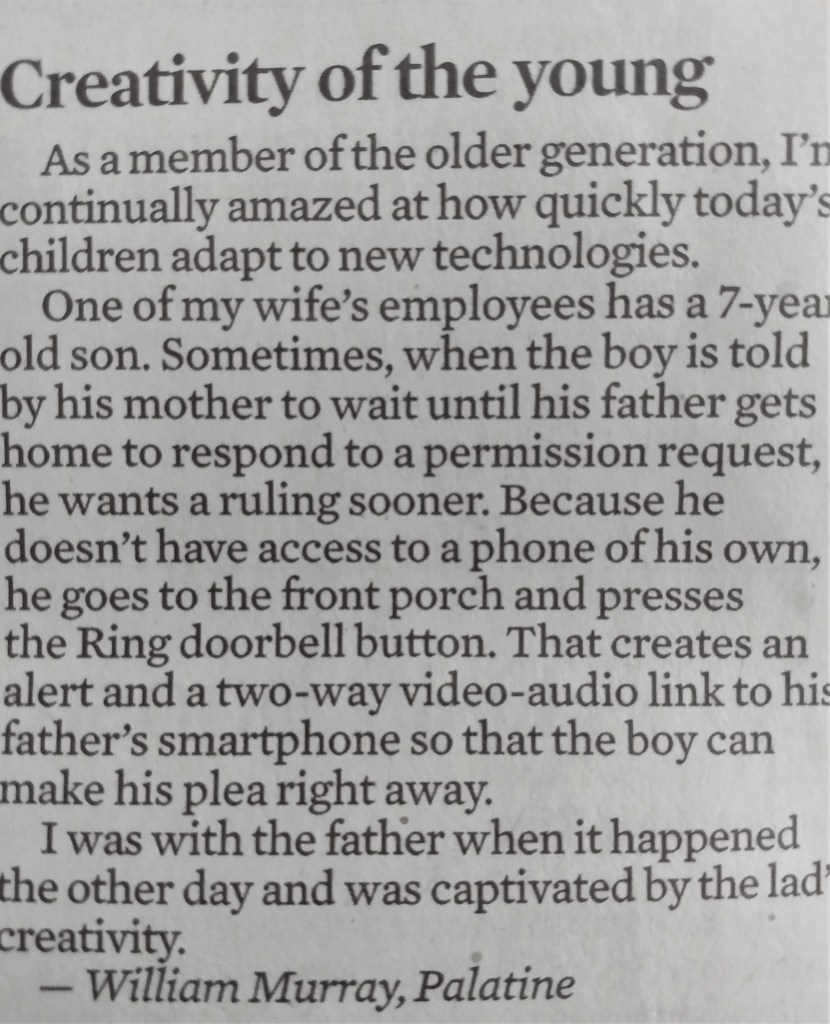
I recently saw a Letter to the Editor in the Chicago Tribune that highlighted the savvy use of technology by a seven year old:

Kids can access their parents multiple ways today and vice versa. This letter suggests the observer was “captivated” by this technology use, hinting at the resourcefulness of the boy.

This response is interesting to compare to the findings of a sociology book I recently browsed. In Digital Divisions: How Schools Create Inequality in the Tech Era, Matthew Rafalow found that schools differed less on their access to or use of technology in learning but in how they treated the student’s creative use of that technology. From the conclusion:

The students that I profiled in the previous chapter suggest that kids’ potential as budding technologists gets bifurcated as they pass through middle school. Despite the fact that digital play with peers led to the development of digital skills with online communication, media editing and production, and even the basics of programming logic, these eighth-graders reported different conceptions of whether online play was acceptable or even welcome in schools. While students at a school for mostly White and wealthy youth came to see digital play, including social media and video games, as fun and even necessary for achievement, students at schools serving less privileged and mostly students of color were taught that play at school was either irrelevant or threatening to schooling. Schools differently disciplined digital play, and in doing so, they different shaped how young people came to evaluate their own digital self-worth in these settings. (135)

Restating the argument a few pages later:

My takeaway from this project is that cultural resources are not like a currency you can hand to anyone in exchange for rewards. The students in this study varied by race-ethnticity and social class, and each developed a set of digital skills in online communication, collaboration, and digital production from play with friends online. Despite each student’s access to this knowledge, only students at the school serving wealthy and predominantly White children were given the right to treat their digital knowledge as currency to be exchanged for achievement. The school organizational context determines not only what ideal cultural resources are but also who the buyer can be to facilitate the exchange. Working- and middle-class Latinx and Asian American youth at Chávez and Sheldon had the same resources but were not permitted to exchange them for a reward. (154)

As Rafalow notes, this is what class reproduction – intersecting with race and ethnicity – looks like in today’s world. Just as Bourdieu suggested with art and music, digital technology is widely available but who it is for and how it is supposed to be used differs by group. Is digital creativity lauded and celebrated for a kid who people think might be headed for success and a creative class career or is it discouraged or punished because it is distracting from acquiring necessary skills?