“McMansions are the largest physical boomer legacy soon inherited by their children”

A Connecticut architect considers the McMansion legacy left by a generation of homeowners and builders:

Skyscrapers are the image of New York. The White House is more America than a home. And McMansions have become a punchline. When I sought to find land in 1982, a broker pushed a building lot in a McMansion development, pushing its allure by flatly asserting, “We’re talking about some seriously beautiful homes here.”…

Time has not been kind to we boomers. We basically tanked the entire world’s economy with “irrational exuberance” that found its most publicly grotesque distortion in those McMansions. Make no mistake millions of less-than-McMansions had more distortional impact on the credit markets than the hundreds of thousands of McMansion, let alone the one-off attempts by individuals who try to buy social legitimacy by building large homes — the real mansions…

McMansions are the largest physical boomer legacy soon inherited by their children, the millennials, who have had the worst economic birthing since the Great Depression. Kate Wagner was barely in her 20s when she called out the final fruits of 40 years of serial housing booms that afflicted America. But the impact of in-your-face domestic chest-beating is especially present in Connecticut, which realtor.com trumpeted as having the “metro” with the third most McMansions in the country. And that impact was doubled down by the added insult of unending instant “tear-downs” of those homes built in the previous generation in the tight Northeast.

As an architect I have remade any number of these instantly dated ego vehicles. We have also revived any number of raised ranches, garrison colonials and Capes. Often those homes need strategic expansion. But with McMansions, removal of the offending detail and pretense is often the first remediation.

I like the idea that a social group – here the emphasis is on Baby Boomers – can leave a physical legacy for later members of the same society. People do not just pass down values, norms, and behaviors; they also leave a physical landscape and places that they have made and shaped. Even though we do not focus much on this in the United States, these places shape us and also provide inertia for what future residents will experience. McMansions have the potential to influence millions of lives even as the original designers, builders, and residents may no longer be present.

At the same time, I wonder how obvious the excesses of the McMansion were while they were being constructed in large numbers. It is relatively easy today to look at them with disdain or wonder at what prompted them. A blog like McMansion Hell has the benefits of hindsight as well as new eyes from a younger resident from a different generation. Did this architect call out McMansions back in the 1990s when wealthy Connecticut communities built them in large numbers? My own research suggests the tide starts to turn against McMansions in the early to mid 2000s as consistent critiques of their architecture and consumption arise as well as there are enough of them in communities across the United States to see them as a single phenomenon.

Going forward, I don’t think McMansions will disappear. There is plenty of money to be made in McMansions compared to building smaller housing units. It is not clear that all millennials or future homebuyers will see them as homes to be avoided. And many of the McMansions critics say are poorly built and designed will last for decades.
Learning about the notorious criminals of other major cities

In recently reading Tenements, Towers & Trash: An Unconventional Illustrated History of New York City, I learned about several notable criminals and crimes in the largest city in the United States. This got me thinking: does every large city have its cast of unsavory lawbreakers that are relatively unknown to those who live outside the city or region?

Without reading histories of every large American city, it is hard to know. And I wonder if it is harder for these infamous characters to go unnoticed on the national scene today with the round the clock news coverage online and on TV that can talk about possibly criminal activity for hours and days without stop. On the flip side, these local characters might even become a part of civic pride or a grim experience everyone has shared or even tourist fodder. While cities can be compared on overall crime statistics (such as with claims that Chicago is the murder capital of the United States), stacking criminal individuals or groups against each other is a more nuanced task.

And would it be worthwhile to be able to name a few notable criminals from every major American city? These cases could help reveal some unique local history and character. But, they could also reinforce notions that cities are centers of crime. With so much interesting material to learn about a large city and/or a metropolitan region, criminal activity would be far down my list of what I would want to know.

A town of over 53,000 residents can elect a mayor with just over 3,600 votes

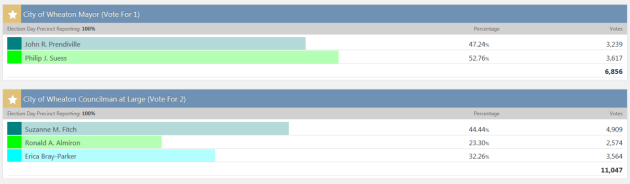
Municipal elections in Illinois took place this past Tuesday. In my suburban community of just over 53,000 residents, here are the results for the two races:

WheatonMunicipalElectionResultsApr19

In races for two important local positions, voter turnout was relatively low. Of the roughly 41,000 adults in the community 18 and older, the mayor was elected by 3,617 voters while his opponent had just over 3,200 votes. In the councilman race, the numbers are a little harder to interpret because voters could select two but the numbers are certainly not much higher. Overall, under 20% of adults voted (hard to know how many are registered) and less than 10% of those adults selected the next mayor.

Perhaps there are a variety of factors at work:

  1. Do residents/voters believe that municipal elections matter? What do local officials do anyways?
  2. Holding municipal elections separately from larger races – state and national races that tend to get more attention – could lessen enthusiasm.
  3. Perhaps the candidates are not that exciting (the two mayoral candidates shared multiple characteristics) or they are unknown to broad swaths of the community.

Low voter turnout is now common and it may not take much to be voted in to local office. But if suburbanites claim to value local government, it is not hard to see the disconnect between choosing local leaders and wanting to maintain local control.


New apartments in the US also getting smaller

As the median size of new homes in the United States drops, so does the size of new apartment units:

According to a recent analysis of apartment sizes by RentCafe, newly built apartments, in general, are 5 percent smaller than those built 10 years ago. The average U.S. unit built in 2018 boasts 941 square feet, down roughly 52 square feet. According to the study, Chicago ranks third in the nation for the smallest average apartment sizes (a tie with Manhattan at 733 square feet).

Census Bureau data from 2017 on the median square footage of multifamily units suggests something similar with a drop from a peak in 2007.

Three quick responses:

  1. While the square footage is dropping, I assume the rental price has not dropped at the same rate. Fewer square feet for the same or a higher price?
  2. According to the same Census data, more multifamily units were constructed in 2017 than in any year in the table (going back to 1999). Do smaller units mean builders and developers can now squeeze in more units?
  3. This data from RentCafe is connected to a rise in microapartments. The Census data suggests the percent of multifamily units under 1,000 square feet has not increased over 10 years between 2007 and 2017.

So is there a significant trend toward smaller rental units? Maybe a small one that could be worth watching but it could take quite a bit of change for microunits to really be built in large numbers.

Building a 1,000+ foot skyscraper in a rural town of 7,000 residents

Skyscrapers and cities are tightly linked. Can one be built in a small town in the countryside?

Until a local company announced plans to send a 320-metre skyscraper soaring over the surrounding countryside, most people in Denmark had only the haziest idea where Brande, a town of 7,000 people in rural Jutland, even was.

The Bestseller Tower, designed by star architectural studio Dorte Mandrup, will not only be the tallest building in Denmark, but the tallest in western Europe, besting the Shard in London by a crucial 10.4 metres…

It won’t be the first rural skyscraper. At the height of Japan’s property bubble back in 1991, a 41-story residential tower, Sky Tower 41, was erected among fields.

But in Jutland, the surrounding landscape is so flat that the tower will be visible from 60km away. Visitors to Jelling, the royal seat of Harald Bluetooth, the Viking king who united Denmark, will see its slender form jutting up from the horizon, as will visitors to Legoland 30km away.

While the article suggests it will not be the only rural skyscraper in the world, they are certainly rare. They are rare enough outside of sizable central business districts that numerous tall buildings in the Chicago suburbs – probably in the 20 to 30 stories in height – attract attention as unusual and sticking out in the landscape in a metropolitan region that takes pride in its tall buildings and architecture.

It is certainly possible to build such a structure almost anywhere but I wonder how this will all work out in day-to-day life in this community. Small towns and rural areas have a particular scale that people are used to and that is human scaled or even dominated by nature and landscapes rather than human creations. Constructing a building over a 1,000 square feet disrupts all of this: it will be visible for miles, it will dwarf anything nearby, and it will cast shadows and block the sun from certain angles. It is not slightly out of scale for this community; it is a massive change. It could be beautiful, modern, and efficient and still have negative consequences for the community.


Suggestion that Hudson Yards and other urban megaprojects threaten suburbs

The glitz of the new Hudson Yards in New York pushes one theater critic to argue such spaces threaten suburbs:

A problem faced by suburbs becomes all too clear at Hudson Yards. Affluent Americans are almost all going to live in cities, starving urban centers of affordable housing just as they’ll choke up the traditional suburban resources. No suburb, I kept thinking, can compete with this. And Hudson Yards, or Lincoln Yards, or whatever comes next, are far from done.

Such large developments in significant urban neighborhoods are worth keeping an eye on because of all the change that comes at once plus what is included in the new spaces.

But, I don’t think Hudson Yards or the proposed megaproject on Chicago’s north side or the development around Staples Center in Los Angeles will threaten suburbs in the long run:

  1. These spaces do not have the same combination of factors that Americans like in suburbs starting with the emphasis on single-family homes and family life. Projects like these have elements of what suburbia can offer but primarily offer a different experience: bustling activity, diversity of dining and cultural options, presumably a greater mix of people. Suburbs can indeed compete with this by offering a different lifestyle.
  2. The housing available in these new projects is primarily for wealthy urbanites, likely appealing to young professionals and older adults who like all the activity and the newness. This may indeed continue to help concentrate the affluent in certain urban neighborhoods but there will be plenty of working to middle-class residents who will be priced out and will find suburban housing more affordable.
  3. Surveys continue to suggest that even young Americans desire a suburban life in the long run, particularly when they reach a certain age or have families. From my vantage point, the emphasis on the rush to the big cities is overplayed.

Both sizable and exciting urban megaprojects can find success alongside suburban life. Perhaps they may even draw on different people groups in the long run, segmented by age as well as resources. And perhaps we should continue to keep paying attention to who has difficulty finding a true home in either type of space.

Suburban ministry accepts notorious convicted murderer as resident

Suburbanites do not want to be associated with crime, particularly notorious ones. So a recent action by a Christian ministry in Aurora is notable:

Wayside Cross Ministries of Aurora officials said Monday that by accepting “Ripper Crew” murderer Thomas Kokoraleis as a resident, the organization is doing what God commands everyone to do: Show kindness and mercy to all, even enemies, the ungrateful and the wicked.

“We are mandated by our Lord Jesus Christ to love our neighbors. According to Luke 16, anyone in a genuine need is a neighbor,” Executive Director James Lukose said in a news release that Wayside Cross also posted on its website, waysidecross.org

Kokoraleis, 58, was released from prison Friday after serving half his 70-year sentence. He is not on parole, and is free to live where he wants, as long as he informs police…

Kokoraleis was one of four men suspected of killing as many as 17 women in Chicago and the suburbs in the early 1980s. His younger brother, Andrew, was one of them and was executed in 1999.

The Chicago Tribune wrote an editorial several days ago on Kokoraleis’s release:

A judge chose to sentence him to life in prison. But his conviction was struck down over legal errors, and the case was resolved with the defendant pleading guilty and being sentenced to 70 years. Thanks to the rules in effect back then, which allowed him to cut his time in half through good behavior, Kokoraleis was released Friday at age 58. He is expected to live at a Christian-oriented facility in the Wheaton area…

We won’t relitigate Thomas Kokoraleis’ case or his guilt. But we feel no hesitation in saying that life behind bars should have been the certain sentence for what he did. There is something profoundly exasperating about seeing someone who took part in such wanton slaughter being allowed to walk free among civilized people.

I wonder if this will cause any furor long-term in Aurora and the surrounding area. UPDATE APRIL 2, 2019 – The mayor of Aurora is not happy about this.

“In light of the unspeakable nature of the crimes committed by the Ripper Crew, I would hope that Wayside would reconsider the decision that brought Kokoraleis to Aurora — particularly given the Ministries’ close proximity to parks, churches and day care centers,” Irvin said in a statement Monday evening. “I absolutely disagree with Wayside Cross Ministries’ decision to allow Kokoraleis to reside at their facility in Aurora.”

Presumably, there are plenty of nearby residents with possible competing loyalties in this particular case: they would claim Christian faith and also be at least hesitant about living near such a murderer. There would be few suburban cases at this level that could push suburbanites to consider balancing justice and forgiveness – and both suburban and American history suggest they would almost always settle on the side of justice and keeping the issue as far away from their homes and community as possible.

I hope there will be a follow-up either way, whether Kokoraleis lives quietly or falls into trouble again.

Fighting discrimination in online housing ads

The Department of Housing and Urban Development and the ACLU are going after discriminatory online housing listings:

The U.S. Department of Housing and Urban Development filed charges against social media giant Facebook on Thursday, alleging that its advertising platform violates the Fair Housing Act by allowing lenders and realtors to target Facebook users on the basis of race, gender, religion, familial status, disability, and national origin.

“Facebook is discriminating against people based upon who they are and where they live,” said HUD Secretary Ben Carson in a statement. “Using a computer to limit a person’s housing choices can be just as discriminatory as slamming a door in someone’s face.”

According to Axios, HUD and Facebook were close to a settlement. Citing anonymous sources, the Axios report says the decision to file charges could be motivated by a desire to appear on the offensive on housing discrimination prior to Carson’s meetings with lawmakers on Capitol Hill next week.

The charges are somewhat surprising as Facebook just settled five similar cases with the American Civil Liberties Union (ACLU) last week. Under the settlement, the company agreed to create a separate advertising portal for real estate listings where advertisers’ options for targeting are limited. Facebook also settled a housing discrimination case with the state of Washington last summer.

The features that make online advertising so attractive – the ability to target particular consumers rather than addressing larger populations – do not work so well in the real estate field where housing is supposed to be available to all.

This reminds me of the conclusion of American Apartheid where the sociologists suggest the necessary rules are in place to combat housing issues but the political will is lacking. If the online realm is now indeed where a lot of housing is rented or sold, then discrimination in online listings needs to be addressed when it does occur.

Add these online occurrences to the ongoing findings of audit tests suggesting differential treatment and there is likely plenty of housing discrimination still to battle. While the 1968 Housing Act banned discrimination on the basis of “refusal to sell or rent a dwelling to any person because of his race, color, religion, or national origin,” many American communities – including the suburbs on the basis of race and class – are what they are today because of exclusion.

McMansion literary tales: a proposed teardown leads to local dysfunction

The McMansion continues to feature in literary works. A new book from a Washington D.C. area author uses a proposed teardown McMansion to highlight suburban issues:

Coincidence or not, Langsdorf’s success comes after leaving her longtime suburban existence. Following her 2012 divorce, Langsdorf moved to Adams Morgan in the District and devoted herself to writing while teaching yoga on the side. And yet, the book takes her back to that former life: “White Elephant” seems to channel all of the frustrations she felt juggling her identities as a mother and creator in a stifling suburb. The novel follows the residents of the fictional enclave of Willard Park — inspired, in part, by Langsdorf’s hometown of Kensington, Md. — where an interloper’s plans to build a McMansion amid the cozy bungalows leads to angry town halls, scandalous romantic dalliances and shady high jinks.

Like Langsdorf, two of the main characters in her ensemble are mothers grappling with their identities beyond being wives and mothers. Allison Miller, who has lived (mostly) happily in Willard Park for more than a decade, wonders what to do with her photography — more than a hobby, less than a career. Her new next-door neighbor, Kaye Cox, can’t figure out who to be, caught between her role as a fixture in her husband’s behemoth of a house and her own interest in interior decoration. These women and their author are well-acquainted with the eternal dilemma for parents, the pull between caregiving duties and other interests, professional and personal…

Almost every neighborhood in the D.C. region has experienced a version of the changes in “White Elephant.” Even Adams Morgan: The Line hotel, for example, occupies a building that was once a church. Langsdorf laughs about some of the struggles she’s seen in her own building, hastening to add that her fellow co-op residents are all great neighbors.

The residents of Willard Park come to realize that houses matter less than their inhabitants — and that the suburbs aren’t for everyone. Langsdorf understands this, too; in her current existence she feels more herself. “My life is much more vibrant,” she says. “I love being able to walk everywhere, and I do have more time to write.”

That a proposed McMansion could lead to “dalliances” and “high jinks” is intriguing to consider…the angry public meetings are much easier to verify.

While it would not have been possible to discuss McMansions before the 1980s since the term did not exist, it sounds like this new work draws on several common suburban critiques featured in novels, films, television shows, and other cultural products. Suburban residents, particularly women and mothers, feel trapped by suburban expectations and a landscape that does not easily lead to human connection or diverse experiences. They then look for ways to break free of the suburban mold and explore different outlets.

These works tend to emphasize those that feel “the suburbs aren’t for everyone.” At the same time, many Americans live in the suburbs by choice and I assume a good number of suburbanites feel their existence is at least okay. Is it because cultural works need crises to overcome (the hero on their journey must overcome something) or are the suburbs are a unique target because they are so common in the United States (over 50% of residents live there) and so reviled?

The growing influence of mascots: a short history of Benny the Bull

In addition to providing fun and distracting from what may be poor play by the team, sports mascots are important brand symbols. The symbolic nature of their existence and their importance in developing and sustaining a brand is highlighted in this summary of Benny the Bull’s life:

Benny accompanied Richard M. Daley to China. Benny has been sued and Benny has been ejected from games. Benny has topped the Forbes list of the most popular sports mascots and Benny has been arrested at the Taste of Chicago. Off the court, the people who played Benny didn’t get health insurance from the Bulls until the Jordan era (or a 401K plan for even longer). One owned a deli in Skokie, another was an evangelical Christian…

I know who Benny has been since he was born; seven people (and countless understudies) have slipped into Benny’s shoes since he debuted Oct. 17, 1969. I know the name and job title of the person playing Benny right now but agreed not to reveal it, because, well — for the sake of the children. The Bulls want to retain some mystery with Benny, so we will honor that — to a degree. As Benny developed as a brand, the Bulls have treated him increasingly as Disney treats Mickey: No one plays Benny! No one is inside Benny! Benny is Benny! That is, a cottage industry, and like any mascot, the face of a franchise. Players come and go, but only Benny remains….

As the Jordan era waned and the business of the Bulls rolled on, Benny gained new relevance. He acquired an entourage — including Lil’ Benny, Mini Benny, and, notoriously, Da Bull, Benny’s angrier brother. Bring up Da Bull to the Bulls today and they look at you as if you asked for a loan: The Chicago man who played Da Bull was arrested in 2004, near the United Center, for selling 6 ounces of marijuana (and later received probation)…

And so this summer Benny — who is being inducted into the new Mascot Hall of Fame in Indiana and getting a new van for appearances — also will be busy. The Bulls say he gets a work-life balance; and he is paid well (low six figures, whisper some close to the job). But the job itself never ends. Asked if he can relate to workaholic Benny, Landey Patton, the first Benny, said he couldn’t dribble, never mind dunk. He said, “It’s all razzmatazz and dancing now. And so corporate, you know? When I was Benny, families could afford tickets. And what are Bulls tickets now — $10?

Four quick thoughts:

1. This relatively recent emphasis on mascots mirrors big shift in sports in recent decades: it is big business and big entertainment, in addition to being about winning games. The mascot can be an important part of the show that needs to go well to help enhance what are booming values of teams. The most recent valuation by Forbes suggests the Bulls are worth $2.9 billion and Benny is part of a well-oiled machine.

2. The article hints at this but I have to think much of this is about attracting kids and hoping they become lifelong fans (and customers).

3. Sports run on certain schedules, usually emphasizing the games, but mascots help the teams and sports stay in the public consciousness all year round. These are now year-round activities, even if the games stretch from late October to early June.

4. I have not attended many Bulls games over the years but I have always been partial to the Benny the Bull blimp who had plenty of airspace to navigate when the team moved to the more expansive United Center in the mid-1990s.