The Chicago area’s net migration is not bad but it can’t attract new residents

The newest Census data suggests both Chicago and the Chicago region are losing residents. But, it may be less about people moving away and more about an inability to attract new residents:

ChicagoAreaPopulationChange2019

Some experts note the metro region also isn’t attracting enough newcomers to make up for people who move away. Immigration from other countries also has long helped stem population loss, but in recent years this influx has been less robust, according to census estimates. Meanwhile, birthrates are slowing statewide, which means there are fewer new residents to make up for other losses…

“We don’t have a particularly high rate of just out-migration, but very few people come here relative to our population, compared to the rest of the country,” said Daniel Kay Hertz, research director at the Center for Tax and Budget Accountability.

Using numbers from the 2015 American Community Survey, conducted by the U.S. census, his agency found that Illinois ranked in the middle of the pack nationally on the rate of people leaving the state, but was third from the bottom on the rate of people coming in…

“The narratives around the state matter and can shape people’s decisions,” Hertz said. “And the ones in Illinois are really, really, really negative in ways that I think overstate some of the issues relative to other places.”
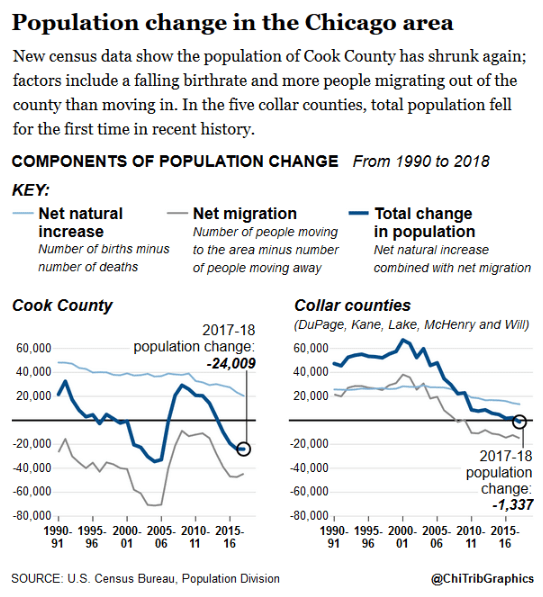
Any major metropolitan area is going to have some people moving out as they get new job opportunities, see greener pastures elsewhere, move for family reasons, and so on. The goal then is to also attract new residents even as some are moving out. Population increases come from new residents plus more births than deaths.

This one expert cited above hints at an interesting conundrum for any city or region beset with population loss or narratives of decline: how do you reverse the trend once it starts picking up steam? As noted, the narratives both within and outside the Chicago region and Illinois are not good: pension debts, inequality, corruption, social issues that have lasted decades, higher taxes, a lack of innovation, not a business-friendly climate, harsh winters, important but bottlenecked infrastructure. If Chicago was the exemplar American city at the turn of the twentieth century, that is no longer the case. Other cities are on the rise, particularly in the Sunbelt stretching from Washington D.C. (with the expansion of and attention paid to the federal government, perhaps now truly the second most important American city) to Houston (whose population keeps growing and may soon surpass Chicago).

It is hard to know exactly how much the larger narrative pushes people to avoid the Chicago area in favor of other places. At the same time, status matters. People and businesses want to go to places that are on the way up, that are gaining people, that have an energy moving toward the future. Chicago and its region still have a lot to offer. For example, millennials still like portions of Chicago for their thriving cultural scenes plus relatively cheap housing compared to other major cities. Perhaps Chicago’s long-term fate is to roughly stay the same at the center of the Midwest region, a significant portion of the country that may also be losing population and status.

The late 2000s “global economic meltdown” and values of McMansions

One columnist connects the economic crisis of the late 2000s and McMansion values:

Perhaps you thought the last decade’s global economic meltdown, which crushed stock prices and McMansion values, would most hurt the wealthy. Nope. The gap between rich and poor in the U.S. expanded in the aftermath of the Great Recession. The (sarcastic) good news: America’s wealth gap expanded less than Bulgaria’s between 2010 and 2017.

Three quick thoughts:

  1. McMansions are often cited as a symptom of the problems that led to the economic crisis and housing bubble of the late 2000s. The spirit of consumption in the United States with lenders providing more and more risky loans (and not recognizing the problematic loans and then selling and buying them as if they were good investments) plus decisions by consumers to purchase more and acquire debt all contributed to the larger issues. If you needed one symbol of excessive consumption from the early 2000s, commentators often go for the McMansion or the SUV.
  2. While the McMansion became an important symbol, housing prices almost across the board declined precipitously. Not just McMansions were affected. And since most American single-family homes are not McMansions, it seems a bit odd to single them out here. Many Americans who would not or could not purchase McMansions felt the effect of declining property values.
  3. Housing construction declined during and stayed depressed for a number of years after the economic crisis. Even during this down time, builders continued to construct McMansions. And once the economy started to pick up, more McMansions appeared. While the economic trends certainly affect how many McMansions go up, the style of home has some staying power. Even if such homes helped contribute to the economic crisis, some Americans still want to build and buy them. The value of such homes may not be the only reason people build and buy them.

Beleaguered shopping malls face more closing stores

Shopping malls face multiple challenges, including more and more store closings:

It’s only April, but already this year more store closures — nearly 6,000 — have been announced than in all of 2018…

U.S. retailers so far have announced they will shut 5,994 stores, while opening 2,641, according to real estate tracking done by Coresight Research. That’s more locations slated to go dark than during last year. In 2018, there were 5,864 closures announced and 3,239 openings, Coresight said.

The planned closures include more than 2,000 from Payless ShoeSource, which filed for bankruptcy, hundreds from clothing retailers like Gymboree, Charlotte Russe, Victoria’s Secret and Gap, and discount chain Fred’s. Meantime, chains like Aldi, Dollar Tree, Ollie’s Bargain Outlet, Five Below and Levi’s are planning to open more stores…

With more store closures likely on the horizon, consumers can expect to start seeing hotels, gyms, apartment complexes, more food halls and grocery stores at traditional malls, turning them into more like city centers. The new Hudson Yards mall, which opened in New York last month, is the perfect example of this mixed-use model.

Before long, shopping malls may morph more into entertainment and public spaces than shopping spaces. In today’s world, it is not enough to cluster a bunch of national retailers together in an indoor or outdoor setting surrounded by plenty of free parking. The era of teenagers hanging out at the mall (and efforts to counter those gatherings) may be over. And it may not be only shopping malls that are in trouble; this may not be an issue of too much suburban sprawl. Rather, shopping districts all over the place, even in Manhattan, may be threatened. Some of these shopping areas will continue, particularly those surrounded by wealth or those that offer unique “cosmopolitan canopies.” Others will be transformed to the point that it will be very difficult to discern they were once shopping malls.

Furthermore, it will be interesting to see how these retailer brands disappear into the night or return in new forms or with new emphases or new money. Will Payless come back? Is Gap in its death throes and will its lessons be absorbed by companies taking up that same business space? Can Sears hang on another decade or even make a comeback?


What I want to know: do TV shows push viewers to buy certain kinds of houses?

After publishing two papers in the last few years on TV depictions of suburbs and their houses (see here and here), it leaves me with one big question: do shows like these directly influence what homes people purchase?

Americans watch a lot of television – still an average of about four hours a day for adults – and they see a lot of dwellings. While there is a mix of housing units shown, scholars point out that television since the 1950s does place a lot of emphasis on single-family homes. This includes fictional shows set in single-family homes in the suburbs (think Bewitched or Desperate Housewives), rural areas (think Lassie), and cities (think Happy Days and King of Queens). More recently, viewers can see homes on HGTV and other networks that emphasize home life (plus the shows on other networks that specifically target homeowners, from This Old House to Trading Spaces). This makes some sense in a country that holds up owning a single-family home, particularly in the suburbs, as an ideal.

But, we know little how about all of this watching about homes translates into choosing homes. My study “From I Love Lucy to Desperate Housewives” did not find much evidence that more popular suburban television shows led to more people living in suburbs (or vice versa). Similarly, outside of some interest from Sopranos’ fans in having a home like Tony, there is little to no evidence that Americans flocked to imitate the home or neighborhood of the Sopranos. While the viewers of HGTV might be relatively wealthy, do they take what they see and directly purchase something like that?

It is relatively easy to make claims about how media products affect thoughts and behavior. However, it is harder to make direct, causal connections. I would guess advertisers around such shows hope such a connection is present. If we could examine this relationship between shows and homes more closely in research studies, it could help us better understand how Americans form, maintain, and change their approaches to homes and communities.

If Americans can celebrate and preserve ranch and modernist homes and Brutalist architecture, we can expect to see preserved McMansions

McMansions are rarely celebrated and are often skewered (read more here and here). Yet, given the number of McMansions constructed in recent decades plus the number of Americans who live in McMansions, I predict this: we can expect to see preserved McMansions in the future. Imagine at least a few McMansion preservation districts or homes converted into museums and/or local history sites to help future American residents envision the past.

Critics argue McMansions have a multiple negative traits including their size, their architecture, and what they stand for. At the same time, not all buildings and structures that are preserved or celebrated are ones that all Americans celebrate. Take but three examples: ranch homes, modernist homes, and Brutalist buildings. Ranch homes have their own proponents and backers but they are also derided for their simplicity and lack of traditional architecture, particularly in mass-produced suburbia. Modernist homes may catch the eye of architects and those interested in minimalist design but I think more Americans would prefer a McMansion. And Brutalist architecture may come under fire but a number of prominent public buildings in this style still stand and will be preserved.

If future Americans want to understand typical life at the turn of the twenty-first century, they may need to see and tour a suburban McMansion. This does not mean that the presentation will be all positive. Those future visitors may scoff at the open design, the architectural mish-mash, the hobby rooms and copious amounts of storage space, the granite countertops and stainless steel appliances, the use of McMansions in horror stories, and the rows upon rows of such homes. Or, such a preserved home might endeavor to explain why Americans continued to buy McMansions even with the negative connotations of the term.

I look forward to seeing some of the first McMansion preservation sites. These may be both business and community opportunities as well as part of an effort by Americans to better understand their own past. And because there are so many McMansions and they are so emblematic of a particular era, let the era of McMansion preservation begin.

The correct interpretation of the concept of a 500 or 1,000 year flood

A flood expert addresses five myths about floods and this includes the idea that a 500 year flood only happens once every 500 years:

Myth No. 3
A “100-year flood” is a historic, once-in-a-century disaster.

Describing floods in terms of “100-year,” “500-year” and “1,000-year” often makes people think the disaster was the most severe to occur in that time frame — as encapsulated by President Trump’s tweet calling Harvey a “once in 500 year flood!” He’s not alone. When researchers from the University of California at Berkeley surveyed residents in Stockton, Calif., about their perceived flood risk, they found that although 34 percent claimed familiarity with the term “100-year flood,” only 2.6 percent defined it correctly. The most common responses were some variation of “A major flood comes every 100 years — it’s a worst-case scenario’’ and ‘‘According to history, every 100 years or so, major flooding has occurred in the area and through documented history, they can predict or hypothesize on what to expect and plan accordingly and hopefully correct.”

In fact, the metric communicates the flood risk of a given area : A home in a 100-year flood plain has a 1 percent chance of flooding in a given year. In 2018, Ellicott City, Md., experienced its second 1,000-year flood in two years, and with Harvey, Houston faced its third 500-year flood in three years.

That risk constantly changes, because of factors such as the natural movement of rivers, the development of new parcels of land, and climate change’s influence on rainfall, snowmelt, storm surges and sea level. “Because of all the uncertainty, a flood that has a 1 percent annual risk of happening has a high water mark that is best described as a range, not a single maximum point,” according to FiveThirtyEight.

I am not surprised that the majority of respondents in the cited survey got this wrong because I have never heard it explained this way. Either way, the general idea still seems to hold: the major flooding/storm/disaster is relatively rare and the probability is low in a given year that the major problem will occur.

Of course, that does not mean that there is no risk or that residents couldn’t experience multiple occurrences within a short time period (though this is predicted to be rare). Low risk events seem to flummox people when they do actually happen. Furthermore, as noted above, conditions can change and the same storms can create more damage depending on development changes.

So if this commonly used way of discussing risk and occurrences of natural disasters is not effective, what would better communicate the idea to local residents and leaders? Would it be better to provide the percent risk of flooding each year?

The difficulty of measuring a splintered pop culture

What are common pop culture products or experiences in today’s world? It is hard to tell:

Does Eilish, for instance, enjoy the same level of celebrity someone of equal accomplishment would have had 15 years ago? I don’t know. There are Soundcloud stars, Instagram stars, YouTube stars, Twitter stars, TikTok stars. Some artists, like Eilish and Lil Nas X, transition from success on a platform like Soundcloud to broader reach. But like Vine, TikTok has its own celebrities. So do YouTube and Instagram. We’ll always have George Clooneys and Lady Gagas, but it almost feels like we might be lurching towards a future with fewer superstars and more stars.

We can still read the market a little more clearly in music, and on social media, but the enigma of streaming services illustrates these challenges well. The problem is this: At a time when we’re both more able and more willing to concentrate in niches, we also have fewer metrics to understand what’s actually happening in our culture…

We have absolutely no idea. People could be watching “Santa Clarita Diet” in similar numbers to something like “It’s Always Sunny in Philadelphia,” or they could be completely ignoring it. The same goes for every show on Amazon, Hulu, and Netflix. We can see what people are chattering about on social media (hardly a representative sample), and where the companies are putting their money. But that’s it. Not only do true “cultural touchstones” seem to be fewer and farther in between in the streaming era, we also have fewer tools to determine what they actually are…

But it also means there’s more incentive for the creators of pop culture to carve us up by our differences rather than find ways to bring us together. It means we’re sharing fewer cultural experiences beyond the process of logging onto Netflix or Spotify, after which the home screen is already customized. On top of all this, it means we’re more and more in the dark about what’s entertaining us, and why that matters. What does cultural impact look like in an era of proliferating niches, where the metrics are murky?

I wonder if this could open up possibilities for new kinds of measurement beyond the producers of such products. For example, if Netflix is unwilling to report their numbers or does so only in certain circumstances, what is stopping new firms or researchers from broadly surveying Americans about their cultural consumption?

There may be additional unique opportunities and challenges for researchers. There are so many niche cultural products that could be considered hits that there is almost an endless supply of phenomena to study and analyze. On the other hand, this will make it more difficult to talk about “popular culture” or “American culture” as a whole. What unites all of these niches of different sizes and tastes?

It will also be interesting to see in 10-20 years what is actually remembered from this era of splintered cultural consumption. What cultural phenomena cross enough boundaries or niches to register with a large portion of the American population? Will the primary touchstones be viral Internet videos or stories rather than songs, movies, TV shows, books, etc.?


A preview of my upcoming talk on social media, emerging adults, and religiosity

Ahead of my participation in the “Emerging Adults: Formation for Mission” conference taking place soon on the Wheaton College campus is an interview regarding my talk:

I would describe the use of social media by emerging adults as a mix of excitement and resignation. A vast majority of emerging adults participate. They describe learning about relationships they already have, connecting with friends and family, seeing pictures, sharing jokes.

They find out about events and news through social media. They search for romantic partners through social media.

On the other side, they can articulate some of the downsides of this use including a lack of focus, not spending time with people (just their feeds), and the conflict that can arise in social media. Not participating means missing key connections and knowledge that others can access. Current emerging adults have known and participated in social media all of their lives and will continue to use social media as they age beyond this life stage.

The emerging adults of today are immersed in social media, technology, and other forms of media and they bring this with them as they consider faith and church.

While there is a lot of work looking at social media or social network site (SNS) use, relatively little of it in sociology and other disciplines addresses how this activity is influenced by or influences religion. This talk will help bring together several years of research projects with my sociology colleagues Peter Mundey and Jon Hill.

Recognizing and learning from “radical suburbs”

A new book from journalist Amanda Kolson Hurley looks at “radical suburbs” that do not fit the stereotype of sleepy, homogeneous, bedroom communities. From an excerpt:

Clichés and misconceptions still define suburbia in the popular imagination, and it drives me crazy. I live in Montgomery County, Maryland, outside of Washington, D.C. I’m a suburbanite, but my life doesn’t revolve around manicured lawns, status anxiety, or a craving for homogeneity. My suburban experience is riding the bus as people chat around me in Spanish and French Creole. It’s having neighbors who hail from Tibet, Brazil, and Kenya as well as Cincinnati. It’s my son attending a school that reflects the diversity—and stubborn inequality—of America today…

Radical Suburbs is about waves of idealists who established alternative suburbs outside of Eastern U.S. cities, beginning in the 1820s and continuing through the 1960s. These groups had very different backgrounds and motivations, but all of them believed in the power of the local community to shape moral and social values, and in the freedom provided by outskirts land to live and build in new ways.

As opposed to the groups who went far into America’s interior to settle isolated communes, these were, in a paradoxical-sounding phrase, practical utopians. Staying close to the city let them try out new ways of living with a financial lifeline and emergency exit. Now, at a time when—it could reasonably be argued—the future of the country hangs on what suburbs do over the next 20 or 30 years, their history shows that bold social and architectural experimentation is not alien to suburbia. In fact, it’s a suburban tradition…

Over the past 150 years, suburbanites have lived in large communal dwellings and tiny shacks, Modernist apartments and neo-Gothic mansions. They’ve been renters and homeowners, domestic servants and corporate executives. They’ve cultivated both emerald lawns and food crops. They’ve sought escape from social progress, and freedom from convention.

Two quick thoughts:

  1. I would be happy if academics and the public alike, particularly those interested in urban regions and issues, would acknowledge and analyze the variety of suburban communities. This book and multiple other studies make exactly this case: the suburbia that is often criticized may fit some suburbs but certainly not all. As jus ta short list, there are suburbs of working-class residents, suburbs of non-white residents, communities built around different ideals than single-family homes and cars, edge cities, and more. Suburban communities may share some fundamental features yet differ significantly on other parts of social life.
  2. I’ll have to read the book but I would be interested in knowing if there are patterns as to how at least a few suburbs could pursue less conventional ideals while a good number of suburbs simply followed convention. In other words, how did radical suburbs start and how can other communities follow similar paths? If these communities present some models worth emulating, how do established suburbs change course? It is possible for suburbs to change but going against local inertia can require significant decisions.

Chicago area voter turnout around 13-15%

The Daily Herald describes the low turnout in municipal elections in the Chicago area a week ago.

Only 13 percent of the suburb’s registered voters cast ballots in Tuesday’s election, the lowest rate for any election since at least 2006…

With hundreds of races in each county, some drew more voters than others. The Hinsdale High School District 86 tax hike question in DuPage County brought more than 40 percent of the district’s voters to the ballot box, with the looming threat of massive extracurricular cuts if the request didn’t pass. It did.

But scores of other races had less than 5 percent turnout, according to vote totals available on some election websites, mainly because they weren’t contested…

The growth in actual voters is little comfort to political scientists, local politicians and suburban election officials, who worry low voter turnout shows a dangerous level of apathy by the electorate.

While the article tries to bring out the positive news – there are more registered voters compared to the last set of municipal elections and some races had higher turnout races – it is hard to sugarcoat these figures. The Chicago suburb in which I live had low turnout for the first mayoral race in years. These local elections can have a significant impact as local leaders react to external pressures as well as have internal discussions. Not every local official makes significant changes and many local officials may run to make small improvements and preserve the nature of their community. At the same time, many communities have key moments in their past to which they could point to as sending the community down a different route and altering the community’s character.

Again, if Americans claim to like local government and local control in suburban settings, why do they not vote in larger numbers for the officials who will help guide their communities and local governments?