Following up on yesterday’s post, here is some survey data from recent decades which shows the preference Americans have for living in small towns:
From a 1985 Gallup survey: “In the latest poll, the category preferred by the largest percentage of those surveyed, 23 percent, was a small town with a population of less than 10,000. This group, combined with the 17 percent who said they preferred to live on a farm and the 8 percent who wanted to live in a rural area but not on a farm, accounted for the 48 percent who preferred less populated settings.”
From footnote #2 in the first chapter of Wuthnow’s Small-Town America: “[A] 1985 Roper Poll found that 61 percent of those surveyed thought a small town was best for “the kind of friends you’d have,” compared with only 12 percent who thought a big city would be best (26 percent volunteered “no difference”). Small towns received equally large or larger preferences as places for leading a healthy life, privacy, and raising children.”
From Pew in 2009: “Americans are all over the map in their views about their ideal community type: 30% say they would most like to live in a small town, 25% in a suburb, 23% in a city and 21% in a rural area.”
A significant issue may be what exactly counts as a small town. A good number of Americans think a small town can include a suburb – this is different than traditional definitions of rural small town. From the same Wuthnow footnote:
Poll results are difficult to interpret because, as I mentioned in the preface, many Americans who live in large metropolitan areas imagine themselves to be living in small towns. In a 2006 poll conducted by the Pew Research Center, for instance, 26 percent of those who responded said they lived in a small town, 16 percent said they lived in a rural area, and 57 percent said they lived in a city or suburb (51 percent said they would prefer a small town or rural area if they could live anywhere)… If those responses were taken at face value, 78 million Americans lived in small towns, whereas the US Census showed that only 52 million lived in unincorporated places of under 25,000 (including incorporated places of that size that were in metropolitan areas), and indicated that 222 million Americans lived in urban areas, whereas the poll responses suggested only 174 million…
There’s been a recognition, he says, that communities must adapt or die. After his book, Hollowing Out the Middle, was published, Carr heard from a number of people from different regions, who were trying a variety of rejuvenation tactics. For example, a career academy in Iowa had begun providing training for high-school students, both college-prep and vocational. Elsewhere, educational and civic jurisdictions were pooling resources and asking employers for input about their needs.
But if such initiatives are to succeed, Conn suggests, they’ll have to listen to Arthur Morgan and stay open-minded. Immigrants can boost local economies; small towns should welcome them, not oppose them. Government is not the enemy of small towns, but many in small towns have grown to distrust government at all levels: The TVA, a giant federal project, was largely a success, and so was rural electrification, another federal project. Today, many small towns rely heavily on state and federal money to keep their economies afloat. Resentment of cities, especially the often mistaken impression that cities soak up all the government spending, is counterproductive. Even Morgan recognized that “the village was too small a unit to fulfill the destinies of human society.” The United States needs its cities. But it need its small towns and rural areas, too.
The population shift of Americans away from small towns and rural areas from the early 1900s to today is quite dramatic. But, it was not just cities that grew: the suburbs came out as the biggest winner with over 50% of Americans now residing there (roughly 30% live in big cities and under 20% live in rural areas).
Even though there are plenty of existing American small towns, for many Americans the true small towns are now suburbs. They have some similar features to the small towns of earlier decades including what residents perceive as a more responsive local government as well as significantly fewer people than the big city. At the same time, they differ significantly: they are not as close-knit, any small suburb is not as cut off socially or geographically from larger population centers, and urban amenities are not far from the suburbs.
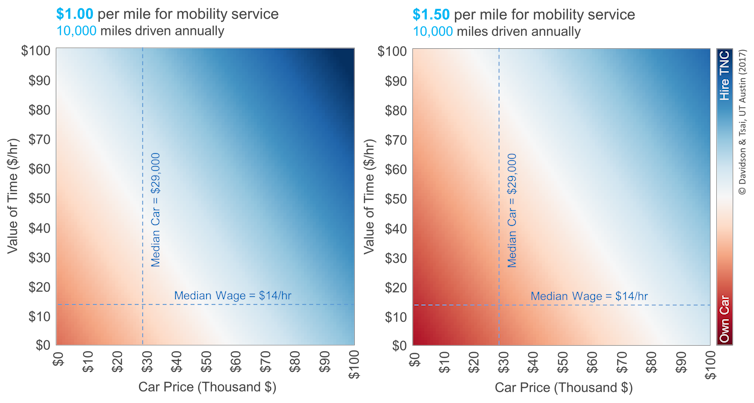
The decision for owning a vehicle or using mobility services is unique to every individual. If you purchase a highly efficient vehicle for less than $25,000 and drive it more than 15,000 miles per year until it falls apart, then you should definitely own a car if your goal is to save money.
But, if you drive less than 10,000 miles per year, face long waits in traffic, or place a high value on your time that would otherwise be spent driving, our calculations show that mobility services might be the cheaper option. Geography can also play a role—it’s not a coincidence that there have historically been so many taxi cabs in New York City, where the high cost of parking and slow pace of traffic consume time and money.
On the other hand, perhaps driverless cars will render this all moot within a short amount of time. Within ten or twenty years, few of us will even need to own a vehicle if we just buy into a car sharing option.
McGhee, who helped develop the efficiency gap measure, wondered if the court should hire a trusted staff of social scientists to help the justices parse empirical arguments. Levinson, the Texas professor, felt that the problem was a lack of rigorous empirical training at most elite law schools, so the long-term solution would be a change in curriculum. Enos and his coauthors proposed “that courts alter their norms and standards regarding the consideration of statistical evidence”; judges are free to ignore statistical evidence, so perhaps nothing will change unless they take this category of evidence more seriously.
But maybe this allergy to statistical evidence is really a smoke screen — a convenient way to make a decision based on ideology while couching it in terms of practicality.
“I don’t put much stock in the claim that the Supreme Court is afraid of adjudicating partisan gerrymanders because it’s afraid of math,” Daniel Hemel, who teaches law at the University of Chicago, told me. “[Roberts] is very smart and so are the judges who would be adjudicating partisan gerrymandering claims — I’m sure he and they could wrap their minds around the math. The ‘gobbledygook’ argument seems to be masking whatever his real objection might be.”
If there is indeed innumeracy present, the justices would not be alone in this. Many Americans do not receive an education in statistics, let alone have enough training to make sense of the statistics regularly used in academic studies.
At the same time, we might go further than the argument made above: should judges make decisions based on statistics (roughly facts) more than ideology or arguments (roughly interpretation)? Again, many Americans struggle with this: there can be broad empirical patterns or even correlations but some would insist that their own personal experiences do not match these. Should judicial decisions be guided by principles and existing case law or by current statistical realities? The courts are not the only social spheres that struggle with this.
“Chicago offers unparalleled potential for future growth for businesses of all sizes and is the ideal place for Amazon to build its HQ2,” Emanuel said in the news release. “This bid will demonstrate to Amazon that Chicago has the talent, transportation and technology to help the company as it reaches new heights and continues to thrive for generations to come.”
Developers of four Chicago sites have provided details of their Amazon bids to the Tribune. Those sites are Lincoln Yards, the planned redevelopment of the former A. Finkl & Sons steel plant and other land along the Chicago River in Lincoln Park and Bucktown; the vacant old main post office along the river and Congress Parkway; 37 acres owned by broadcast company Tribune Media along the Chicago River near Chicago Avenue and Halsted Street; and the former Michael Reese Hospital site and nearby land in Bronzeville.
Chicago’s bid highlighted Chicago’s transportation network, talent pool, diverse economy, airport access, quality of life and proximity to research centers, according to the news release…
On Sept. 7, the day Seattle-based Amazon announced plans to invest $5 billion on creating a second headquarters, Emanuel told the Tribune the city planned to make a bid, and said he’d already spoken with Amazon CEO Jeff Bezos multiple times about bringing HQ2 to Chicago.
An wild card factor: if President Trump continues to use Chicago as an example of a (Democratic) city with problems, would Bezos and company like to stick it to him and show they are committed Chicago? Lots of cities can offer land and other incentives but Amazon could claim to be a significant part of turning Chicago around. (Whether a single headquarters could do this is another story but there are business considerations as well as political narratives at play here.)
Now to see how long it takes Amazon to announce a decision.
No, the truth is that like cars, McMansion houses, food portions and soft drink sizes, Americans are getting bigger every day–and because it is happening everywhere, few notice. Worse, the harder we try to lose poundage with low calorie foods, fitness centers and personal trainers, the bigger we are becoming. Even people in non-industrialized countries are packing on the pounds as Big Food peddles it high calorie, addictive processed food in “new markets.”
A correlation without causation argument. And you do not have to go McMansions to make the same claim: the average size of new homes has increased from roughly 1,000 square feet to 2,500 square over sixty years. But, how might we really show that having other bigger items in our lives leads to having other bigger items in our lives? Would the reverse also be true: that if we had increasingly smaller items in our lives, we would desire smallness over all? If these are all linked, perhaps we could tie this to the big American frontier or the large American ideals at the founding of the country.
Perhaps there are other arguments to be made here. Do McMansions offer more space for people to spread out? Or, could heavier people be more likely to purchase McMansions (and is this related more to their stage in life)?
Instead, analysts said, the decline in both marriage and partnerships is likely a result of the declining ability of men to earn a salary large enough to sustain a family.
“All signs point to the growing fragility of the male wage earner,” said Cheryl Russell, a demographer and editorial director at the New Strategist Press. “The demographic segments most likely to be living without a partner are the ones in which men are struggling the most — young adults, the less educated, Hispanics, and blacks.”
Russell pointed to data that shows marriage rates increase for younger Americans in connection with salaries. Fewer than half of men between the ages of 30 and 34 who earn less than $40,000 a year are married. More than half of those who make more than $40,000 a year are married, including two-thirds of those who make between $75,000 and $100,000 a year…
The Pew data underscores the economic marriage gap: Adults who do not live with partners are more than twice as likely to live in poverty than those who have partners.
“Our surveys show us that one of the things that’s holding unmarried adults back from getting married is that they feel they’re not financially stable enough,” Parker said.
While there are likely additional reasons for this (one example: the development of the idea that marriage is about two economically stable people coming together), marriage in American is increasingly tied to social class.
Fresh college graduates might be attracted to downtown bars and carless commutes, but these days, for older millennials starting families and taking out mortgages, a job in the suburbs has its own appeal. “What people find is that the city offers a high quality of life at the income extremes,” said Lamphere, who is chief executive of Van Vlissingen & Co., a real-estate developer based in the Chicago suburb of Lincolnshire, Ill. “The city is a difficult place for the average working family.”
Many employers, hoping to attract millennials as they age, are trying to marry the best of urban and suburban life, choosing sites near public transit and walkable suburban main streets. “What’s desired downtown is being transferred to suburban environments to attract a suburban workforce,” said Scott Marshall, an executive managing director for investor leasing at CBRE Group…
None of this means the suburbs will supplant central cities as job hubs. After all, jobs traditionally based in cities-jobs in professional industries as well as the service jobs that support them-are growing faster than those typically based outside of them, according to Jed Kolko, chief economist at Indeed.
At the same time, Americans are more likely to live in the suburbs today than they were in 2000, and even the young, affluent ones drawn to cities tend to move once their kids reach school age, Kolko’s research shows. Many of those workers will suffer long commutes into the city center. Others will opt for jobs closer to their suburban homes.
Which of these two patterns is more true: (1) employers chase locations in a cyclical nature with more moving to the suburbs after World War II and then returning to the city or some cities in more recent years as certain urban locations became trendy and/or desirable or (2) employers since World War II have regularly gone back and forth between cities and suburbs depending on their employee needs and changes within metropolitan regions. Since I do not study this exact topic, I do not know which explanation the data matches (or if there is even a third option). Yet, certain interested parties – the media, city and suburban leaders, and companies often like to push a particular narrative to help their side look better.
Indeed, this article suggests a third option: employers want to find millennials who want both the suburban life – nice, safe, quiet communities – and the urban life – exciting cultural scene. Certain suburbs do offer this kind of lifestyle and some academics have argued this is the way the suburbs are going: even as some will still be interested in spreading the edges of suburbia further and further out, at least a few suburbs will become denser and influential small cities. I’m not sure this is entirely tied to millennials as such locations could appeal to older suburbanites who want a more walkable area and may not require single-family homes.
In other words, the jury is still out on this as a possible trend.
A recent episode of Adam Ruins Everything addressed how racism helped create the American suburbs. Here are my quick thoughts in response to “The Disturbing History of the Suburbs.”
-Using the Settlers of the Suburbs game as a visual tool is a clever technique with its Monopoly appearance (though I could also imagine linking it to Settlers of Catan). Urbanists over the years have developed numerous classroom activities involving games to help show students who development works. Like games, development tends to follow certain rules or patterns (even if from the outside those rules are hard to see or, in the case of the suburbs, it all looks fairly haphazard). Also, for a simulation of residential segregation, see the modeling of economist Thomas Schelling where the preferences of individual residents to live near people like them can add up to a racist system. For a good board game that gets at suburban development (though there is only a limited racial dimension), see my quick review of Suburbia.
-The main emphasis here is on redlining: federal guidelines for making loans based on the neighborhoods the home was in was then also picked up by private developers. There is a lot more to this story including what were the patterns already in place that make redlining seem logical to the government in the 1930s (the book Sundown Townscan help explain a lot as black Americans had truer geographic dispersion from roughly 1865 to 1890 but then were restricted in where they could live in the North) as well as what other groups were discriminated against with these policies. Redlining certainly did a lot but it was not the only technique used to limit where non-whites could live. Other options included restrictive covenants, provisions written into deeds, racial steering, blockbusting, and riots and bombings. And the groups targeted included blacks, Jews, Asians, Mexicans, and others. In other words, redlining was an important part of a large package used by white structures and individuals to keep their communities all white.
-The video then nicely suggests that the effects of redlining compounded over time: growing individual wealth for white homeowners, new development in whiter communities, limited wealth in redlined communities, and segregated schools in the long run. This is the Matthew Effect in action.
-At one point, Adam suggests Levittown is still mostly white. This may be the case yet minorities have moved in increasing numbers to suburbs in recent decades. At the same time, the legacy of housing discrimination lives on as racial and ethnic groups are not necessarily evenly dispersed across suburbs. And, as noted later, black and Latino residents still have a harder time obtaining loans and continue to face housing discrimination. This is despite the 1968 Housing Act which was intended to eliminate such discrimination; the sociologists who wrote American Apartheidsuggested that we lack the political will to see the Housing Act through.
-Nikole Hannah-Jones of NYT makes an appearance to talk about school funding and how white suburbs can draw upon a larger property tax base. Yet, Hannah-Jones goes much further in a 2015 episode of This American Life titled “The Problem We All Live With.” I highly recommend this and have had multiple classes listen to the story of segregated schools in Ferguson, Missouri and other nearby suburbs of St. Louis. By a loophole in state law, Ferguson students were allowed to attend a wealthier white district and it worked…until the loophole was closed. School funding is not the major issue. The deeper issue is the segregation of schools which we know can help minority students. And we know that integration – the 1966 Coleman Report made this clear and busing was tried in a few places for a few years until the outcry was too great – would work but few suburbanites want to consider it as a legitimate option.
-The video closes with these two lines: “The suburb you live in was built on a foundation of segregation. And we can’t close our eyes to that.” I imagine many white suburbanites would still object. At least two good academic books addressing two different contexts (White Flightin Atlanta and Colored Propertyin Detroit) show how white suburbanites in the 1960s made a switch from race-based arguments for segregation to economic-based ones. Now, if you ask suburbanites about race and ethnicity in their community, they will tend to say that they do not know of any issues or do not contribute to the problem yet they are more willing to talk about quality of life, property values, and good schools. Additionally, suburbanites tend to associate certain classes with certain racial and ethnic groups, leading to different treatment. Of course, race and class are intimately intertwined in the United States and class can often be used as a proxy for excluding by race or ethnicity.
-Just a note on sources: the video uses an interesting mix of scholarly and journalistic sources. There is a lot of excellent academic literature on race and the suburbs and I have tried to point to some of those in this review.
In sum, this video could be a great start to a discussion of ongoing racial disparities in the suburbs. Residential segregation is not just present in large cities and it has long-lasting consequences. Even though the oft-cited histories of the American suburbs – such as Crabgrass Frontier– acknowledge redlining and discuss its implications, many Americans may be unaware of how race strongly influenced the creation of suburbs. (There were other influential factors present as well but that is a long story.) Going further, there are easy ways to go beyond this video and draw upon more complex studies of race in the suburbs.
The city, along with the Naperville Development Partnership and the Naperville Area Chamber of Commerce, sponsored an open house Tuesday to gather opinions on a streetscape renovation plan — and how to pay for it — from property owners, business owners and nearby residents.
Those who stopped by Tuesday morning said they liked elements of the proposed facelift for the stretch of Ogden between Washington Street and Naperville’s eastern border east of Naper Boulevard, but they worried the cost could prevent it from happening…
The idea is to update the look and feel of intersections and parkways along East Ogden Avenue so drivers know they’re in Naperville, shoppers find the area more inviting and businesses see it as primed for development, said Christine Jeffries, president of the Naperville Development Partnership…
Each [intersection] could receive some sort of sign for “Uptown Naperville,” some with large silver letters spelling out “NAPERVILLE” or referring to the city with a tall “N.”
As usual, there are questions about how to pay the $5 million the plan requires. That is one issue.
But, I would suggest there is a deeper issue: can these kinds of improvements truly lead to more development and a stronger sense of community? East Ogden Avenue is like many sizable suburban streets: it is fronted by numerous businesses (ranging from restaurants to auto care facilities to big box stores to home converted to offices), there are signs and buildings everywhere, and has numerous cut-outs to the road. To many, this look is not very attractive. These are the sorts of streetscapes that wealthier suburbs today try to avoid even if they were common several decades ago.
Does putting signs at intersections, putting in new landscaping, burying power lines, and rebranding the stretch “Uptown Naperville” really change what is there? It may look nicer. It may tell people more clearly that they are in Naperville (God forbid that they are in Lisle). But, is this the true answer to a kind of development that is outdated and disliked? I am skeptical. Just contrast this stretch to downtown Naperville where a certain level of density and vibrancy leads to an exciting scene. The stretch on Ogden is too long, too broken up, devoid of attractive residential units (though they are often just behind the businesses), and difficult to connect.
An alternative approach might be this. Take one of the busier intersections, like the northeast corner of Washington and Ogden. There is a busy strip mall there with a Jewel grocery store and a Starbucks in the outlot. Why not build a mixed-use residential development just to the north or east. Make this small area a bit of a destination. Increase foot traffic (and who right now really wants to walk or bike along Ogden). Provide more anchors to a transient stretch. If this is successful, keep the idea moving to the east. This is a much longer project and it may not be possible to always put in attractive mixed-use buildings. Yet, there is demand for residential units in Naperville and units along Ogden are not that far from downtown or the downtown Metra station for those interested in commuting.

 Legally Sociable