The importance of statistics on college campuses

Within a longer look at the fate of the humanities, one Harvard student suggests statistics dominates campus conversations:

Photo by Markus Spiske on Pexels.com

I asked Haimo whether there seemed to be a dominant vernacular at Harvard. (When I was a student there, people talked a lot about things being “reified.”) Haimo told me that there was: the language of statistics. One of the leading courses at Harvard now is introductory statistics, enrolling some seven hundred students a semester, up from ninety in 2005. “Even if I’m in the humanities, and giving my impression of something, somebody might point out to me, ‘Well, who was your sample? How are you gathering your data?’ ” he said. “I mean, statistics is everywhere. It’s part of any good critical analysis of things.”

It struck me that I knew at once what Haimo meant: on social media, and in the press that sends data visualizations skittering across it, statistics is now everywhere, our language for exchanging knowledge. Today, a quantitative idea of rigor underlies even a lot of arguments about the humanities’ special value. Last school year, Spencer Glassman, a history major, argued in a column for the student paper that Harvard’s humanities “need to be more rigorous,” because they set no standards comparable to the “tangible things that any student who completes Stat 110 or Physics 16 must know.” He told me, “One could easily walk away with an A or A-minus and not have learned anything. All the STEM concentrators have this attitude that humanities are a joke.”…

Haimo and I turned back toward Harvard Square. “I think the problem for the humanities is you can feel like you’re not really going anywhere, and that’s very scary,” he said. “You write one essay better than the other from one semester to the next. That’s not the same as, you know, being able to solve this economics problem, or code this thing, or do policy analysis.” This has always been true, but students now recognized less of the long-term value of writing better or thinking more deeply than they previously had. Last summer, Haimo worked at the HistoryMakers, an organization building an archive of African American oral history. He said, “When I was applying, I kept thinking, What qualifies me for this job? Sure, I can research, I can write things.” He leaned forward to check for passing traffic. “But those skills are very difficult to demonstrate, and it’s frankly not what the world at large seems in demand of.”

I suspect this level of authority is not just true on a college campus: numbers have a particular power in the world today. They convey proof. Patterns and trends. There can often be little space to ask where the numbers came from or what they mean.

Is this the only way to understand the world? No. We need to consider all sorts of data to understand and explain what is going on. Stories and narratives do not just exist to flesh out quantitative patterns; they can convey deep truths and raise important questions.

But what if we only care today about what is most efficient and most able to directly translate into money? If college students and others prioritize jobs over everything else, does this advantage numbers and their connections to STEM and certain occupations that are the only ways or perceived certain ways to wealth and a return on investment? From later in the article:

In a quantitative society for which optimization—getting the most output from your input—has become a self-evident good, universities prize actions that shift numbers, and pre-professionalism lends itself to traceable change.

If American society prizes money and a certain kind of success above all else, are these patterns that surprising?

How much easier is it to build a new Chipotle than repurpose a vacant storefront nearby?

Near our suburban house is a shopping center consisting largely of strip malls and several anchor grocery stores. This development constructed in the late 1980s has fallen had hard times in recent years with numerous vacant storefronts.

Thus, it was surprising to see the construction that started last year at the site of a former national chain restaurant in this shopping center. This spot had been vacant for several years. The building came down and a new strip mall is going up. The new commercial space has an easy turn-in off a busy arterial road.

I have heard that it is easier to build a new big box store than to repurpose an old one. For example, numerous grocery stores in the Chicago region sat empty for years. Some big box businesses have moved out of older buildings and reopened in new structures not that far away.

The new Chipotle building will certainly be geared toward exactly what this business needs. Additionally, there will be at least one new storefront next to the restaurant. The old building had a different layout inside, one more fitting for a sit-down restaurant, and with on additional commercial space.

At the same time, how many strip malls, shopping malls, big box stores, and restaurants are torn down each year because the space they have is not exactly what a different business wants? What happens to all of these materials? How much time goes into tearing down? How substantially are these shopping areas changed by adding a few new buildings here and there? This Chipotle could have moved into a vacant property within the shopping center.

I could imagine more modular structures or incentives for reusing buildings or asking businesses to adapt to existing spaces. But, if it is cheaper or more efficient to tear down one building and redevelop another, then that is what businesses will do.

Remembering the frenzy and promise regarding Amazon HQ2

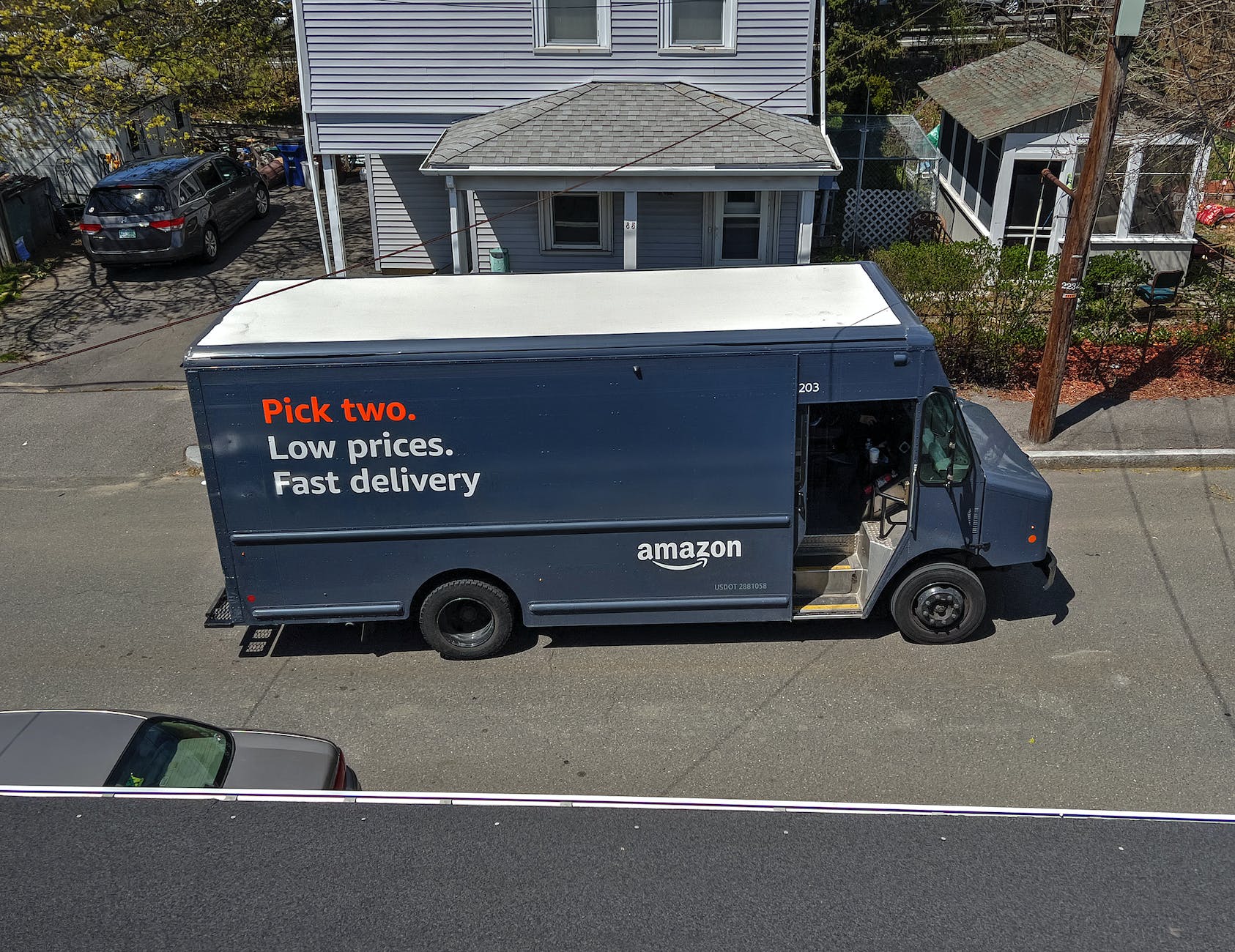
Amazon announced part of their HQ2 is coming along on schedule but the full project will soon go on pause:

Photo by James Anthony on Pexels.com

John Schoettler, Amazon’s real estate head, said in a statement the company is pushing out the groundbreaking of PenPlace, the second phase of the sprawling northern Virginia campus. The first phase of the campus, known as Metropolitan Park, is expected to open on time this June and will be occupied by 8,000 employees.

The move comes as Amazon CEO Andy Jassy has taken steps to curtail expenses across the company in the face of slowing revenue and a gloomy economic outlook. That’s led to the company announcing the largest layoffs in its history, totaling more than 18,000 employees, while also reevaluating its real estate portfolio and sunsetting some projects…

PenPlace encompasses three 22-story office buildings, more than 100,000 square feet of retail space and a 350-foot-tall tower, called “The Helix.” The development is larger than Metropolitan Park, which sits south of PenPlace, and includes two additional, 22-story office towers, as well as a mixed-use site featuring retail, restaurants and green spaces.

Amazon selected Arlington as the site of HQ2, in addition to the Long Island City neighborhood of Queens, New York, as part of a closely watched, splashy search for a second headquarters that kicked off in 2017. The company announced in 2019 it would halt plans to build its new headquarters in New York after it faced pushback from local activists and city council leaders.

Numerous communities across the United States submitted proposals to host this second headquarters and the company sought tax breaks. The promise of the new headquarters involved at least these two big features: the status of Amazon in your community plus the thousands of jobs in a corporate headquarters.

With the changes in the world, will these promises pan out for Arlington, Virginia and the D.C. metro area? It sounds like at least 8,000 employees will be onsite. However, the headquarters may never be as big as once envisioned. Does Amazon have the same status in 2023 that it did in 2017? This include everything from its financial outlook to its recent layoffs to changes in the everyday Amazon experience for customers.

On the whole, I would guess local leaders will still pitch this as a big win. We got Amazon and all these jobs (and implying that others did not). The long-term effects might be less clear, particularly if tax breaks for Amazon and opportunity costs and the longer-term fortunes of the company are factored in.

Do sports fans want shorter games, more action, or a higher action to time ratio?

Baseball has taken significant steps this season to shorten the game through new features like a clock for pitchers and batters. A growing consensus over recent years has suggested fans want shorter games. College football is considering shortening games. However, in the absence of data I have encountered about what fans actually want, I wonder if it is really about shorter games. These might be two other options that sports fans in America want:

-More action. Studies have shown sports like baseball and football actually do not have much game action across the multiple hour experience. Pitch clocks make the action happen quicker but do not necessarily mean there will be more balls in play or runners on base. Baseball has moved in recent years to more three true outcomes: strikeouts, walks, and home runs. These involve limited action.

-A higher action to time ratio. Perhaps what fans want is not shorter time but more action within the time of the game. Shortening the time with no change to the action would provide a higher ratio. Shortened times plus more action would further increase the ratio. Other sports have more flow or continuous action, like hockey or soccer (though many American fans might consider these action low-stakes or boring action). Or, watching a condensed game where the time between all pitches or all football plays is removed can be an interesting experience.

I suspect there might be plenty of experimentation in the coming years regarding finding formulas for sports in order to retain or attract the attention of fans. This will also happen with ongoing interaction with other forms of entertainment that offer different experiences and timelines.

Apartments and housingcome to the shopping malls of the OC

Orange County might be as paradigmatic of postwar suburbania as any county in the United States. Now, its shopping malls are in for a change many malls are considering: adding apartments and housing units.

“This is really our opportunity to create something that we can be absolutely proud of for the next generation to create those same fond memories that I have and that others have in a fashion that is consistent with what the times are now,” Cordon said.

Bill Shopoff said his company, which purchased the Macy’s store and the former Sears store in the Westminster Mall last year, hopes to draw people back with shops, a hotel, townhouses and apartments…

As for who will rent or purchase the homes in his preliminary plan, Shopoff is counting on a modern type of suburban dweller — one who would rather walk to restaurants and other amenities than live in a single-family home with a yard.

Experts say that new laws, along with increased pressure from the state to build more homes, have convinced some local officials who might have been resistant to rezoning commercial properties in the past…

In Laguna Hills, the mall is being repurposed along the lines of Caruso’s Los Angeles-area developments, with up to 1,500 apartments, an upscale hotel, commercial office space and 250,000 square feet of stores surrounding a large green space.

This is one of the leading strategies in a competitive shopping malls market. By building apartments, developers can add residents who will be on-site and who will patronize restaurants and stores as well as remove some of the commercial property that is now hard to fill in the Internet economy. The idea is that the malls become vibrant, mixed-use locations where people are out at all hours consuming goods and food.

If all the Orange County malls go this route, will they all make it? Even in a relatively wealthy area, not all the malls will survive.

Residential population in Chicago’s Loop has grown

A new population estimate in Chicago’s Loop suggests the number of residents increased in recent years:

The number of residents in the Loop — as the city’s central business district is known — grew by almost 9% since 2020, according to estimates from the Chicago Loop Alliance…

Population in the Loop, an area bounded by the Chicago River on the north and west sides, stands at 46,000, with the number of residents expected to grow another 17% by 2028, the group estimates. About 95% of residential properties are occupied, up from the pandemic low of 87%, and a rate that exceeds 2019 levels…

Most of the Loop’s population is 25 to 34 years old, with more than 80% living alone or with one person. Almost half don’t own a car and the majority cite the ability to walk to places, the central location and proximity to work as top reasons for living downtown…

The future of the Loop will also be more residential. Another 5,000 housing units are expected to be added by 2028, bringing the district’s total population to 54,000, according to the report. The estimates assume the global economy avoids a major recession, that the cost of building doesn’t become prohibitive and that city incentives to convert commercial blocks into homes move forward. Crime, rising property taxes and developments elsewhere are also threats to the forecast.

It will be interesting to see if and how this trend continues. Does this mean office space converted into residences? New development in the Loop where there are city-wide political battles on where development should be encouraged? Population growth in one part of the city while the population drops elsewhere?

Regardless of the larger context of what has happened in the Loop in the last few years, I am guessing this data point will be used to support development and civic plans.

Do big bureaucracies or democracies have customer-service problems?

Americans can find it difficult to find accountability with government or businesses:

Democracy’s ideal is built on a foundation of accountability. In the past, many, if not most, of the decisions that mattered to our lives were taken by people and businesses that felt close to us. That’s not the case anymore. Now all roads seem to lead to bad hold music.

Whenever we encounter a problem we didn’t create—like my outrageous electricity charge, or vacations ruined by an incompetent airline, or hospital-billing errors, or a mix-up at the IRS—all we can really do is go online for a customer-service number and cross our fingers that, by some miracle, the call won’t consume the entire day, or worse. When a person coping with cancer treatment spends hours on the phone with her insurance company or Medicaid, she may wonder why her society is so cruel, or so incompetent, or both. And she may start to see the appeal of a demagogue who promises to deliver simple solutions: the “I alone can fix it” candidate…

In the European Union, if an airline causes a flight delay of more than three hours, it has to pay you 250 to 600 euros, depending on the length of the flight. In the U.K., when a train is more than 15 minutes late, I can go to a website and, in a few minutes, demand financial compensation.

For the most part in America, when you screw up, you pay, but when corporations or governments screw up, nobody pays. Even when protections do exist, they’re difficult to navigate, or are unknown to most citizens. Other democracies have made clear it doesn’t have to be that way. It’s not rocket science to solve such maddening everyday problems, and American democracy would be better off if the government devoted more effort to it.

Government could indeed be more on the side of residents rather than the side of corporations and itself.

But, I wonder if a good number of Americans would see this as an inevitable function of the size of government or business. When these actors become large, it can be harder for decisions to be made and mistakes righted. Big government and big business become caught up in trying to achieve their own goals rather than caring about the little people.

There is a long history of this thinking in the United States. How much should the federal or state government control? Do the best ideas come from established entities or from startups and more nimble organizations? It is also part of the appeal of suburbs to many where residents can have more access to and more participation in local government and decisions. One perception is that local governments have to make things work for everyday life to go on.

As sociologist Max Weber noted, bureaucracies can be efficient and necessary in the modern era but they can also lead to an iron cage. Can governments that clearly work for the people reduce this feeling of the iron cage?

Barbie’s DreamHouses and American houses

A new book shows how the Barbie DreamHouse changed over time:

The monograph, which the publishers say is “the first architectural survey of the world’s best-selling dollhouse”, features glossy images of the houses captured by fashion photographer Evelyn Pustka, alongside detailed architectural drawings…

The homes themselves range from contemporary influencer houses all the way back to the mid-century bungalow of the 60s.

In this way, the book establishes the Dreamhouse as an early example of homes turning from private domains into a means of expressing and performing our personality for others – alongside the Eames house, the Playboy apartments and Jackie Kennedy’s televised tour of the White House in 1962…

“So there’s this bifurcation where the Dreamhouse is more in conversation with McMansions, which might reference postmodern architecture but lose the kind of ironic quoting involved in using Doric columns.”

The emphasis here seems to be on how the Barbie homes reflected architectural styles. However, how much did these toys shape architectural styles? As people played with these houses, how did it change their perceptions of houses? This might be difficult to ascertain but presentations of homes and what is normal or aspirational can help shape what people expect.

A question: have any constructed houses been inspired by the Barbie DreamHouses? This could be another signal of how Barbie has affected homes.

Homeowner’s wealth drops in recent months but still up significantly from beginning of pandemic

The amount of wealth homeowners in the United States has dropped in recent months:

U.S. homeowners have lost $2.3 trillion since June, according to a new report from the real-estate brokerage Redfin. The total value of U.S. homes was $45.3 trillion at the end of 2022, down 4.9% from a record high of $47.7 trillion in June. That figure signifies the largest June-to-December percentage decline since 2008.

But housing wealth is significantly up since the beginning of COVID-19:

“The housing market has shed some of its value, but most homeowners will still reap big rewards from the pandemic housing boom. The total value of U.S. homes remains roughly $13 trillion higher than it was in February 2020, the month before the coronavirus was declared a pandemic,” said Redfin Economics Research Lead Chen Zhao in the report.

“Unfortunately, a lot of people were left behind. Many Americans couldn’t afford to buy homes even when mortgage rates hit rock bottom in 2021, which means they missed out on a significant wealth building opportunity,” Zhao added.

If many Americans view housing as an investment, then owning a home during the pandemic has paid off. Just by being a homeowner at the right time, they benefited.

Hence, I am a little confused by the story that leads with the recent data. The recent drop is just a portion of the big gain from February 2020 on. People do feel losses strongly but the bigger picture is that homeowners have gained much in recent years.

The two reasons I try to work far ahead of deadlines

I recently completed a draft of a research paper a day and a half of a deadline. I had worked on launching this paper for months and it felt good to complete it. After I met the deadline, I thought again about the process: why do I regularly work ahead of deadlines? Here are two reasons:

  1. I have more time to think. If I can start writing earlier, the writing process helps me think. Just having to write means I think about what I am saying and then having words down also pushes me to think about how the argument will continue or resolve. The time it takes to think through and develop academic arguments is underrated as I find it difficult to come up with a nicely framed argument in one sitting or at a particular moment. Even when I think I have the writing complete or have completed a section, working ahead of a deadline means I then have time to let it sit and I can consider it more clearly.
  2. You never know what might come up day to day to prevent writing, thinking, and making progress toward the deadline. This can range from things that limit thinking – a new issue that arises – to changes in the calendar or daily schedule – a person to care for, a new meeting – to who knows what. As a deadline approaches, it is hard to know what might arise, even if I have clearly blocked out time to work on a project. If I work further ahead, I can accept these changes and work around them more easily.

Would this approach work for everyone? No. It might not even have worked for me earlier as a student or as a sociologist where I had greater capacity to sit down and write a lot in one long sitting and had fewer interruptions or impediments to such sessions. Deadlines can be helpful motivators, even if some work ahead of them and others work on projects more closely to their due dates.