Americans largely in favor of policies that would lead to more housing – but how many want that housing near them?

New data from Pew shows large majorities of Americans are in favor of more housing:

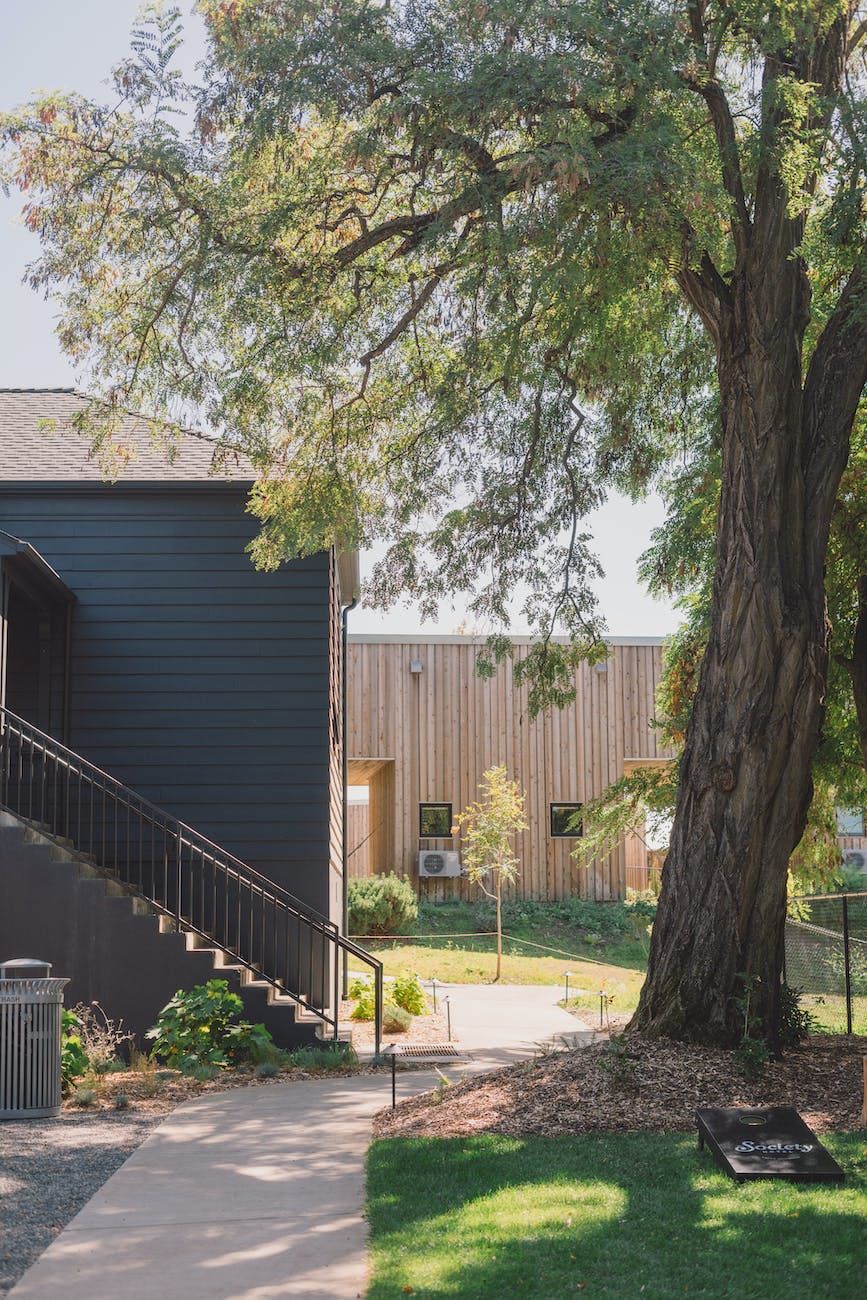
Photo by Maria Orlova on Pexels.com

The findings from one of the largest surveys done on these issues shows significant but varying support for 10 policy initiatives to encourage more housing. At the high end, nearly 9 in 10 (86%) say they would back efforts to expedite permitting processes, while at the lower end, about half (49%) support the concept of allowing smaller lots, and homes to be built closer together…

Support for most of the housing policies transcended the usual fault lines of political party, region, race, income, and gender. The eight most popular proposals received clear majority support from Republicans, Democrats, and independents. In addition, 9 of the 10 tested measures received majority support from both renters and homeowners. All of these policies have either already been shown to work in improving housing affordability in American cities and towns or have recently been enacted by state or city policymakers hoping to do so.

Some approaches that stood out as especially popular—earning support from more than 70% of respondents—are similar to state laws that have passed in recent years (although the survey questions themselves were not modeled on any particular laws). For example, in 2023, California, Montana, Texas, and Washington took steps to simplify permitting for new housing. In recent years, California, Massachusetts, Montana, and Utah have passed laws to enable more housing near commerce or transit. And Maine, Montana, Oregon, Utah, and Vermont, among others, have enacted legislation to allow houses to have an accessory apartment or dwelling unit, as have many cities…

Respondents also broadly supported the reasons behind efforts to create more housing, with 65% to 82% seeing each reason as excellent or good. (See Figures 3 and 4.) However, in some cases, Republicans and Democrats prioritized different reasons. For example, somewhat more Republicans (68%) than Democrats (62%) identified freedom for property owners as an excellent or good reason, while more Democrats (81%) than Republicans (49%) chose reducing racial segregation as an excellent or good reason. But large majorities of Democrats, Republicans, and independents see improving housing affordability and allowing more people to live near their preferred jobs and schools as excellent or good reasons to change housing rules to allow more homes to be built in cities and suburbs. Successful state-level efforts to allow more housing have consistently received bipartisan support, and the survey results indicate that people with different political views can come together to support policies to end the housing shortage and affordability crisis for different reasons. 

Americans like the idea of owning housing. Add this to the current state of housing where both owning and renting is expensive and Americans broadly like more housing.

Here is my question: how many want this new housing near them? Even if Americans like more housing in the abstract, they may display much more resistance when this becomes a local issue. This is part of the reason housing is such a difficult issue to address in the United States: it is often a local issue where local governments and residents who want to control their surroundings. Housing is a good thing but people often move to a neighborhood and community and want to limit who else can live there.

Thus, the expression of this majority for housing is difficult to put into practice. Even state laws are often fraught as it can run against local desires. Take the efforts in Illinois to promote affordable housing at the state level: the initial legislation had limited enforcement and more would need to be done for state-level policy to provide more housing.

As noted above, one of the routes forward that could gather more local support involves policies that provide more opportunities for current property owners. Adding ADUs, for example, provides a choice for current property owners to generate more income or provide housing for family. Other policies might be viewed as funneling money to outside developers or providing housing for people who would not be as welcome in the community. If policies can add housing units and enrich/protect homeowners, they might find more support.

Pilot ADU program in New York City

New York City has started a small program that could help address the need for housing in the city:

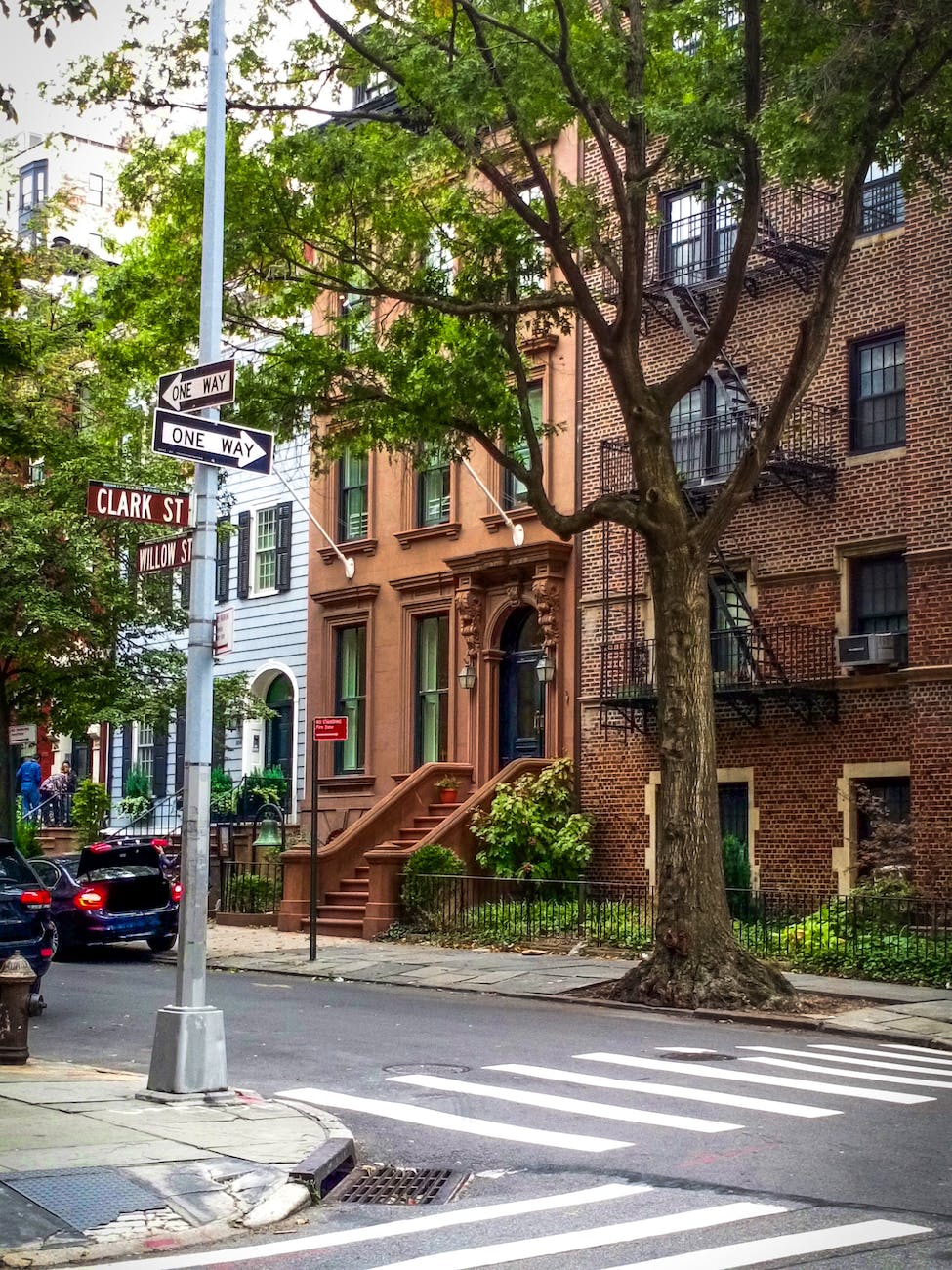
Photo by Centosfotos on Pexels.com

New York City just unveiled its newest effort, which will hand 15 homeowners up to $395,000 to build an additional apartment. This could mean an extra unit in a garage, basement, or attic, or a tiny home in the backyard. The idea is to boost housing density in a city in desperate need of new housing.

New Yorkers can apply online for the funding, but high-income residents aren’t eligible — the income limit for a family of four is $232,980, the New York Times reported. And the ADUs that are built will have a limit on rent: a one-bedroom can’t be rented for more than $2,600.

The city’s department of housing preservation and development on Tuesday unveiled the “Plus One ADU” pilot program, similar to a state-wide initiative with the same name that has doled out tens of millions of dollars to help homeowners across New York State build ADUs in their backyards…

The effort is part of the city’s sweeping new housing reform proposal, which seeks to pave the way for 100,000 new homes in the city by encouraging conversions of commercial buildings into residential, boosting density near mass transit, and reducing space devoted to parking. The proposal also aims to legalize ADU construction across much more of the city.

Adding 100,000 units would be helpful as the city, like many major cities, needs lots and lots of units to provide more housing options and address housing costs. But, how quickly can these units be added and how much can they ease the housing issues? It would be worth looking at the math on this; at what point do the government funds lead to long-term savings? Hopefully, this is part of a comprehensive strategy that tries to add housing units in multiple ways.

Not all New York City is as dense as Manhattan but it is a pretty dense American city. How dense are city residents willing to go? Like many cities, there are different clusters of housing units in different neighborhoods. Adding a housing in basements or backyards can only happen in certain places and these changes would add residents. ADUs might be less visible than other means of providing more housing units – for example, high-rises would not be welcome in many residential neighborhoods – but Is there a point where residents feel there are enough ADUs?

What allowing “build[ing] more houses on less land” in Austin could lead to

Austin, Texas recently changed its regulations to allow property owners to “build more houses on less land”:

Photo by Abigail Sylvester on Pexels.com

Homeowners now have increased flexibility to build more houses on less land, after the lot size required for a home was reduced from 5,750 square feet to 2,500 via the HOME initiative (Home Options for Middle-income Empowerment). The policy also increases the number of housing structures that can sit on that 2,500 square feet from two to three. 

The debate over these changes continues:

The debate around a policy like this comes down to whether someone believes increased density (more housing for more people on smaller footprints) will help the situation, or will lead to overbuilding, crime, and rental cash grabs. The latter tends to sound a lot like NIMBY talking points more concerned with preserving the charm of longstanding Austin neighborhoods.

Some developers and homeowners feel that the resolution alleviates just a small part of Austin’s building woes, since the zoning codes are still complex and difficult to navigate. Jason Kahle, who owns Small Home Solutions, LLC, says he and his 10 employees are “going to be all over” the changes in a market where it seems everyone with a large-enough lot has considered building a granny pod, mother-in-law suite, or backyard office. 

But being free to build on a smaller lot is not the same as being able to feasibly do it within existing rules, Kahle points out. “There’s a lot of wheels turning at the same time,” he says. “Austin Energy is a challenge. We have protected trees, impervious cover, floor-area ratio rules, the level of detail the city requires on civil engineer plans, the subchapter McMansion ordinance, temp drawings. It’s a lot to deal with.” The McMansion regulations, also known as “Subchapter F” in the city’s housing code, set detailed and strict limits, including height and setbacks from the edges of a lot.

Laura Boas, an Austin physical therapist, is building an “accessory dwelling unit” for her family behind her 1950s-era, 720-square-foot cottage in the Brentwood neighborhood. She’s seen massive 2,500-square-foot homes go up in her area, and her lot is big enough to support additional buildings. Boas lives alone and jokes, “I’m part of the problem.”

It sounds like the goal is to allow for more housing units without changing many existing lots and allowing for smaller lots. This is a different approach than promoting more multi-family housing or larger structures containing more residential units. These changes keep the single-family character and the scale of the neighborhood similar while adding more units and people.

It will be interesting to see if an approach like this solves the problems it was intended to solve. Will the number of new McMansions decrease as property owners pursue other options? Does this add enough units? Does it ease housing affordability? If not, what changes would residents and the city be willing to enact? I hope researchers and policy experts are keeping track of the changes in cities that have enabled similar regulations. This could help determine whether adding ADUs (such as in Portland) is helpful.

ADU construction up in Seattle – to nearly 1,000 in a year

Recent changes to regulations in Seattle made the construction of accessory dwelling units (ADUs) more attractive and local property owners are responding:

Photo by Chait Goli on Pexels.com

The addition of accessory dwelling units in Seattle has surged since 2019, when the city revamped its regulations to encourage their creation, pitching the units as a way to add density gently and provide a wider menu of living opportunities in neighborhoods dominated by single houses.

Almost 1,000 ADUs were permitted last year, up from 280 in 2019. That’s a 250% increase.

How does this compare to the amount of housing needed?

The state must add 55,000 homes per year over the next 20 years to meet demand, according to Department of Commerce projections published last week. More than half must be affordable to low-income residents, and new homes are needed at all income levels, the projections said…

ADUs remain a relatively minor component of Seattle’s housing production, given that more than 11,000 homes were built last year in multifamily structures like apartment buildings and town houses…

Will these new units prove to be the answer to affordable housing? In terms of sheer numbers, the quick answer seems to be: not yet. This pace would need to pick up and/or continue for a while.

Additionally, as the article discusses, who is building these units and who is living in them? If they are primarily built and rented by wealthier property owners, does this further housing inequality?

It will also be interesting to see how the increasing density in neighborhoods affects everyday life. Will residents find additional units on properties preferable to multifamily dwellings?

Chicago to test ADUs: coach houses, attic and basement apartments

With housing issues in the city and region, Chicago is testing out several ways property owners can convert parts of their property into residences:

Photo by Anna Shvets on Pexels.com

Coach houses – stand-alone housing structures sometimes built above garages and sometimes referred to as “granny flats” – were once prevalent in Chicago, but changes in zoning and parking requirements caused their construction to be banned in 1957. In December, the Chicago City Council re-legalized coach houses and apartment units in basements and attics, passing the Affordable Dwelling Units Ordinance. The ordinance took effect May 1, and the city is now accepting applications.

The five pilot areas cover much of the city, with zones in the north, northwest, west, south, and southeast areas of Chicago. After a three-year evaluation period in these pilot zones, the city will decide whether to make the ordinance citywide policy…

For properties planning to construct two or more additional dwelling units, every other unit must be affordable housing.

This opens up new opportunities both for property owners and those searching for housing. For landlords, they can gain more income, house family members, or create new space on their property that people could live in later. For those needing housing, these are likely smaller spaces that could provide dwellings in residential neighborhoods and possibly help keep such housing more affordable with more units available.

But, how many of these units will be created? Property owners might not like the idea of someone living so close to them. It takes money to create these units. The density of residential neighborhoods is important to many single-family home owners; they often want more space. Does this create more demand for parking and vehicles? Could this lead to tension on a block if some want to add units and neighbors are not as bullish on the prospects?

Furthermore, do these efforts continue to concentrate wealth and opportunities in the hands of particular land owners who can afford to create and rent units? Will this truly lead to more cheap housing or will certain neighborhoods have more of these units at higher prices?

An ADU as an investment opportunity on HGTV’s Flip or Flop

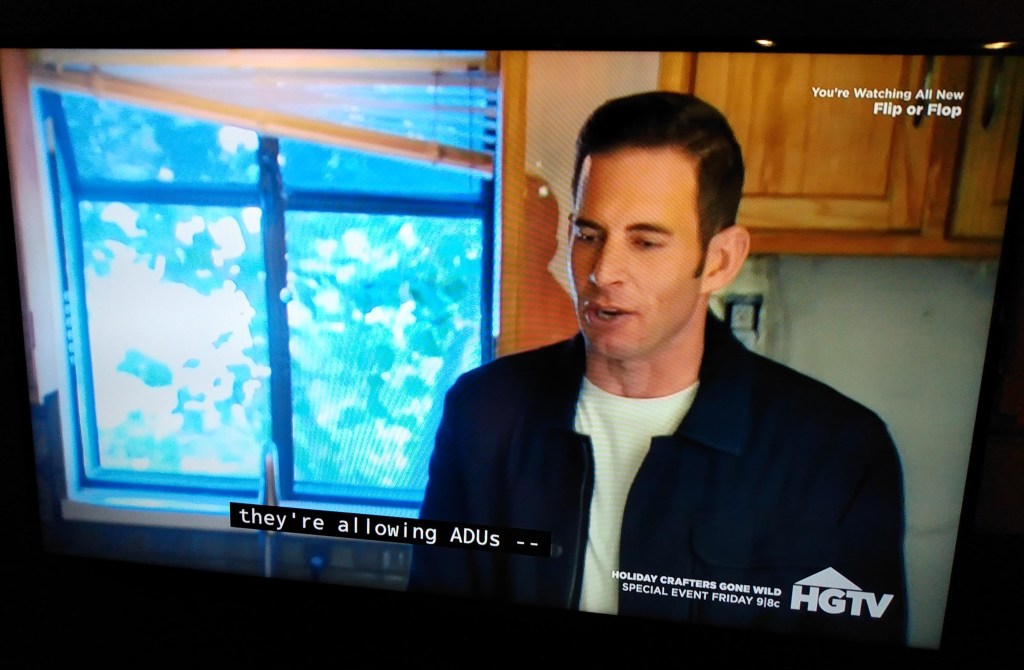
Last night’s new episode of Flip or Flop, Season 9 Episode 7, featured a home with an ADU (accessory dwelling unit). And this unique feature of the home offers a chance to make more money:

After Tarek and Christina realize the garage in the backyard is now a living space, Tarek lays out the argument: this is not just a studio space or a he/she-shed. It is possibly a rentable unit. This may make this property even more enticing.

This got me thinking. ADUs are supposed to help provide more housing units in more expensive markets like Portland and Los Angeles. Instead of building denser, taller housing in single-family home neighborhoods, ADUs take advantage of existing yard space, garages, or other buildings on residential properties.

But, while the ADUs might provide more housing, they may not necessarily provide housing that is that much cheaper. Take the example from Flip or Flop: with a home valued at over $1 million in North Hollywood, they estimated they could rent the studio ADU with a full bathroom and kitchen for $2,000 a month. How many people could afford this?

Further, such units could become a tool for residents and developers to generate more revenue. In such competitive markets, adding any kind of residential unit presents an opportunity. The ADU could enable a homeowner to generate money from their property. An investor interested in a single home or one with multiple homes could generate even more money with ADUs.

To truly provide housing that is more plentiful and at a reasonable price, it seems like a lot of ADUs are needed. They cannot provide as many units as large multifamily developments might. Yes, they do not disturb the existing character of a neighborhood much. But, if the ultimate goal is to broadly expand housing options, the occasional ADU in an expensive area might not be enough.

ADUs and granny flats more popular in some parts of the country and not others

Cities like Portland and Los Angeles may be interested in promoting accessory dwelling units (ADUs) but there is less interest in other parts of the United States:

The future for ADUs on the East Coast and in the Sun Belt is less clear. In older cities such as Boston and New York, much of the housing stock was built before World War II and is more dense than postwar suburban neighborhoods. Sun Belt cities such as Atlanta, Dallas and Phoenix were developed more recently, but housing prices, for the most part, have not reached the peaks seen on the West Coast.

“If you grew up in New York City or Boston, you have a different acceptance for density, rather than in the West, where open space has always been prized,” Chapple said. “It has been really hard to retrofit these cities that were built at a later time.”

In the District of Columbia, it’s common to find ADUs in the form of finished basements under older townhouses. Suburbs such as Montgomery County, Maryland, offer a better opportunity for detached accessory dwellings. Before 2013, Montgomery homeowners had to endure a complex process of reviews that took several months. Five years ago, the rules were relaxed to allow for licensing in about 90 to 110 days. The measure drew controversy because of concerns about parking, trash and crowding of neighborhood schools.

Dan Reed, an urban planner and Montgomery resident since 1991, said that the measure has proved popular and that the county might be primed to ease regulation further.

The first factor for ADUs seems to be the price of housing. In areas where prices are relatively high, much of the West Coast, ADUs are viewed as good ways to promote cheaper housing.

The second factor seems to be density of properties. Smaller lots mean less space for ADUs as well as ADUs likely being closer to other housing.

A third factor is regulation. How easy is it for a homeowner or landowner to create an ADU on their property?

I wonder if there are some other possible factors at play that could help explain regional differences. Are all people everywhere willing to have others live on their property (or does financial need overrule this)? Could suburbanites view ADUs as a threat to property values? Are there certain architectural styles that lend themselves to ADUs? Does the presence of alleys help or hinder the development of ADUs? Do some places have a longer history of ADU use (such as through multiple generations living on a property or the presence of servants)?