Watching the planes in style at SeaTac

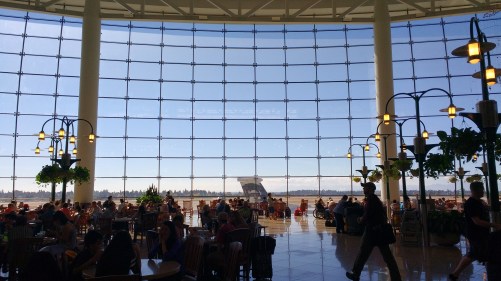
After walking through security at SeaTac, I entered the central food court and shopping area. I was greeted with this view:
IMG_20160823_155444200

From this gallery, you can watch the main runways as planes takeoff and land and you can do so seated in wooden rocking chairs (close to the windows). I assume many airports are designed with providing sufficient gates and access to planes in mind. Think of O’Hare or Atlanta where the concourses are long. Yet, this view took the mall court airport plan – common across many newer airports including ones I’ve seen in Tampa, Orlando, and Las Vegas – to another level: providing a large view of the most interesting work of the airport as planes travel at high speed.

An overview of the airport feature from when it opened in 2005:

The feature attraction, however, is the 60-by-350-foot glass wall that overlooks the runways and, in amenable weather, the Olympic Mountains. It’s more than just a big picture window. The panes are wrenched into a compound curve, convex in the vertical plane and concave in the horizontal. It looks more like a portal to a space warp than a mere window. The web of steel cables, struts and attachment spiders that allow the curtain wall to flex up to 11 inches in a worst-case windstorm or earthquake is all exposed to view, a celebration of virtuoso building technology…

Architect Curtis Fentress, the terminal’s principal designer, is convinced that people want to feel the excitement of travel again, and that it touches a deeper place than momentarily marveling at the apparent miracle of 400-ton cigars storming into the sky. He recalls a boyhood visit to the airport to see his uncle off to the Korean War. “We watched him wave to us from the plane,” Fentress recalls — an impression half a century old, burned indelibly into his mind.

Bonus: this area seemed to particularly fascinate small children. This is no small feat in the harried realm of traveling.

What is the economic benefit of O’Hare Airport to the Chicago region?

Noise complaints may be up but local officials say O’Hare Airport has a big economic impact:

Chicago estimates O’Hare contributes more than $38 billion to the economy of the six counties and sustains about 450,000 jobs directly and indirectly. Airport expansion could generate an extra $18 billion and create 195,000 new jobs, the city projects.

Mayor Rahm Emanuel, in a speech to the City Club in June, attributed recent economic successes to O’Hare and Midway International Airport. “Out of the 10 major metropolitan areas (in the U.S.) last year, Chicagoland had 12,000 businesses created,” Emanuel said. “That’s No. 2 in the United States.”

I’m guessing these statistics won’t quiet the critics of the new noise patterns yet it should remind the region’s residents how an airport might indirectly help them all beyond providing easier and cheaper access to points around the globe.

O’Hare Airport now officially world’s busiest airport again

Occasionally status anxious Chicago can breathe a little easier: O’Hare was just certified the world’s busiest airport.

While 2014 traffic at O’Hare was down by 0.2 percent, it lost less traffic than the Atlanta airport, where traffic declined by 4.7 percent, according to new FAA data. O’Hare had 881,933 arrivals and departures; Atlanta had 868,359.

But the Atlanta airport is likely to retain the title of busiest airport for passenger traffic.

City officials have said international passenger volume have helped O’Hare totals. In the last 18 months, O’Hare and Midway airports added six new international airlines and dozens of destinations, according to the city.

O’Hare regains bragging rights to the title it had mostly owned since the dawn of the Jet Age, when it surpassed the number of flights at Midway Airport, which had been the leader.

As a transportation center, this looks good for Chicago. Yet, there are two more negative signs: Atlanta may still have more passengers (which number matters more?) and flights were down (Which may have more to do with airlines consolidating as well as trying to cut costs by filling existing flights). Additionally, the lead over Atlanta isn’t that big. I’m guessing this means the competition will continue for years to come and I am curious to know if Chicago and/or O’Hare have some plans in the works to keep their regained lead.

Aurora fire illustrates need for redundancy in key infrastructure systems

A fire at an Aurora FAA facility caused all sorts of airport problems in Chicago and across the country:

The FAA said it’s working “closely with the airlines that serve the Chicago-area airports to minimize disruptions for travelers” and expects to “continue to increase the traffic flow at those two airports over the weekend.” FAA officials did not respond Saturday to requests for more information.At least 778 flights had been canceled Saturday out of both airports by just before 3 p.m., according to Flightstats, a website that monitors air traffic.

O’Hare was able to operate at around 60 percent of its usual Saturday capacity, said Doug Church, a spokesman for the National Air Traffic Controllers Association.

Because of the fire at the Aurora facility, O’Hare’s control tower can’t receive or send to other control centers the airlines’ automated flight plans, so airlines are having to fax them to O’Hare. That’s requiring two controllers to staff every position at the main O’Hare tower, and had to close the auxiliary north tower at the airport, Church said.

While this is certainly an unusual accident, it illustrates the fragility of some of our key infrastructure: the behind-the-scenes equipment and people that keep airplanes flying and airports operating. As many have noted, flying has become quite hum-drum in the United States in recent decades and this is partly due to the general efficiency of this system. No one likes delays or lost luggage or maintenance problems but it is still pretty remarkable the number of flights in the air on a daily basis and the relative ease of traveling across long distances.

What we need are some redundancies in these key systems in case something does go wrong. As the article notes, the whole system isn’t shut down because flight plans can be sent by fax. But, there isn’t a quicker way – like digital photos or digital scans – to do this? Can’t this be done with one person? But, building redundant systems might often cost significant money upfront, a luxury many systems don’t have. At the least, this incident in Aurora should lead to some rethinking of what can be done better in the future if a key facility breaks down.

Chicago’s O’Hare set to become world’s busiest airport again?

Officials suggested O’Hare Airport is on pace this year to become the world’s busiest airport:

O’Hare International Airport is on pace to again be the world’s busiest airport, a designation it lost a decade ago, Chicago city officials noted Wednesday.

Hartsfield-Jackson Atlanta International Airport wrestled the top honor away from O’Hare in 2005 and has held onto it since, according to the official flight count by the Federal Aviation Administration. Before that, O’Hare had bragging rights to the title since the dawn of the Jet Age, when it surpassed the number of flights at Midway Airport, which had been the leader.

From January to August of this year, more than 580,000 flights departed or landed at O’Hare, according to the FAA. City officials say part of the growth is due to international passenger volume, which through the first half of the year rose 8 percent at O’Hare, to 5.2 million passengers, and rose 15 percent at Midway, to 289,300 passengers. In the last 18 months, O’Hare and Midway International Airports welcomed six new international airlines and added dozens of new destinations.

“O’Hare isn’t just the busiest airport in the world, it’s an asset for the City of Chicago,” Mayor Rahm Emanuel said in a statement. “These new gains will help us attract new businesses and solidify our place as the best connected city in the U.S. and around the world.”

A distressing lack of data here as we get some numbers about the flights at O’Hare but no data about Hartsfield. But, if true, this would give something Chicago to brag about again (reinforces Chicago’s position as a transportation hub which is part geography in the middle of the country and located near the southern end of one of the Great Lakes as well as the construction of transportation infrastructure) though I suspect frequent fliers will be less thrilled.

Additionally, is there any correlation with this data and the recent rise in complaints about noise from O’Hare?

The unfinished “concrete bathtub” Block 37 CTA station

Here is an inside look at the partly completed Block 37 CTA station that was once intended to be home to express service to both Chicago airports:

The superstation, which was mothballed in 2008, runs on a diagonal from beneath the corner of Randolph and Dearborn streets, southeast to the corner of State and Washington streets. I’m not supposed to say how you access the space — security concerns, you know — but let’s just say that a variety of elevators, locked doors and ladders are involved.What’s striking once you get in the space is its size: as long as a football field-and-a-half (472 feet), 68 feet wide and averaging 28 feet high. Call it a concrete bathtub — or an “envelope,” as our tour guide, Chicago Transit Authority Chief Infrastructure Officer Chris Bushell, put it — with rows of support pillars receding into the dim far distance. And all completely unlit, except for some temporary light strung up on the mezzanine and the portable lights we brought along…

The money needed for express train service, likely in the billions, never was obtained. And any private-sector interest melted away when the economy entered its worst downturn in many decades in the late 2000s. So, the city stopped after completing the shell and built no more.

By that time, though, City Hall had spent $218 million — $171 million of CTA bonds, $42 million in tax-increment financing and $5 million from outside grants, the CTA says. And to make the station useable — to connect the tracks, build the escalators, attach all of the needed electrical and plumbing to the outlets — will take an additional $150 million or so, the CTA says.

It’s too bad the city won’t say what they envision doing with this space. Just how long will it stay empty? Because of this, I’m a little surprised Chicago was willing to show reporters exactly what they built. Not only was several hundred million spent, the city still does not have any faster train service to the airports. All together, this is not exactly a shining moment in Chicago infrastructure.

Mixing genres with Sears’ “Connecting Flight” commercial

The Sears TV commercial running right now titled “Connecting Flights” turns a holiday romantic comedy trailer into an appliance advertisement. Watch here.

My Culture, Media, and Society class recently discussed genres and how they help structure narratives. If you have seen a holiday romantic comedy movie trailer or commercial, you have seen the opening part of this particular advertisement. Two people are trapped at an airport after their flights have been canceled. They meet and start enjoying each other’s company in the airport. Yet, when they finally find flights out, they realize they want to stay together and start running toward each other.

This is where the genre falls apart. Instead of running the arms of the other, each crashes into a stainless steel refrigerator. And it turns into a clear advertisement for Sears. On one hand, it is a smart use of an existing type of cultural work. On the other hand, the ending is so different than the beginning that I wonder how many people like Sears at the end. It is a bait and switch: what happened to the cheesy, feel-good romantic comedy?

In the end, Sears uses an existing narrative form to try to provide a new perspective on appliances, one of the few things Sears now has going for it. But, the contrast in genres, switching so abruptly from holiday romantic comedy to selling home appliances, is jarring.

Sociologist: airports used to house hundreds of people

Perhaps Tom Hank’s role in The Terminal wasn’t that unusual. In an excerpt of a new book about airport security, sociologist Harvey Molotch cites some sociological research about people living in airports:

For people much lower on the social totem pole than appliance dealers and closer to our own time, airport openness served another function. Airports sheltered the homeless. According to the research of sociologist Kim Hopper, hundreds of people once lived in airports. It was a plausible solution to a host of practical problems. Airports have heat in the winter and air-conditioning in the summer. They have running water and bathroom facilities that are mostly empty for long periods of time. And there is also a good supply of free food, cast off by restaurants or left behind by hurried passengers. Also, sleeping at the gates is common enough to allow homeless people to have a rest without being too obtrusive. But now without a boarding pass, homeless people cannot get very far. They were living in the interstices, and interstices are inimical to security regimes.

Considering airport security today, it is hard to imagine this. But it would be interesting to hear some of these stories. How long could one live in an airport? What exactly was the standard of living in such a setting?

If this is true, did the homeless live in other public settings? Like The Terminal, perhaps the story of The Mixed-Up Files of Mrs. Basil E. Frankweiler is also not too unusual…

Which comes first, the jobs or the people?

New research from an urban sociologist suggests that the conventional wisdom that jobs bring new residents doesn’t match reality:

But according to a study in the Journal of Urban Affairs, MSU’s Zachary Neal found the opposite to be true. Bringing the people in first – specifically, airline passengers traveling on business – leads to a fairly significant increase in jobs, he said.

“The findings indicate that people come first, then the jobs,” said Neal, assistant professor of sociology. “It’s just the opposite of an ‘If you build it, they will come’ sort of an approach.”

For the study, Neal examined the number of business air-travel passengers in major U.S. cities during a 15-year period (1993-2008). Business passengers destined for a city and not just passing through are a key to job growth, he said.

Attracting business travelers to the host city for meetings and other business activities by offering an easily accessible airport and other amenities such as hotels and conference centers is one of the best ways to create new jobs, Neal said. These business travelers bring with them new ideas and potential investment, which creates a positive climate for innovation and job growth. In the study, Neal analyzed all permanent nonfarm jobs…

Neal added that business airline traffic is far more important for a city’s economic vitality than population size – a finding he established in an earlier study and reaffirmed with the current research.

So will cities alter their strategies for creating jobs to match this research?

This could be taken as a call for improved infrastructure, specifically airports and convention centers. Such projects can be expensive and difficult to get off the ground. (As a good example, see the case of the proposed expansion of O’Hare Airport.) But if Neal is right, then having more capacity to bring in business travelers would lead to more jobs. The upfront cost to expand the airport or convention center or attract hotels for business travelers would pay off down the road.

And Americans vote again for the automobile

Surveys from AAA suggest Americans will be traveling by car in record proportions for Thanksgiving:

Next week, 94 percent of Thanksgiving travelers nationally are expected to drive — up from 86 percent in 2008 and 80 percent in 2000, according surveys conducted by AAA.

The air-travel share is projected at 3.8 percent this Thanksgiving, the lowest figure in a decade. Air travel accounted for 13 percent of Thanksgiving travel in 2000, AAA said.

A quick interpretation might be that people are fed up with airport security. But interestingly, these surveys were conducted before the TSA announced more intrusive search procedures:

AAA officials noted that the data on Thanksgiving travel, which are based on the plans of people surveyed, were collected before the TSA announced it was switching to more intensive pat-downs of airline passengers and increased use of the full-body scanners.

“Those folks who said, ‘I’ve had it with the airport hassle and I’m traveling by auto,’ did so before the TSA’s new rules were put in place,” said Beth Mosher, spokeswoman for AAA Chicago. “We’ve seen a lot of people grousing. It’s hard to say if people will eventually get used to the changes. We’ll know more once we see Christmas travel numbers.”

I haven’t seen these survey figures and whether they ask people specifically why they chose the travel mode they did.

But I’ll quickly offer another take: Americans don’t need much of an excuse to travel by car. Our love affair with the car (or more appropriately for family travels this weekend, the SUV or minivan) is well-established and could be an important factor in this story. Ultimately, travel within a certain radius (roughly 6-14 hours of driving one way) could either be done by airplane or car (or as some hope, by faster trains in the future). Certain factors, such as ticket prices, weather, availability, gas prices, and other odd factors, such as new airport security measures, can push people back to their vehicles which they might have been reluctant to leave behind anyway.