Photo by u041eu043bu044cu0433u0430 u041fu0443u0441u0442u043eu0432u0441u0438u043au0445 on Pexels.com
NBC’s recent cancellation of the quirky, stylish mystery made it official that the bloom was off the primetime show set in suburban Detroit. Premiering in late February, “Grosse Pointe Garden Society” wrapped its first season in mid-May, leaving behind 13 episodes about four members of the green-thumbs club with secrets buried amidst the greenery…
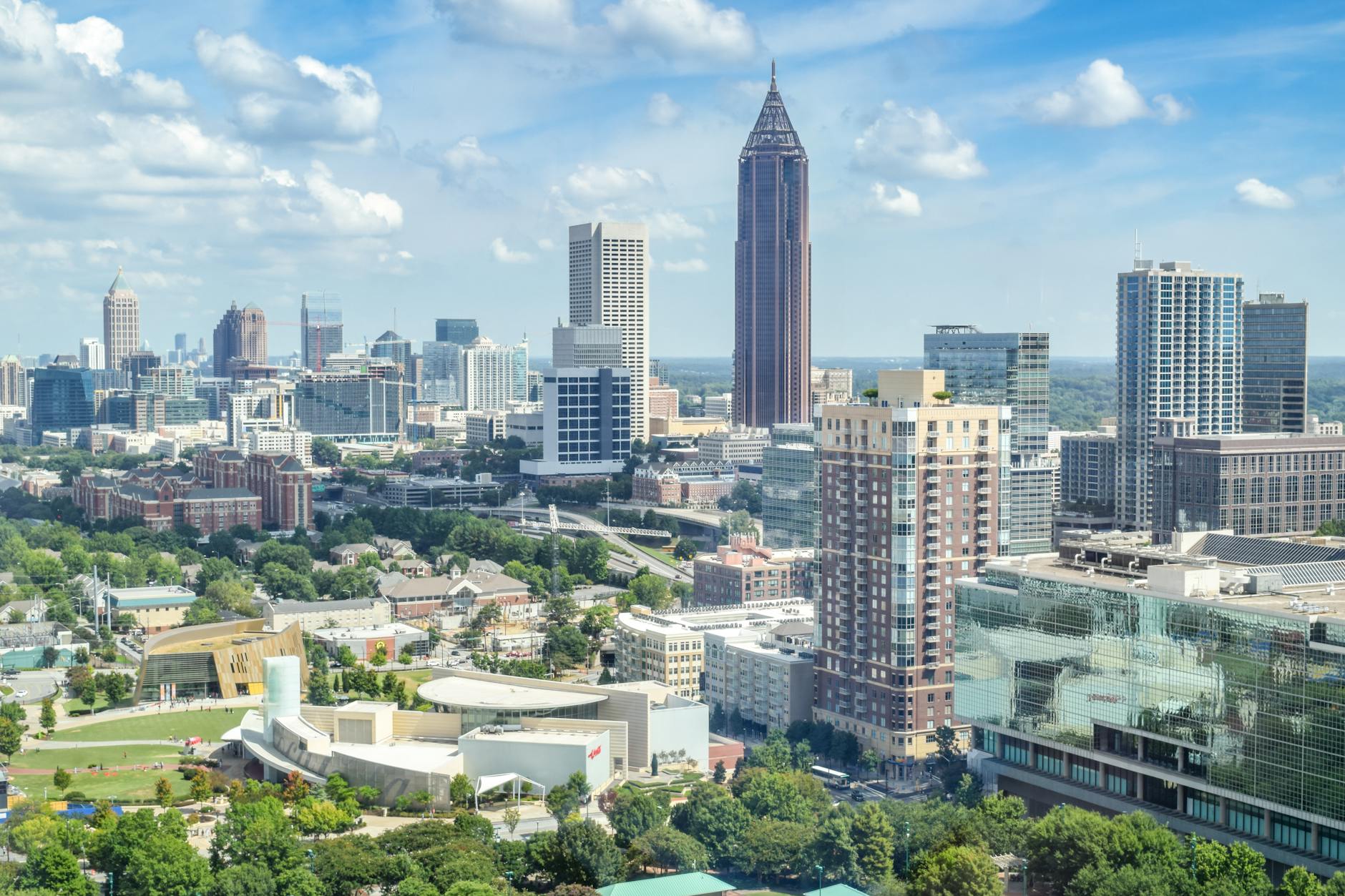
Although “Grosse Pointe Garden Society” looked convincing in its stately affluence, the actually series was filmed in Atlanta because of Georgia’s film tax incentives.
Can one wealthy suburb or neighborhood be easily swapped for another? I have not seen the TV show but I can imagine some of the ways this could be done. Establishing shots from one place while close-up action filmed elsewhere. A limited number of views of the community or neighborhoods or exteriors. Using studios or back lots.
I wonder if there are signs on the show that it is not actually filmed in Grosse Pointe. Differences in architecture? How about local trees? A lack of wear and tear on vehicles from winter that would be present in Michigan but not in Georgia?
This happens all the time on TV shows and in films: they are said to be set in one place but are filmed in other places. Perhaps the average viewer cannot tell the difference between the two or does not notice. Maybe it does not matter in many cases as the primary action follows a set of characters and the setting is just in the background. But if a show is named after a specific place, might it help a little to film it in that place?
Census data show more people from within the U.S. left metro Atlanta than moved to it during the 12 months that ended in mid-2024. It was a modest decline, about 1,330 people. But it heralds a significant moment for the longtime growth magnet: This is the first time metro Atlanta lost domestic migrants since the Census Bureau started detailing these numbers three decades ago.
If people are not moving to the Atlanta, where are they going instead? Here are some hints:
Growth in some other big Sunbelt metros has slowed, too, after pandemic-fueled population surges, including around Phoenix and Tampa, Fla., the census data show. Recent Bank of America change-of-address data also show big metros in the region losing steam…
“We just couldn’t afford to live there and have the lifestyle we wanted,” said Adelia Fish, 29 years old, who left suburban Atlanta with her husband in May for a newly built, three-bedroom home in Chattanooga, Tenn…
Whether that big-metro slowdown continues remains to be seen. But census data also indicate many smaller regions in the South—places like Huntsville, Ala., Wilmington, N.C., and Knoxville and Chattanooga in Tennessee—are picking up the slack. Their metros are all running ahead of pre-Covid trends.
The article hints at multiple reasons for this:
Bigger metropolitan regions like Atlanta have advantages but they are at a point where the costs of living there are now higher – housing costs, traffic, limited housing options.
Smaller metro areas can provide cheaper housing and a smaller scale.
Certain jobs or careers are portable or can be done in multiple places, not just in the biggest metro areas.
What does this do to Atlanta and other places that have been used to growth for decades? It is about status – we are on the rise! – and about planning – continued demand for land and buildings leads to different options.
If these patterns continue, keep on eye on what metropolitan areas become the hot ones in the next 5-10 years. How do they respond to a new status and local changes?
Atlanta’s Department of Watershed Management announced water service would be halted at 5 p.m. Friday in much of Atlanta, including all of downtown, so crews can work to repair breaks on a 48-inch and 36-inch transmission line “that carries large volumes of water to the metropolitan area.”
Just after 2 p.m., the Watershed Management Department issued a boil water advisory “out of an abundance of caution.” The advisory affects any Atlanta water customers who have experienced a water outage or low water pressure. The order was still in place on Sunday afternoon, even though repairs were completed on the major break near Joseph E. Boone Boulevard. Other repairs were continuing.
More details on water main breaks and pipes in Atlanta:
The problems began Friday morning where three large water mains intersect just west of downtown. Wiggins said at a Saturday news conference that at least some of the pipes that burst were old and corroded. With pipes coming together in a confined area, it was a tight squeeze to make repairs, with only one worker at a time working in the manhole accessing the junction. Repairs were completed Saturday evening, officials said.
Another water main later burst in the city’s Midtown neighborhood, which is studded with new office, hotel and apartment towers. Wiggins said Saturday that officials weren’t sure yet why that pipe had broken. That leak continued to gush through the city streets Sunday. City officials said Saturday that they were working on ways to isolate the leak from the larger water system and were awaiting a part needed to repair to the pipe. Dickens declared a state of emergency so the city could buy materials and hire workers without following the normal purchasing laws.
Faltering infrastructure is a common story in older parts of American cities. Atlanta has spent billions in recent years to upgrade its aging sewer and water infrastructure, including a tunnel drilled through 5 miles of rock to provide the city more than 30 days of stored water. Last month, voters approved continuing a 1-cent sales tax to pay for federally mandated sewer upgrades. The city at one time routinely dumped untreated sewage into creeks and the Chattahoochee River.
What are the odds of multiple major breaks in one weekend? Is the best way to address this to completely update the system?
Vital infrastructure is not just built once and then runs forever. It needs to be maintained. Expanding regions and changing conditions may require major updates. Constructing these systems in the first place required a lot of work; keeping these systems fit for the future may require even more.
Some stories in recent years have drawn attention to urban water issues. Water problems in Flint. Lead pipes throughout Chicago. Drought in California. Addressing these issues might not be exciting but it is essential to current residents, let alone visions of a bright future.
I imagine there is some sort of story that already tackles this but what happens in a large city if there is no water for more than a few days. What happens? Who is prepared?
I have now visited the Georgia Aquarium in Atlanta three times (first visit in 2010 reviewed here). Each time, I enjoy visiting the Ocean Voyager exhibit:
This picture comes from the viewing gallery at the end of the exhibit after visitors have already walked through a glass tunnel and looked through multiple windows into the exhibit. You can see a whale shark, two manta rays, and other species in the image above. Here is how the aquarium describes this:
Our Ocean Voyager gallery, built by The Home Depot, is home to whale sharks, manta rays and thousands of other fascinating fish. As one of the largest single aquatic exhibits in the world, Ocean Voyager features an acrylic tunnel for guests to view thousands of marine creatures on all sides, as well as a giant acrylic viewing window to explore our oceans like never before.
This exhibit was specially designed to house whale sharks, the largest fish species in the world. Schools of predatory trevally jacks, squadrons of small and large stingrays, enormous goliath grouper and several sharks all ply the waters of this ocean habitat. With 4,574 square feet of viewing windows, a 100-foot-long underwater tunnel, 185 tons of acrylic windows and one of the largest viewing windows in the world at 23 feet tall by 61 feet wide and 2 feet thick, visitors will have multiple opportunities to view all of these magnificent animals.
Zoos and aquariums can tend to offer visitors similar animals and exhibits. To create something truly unique in size and animals is a treat to behold. For good reason, there are always plenty of people sitting in front of this giant gallery wall trying to take it all in.
What happens when the needs of a church for a larger parsonage converge with the interests present in a district of older single-family homes where teardown McMansions occur? Here is a case from the Buckhead neighborhood of Atlanta:
The 81-year-old house at 3210 West Shadowlawn Ave. is listed as contributing to the Alberta Drive-Mathieson Drive-West Shadowlawn Avenue Historic District, which was added to the National Register of Historic Places in 2015. But that does not prevent demolition and the property has no City historic protections. The church claims the house is “uninhabitable” and can’t meet its mother organization’s requirements for large parsonages…
The historic district application was filed with the National Park Service in 2014 by the Georgia Historic Preservation Division. The filing says the neighborhoods are historically significant as part of a building boom that followed a 1907 trolley line extension on Peachtree, and for its wealth of intact architecture dating from the 1910s through the 1960s. West Shadowlawn, the filing says, was named for a subdivision called Shadow Lawn, which started construction in 1922. The filing includes a photo of the house at 3210. The main church property is not included in the historic district.
Rev. Bill Britt, the church’s senior minister, told the DRC that the plan is to build a parsonage as a home for a member of its clergy who currently rents elsewhere in the city. The existing one-story house would be replaced with a larger, two-story version…
Project architect Brandon Ingram noted that many houses on the street date to the period of the 1920s through 1940s. He said the church wanted the new parsonage to be be “respectful” of that aesthetic and look “a little bit more vintage” rather than “some giant Buckhead McMansion.”
This sounds like a typical teardown situation: there is an older property in a desirable single-family home neighborhood that needs some work. It does not have modern features or the size of new homes today. A property owner wants to tear it down and build a new home. Some in the community want to preserve the old home and worry that a new home changes the local character. Some in the community want property owners to have the right to do what they want with their property and be able to reap the benefits of what might come along.
Does it change the situation if it is a local church that wants to pursue the teardown? The church will likely profit from a teardown – increased property value, a newer home – but it is also a community or non-profit actor and not just a private owner. The church has been around a long time and the parsonage may not change hands for a long time. The intended use is for church staff.
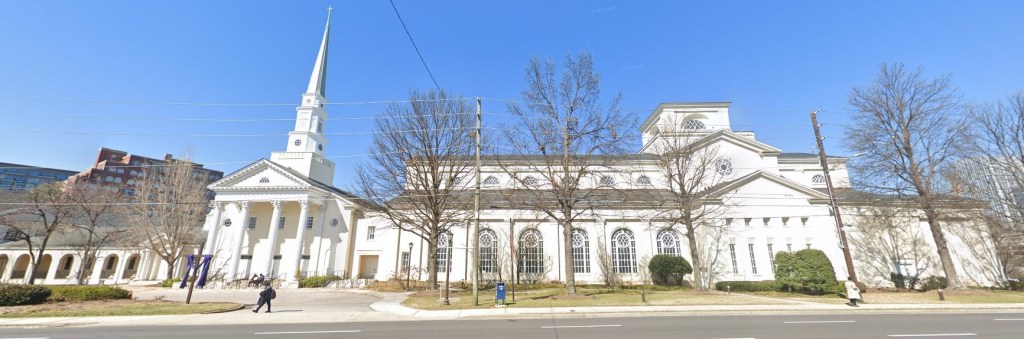
Is a church that is a long-term member of the community less likely to construct a McMansion and instead lean more toward the existing architecture of the neighborhood? Trying to picture a McMansion nearby a historic looking church building – see image below – does not work as well as imagining a McMansion near a newer megachurch in the sprawling suburbs.
Google Street View of Peachtree Road United Methodist Church
If religious congregations are in the business of building McMansions, there may be an interesting story to tell.
Like the Phoenix, Atlanta had risen from its own ashes following its destruction in 1864. Many times during the city’s history, Atlanta has redefined and reinvented itself, rising again as the city slogan, Resurgens, suggests. The “Atlanta Spirit” is another oft-referenced slogan describing an entrepreneurial and ambitious attitude that has shaped the city’s historical identity.
On October 11, 1871, three days after the fire started that devastated the city, Bross’s Tribune proclaimed, “CHEER UP. In the midst of a calamity without parallel in the world’s history, looking upon the ashes of thirty years’ accumulations, the people of this once beautiful city have resolved that CHICAGO SHALL RISE AGAIN.”
Bross, who was an avid promoter of the city, predicted that Chicago would be rebuilt in five years and would reach a population of 1 million by the turn of the century, as Donald Miller reports in City of the Century.
There is an accepted narrative that the fire created a blank slate upon which Chicago was quickly rebuilt. That blank slate allowed it to become a dynamic city of innovative architecture with a fresh skyline dotted with a brand-new building called the skyscraper.
“The great legend of Chicago is that it’s a ‘phoenix city’ – it almost instantly rebuilt itself bigger and better from the ashes. And to a certain and significant extent, that’s true,” said Carl Smith, professor emeritus of English at Northwestern University and author of Chicago’s Great Fire: The Destruction and Resurrection of an Iconic American City.
Those former residents were industrious, enterprising and imaginative. They built an irrigation system, consisting mostly of some 135 miles of canals, and the land became fertile. The ultimate fate of this ancient society, however, is a mystery. The accepted belief is that it was destroyed by a prolonged drought. Roving Indians, observing the Pueblo Grande ruins and the vast canal system these people left behind, gave them the name “Ho Ho Kam” — the people who have gone…
By 1868, a small colony had formed approximately four miles east of the present city. Swilling’s Mill became the new name of the area. It was then changed to Helling Mill, after which it became Mill City, and years later, East Phoenix. Swilling, having been a confederate soldier, wanted to name the new settlement Stonewall after Stonewall Jackson. Others suggested the name Salina, but neither name suited the inhabitants. It was Darrell Duppa who suggested the name Phoenix, inasmuch as the new town would spring from the ruins of a former civilization. That is the accepted derivation of our name.
Many cities have faced crises, disasters, or unusual starts. Local histories and narratives can also emphasize positive moments (and downplay negative moments). The rising from the ashes, overcoming great obstacles, coming back to life, these are all powerful narratives for big cities. They imply success, progress, and hopefully growth.
What these narratives mean now may be harder to ascertain. What does the aftermath of the Chicago Fire mean for Chicago today? Is Phoenix still rebuilding a great civilization? More than 150 years after the Civil War, is Atlanta continuing to reinvent itself? A city rising from the dead once is impressive but it may be harder to pull off over decades of change.
“When suburbanites come intown, they want to bring the suburbs with them. The day of the urban pioneer is gone,” says attorney Lee Meadows. The heart-pine floors, plaster walls, and black-and-white tile bathrooms of compact 1920s Craftsman bungalows can’t compete with the wired-for-plasma-TV mantel and Carrera marble–accented master bath of that “Neo-Craftsman” on Oakdale. (August 2007)
This is a short description but this seems to capture the McMansion era well:
-Bringing particular expectations about homes to cities and suburbs, whether they fit or not.
-Preferring new larger homes with features over historic homes.
-Particular features of these new homes included flat screens mounted over the mantel, marble in the bathrooms, and aping established architectural styles.
All that might be missing is the spread of McMansions in Sunbelt regions and the size of these homes, especially on certain smaller lots.
Of course, this comes before the housing bubble burst and more hardened opposition to McMansions. These homes are still constructed today in cities and suburbs but the thrill of McMansions has diminished. In other words, the “irrational exuberance” of McMansions is gone except perhaps in particular locations and for certain builders and buyers. For this reason, and perhaps many others, 2007 seems very far away.
When the British film studio company Pinewood opened a production facility outside Atlanta in 2014, it framed the venture as a one-stop-shop alternative to the mature but spatially fragmented system in Hollywood. With a high-tech media center, soundstages, offices, prop houses, and set builders all colocated, Pinewood Atlanta was a turnkey space for filming. An early relationship with Marvel Studios led to a steady stream of big-budget superhero movies such as Ant Man and Captain America: Civil War, and Pinewood Atlanta quickly became a contender in the film business.
But some of its local investors wanted it to be more than just a production facility. They wanted the entire business to have a place at the studios, with development of new shows happening where they’d eventually be filmed, and local workers able to easily commute to jobs on the site, about 20 miles south of Atlanta. So they decided to build a town…
Pinewood recently left the project, amiably, and the studio and town are now fully in the hands of local founders, who have accelerated Trilith’s development, which broke ground two years ago. Planned with New Urbanist design principles, Trilith is a dense, pedestrian-oriented, mixed-use village, with a commercial town center, more than half of its area dedicated to green space and forest, and room for an eventual population of 5,000. About 500 people are currently living in the town, which is planned to have a total of 1,400 townhomes, apartments, cohousing units, and 500-square-foot “microhomes.” Housing is available to rent or buy, and Trilith’s developers say it’s luring residents from within the film industry as well as people from other walks of life…
Parker says the town was inspired by Seaside, a New Urbanist community in Florida famous for its use as the setting of The Truman Show. Trilith was designed by the Atlanta-based planning firm Lew Oliver, with homes designed and built by companies such as 1023 Construction and Brightwater Homes. Parker says the design was intended to appeal to young creatives, with an emphasis on wellness and access to the outdoors, but with the kinds of amenities people want in a town. The first of the town’s restaurants recently opened, and 11 more are in the works. A 60,000-square-foot fitness studio was recently completed, and a K-12 school is already open.
Three quick thoughts:
It will be interesting to see how the relationship between the film industry and the town continues. On one hand, it could create a regular level of business and residents. On the other hand, not everyone in the community will be involved and interests could collide. Will this be like other suburbs and communities that rely heavily on one industry or sector (with both the advantages and disadvantages that come with this)?
Later portions of the article discuss the diversity of residents in the community. Seaside looks good on film but has been more of a wealthy community than one that lives up to its New Urbanist principles of having mixed-income housing and residents. Will the desirability of such a community drive up housing costs? Will the connection to the film industry make it more difficult to others to move in?
Does this provide a new model for numerous industries? For example, prior to COVID-19 big tech firms had constructed large, all-encompassing headquarters intended in part to help keep workers close. Or, large office buildings in central areas help consolidate workers and multiple sectors. But, perhaps this New Urbanist vision provides an alternative: more space in the suburbs, film facilities, other opportunities in the town outside of film.
Accompanying the announcement, the team released a map showing where, precisely, Braves Country was—and, notably, where it wasn’t. That view of the greater Atlanta area was speckled with red dots, each one indicating the home of a 2012 ticket buyer, including season-ticket holders. Only a smattering of red appeared to the east, west and south of Turner Field, while thousands of dots congealed into a ribbon above downtown that expanded into a wide swath in the half-dozen suburban and exurban counties to the north. The new stadium would be closer to the middle of that mass, which happened to embody an older, whiter and more conservative population than the city proper. Those northern suburbs were fast diversifying, yet many in Atlanta—particularly in its black population—felt slighted by the decision, their perspectives colored by decades of racial and political tension between city and sprawl.
Five months later MLS commissioner Don Garber, Falcons owner Arthur Blank and then-mayor Kasim Reed proclaimed in their own press conference that downtown Atlanta would be home to MLS’s 22nd franchise, and the new club, Atlanta United, would take the pitch in 2017, the same year the Braves headed to Cobb. The soccer team would play in the same new $1.6 billion stadium the Falcons would soon call home, but United would be no afterthought. The facility would be designed to accommodate the beautiful game from the start. Pushing back against skepticism and pointing to an influx of young professionals near Atlanta’s urban core, Blank assured MLS’s leaders he could fill the massive venue, even in a market known for lukewarm enthusiasm toward pro sports. Reed boasted that his city’s foreign-born (and, seemingly implied, soccer-loving) population was growing at the second-fastest rate in the U.S. Garber himself insisted these factors combined to make downtown an ideal MLS incubator. The city “embodies what we call a ‘new America,'” he said, “an America that’s blossoming with ethnic diversity.”
Fast-forward five years, and Atlanta United’s ticket-sales map, while not a direct inverse, is considerably more centralized than Braves Country (or even, says United president Darren Eales, a depiction of the Falcons’ fan base). United, meanwhile, aided no doubt by winning the 2018 MLS Cup, has led MLS in attendance in each of its three seasons, averaging 53,003 fans in ’19, among the highest in the world. This echoes the success the Braves found when they chased their audience to the north, the farthest any MLB team had ventured from its city center in 50 years. The Braves’ average home attendance, aided too by on-field success, reached 32,779 fans this season, up 31% from their last year at Turner Field…
Kruse, the Princeton history professor, is blunt in his assessment of such feelings. “These ideas about downtown being a dangerous place are really about the people downtown,” he says. For years he thought that “suburbanites want nothing to do with the city except to see the Braves.” But today? “That last connection has been severed. I see this movement of the stadium as the culmination of white flight.”
Trying to connect with particular fan bases or contributing to decades-long processes of residential segregation and white flight? How about both?
Three additional thoughts:
More could be made here of the public money the Braves received from Cobb County. Plus, they could develop land around the new stadium, now a common tactic to generate more revenue beyond fan attendance. Yes, fan attendance is important but the long-term money may be in investing money in land surrounded by whiter and wealthier residents. Stadium development then just continues the process of limited capital investment in neighborhoods that could really use it and concentrates it in places where wealth is already present.
Baseball is widely regarded as having an older and whiter fan base. Soccer is said to have a more diverse and younger fan base. In addition to the demographics of the Atlanta area, the sports themselves try to appeal to different audiences (even as they might work to reach out to different groups).
It will be interesting to see how many sports teams in the next few decades move to more niche locations while still claiming to be from the big city. Civic identity is often tied to sports teams as most metro areas can only support one team from the major American sports. Can big city politicians still lose when the team from the area decides to move to a suburb (see a recent example in the Las Vegas area) but takes that revenue out of the big city? Can a team that locates in one particular area of the metropolitan region still easily represent the entire region?
This intertwined history of infrastructure and racial inequality extended into the 1950s and 1960s with the creation of the Interstate highway system. The federal government shouldered nine-tenths of the cost of the new Interstate highways, but local officials often had a say in selecting the path. As in most American cities in the decades after the Second World War, the new highways in Atlanta — local expressways at first, then Interstates — were steered along routes that bulldozed “blighted” neighborhoods that housed its poorest residents, almost always racial minorities. This was a common practice not just in Southern cities like Jacksonville, Miami, Nashville, New Orleans, Richmond and Tampa, but in countless metropolises across the country, including Chicago, Cincinnati, Denver, Detroit, Indianapolis, Los Angeles, Milwaukee, Pittsburgh, St. Louis, Syracuse and Washington.
While Interstates were regularly used to destroy black neighborhoods, they were also used to keep black and white neighborhoods apart. Today, major roads and highways serve as stark dividing lines between black and white sections in cities like Buffalo, Hartford, Kansas City, Milwaukee, Pittsburgh and St. Louis. In Atlanta, the intent to segregate was crystal clear. Interstate 20, the east-west corridor that connects with I-75 and I-85 in Atlanta’s center, was deliberately plotted along a winding route in the late 1950s to serve, in the words of Mayor Bill Hartsfield, as “the boundary between the white and Negro communities” on the west side of town. Black neighborhoods, he hoped, would be hemmed in on one side of the new expressway, while white neighborhoods on the other side of it would be protected. Racial residential patterns have long since changed, of course, but the awkward path of I-20 remains in place…
[S]uburbanites waged a sustained campaign against the Metropolitan Atlanta Rapid Transit Authority (MARTA) from its inception. Residents of the nearly all-white Cobb County resoundingly rejected the system in a 1965 vote. In 1971, Gwinnett and Clayton Counties, which were then also overwhelmingly white, followed suit, voting down a proposal to join MARTA by nearly 4-1 margins, and keeping MARTA out became the default position of many local politicians. (Emmett Burton, a Cobb County commissioner, won praise for promising to “stock the Chattahoochee with piranha” if that were needed to keep MARTA away.) David Chesnut, the white chairman of MARTA, insisted in 1987 that suburban opposition to mass transit had been “90 percent a racial issue.” Because of that resistance, MARTA became a city-only service that did little to relieve commuter traffic. By the mid-1980s, white racists were joking that MARTA, with its heavily black ridership, stood for “Moving Africans Rapidly Through Atlanta.”…
Earlier this year, Gwinnett County voted MARTA down for a third time. Proponents had hoped that changes in the county’s racial composition, which was becoming less white, might make a difference. But the March initiative still failed by an eight-point margin. Officials discovered that some nonwhite suburbanites shared the isolationist instincts of earlier white suburbanites. One white property manager in her late 50s told a reporter that she voted against mass transit because it was used by poorer residents and immigrants, whom she called “illegals.” “Why should we pay for it?” she asked. “Why subsidize people who can’t manage their money and save up a dime to buy a car?”
Translation: decisions about transportation were both a consequence of a national inclination toward racial and ethnic segregation and an ongoing contributor toward racial and ethnic segregation. In a country that is relatively sprawling and prefers cars, determining who has access to transportation and what kind of transportation is available can be part of who can get ahead.
While the root cause of all of this may be racial issues, it is interesting to consider this as a congestion issue. Would the public be convinced to change transportation infrastructure because they dislike sitting in traffic? The evidence from Atlanta as well as numerous other American cities (such as developing a regional transportation effort in the Chicago region) suggests this is not a strong argument. Wealthier residents are hesitant to ride buses, trains may be tolerable, but driving is still preferred even when so many hours per year are devoted to it. Suburban Americans like cars and they like the ability to exclude and I would argue the second is the master priority when push comes to shove.






 Legally Sociable