Fewer children born in the US affects one of the major reasons given for living in the suburbs

Multiple intertwined social forces created the American suburbs as we know them today. One factor involves raising children in the suburbs. The suburbs are perceived by many to be the best places to raise children due to their houses, yards, quieter environments compared to the city, good schools, and other amenities. And since Americans often want or expect their children to do better than themselves, the suburbs are the place in which they believe this happens.

Photo by Yunuen Zempoaltecatl on Pexels.com

What happens if fewer children are born in the United States? This will not necessarily stop people from living in or wanting to live in the suburbs. But it could change their calculations about where to live or how to live in the suburbs. Some quick examples of how this might play out:

  1. Suburbs are built on the idea of growth: new subdivisions, new activity. If growth slows, communities have a different identity and have to draw on different revenue sources. With less growth, communities shift to maintenance or building in different ways (see #2).
  2. Suburbs have historically prioritized single-family homes as they provide space for nuclear families. But if fewer people need the space and yards of single-family homes (plus the issue of current prices), communities and developers will go for more townhouses and condos.
  3. There is a reduced need for schools. Education is often viewed in the United States as the tool for social advancement. Many suburbs take pride in their schools. Growing suburbs equaled more schools. But fewer kids in the community means fewer enrolled students.
  4. A suburban lifestyle built around kids’ activities and driving them around. The suburbs often require driving kids to school, sports, religious congregations, and more. The driving will not necessarily cease but the era of “Walmart moms” and “soccer moms” might diminish.

Many have complained that the streets of the suburbs are quieter than they used to be because kids are now inside or in organized activities. What if the suburban streets of the future (and schools and playgrounds and park districts and so on) are quiet because there are no kids living in suburbia?


Lower US birth rates, closing K-12 schools

What happens in American communities when schools close because there are fewer kids?

Photo by RDNE Stock project on Pexels.com

The district is one among many in the United States that have closed schools and are considering closing more. One of the primary reasons is that many adults in the US are simply not having kids, or having fewer of them. And an increasing number of those who do are instead sending their kids to private schools or homeschooling them.

That trend, experts say, means that more US schools are becoming underenrolled, which places school districts in a difficult financial situation because that decline in students means they get less public funding. They must then decide between uprooting students from familiar surroundings and friends or keeping those institutions open even if it doesn’t make fiscal sense…

While districts had planned for fewer students in the coming years, the Covid-19 pandemic and the associated virtual learning accelerated that downturn, Dee said. In fall of 2020, enrollment in US public schools decreased by 1.1 million, according to a study co-authored by Dee.

This trend could have lots of different effects. What happens in communities where schools brought people together and also served like community centers? There might be other settings that could serve this purpose but schools have a way of bringing parents, students, and community members together. What happens to the school properties; how will they be used in the future? A school may have been there for decades and the neighbors might not like what is proposed next for the land. Or they may not like a vacant building if the property is not sold or there is limited interested in redevelopment.

Since Americans tend to think growth is good, do these changes also lead people to think schools are failing or doing worse? If the cause of closing schools is primarily having fewer schools, will people perceive schools are not doing what they should? Even more complicated: local populations could be growing or not declining and schools could still close if fewer people are having children.

Finally, what are good ways to memorialize or celebrate a school and what it meant when it closes? Even if the building is no longer there or it is no longer home to students, there are ways to keep its memory alive.

What does it mean that India’s population will pass China’s population?

India will soon have more people than China. What does that mean?

Photo by Still Pixels on Pexels.com

The United Nations has said India’s population is projected to surpass China’s sometime this year. Many demographers estimate it could happen this month, if it hasn’t already. India’s population is expected to reach 1.429 billion by the end of the year, according to the U.N. China will fall to second place, with 1.426 billion people. Both dwarf the U.S. at a projected 340 million.

India’s rising population means it’s likely to keep its economy growing, buy more of the world’s goods and play a bigger role in global affairs, even as it grapples with poverty and a lack of jobs. 

China’s demographic headwinds will make it harder for the country to achieve its economic ambitions, or to supplant the U.S. as the world’s biggest economy, despite its rising wealth and military power…

India’s population is expected to keep growing for the next four decades, peaking at nearly 1.7 billion in 2063. China’s population, which declined last year for the first time since famines in the 1960s, according to government data, is projected to shrink rapidly. By the start of the next century, India’s population is expected to be double that of China’s.    

Numbers are just numbers; we give them significance. Is this just about large numbers and their ability to impress people? Here, two countries have nearly a billion and half people each. That is a lot of people and far ahead of the next most populous countries.

It could also be about being the country with the most people. This has been China for a while but will soon be India. Does having the most people provide an exalted status?

Or, is it about economic activity and growth. A large and growing population means economic opportunities internally and externally.

Yet, it could be more about growth than absolute numbers. Yes, it is important to be first in population but this is also about expected growth for India and a declining population in China. Not only will India be #1 in residents, it could be far ahead of China in population soon.

What this all adds up to is hard to say. India will be the most populous nation, China will be second. The population arrows will be headed in different directions. Does it mean a significant change in status and economic status? The number of people in each country may just play a role in this.

America’s “cities have effectively traded away their children, swapping capital for kids”

Derek Thompson discusses the decrease in children in large American cities:

Cities have effectively traded away their children, swapping capital for kids. College graduates descend into cities, inhale fast-casual meals, emit the fumes of overwork, get washed, and bounce to smaller cities or the suburbs by the time their kids are old enough to spell. It’s a coast-to-coast trend: In Washington, D.C., the overall population has grown more than 20 percent this century, but the number of children under the age of 18 has declined. Meanwhile, San Francisco has the lowest share of children of any of the largest 100 cities in the U.S…

But the economic consequences of the childless city go deeper. For example, the high cost of urban living may be discouraging some couples from having as many children as they’d prefer. That would mean American cities aren’t just expelling school-age children; they’re actively discouraging them from being born in the first place. In 2018, the U.S. fertility rate fell to its all-time low. Without sustained immigration, the U.S. could shrink for the first time since World World I. Underpopulation would be a profound economic problem—it’s associated with less dynamism and less productivity—and a fiscal catastrophe. The erosion of the working population would threaten one great reward of liberal societies, which is a tax-funded welfare and eldercare state to protect individuals from illness, age, and bad luck…

Finally, childless cities exacerbate the rural-urban conundrum that has come to define American politics. With its rich blue cities and red rural plains, the U.S. has an economy biased toward high-density areas but an electoral system biased toward low-density areas. The discrepancy has the trappings of a constitutional crisis.  The richest cities have become magnets for redundant masses of young rich liberals, making them electorally impotent. Hillary Clinton won Brooklyn by 461,000 votes, about seven times the margin by which she lost Pennsylvania, Michigan, and Wisconsin combined. Meanwhile, rural voters draw indignant power from their perceived economic weakness. Trump won with majority support in areas that produce just one-third of GDP by showering hate and vitriol on cities that attract immigration and capital…

For those young and middle-aged Americans who are having sex and having children, the smaller cities and suburbs might simply be a better place to live—and not just for the obvious reason that they’re more cost-friendly for the non-rich. Perhaps parents are clustering in suburbs today for the same reason that companies cluster in rich cities: Doing so is more efficient. Suburbs have more “schools, parks, stroller-friendly areas, restaurants with high chairs, babysitters, [and] large parking spaces for SUV’s,” wrote Conor Sen, an investor and columnist for Bloomberg. It’s akin to a division of labor: America’s rich cities specialize in the young, rich, and childless; America’s suburbs specialize in parents. The childless city may be inescapable.

The book and film Children of Men suggested people in the near future would not have children for some uncontrollable reason but perhaps cities will have fewer children by the collective individual and social choices of urban dwellers.

This also has implications for the American Dream which has tended to suggest parents will work hard and pass along benefits to future generations. Not having as many direct beneficiaries of actions could alter how people think about the future: it is one thing to project changes for a community (“this is good for Chicago’s future, whoever happens to live here”) versus thinking about more direct benefits which could also help a community (“my children will be better off – and they can continue to live in Chicago and benefit others”).

Final thought: this is a rare time when someone could claim the suburbs are “more efficient” for raising children. On one hand, I see the point: the suburban infrastructure has been built around children for decades. On the other hand, this idea of “efficiency” is an odd one as children can also be raised in cities and what Americans value for children and families is often closely tied to perceptions of cities and suburbs.

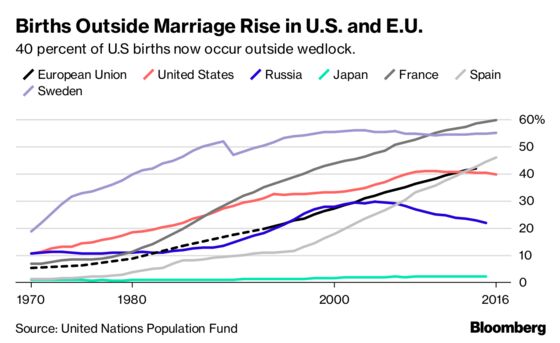
News story suggests 40% is “Almost Half”

A Bloomberg story looks at the rise in birth in the United States outside of marriage and has this headline:

Almost Half of U.S. Births Happen Outside Marriage, Signaling Cultural Shift

And then the story quickly gets to the data:

Forty percent of all births in the U.S. now occur outside of wedlock, up from 10 percent in 1970, according to an annual report released on Wednesday by the United Nations Population Fund (UNFPA), the largest international provider of sexual and reproductive health services. That number is even higher in the European Union.

Almost Half of U.S. Births Happen Outside Marriage, Signaling Cultural Shift

There is no doubt that this is significant trend over nearly 50 years. One expert sums this up toward the end of the story:

The traditional progression of Western life “has been reversed,” said John Santelli, a professor in population, family health and pediatrics at Columbia’s Mailman School of Public Health. “Cohabiting partners are having children before getting married. That’s a long-term trend across developing nations.”

Yet, the headline oversells the change. A move from 10% of births to 40% of births is large. But, is 40% nearly 50%? When I hear almost half, I would expect a number between 45% and 49.99%. Claiming 40% is nearly half is going a little too far.

I think the reading public would better served by either using the 40% figure or saying “Two-Fifths.” Or, perhaps the headline might speak to the 30% jump in nearly 50 years.

In the grand scheme of things, this is a minor issue. The rest of the story does a nice job presenting the data and discussing what is behind the change. But, this is a headline dominated age – you have to catch those eyes scrolling quickly on their phones – and this headline goes a bit too far.

Multiple measures and small trends: American birthrates down, births per woman up

A new Pew report explains this statistical oddity: the annual birthrate in the US is down but women are having more children.

How can fertility be down even as the number of women who are having children is going up? There are complex statistical reasons for this, but the main cause of this confusing discrepancy is the age at which women are having children. Women are having children later in life — the median age for having a first baby is 26 now, up from 23 in 1994 — and this delay causes annual birth rates to go down, even as the cumulative number of babies per woman has risen…


Another factor, Livingston said, is the drop in teen birth rates, with black women seeing the biggest drop in that category.

See the Pew report here. An additional part of the explanation is that there are multiple measures at play here. A Pew report from earlier in 2018 explains:

But aside from this debate, the question remains: Is this really a record low? The short answer is: It’s complicated.

That’s because there are different ways to measure fertility. Three of the most commonly used indicators of fertility are the general fertility rate (GFR); completed fertility; and the total fertility rate (TFR). All three reflect fertility behavior in slightly different ways – respectively, in terms of the annual rate at which women are presently having kids; the number of kids they ultimately have; or the hypothetical number they would likely have based on present fertility patterns.

None of these indicators is “right” or “wrong,” but each tells a different story about when fertility bottomed out.

Measurement matters and the different measures can fit different social and political views.

I wonder if part of the issue is also that there is a clear drop in births from the earlier era – roughly 1950 to 1970 which we often associate with Baby Boomers – but the last 3+ decades have been relatively flat. This plateau of recent decades means researchers and commentators may be more prone to jump on small changes in the data. Many people would love to predict the next big significant rise or fall in numbers but a significant change may not be there, particularly when looking at multiple measures.

Hard to counter China’s aging, even with change in one-child policy

The change in China’s one-child policy may not have much effect on its demographics:

“The population in China is going to continue to age,” said Kristin Bietsch, a research associate at the Population Reference Bureau in Washington, D.C. “Even though they’re hoping to increase their fertility, they’re still going to have a substantial population aging — and this is going to happen even with the increase in fertility.”…Adrian Raftery, a professor of statistics and sociology at the University of Washington in Seattle, agreed: “The (United Nations) has already been projecting a small and slow increase in China’s fertility rates over the coming decades, and this news makes this even more likely to happen,” he said. “The increase is not likely to be large, though.”…

Like much of Europe, China’s population is aging rapidly — India’s population, now at 1.3 billion, is expected to surpass China’s within seven years, according to the United Nations…

But many demographers argue the birthrate would have fallen anyway as China’s economy developed and education levels rose. They foresee a looming crisis because the policy reduced the young labor pool that must support the large baby boom generation as it retires.

Three quick thoughts:

  1. See more about demographic transition here: as countries develop and have more wealth, residents have fewer children. Even as the one-child policy disappears, there may not be a rush to have two children.
  2. Governments have the ability to set policies such as these but one problem with influential policies is that they also need good timing. If the goal was to reduce the proportion of older residents, this change came late and it will now take more time to counteract the unintended consequences of the initial policy.
  3. I haven’t seen much about the real reasons China reversed this policy. Presumably, it has to do with aging – a modern society needs a broad base of young workers both for economic growth as well as to pay into the system to take care of older residents. Yet, this article brings up the population of India – might the shift also have to do with the population growth of India? Are there other reasons as well?

Percent of American teenagers at its lowest point ever

The development of the age category teenager has been influential in American society but recent data suggests the percent of Americans who are teenagers has never been lower:

Here’s the total number of 13-to-19 year olds over the past 50 years. (The most recent data from the Census Bureau is an estimate from 2013.)

It will be interesting to see how this plays out in different social spheres including:

1. Education. Does this mean the closing of schools/colleges and fewer jobs for educators?

2. Marketing. Teenagers wanted to utilize their disposable income and brands wanted to hook them as consumers for life. But, with fewer teenagers, brands will really have to make sure they reach enough teenagers.

3. Suburbs. These areas have been devoted to children for decades while also not knowing what to do with teenagers who often wanted to escape the relatively dull, often private settings.

4. All sorts of occupations. Are there certain industries that won’t attract enough teenagers?

I could go on. But, I would also note that there may be even fewer teenagers if it hadn’t been for higher birth rates among the tens of millions of immigrants who have made their way to the United States in recent decades.

More demographic issues, this time in Southern Europe

Amidst news that Japan experienced a record population drop in 2010, today, the New York Times reports on Southern Europe where there is a lack of jobs for the young even as a growing elderly population requires support and how this has led to a “pervasive malaise among young people”:

Indeed, experts warn of a looming demographic disaster in Southern Europe, which has among the lowest birth rates in the Western world. With pensioners living longer and young people entering the work force later — and paying less in taxes because their salaries are so low — it is only a matter of time before state coffers run dry.

“What we have is a Ponzi scheme,” said Laurence J. Kotlikoff, an economist at Boston University and an expert in fiscal policy.

He said that pay-as-you-go social security and health care were a looming fiscal disaster in Southern Europe and beyond. “If these fertility rates continue through time, you won’t have Italians, Spanish, Greeks, Portuguese or Russians,” he said. “I imagine the Chinese will just move into Southern Europe.”

The problem goes far beyond youth unemployment, which is at 40 percent in Spain and 28 percent in Italy. It is also about underemployment. Today, young people in Southern Europe are effectively exploited by the very mechanisms created a decade ago to help make the labor market more flexible, like temporary contracts.

Whoever is going to tackle these issues is going to have be very brave or thick-skinned.

While the consequences of long-term low birth rates are becoming more clear, why is there not more discussion about boosting these birth rates? How exactly did the birth rate drop so much? How did it become so desirable for nations and individuals to have so few children? Could governments provide incentives to families so that they would have more children?

It will also be interesting to track how this “malaise” works its way through the younger generation. Could this be the first generation in a while that has a tougher life than their parents in terms of having to work longer and harder just to keep society afloat? What are the social consequences of this malaise: less productivity, less interest in civil society, general unrest?

Record population drop in Japan

Numerous industrialized nations are facing a demographic challenge: an aging population coupled with a low birth rate. Japan is one of these countries and experienced a record population drop in 2010:

Japan faces a looming demographic squeeze. Baby boomers are moving toward retirement, with fewer workers and taxpayers to replace them. The Japanese boast among the highest life expectancies in the world but have extremely low birth rates.

Japan logged 1.19 million deaths in 2010 — the biggest number since 1947 when the health ministry’s annual records began. The number of births was nearly flat at 1.07 million.

As a result, Japan contracted by 123,000 people, which was the most ever and represents the fourth consecutive year of population decline. The top causes of death were cancer, heart disease and stroke, the ministry said.

Japanese aged 65 and older make up about a quarter of Japan’s current population. The government projects that by 2050, that figure will climb to 40 percent.

This will have some enormous social consequences in the coming decades: an growing older population will require more and more government services that will be paid for by a shrinking base of younger workers.

One important piece of the story seems to be missing in this article: immigration. Japan has historically been relatively closed to immigration where other industrialized nations have various rates of immigration. In the United States, population growth has been fueled by higher birth rates than some other industrialized nations plus high levels of immigration. As countries continue to think about this demographic shift, could more nations see immigration as a solution to looming budget issues related to government programs for the elderly?