Rahm Emanuel on what divides people and how art can bring people together

Toward the end of an interview about the arts during his tenure as Chicago mayor, Rahm Emanuel briefly discussed factors that divide people and bring them together:

I think Lori and Amy know that the arts are the soul of a great city. Martin Luther King used to say the most segregated day in America is Sunday. The arts can make the other six days more integrated. Technology is balkanizing and dis-aggregating people. Only a government working with artists can create equity across shared experience.

According to this short quote, two factors work against community:

  1. Religion. Watch MLK make his 1960 statement about the most segregated hour in Christian America. So if religion in the US has tended to divide people by race (see Divided By Faith) and Chicago is one of the most segregated cities in America, Emanuel may have a point about this in Chicago.
  2. Technology. Emanuel could join a chorus of pundits and scholars who argue technology has detrimental effects on community life.

On the other hand, Emanuel cites two forces that encourage community:

  1. Art/the arts.
  2. Government helping to facilitate the work of artists.

There is little doubt that major cities in recent decades have used the arts and cultural experiences alongside public art to try to drive growth. Whether this truly enhances community in the long run, particularly when other forces at work – with Emanuel’s reference to equity, I can’t help but think of uneven development and capital investment in cities like Chicago – work against community, remains to be seen. In other words, can shared experiences overcome persistent social inequalities?
The legacy of Mayor Rahm Emanuel and Chicago as a global city

After weighing the highs and lows of Chicago mayor Rahm Emanuel’s eight years in office, a Chicago Tribune editorial ends with this:

Because in the end, Mayor Emanuel kept his word. He pushed Chicago to keep moving, to shuffle forward, to improve its rank as a global city.

Not many big-city mayors can say that.

Two quick thoughts on how this conclusion feeds ongoing narratives about cities and Chicago:

  1. “Keep moving” and “improve” are linked to the idea of continuous city growth. Chicago may be slowly losing residents – or at least losing ground to faster-growing cities close in population like Toronto and Houston – but Emanuel helped stem the tide. Imagine this legacy: Mayor Emanuel could not increase Chicago’s population but think how much worse it would have been without all those new buildings downtown and in wealthy neighborhoods!
  2. Emanuel himself had a goal of keeping Chicago as a major global city. Indeed, it is. But, Chicago also has a lingering fear that it is not considered a global city, particularly compared to places like New York City. The population loss is likely part of this but so may be a location in the Midwest away from the exciting coasts. Again, for Emanuel’s long-term legacy: Chicago stayed in the top 50 of global cities!

Finally, all of this conversation makes it sound as if the mayor was the only one with influence in the city. The mayor of Chicago may always have an outsized influence – I’m reminded of former mayor Richard M. Daley’s visit to campus in 2011. This big man theory of history covers up a lot of other processes, including the work (or rubber-stamping?) of the City Council, the flow of global capital into Chicago, the influence of developers and wealthy business leaders, and numerous changes taking place within disadvantaged neighborhoods.

The Chicago area’s net migration is not bad but it can’t attract new residents

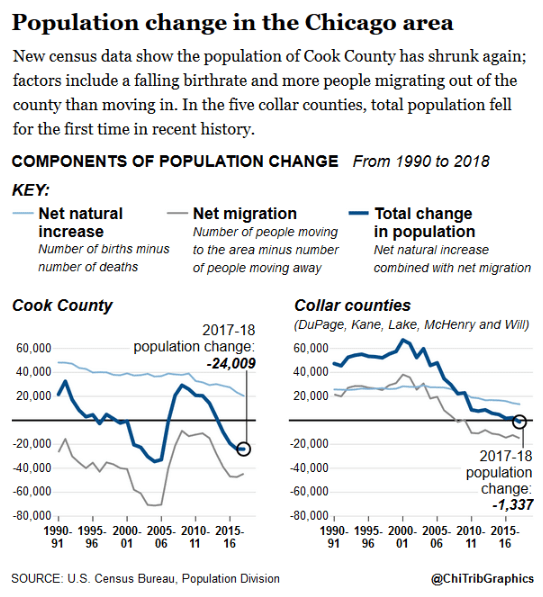
The newest Census data suggests both Chicago and the Chicago region are losing residents. But, it may be less about people moving away and more about an inability to attract new residents:

ChicagoAreaPopulationChange2019

Some experts note the metro region also isn’t attracting enough newcomers to make up for people who move away. Immigration from other countries also has long helped stem population loss, but in recent years this influx has been less robust, according to census estimates. Meanwhile, birthrates are slowing statewide, which means there are fewer new residents to make up for other losses…

“We don’t have a particularly high rate of just out-migration, but very few people come here relative to our population, compared to the rest of the country,” said Daniel Kay Hertz, research director at the Center for Tax and Budget Accountability.

Using numbers from the 2015 American Community Survey, conducted by the U.S. census, his agency found that Illinois ranked in the middle of the pack nationally on the rate of people leaving the state, but was third from the bottom on the rate of people coming in…

“The narratives around the state matter and can shape people’s decisions,” Hertz said. “And the ones in Illinois are really, really, really negative in ways that I think overstate some of the issues relative to other places.”

Any major metropolitan area is going to have some people moving out as they get new job opportunities, see greener pastures elsewhere, move for family reasons, and so on. The goal then is to also attract new residents even as some are moving out. Population increases come from new residents plus more births than deaths.

This one expert cited above hints at an interesting conundrum for any city or region beset with population loss or narratives of decline: how do you reverse the trend once it starts picking up steam? As noted, the narratives both within and outside the Chicago region and Illinois are not good: pension debts, inequality, corruption, social issues that have lasted decades, higher taxes, a lack of innovation, not a business-friendly climate, harsh winters, important but bottlenecked infrastructure. If Chicago was the exemplar American city at the turn of the twentieth century, that is no longer the case. Other cities are on the rise, particularly in the Sunbelt stretching from Washington D.C. (with the expansion of and attention paid to the federal government, perhaps now truly the second most important American city) to Houston (whose population keeps growing and may soon surpass Chicago).

It is hard to know exactly how much the larger narrative pushes people to avoid the Chicago area in favor of other places. At the same time, status matters. People and businesses want to go to places that are on the way up, that are gaining people, that have an energy moving toward the future. Chicago and its region still have a lot to offer. For example, millennials still like portions of Chicago for their thriving cultural scenes plus relatively cheap housing compared to other major cities. Perhaps Chicago’s long-term fate is to roughly stay the same at the center of the Midwest region, a significant portion of the country that may also be losing population and status.

Informing the public about delays in completing large public projects

The reasons for delayed Jane Byrne Interchange project in Chicago are only now trickling out to the public:

In January 2015 — just over a year into construction — university workers noticed the building had been sinking and shifting, leaving cracks in the foundation and making it impossible to shut some doors and windows, according to court records…

Over the next 1½ years, IDOT blamed engineering firms it had hired for missing the poor soil conditions that contributed to the problem. That led to a redesign of a key retaining wall that boosted costs by $12.5 million and dragged out that part of the project at least 18 more months…

IDOT’s Tridgell gave the Tribune a list of other reasons for delays. Among them: The city was leery of shutting down ramps and lanes on many weekends because of festivals and other events. And other local agencies required extra permits and reviews for work…

UIC’s Sriraj said public outreach is challenging on big projects, with no “gold standard” on how much is appropriate.

The public is likely not surprised that such a large project is behind schedule and over budget. This is common on major infrastructure projects. They just want the project done. (And I’m sure some of the cynical ones will note that even when the Byrne project is done, repaving of its surfaces will probably begin again very soon.)

Is this expectation of poor performance what then allows public agencies to not have to explain further delays and costs? Realistically, there is little the public can do whether they know about the delays and cost overruns or not: the construction keeps going until it does not. And the article hints that there is possibly little the state can do to compel contractors to do better work. So, because the news looks bad, is it just better to sit on the information?

I would prefer it work this way: given that such large projects affect many people and involve a lot of taxpayer dollars, the public should have access to clear timelines and explanations for delays. Many people won’t care, not matter how much information is available. But, in general, public life is valuable and information should be widely available and not hidden for fear of angering people or avoiding blame. At the least, knowing about delays and increased costs could theoretically help voters make better choices in the future about leaders who will guide these processes.

If a megaproject proposal doubles the number of onsite affordable housing units in a bid to get approval, doesn’t this mean the profits will be substantial?

The latest proposal for the Lincoln Yards project on Chicago’s north side will now include 600 on-site affordable housing units – 300 more than before:

It will be the largest on-site commitment in the 16-year history of Chicago’s affordable requirements ordinance, according to Ald. Brian Hopkins, 2nd. Hopkins will join the Chicago developer and affordable housing advocates to announce the revised plan in a news conference Tuesday morning at City Hall…

Sterling Bay wants to build about 15 million square feet of commercial and residential buildings on 54.5 acres of riverfront land along Lincoln Park and Bucktown. That includes 6,000 residential units on the sprawling site between North and Webster avenues…

Under the compromise unveiled Tuesday, Sterling Bay will provide 600 on-site affordable units, while the maximum number of off-site units it will provide within 3 miles decreases to 300, from a previous 600. The Affordable Housing Opportunity Fund payment remains unchanged.

Half of Sterling Bay’s $39 million fee will support construction of about 1,000 affordable units citywide, and the other half will support 15 years of rental subsidies for 130 very low-income families through the Chicago Low Income Housing Trust Fund, according to Hopkins.

Two quick responses:

1. If the developers can offer more onsite units, then Chicago should probably think hard about increasing its requirements. The developer is still very interested in the project even with providing more on-site units.

2. This project must really be projected to turn a nice profit if these last-minute adjustments can be made. Perhaps it is all about negotiating – offer a low figure and then it looks nice if you adjust up – but developers tend to want to get plenty of profit by the end.

On the whole, when these kinds of prime properties come up for development and/or a developer gets a big idea, there could be better ways to ensure there is more affordable housing included in what is eventually built rather than just settling for a relatively low figure. Even with more land devoted to affordable housing and parks, the plans still provides plenty of room for money to be made. Would Sterling Bay be scared off if the affordable housing requirements were higher and, if so, would other developers jump right in to develop such a property?

Forgetting the railroad tracks in downtown Chicago when they are covered up by developments

As Chicago grew at a rapid pace in the nineteenth century, the railroad lines that helped make the city largely converged in one place: the south bank of the Chicago River alongside Lake Michigan where goods could be loaded and unloaded for the city or for ships. A 1948 image on the Maggie Daley Park website gives some indication of the scene:

Later development of land, such as Millennium Park, helped eliminate and then cover up more of the tracks. And a new proposed development south of Grant Park may cover up more:

Even as city officials weigh other proposed megadevelopment deals in and near downtown, a Wisconsin developer who played a key role in building Ford Field in Detroit and rebuilding Lambeau Field in Green Bay is pitching another: a multibillion-dollar plan to deck over Metra Electric rail tracks west of Soldier Field to build a mix of residential, office and retail space.

Several sources close to the matter say a partnership headed by Wisconsin executive Bob Dunn has briefed City Hall and other officials on plans, set to be officially unveiled next month, to build over 34 acres of Metra Electric tracks and storage facilities just west of South Lake Shore Drive, from McFetridge Drive south to roughly 20th Street.

Air rights to build over the tracks were acquired more than 20 years ago by developer Gerald Fogelson, who built the huge Central Station residential complex just to the north, south and east of Roosevelt Road and Michigan Avenue. Fogelson had hoped to develop the adjacent air-rights property himself as a sort of a Central Station 2.0, and as late as 2015 he was looking for a partner, describing then a $3 billion long-term plan with 3,000 apartments and 500 hotel rooms.

But Fogelson’s plans never jelled, and a new group named Landmark Development has emerged, with Fogelson still involved but Dunn, who is president of Milwaukee-based Hammes, now serving as lead developer.

Few would argue that the railroad tracks downtown and along the lakefront contributed to a beautiful aesthetic. Between the noise and the sights, most residents and leaders would prefer to see buildings, parks, and water than tracks. But, I wonder if the continued covering of tracks and building on the air rights might help lead Chicagoans to forget both the historical and current importance of the railroads to Chicago.

As Chicago grew, the railroads helped Chicago become the center of the Midwest as commodities came in from north, west, and south and were turned around for the Chicago market or markets out East. (See Nature’s Metropolis for all the details.) Today, Chicago is still a railroad center with numerous important railroad lines and a lot of freight traffic. The move in recent years to relieve accidents, ensure on-time trains, and traffic congestion is to move more and more of the railroad traffic to the outskirts of the region.

It might be easy today in a world of smartphones to forget the basic railroad infrastructure that helps undergird Chicago and the country. Chicago itself has shifted away from a commodity based economy and joined the ranks of finance and corporate capitals (and done so successfully). Yet, the railroad will continue to be important for Chicago even if it is no longer visible in some of the city’s most iconic locations.

Still looking for innovative solutions to empty big box stores

As some South Side Chicago residents lament the closing of two Target stores, the Chicago Tribune calls for the city of Chicago to follow the lead of other communities and find productive uses:

In Waukegan, Cristo Rey St. Martin College Prep, a Catholic school that serves mostly middle-income and minority students, refurbished an old Kmart for a modest $10 million. Architects added windows and skylights, flooding the space with natural light while economically redeploying the building’s existing features.

In Cleveland’s Collinwood community, the city bought an empty Big Lots store and turned it into a recreation center with fitness classes and an indoor water park.

Milwaukee lured a light manufacturing company to an abandoned Lowe’s store. In another part of the city, Children’s Hospital of Wisconsin opened a clinic inside a former Office Depot.

In Muncie, Ind., U-Haul opened an office and storage facility in a former Kmart.

Wisconsin Rapids, Wis., hosts a senior citizen resource center with adult day care in a former Walmart. You’d never know, looking at the creatively adapted space, that it once included a garden center and aisles of baby diapers and toys.

These are all good examples but it downplays the difficulty of the task at hand: everywhere from Manhattan to suburbs to small towns are dealing with empty retail and big box locations. Just a few of the issues at hand:

  1. Will the new use generate taxes in the same way as the retail use? Religious groups and community centers are not going to bring in similar monies even if they are helpful sites for the community.
  2. What will it cost to redevelop the property for other uses and who will pay that cost?
  3. Will neighbors always approve the new use? They moved next to what they thought was one thing and even the exit of a big box store may not automatically lead to a more desirable land use in their eyes.
  4. In the long run, how can a community overcome the loss of status and revenues from losing businesses? Again, community uses are good but many communities build their reputation on having businesses and certain revenues.

Perhaps one of the best answers to this issue is to not approve as many retail and big box uses in the first place or to require that the buildings be built or connected to surrounding neighborhoods in such ways that a new use would not be a major shift. The typical warehouse, strip mall, concrete box option surrounded by large parking lots is not easy to fix up.

Chicago’s clout extends to receiving more news coverage of cold even as Minneapolis was colder

Despite concerns at times, Chicago is indeed a leading global city. This week suggests another way this might play out: the cold temperatures and wind chill in Chicago received a lot of media attention while the colder temperatures in Minnesota and north of Chicago received less.


There are several ways to think about this:

  1. People expect Minnesota and places north of Chicago to be colder so when they are extremely cold, this is less noteworthy.
  2. Fewer people live in the cities north of Chicago so the cold affects fewer people.
  3. Chicago is a much higher-status city and any news in Chicago is going to outweigh news in Minneapolis.

Perhaps all of these factors may be at play and interrelated. Reasons #2 and #3 are connected: Chicago has a higher status in part because of its larger population. Similarly, leading global cities tend not to be located too far north or south (connecting reasons #1 and #3).

This may help Chicagoland residents feel better about the severe cold: people throughout the United States and even the world note the cold you are experiencing because of your city’s status.

Confronting and remembering Chicago’s 1919 race riots

It can be hard for American communities to acknowledge bad moments in their past. Numerous museums in Chicago are planning to help the city and region think about the 1919 race riots one hundred years later:

One hundred years ago this summer, a black teen on a raft crossed an imaginary line into a “white” section of a Lake Michigan beach, was stoned by white bathers and drowned. The interracial battle on city streets that followed caused 38 deaths and set the stage for decades of segregation, discrimination and civic dysfunction.

Yet if you search the city for a commemoration of the Chicago Race Riots, as the events of July 1919 are known, you’ll find just one small marker, according to organizers of an upcoming series of events. Along the lakefront near 29th Street, affixed to a boulder there is a plaque — funded by suburban high school students — that says, “Dedicated to All the Victims of the Race Riot That Began Near This Place.”

The city’s collective neglect of this dark and seminal moment in its history is a topic that the Newberry Library and 13 other Chicago institutions hope to address with the yearlong project “Chicago 1919: Confronting the Race Riots,” an initiative that the partners in the project will announce formally next week.

The goal is to use seminars, film, spoken word performance and even a bicycle tour to help “understand a history that frankly has been forgotten, has purposely not been remembered and certainly has not been commemorated,” said Liesl Olson, director of Chicago studies at the independent research library. “Most historians are kind of appalled by how little is discussed about this moment. There’s a lot of shame in it, really.”

My own research in suburban communities suggests this neglect of certain past events is often deliberate misremembering, particularly when these events involve race. Typically, a community’s history is presented as a collection of high points: the area was settled, the community was founded, good things happened here, here, and here, and all this helped make the great community we have today. Yet, communities are often shaped by negative events, moments involving conflict, disagreement, and even violence. Chicago’s engagement with race involves many of these moments and these exhibits have the ability to suggest much of that later activity – think bombings when blacks moved into white neighborhoods, riots in poor neighborhoods in the 1960s, virulent reactions to MLK marching in Chicago in 1966 – has its roots in the 1919 riots. The true measure of a year of exhibits may be how much the future retellings of Chicago’s history includes the 1919 riots as an important moment.