Five variables to determine “The Best Cities for Living the American Dream”

SmartAsset released their 2018 rankings for “The Best Cities for Living the American Dream.” Here are the top cities and the factors they used to develop the rankings:
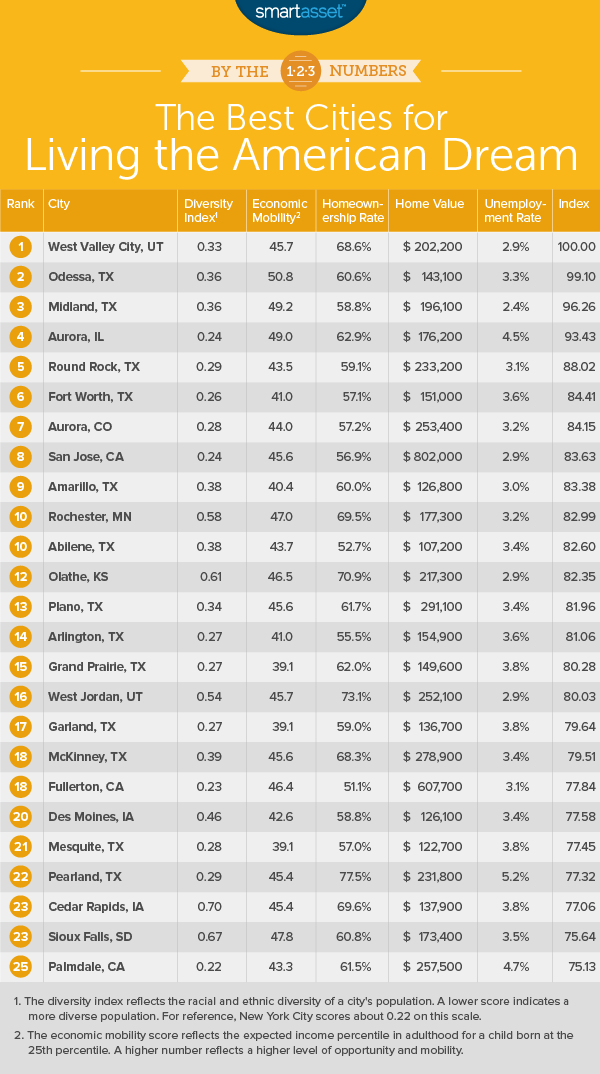
Best Cities for Living the American Dream

Diversity score. To create this statistic, we looked at the population percentage of different racial and ethnic groups in each city. A lower number represents more diversity. Data comes from the U.S. Census Bureau’s 2016 1-year American Community Survey.

Economic mobility. This metric looks at generational change in economic position for families. A higher number shows greater mobility. Data comes from The Equality of Opportunity Project.

Homeownership rate. This is the percent of households who own their home. Data comes from the Census Bureau’s 2016 1-year American Community Survey.

Home value. This is the median home value in every city. For this study, a lower home value is considered better as we use it as a measure of affordability. Data comes from the Census Bureau’s 1-year American Community Survey.

Unemployment rate. This is the unemployment rate by county. Data comes from the Bureau of Labor Statistics and is for January 2018.

Several quick thoughts:

  1. The five measures seem to make sense. You could quibble with different aspects, such as measuring the unemployment rate at the county level rather than the city or metropolitan region.
  2. What would make sense to add to this list of five measures? There is no measure of educational achievement on this list and it might be interesting to consider the foreign-born population in each place (particularly since the foreign-born population is at a high in American history). Do lower taxes matter?
  3. The list is skewed away from two areas: (a) the East and West coasts and (b) the biggest American cities. I would imagine the coastal cities have difficulty with home values. However, it is less obvious to me why the biggest cities, particularly those in the South and Midwest, do not make the top of these rankings.
  4. How many Americans would give up where they currently live to move to one of these places that supposedly offers a better chance at finding the American Dream? Some experts suggest Americans should simply go where there are opportunities, whether these are jobs, cheaper housing, or less taxes. Yet, it is not necessarily easy to just pick and go, particularly to places like these that might not be very well known. (And, it could also be the case that a large influx of people to each of these top-ranked locations would influence these places.)

City vs. suburbs in Nashville transit vote

An ambitious transit plan in the Nashville metropolitan area was roundly defeated by voters:

Had it passed, Let’s Move Nashville—the boldest municipal transit plan in recent memory—would have launched five light-rail lines, one downtown tunnel, four bus rapid transit lines, four new crosstown buses, and more than a dozen transit centers around the city. Depending on how you do the math, the scheme would have cost $5.4 billion or more like $9 billion, funded by a raft of boosted local taxes. More than 44,000 voters across Metro Nashville’s Davidson County came out in favor of the referendum, with more than 79,000 voting against it…

That’s a simplified version of the city’s politics, of course; while the vote fell broadly along urbanite versus suburbanite lines, a map reflecting the vote tally, and not just the vote result, would look more purplish. But not all that purplish. In the end, a vision for transforming transit in Nashville could not transform the politics of the city.

“There were a host of reasons [the proposal failed], like the cost ($9 billion), the scale (20 plus miles of light rail), the funding source (sales tax increase) and the financing structure (a decade of interest-only payments),” writes Emily Evans, managing director for healthcare policy for Hedgeye Potomac Research, in an email. Evans previously worked as a municipal financial analyst and served on the Nashville City Council for nine years.

A complicated plan like this has a lot of moving parts that voters could either support or vote against. At the same time, it can be a difficult sell for those outside the city core or in the suburbs to support mass transit plans that (1) they feel are not as necessary since they are able to drive where they need to go and (2) that might bring new people to their neighborhoods. When given a choice and their own personal resources, many Americans would prefer not to use mass transit, particularly if they would have to pay more for something they do not perceive helping them.

I would suggest this gets back to larger issues of whether regions really want to work together. Can cities and suburbs both thrive due to joint projects and shared resources? Or, is this a zero-sum game where resources can taken from one area and given to another in the same region is seen as a loss? The voters of Nashville remain to be convinced that mass transit is a big enough boon for themselves, let alone everyone.

Fallacy: if suburbs or a big city gain people, the other necessarily has to lose

The history of American metropolitan areas suggests that if a big city loses people, the suburbs gain people and vice versa. Yet, I argue this is an inadequate view of metropolitan regions. Consider a recent story on how the revival of downtown Detroit could harm its suburbs:

The failure of a few landmarks does not mean Detroit’s suburbs are doomed, but some local leaders see writing on the wall. Oakland County’s famously abrasive county executive, L. Brooks Patterson, has long taken a vocal pro-sprawl position, but even his government is making an effort to invest in the county’s handful of historic downtowns, via what’s touted as the “nation’s first and only county-wide Main Street program.” Archetypal suburbs like Troy are also getting in on the act. While it may be hard now to imagine walking along Troy’s main drag, a busy six-lane thoroughfare called Big Beaver Road, the city recently installed wider sidewalks, revised zoning to encourage taller buildings and multifamily housing, and took a stab at transit with a trolley-style shuttle bus.

“Everybody’s trying to create places in Southeast Michigan, which didn’t really have places before,” says Barry Murray, director of economic and community development for Dearborn, which borders Detroit to the southwest. “And there’s a lot of interest in diversified housing options, from young people who want to be in the hearts of downtowns.”

Dearborn, with a bustling commercial center of its own less than seven miles from Detroit’s, is in a better position to adapt to the changing times than most of its suburban peers. The city has been Ford’s hometown for the past century, and while a few thousand Ford workers might be moving down Michigan Avenue, the automaker is also spending more than $1 billion to reimagine its Dearborn headquarters along the lines of a Silicon Valley Tech Campus, and to create a new mixed-use development around Dearborn’s historic Wagner Hotel. Murray expects at least 1,000 new apartments to come online over the next few years—at present, he estimates, 90 percent of the city’s 38,000 housing units are detached single-family homes. Meanwhile, a declining mall where 1,800 Ford employees are temporarily occupying an old Lord & Taylor is “an active planning area,” Murray says. “We know these retailers are not going to be there forever.”

Southfield, just across Eight Mile Road from Detroit, could tell Dearborn a thing or two about disappearing retail—last year, it began tearing down Northland Center, the first shopping mall in America. Since Amazon turned down the city’s offer of the site for its second headquarters, Southfield is moving forward with a plan to crisscross the property with through streets and make way for offices, restaurants, apartments and a park—an effort to create a downtown in a city built without one. Says Mayor Kenson Siver, “We have a lot of plans here.”

This is a common approach to population changes: cities and suburbs are locked in a zero-sum mortal combat for residents. Suburbs have won this battle over time with over 50% of Americans living around major cities. (Hence, the countless stories in recent decades about a population migration to cities which will come at the expense of suburbs. I believe the data overall is limited regarding a major shift in American preferences for city life.)

I would suggest this view contains some truth – communities do compete with each other for prestige, jobs, their tax base, and residents – but also ignores the larger reality of how cities and suburbs work in today’s world. The metropolitan region is a connected unit and the communities and agents work together. The differences between suburbs and city are ultimately smaller than the differences with other metropolitan regions. If Detroit’s core attracts new businesses and residents, this can only be good in the long run. If Detroit is only able to attract businesses and residents from the suburbs, this is not real growth – it simply shuffling actors around within the region. When both Detroit’s suburbs and core bring in people from other regions, they can grow together and the metropolitan region (and all the people within it can thrive).

Of course, there are hurdles to coming to this perspective. Individual communities, city or suburbs, will not like if they lose assets and others around them gain. Racial and class differences lurk behind these current and historic differences. Money is tight. Ideally, suburban and urban leaders would come together to talk about how to proceed positively as a region. Going further, they could discuss how to share resources. (This is probably the toughest sell in American regions, particularly from wealthier communities who do not want to lose the resources they see as theirs.) But, working together for the greater Detroit area would pay off in the long run and help ensure a thriving region.

City landmarks, maps, and status

A Chicago group recently used a survey to look at how well big city residents know local landmarks:

According to a 360 Chicago spokesperson, the impetus for the survey was to “see how familiar residents in major cities across the U.S are with their hometowns, but also determine which cities have the type of stand-out landmarks that even outsiders can pick out on a map.”

The survey quizzed 2,000 residents from 10 cities, wherein every person was provided a list of 10 famous landmarks in their city and asked to ID those pinned on the map (five of the 10 listed were not pinned).

Some of the Chicago landmarks included were Robie House, Navy Pier, Second City, Merchandise Mart, the Art Institute and the 606 trail.

The Art Institute was the best known landmark, while the 606 stumped the most folks.

The data revealed Chicago residents were savvier at identifying Los Angeles landmarks than those in their own backyard. Not sure what that says about Chicagoans, but at least residents from other major metropolises in the country know the Chicago landscape more than their own towns — shout out to Houston and Seattle!

I do not know exactly how the survey was put together but three parts intrigue me:

  1. Landmarks are important for big cities, both for residents and possible visitors. For residents, they provide a sense of the character of the city. For visitors, they become perhaps the only thing they really know or have seen in the city. Either way, landmarks are anchors for millions of people. This could be seen as strange; could the Sears Tower or Empire State Building really represent the lives of millions of people?
  2. Putting landmarks on a map requires an extra set of knowledge. Landmark buildings and their images or silhouettes are all over the place. But, being able to place them in a particular context is much harder. Residents of a big city, let alone visitors, may have few opportunities to make it to other parts of the city.
  3. Landmarks are tied to the status of the city. I would guess larger and more important cities are likely to have more recognizable landmarks. For example, I could not likely pick out a single building or landmark from Houston even though it is the fourth largest city in the United States. Some of these landmarks become status symbols for the city. On the other hand, some buildings are just really unusual – think the Space Needle in Seattle or the Opera House in Sydney – and this could help put a particular city “on the map.”

The ongoing stark inequality of Chicago and other major cities

Alana Semuels discusses the inequality present in the global city of Chicago but it reminds me that (1)  sociologists have studied this for roughly 100 years even (2) as conditions have both changed and stayed the same.

The contrast between a seemingly prospering city and groups and individuals who cannot access this prosperity is an old theme in the Chicago School of urban sociology. In The Gold Coast and the Slum, Zorbaugh explains how some of the wealthiest and poorest Chicagoans can live in such proximity. Two neighborhoods that are geographically close are worlds apart socially. This is little different from descriptions of industrializing cities in England in the mid-1800s (which helped prompt the work of Marx and Engels) or examining today’s megacities in developing nations where a wealthy core is surrounded by slums and shantytowns.

The reasons for this disparity are both similar and different. Semuels sums up the two major issues:

Why are large swaths of Chicago’s population unable to get ahead? There are two main reasons. The first and most obvious is the legacy of segregation that has made it difficult for poor black families to gain access to the economic activity in other parts of the city. This segregation has meant that African Americans live near worse educational opportunities and fewer jobs than other people in Chicago. City leaders in Chicago have exacerbated this segregation over the years, according to Diamond, channeling money downtown and away from the poor neighborhoods. “Public policies played a huge role in reinforcing the walls around the ghetto,” he told me.

The second factor is the disappearance of industrial jobs in factories, steel plants, and logistics companies. Half a century ago, people with little education could find good jobs in the behemoths that dotted Chicago’s south and west sides. Now, most of those factories have moved overseas or to the suburbs, and there are fewer employment opportunities here for people without much education. Chicago underscores that it’s not just white, rural Americans who have been hard hit by the disappearance of manufacturing jobs.

The segregation of one hundred years ago is still with us, even if it has changed form (from overt discrimination to more covert means). The business district of Chicago was a thriving place 100 years ago as many of the poorer and less white neighborhoods languished. The job front has changed; yet, it is not as if the manufacturing jobs that started appearing in cities with the Industrial Revolution were all that helpful for the lower classes at the time (again think of Marx and Engels).

On the whole, it is helpful to regularly remind people of the complexities of cities. Cities should not be viewed solely as their impressive skylines or booming economies. Even the leading cities of the world are home to many less advantaged residents. Whether the gaps in cities themselves could go a long ways toward determining whether broader social inequalities can be successfully addressed.

Survey suggests women prefer suburbs more than men

A 2016 survey from mortgage company Lendinghome shows gender differences in which kind of places men and women would like to live:

According to Lendinghome, 54 percent of women want to live in the suburbs, while only 42 percent of men share that goal. Among women, 46 percent prefer established neighborhoods, while only 21 percent want an urban-like environment; for men those two options are nearly equally favored: 40 percent want an urban-like environment and 39 percent want an established neighborhood. One good thing about living in Chicago is that you can find neighborhoods that fit both criteria, said Julie Kim, realty agent with Century 21 in Lincolnwood. “One neighborhood I love showing to couples with this dilemma is Sauganash, which is still part of Chicago but gives that nice suburban pleasantville type of feel,” she said.

Lendinghome summarized the findings this way in May 2017:

Some couples may also struggle with different housing preferences based on gender and location. The data shows that women prefer traditional, cozy homes (48 percent) in the suburbs (54 percent), while men are more open to modern homes (48 percent) in urban-like settings (40 percent). Additionally, survey respondents from the West opted for city living (31 percent) more than those from the Midwest (8 percent).

Here is some speculation on why these differences might exist. The suburbs are often touted as the place that is better for kids because there is more space, the schools are better, and neighborhoods are safer. Since women are still often more responsible for the care of children, perhaps they prefer the suburbs because of their children. Additionally, many Americans see cities as less safe and women may feel this even more as they do not desire having to look out for their safety on a daily basis in the city.

In contrast, men have less responsibility for childcare or don’t think about this as much as being in their future and cities then offer more excitement. If they do think of the suburban life, some may see it as a trap: going to work for long periods bookended by significant commutes, having to keep up a yard, a lack of neighborhood activity, and a life revolving around the nuclear family with little chance for getting away.

I would guess that the preference for a suburban life goes up for both men and women with children but is lower both before couples have children and after those kids leave the house or become adults.


Comparing “Trickle-Down America” (urban) and “Stagnant America” (rural)

Recent comments from Hillary Clinton praising American “places that are optimistic, diverse, dynamic, moving forward” leads to this comparison between “trickle-down” and “stagnant” Americas:

Over the past 40 or so years, the U.S. has been fragmenting into two parallel societies, which I’ll call Trickle-Down America and Stagnant America. Each one looks upon the other with suspicion and hostility. Trickle-Down America is the America of our biggest metropolitan areas, and it is defined by comparatively high levels of density, diversity, and economic inequality. Importantly, the richest people in Trickle-Down America are typically white, while the service-sector workers who enable them to work longer hours are disproportionately brown and black. Stagnant America can be found in rural regions, small cities and towns, and outer suburbs across the country. This America is largely white and relatively equal, though it too is scarred by poverty, particularly among Hispanics and blacks. America’s most and least educated workers are concentrated in Trickle-Down America, while Stagnant America is home to most of America’s working- and middle-class white voters.

Is Trickle-Down America morally superior to Stagnant America? A good starting point is to reflect on the sources of Trickle-Down America’s wealth. In New York City, my hometown, the local economy has long been dominated by the financial-services sector, which has grown mightily in recent decades. Has the financialization of the U.S. economy been an unadulterated good for the country as a whole? There are many thoughtful people who’d argue otherwise. Indeed, some argue that rents flowing to the financial sector have badly distorted the U.S. economy, and have contributed to the devastation of tradeable sector employment in Stagnant America. Corporations headquartered in America’s cosmopolitan cities have profited immensely from the emergence of a globalized division of labor. Yet many of these same multinationals have pioneered tax-avoidance strategies that have made it harder for the federal government to compensate those who’ve lost out with globalization, all while deploying their considerable influence to get the U.S. government to pressure other countries to adopt intellectual-property protections that serve their interests. And then there is the federal government itself, and its vast, growing army of private administrative proxies—contractors, non-profits dependent on public subsidies, and the like—that has helped make Washington, D.C., and its environs one of the country’s most affluent and educated regions. It’s hard to disentangle exactly how much of Trickle-Down America’s success relative to Stagnant America is a product of straightforward rent-seeking. I certainly doubt that it accounts for all of it, or even most. But surely it accounts for some, and that should give Trickle-Down America’s champions pause.

One important thing to keep in mind is that Trickle-Down America is, overall, characterized by more stringent land-use limits than Stagnant America. These limits have raised housing costs in affluent coastal regions, which has redounded to the benefit of incumbent homeowners. Yet high housing costs have deterred inward domestic migration while driving out large numbers of working-and middle-class residents…

For now, though, Trickle-Down America’s affluent professionals find themselves in a sweet spot, which surely accounts for some of Clinton’s triumphalism. The food is better. Beautiful old houses are being renovated everywhere you turn. An abundance of low-wage immigrant labor adds diversity and dynamism to cosmopolitan cities, yet the noncitizen working class isn’t in a position to press for a more egalitarian social order—one that could prove discomfiting for local elites. Best of all, opposition to Trump is helping to obscure simmering discontent over Trickle-Down America’s business model.

This is a different way of categorizing the stark urban and rural political divides of recent years. Yet, it also highlights a key issue simmering within the leading cities and metropolitan areas that are so important to American life: who really benefits in the major cities? Are the high levels of innovation, growth, development, and cultural excitement accessible to all urban residents or do the spoils disproportionately go to the top?Inequality cuts across multiple strata of society. Certainly there are stark differences within cities as well as between urban and rural areas. I’ll add a third area that complicates the story above (though these are likely lumped in with the Trickle-Down America segment): the inequality present in American suburbs. Even as the majority of Americans live in suburbs and seem to have achieved the American Dream of suburban life, life outcomes can differ dramatically across suburban communities.

What makes this suburban inequality more interesting for the realm of politics is how is affects voting: areas generally closer to the big city or with demographics more like the big city vote Democrat and wealthier communities and areas further out in regions vote Republicans. Will these same sort of voting cleavages arise in rural areas in cities as various inequalities receive more attention?

Fighting harder against gentrification

Activists in Los Angeles and a few other cities are ramping up their efforts to fend off gentrification:

That’s because it was organized by Defend Boyle Heights, a coalition of scorched-earth young activists from the surrounding neighborhood — the heart of Mexican-American L.A. — who have rejected the old, peaceful forms of resistance (discussion, dialogue, policy proposals) and decided that the only sensible response is to attack and hopefully frighten off the sorts of art galleries, craft breweries and single-origin coffee shops that tend to pave the way for more powerful invaders: the real estate agents, developers and bankers whose arrival typically mark a neighborhood’s point of no return…

By “making s*** crack” — by boycotting, protesting, disrupting, threatening and shouting in the streets — Defend Boyle Heights and its allies have notched a series of surprising victories over the past two and a half years, even as the forces of gentrification continue to make inroads in the neighborhood. A gallery closed its doors after its “staff and artists were routinely trolled online and harassed in person.” An experimental street opera was shut down after members of the Roosevelt High School band — egged on by a group of activists — used saxophones, trombones and trumpets to drown it out. A real estate bike tour promising clients access to a “charming, historic, walkable and bikeable neighborhood” was scrapped after the agent reported threats of violence. “I can’t help but hope that your 60-minute bike ride is a total disaster and that everyone who eats your artisanal treats pukes immediately,” said one message. The national (and international) media descended, with many outlets flocking to Weird Wave Coffee, a hip new shop that was immediately targeted by activists after opening last summer….

These harsh realities aren’t lost on millennials of color — especially young men and women from gentrifying neighborhoods, where such inequities tend to be on vivid, daily display. To that end, a 2016 Harvard Institute of Politics poll found that only 42 percent of 18-to-29-year-olds now support capitalism; a third now identify as socialists. Among those who backed Hillary Clinton’s presidential candidacy, the number was even higher — a full 54 percent — and minorities and people without a college degree were more likely to support socialism as well…

“We are devoting our time to building a national movement against gentrification,” they wrote in a February blog post titled “Defending Boyle Heights and f***ing s*** up: A 2017 summation and report back from our Hood Solidarity tour.” “Boyle Heights has … become a beacon of hope for other communities facing similar threats. … We are hopeful that in the coming years, with the effort necessary to sustain a movement, poor and working-class people can escalate the class war against gentrification and actually hinder and possibly reverse its effects.”

As the article notes, gentrification is not new but reactions to it have changed over time. Most major cities are beholden to development and have been for decades: development and growth is good, particularly when it is taking place in neighborhoods that have seen better days (think of older urban renewal programs), and politicians and developers can have a symbiotic relationship. Yet, this development often does not help poorer residents who even if they are not pushed out of the neighborhood do benefit in the same ways as developers and politicians.

A few ongoing questions about these efforts:

  1. Do more strident responses to gentrification then allow more negotiation to take place about the future of neighborhoods?
  2. At what point do cities, developers, and business owners push back harder against such protests?
  3. Can protests like these slow or stop gentrification? Can they prompt a larger spirit against gentrification in the community?

Something to keep watching.

Social change through a bureaucratic manual

Producing a manual may not seem like an effective pathway to social change but it can help in certain areas, such as new standards for bicycling in American cities:

To codify their emerging practice, they turned to the National Association of City Transportation Officials (NACTO). NACTO had been formed in 1996 as a forum for big-city transportation planners to swap ideas, but it had never published a design guide before. That became one of its top priorities after Sadik-Khan was named president of the organization. For several months beginning in 2010, a group of 40 consultants and city transportation planners reviewed bike-lane designs from around the world and across the United States.

The result was NACTO’s Urban Bikeway Design Guide, the first national design standard for protected bike lanes. Like other standards, it answers the questions of space, time, and information that are at the heart of street design. How wide should a protected bike lane be? At least five feet, but ideally seven. How does one mix bike lanes and bus stops? Send the lane behind the bus stop, with enough space for bus riders to comfortably board and get off the bus. What about when bike lanes and turn lanes meet? Give bikes their own exclusive signals, or create “mixing zones,” shared spaces where people in cars and on bikes take turns entering the space…

The publication of the NACTO bikeway guide didn’t directly result in the creation of any new bike lanes. But the planners and engineers who wrote it recognized that for each of them to further progress in their own city, they had to collaborate on standards that would enable progress in any city.

As it turns out, the Urban Bikeway Design Guide was just the beginning. NACTO later released the more comprehensive Urban Street Design Guide, a broader effort to push back against America’s car-first road designs and define streets that support urban life, with narrow lanes that encourage reasonable driving speeds and traffic signals that give people plenty of time to cross the street. More recently, the organization has published guides on designing streets to speed up public transit, and incorporate storm-water infrastructure.

It sounds like the manual was the culmination of collective efforts in multiple cities as well as the form that would be recognized in that particular field (urban planning). But, it hints at larger issues involving social change: it can happen through a variety of materials and people. If I were to teach about social change in an Introduction to Sociology class, we might talk about (1) large-scale social movements or (2) significant shifts in large institutions (like the economy or politics). We acknowledge material changes here and there: think the revolution of the printing press, the arrival of social media or smartphones, the invention of air conditioning, etc. Yet, bureaucratic changes (except national laws) receive little attention even though such shifts can influence many people without even knowing. Take the bike lanes example from above: the average city resident may notice the shift but would probably attribute the change to either local officials or local interest groups (and both would be partly true). But, the manual behind the changes will only be known to experts in that field.

The difficulty of changing corporate names on significant urban buildings

The Hancock may soon officially be no more in Chicago but that does not mean the name will disappear from use, including by architecture critics like Blair Kamin:

But names still matter. “Willis Tower” has never felt right. It’s foreign — literally. At the height of the Great Recession, with Sears Tower’s owners desperate to lure tenants, a British reinsurance company swept in and cut an office lease deal that gave it naming rights. Lots of people, including Mayor Rahm Emanuel, would rather that the modernist high-rise continue to be called Sears…

The eclectic Wrigley Building, thank goodness, is still the Wrigley Building, even though its namesake company no longer occupies it. The building’s whiteness was meant to symbolize the freshness of chewing gum. The architecture and the name were part of a single, organic package, just as they were in New York’s Art Deco Chrysler Building, where eagle gargoyles adorned the building like Chrysler hood ornaments…

But as I’ve written in recent weeks, pondering the Chicago Tribune’s impending move from Tribune Tower to the old Prudential Building (now One Prudential Plaza), buildings are commodities subject to the dictates of the marketplace; expecting them to stay frozen in time is unrealistic. The same goes for their names.

That’s why Boston’s John Hancock Tower, a 62-story glass-sheathed high-rise that is as elegant as Chicago’s Hancock is brawny, became known in 2015 by its street address — 200 Clarendon. When the lease of the John Hancock company expired, the tower’s owner no longer was allowed to use the Hancock name. The new name hasn’t exactly caught on with the locals.

Three things strike me here:

  1. Iconic structures are more likely to retain their original names even when later changes dictate the official name is something else. What makes those buildings iconic can differ: it may have been occupied by an important local company or it may have unique architectural features. The buildings cited above in Chicago have both things going for them.
  2. It is a little strange for locals to cling so strongly to corporate identities in the names of buildings. Would it be better to instead name major structures after something other than the company behind it? An address may be rather bland but perhaps the name could be connected to the particular architecture and design or tied to a famous figure, moment in history, or feature of the location.
  3. Perhaps the deeper issue is connecting buildings to history. If naming rights are simply up for grabs, prominent locations can change their identity regularly. Not only might this be disorienting to locals, it can remove the structure from its creation and its place within a city. The issue may not be naming rights but rather making sure that buildings are defined by locals rather than by out-of-towners or global interest.

I suspect residents of Chicago will be calling the structure the Hancock for years to come.