Blame drivers for 94% of crashes or find fault in the larger system

Are drivers responsible for 94% of accidents? That is just one way to look at the issue:

Photo by Artyom Kulakov on Pexels.com

In 2015, the National Highway Traffic Safety Administration, a branch of the U.S. Department of Transportation, published a two-page memo declaring that “the critical reason, which is the last event in the crash causal chain, was assigned to the driver in 94% of the crashes.” The memo, which was based on the NHTSA’s own analysis of crashes, then offered a key caveat: “Although the critical reason is an important part of the description of events leading up to the crash, it is not intended to be interpreted as the cause of the crash.”…

Seeking to find a single cause for a crash is a fundamentally flawed approach to road safety, but it underpins much of American traffic enforcement and crash prevention. After a collision, police file a report, noting who violated traffic laws and generally ignoring factors like road and vehicle design. Insurance companies, too, are structured to hold someone accountable. Drivers aren’t the only ones who face such judgments. Following a crash, a pedestrian might be blamed for crossing a street where there is no crosswalk (even if the nearest one is a quarter mile away), and a cyclist might be cited for not wearing a helmet (although a protected bike lane would have prevented the crash entirely). News stories reinforce these narratives, with stories limited to the driver who was speeding or the pedestrian who crossed against the light…

With responsibility falling on those directly involved in a crash, it’s unsurprising that so many highway-safety efforts revolve around education campaigns, assuming that if people were just more careful, we’d all be okay. Officials at the NHTSA and state DOTs pour millions of dollars into these programs, but their benefits seem modest at best. Officials “see their role as trying to cajole people on the roads to make smarter decisions,” Seth LaJeunesse, a senior research associate at the University of North Carolina’s Highway Safety Research Center, told me. “Wear a seat belt, don’t be drunk when driving, and signal appropriately. I think it’s misguided. After all, who’s going to address structural problems, if it’s just people being stupid out there on the road?”…

With the infrastructure bill now signed into law, the federal government has a chance to rethink its approach and messaging. Dumping the dangerous 94 percent myth would be a good start; deemphasizing pointless traffic-safety PR campaigns would help too. Encouraging state and local transportation agencies—not just law enforcement—to investigate crashes, which New York City is now doing, would be even better. What we need most is a reexamination of how carmakers, traffic engineers, and community members—as well as the traveling public—together bear responsibility for saving some of the thousands of lives lost annually on American roadways. Blaming human error alone is convenient, but it places all Americans in greater danger.

Put together a society based around driving and a cultural emphasis on individualism and you have this situation. Is the individual operator responsible or a system that puts people in large vehicles traveling at fast speeds?

It is less clear from this piece how to view the system as a whole in order to improve the safety of roads. There are a lot of pieces that different actors have highlighted over the years. Fewer vehicles on the road? More room for pedestrians and bicyclists? More safety features in vehicles? Lower speeds? All of these could help but they would each threaten the current system which attempts to move as many vehicles as quickly as possible.

The approach many government and business actors seem to take at the moment toward this are attempts at incremental progress. Who would put all of these pieces together in a short amount of time, especially if individual drivers are willing to take responsibility? Americans seem fairly content with traffic fatalities and pedestrian deaths.

Wrestling with the ongoing – and increasing – numbers of pedestrian deaths in the United States

After a pedestrian death in her neighborhood, one writer considers the issue in the United States:

Photo by Josh Hild on Pexels.com

My neighborhood isn’t unique. So far this year, 15 pedestrians have been killed by drivers in the nation’s capital, and total traffic fatalities are up to 37-the highest number since 2008. This is all despite Mayor Muriel Bowser’s goal to end traffic deaths by 2024 as part of the Vision Zero program signed on to by leaders of D.C. and other major U.S. cities. The District Department of Transportation has made some changes to protect walkers and cyclists, such as reducing speed limits and installing more bike lanes. Ironically, total traffic fatalities have increased steadily since the program began.

The same trend is reflected in cities across America. Part of the increase in pedestrian deaths is probably because our vehicles are bigger than ever. “Our pickup trucks and SUVs are gigantic compared to the sizes they used to be,” giving drivers less visibility and a greater sense of security, which makes them more aggressive on the road, says Rohit Aggarwala, a fellow at the urban Tech Hub at Cornell Tech and the former director of long-term planning and sustainability for New York City. During the pandemic’s early days, as fewer Americans drove to work or school, it seemed safe to assume that fewer pedestrians would die Instead, fatalities have jumped. Conclusive research isn’t out yet, but the increase is likely at least in part due to a drop in traffic congestion and an ensuing increase in speed: “People were still walking around their neighborhoods during lockdown, and you had a [small] number of people on the streets driving very, very fast,” Aggarwala told me. Older adults, people walking in low-income areas, and Black and Native Americans are all overrepresented in pedestrian-death statistics.

Most pedestrian deaths are preventable, and experts believe that the solutions are straightforward. Aggarwala and his team at Cornell Tech are pushing for three major changes to America’s driving infrastructure: more robust traffic-camera enforcement, to capture not just speeding but all kinds of moving violations; road redesign that would decrease lane size and add speed bumps to nudge drivers to slow down; and finally, upping the standards for vehicle safety. Car manufacturers in Europe are required to test cars for pedestrian impact; they design hoods to slope downward so that drivers can see anyone who might wander into the road. American automakers could do the same, or add pedestrian-detection systems or speed limiters to cars. Many of these changes would not only make roads safer for pedestrians but also could reduce police violence at the same time. “The U.S. hasn’t considered any of this,” Aggarwala said. “We have a tradition of focusing on vehicle safety as only being about the occupant.”

This is an ongoing issue as long as roads are primarily for cars and vehicles. The priority for decades in the United States has been to make roads optimal for vehicles. Pedestrians and other street level activity is, on the whole, not as important.

When I read this, I thought about the efforts to include equipment in all new cars that would test to see if the drivers was driving impaired. How did this come about? Drunk driving has been a recognized issue for years with organized groups making sure it was on the public’s radar screen. Is a social movement against pedestrian deaths and promoting pedestrian safety necessary to make significant changes? The solutions might be straightforward but the political and societal will is lacking.

Driving down, traffic deaths up in Illinois and across the US

Usually traffic deaths decrease when people drive less. This has not been the case in Illinois or the United States as a whole in the last year:

Photo by Steven Arenas on Pexels.com

About 1,166 people died in motor vehicle crashes in Illinois in 2020, a nearly 16% increase over 2019, according to the Illinois Department of Transportation. That’s a provisional number, said IDOT spokesperson Guy Tridgell, since it takes the state agency 12-18 months to finalize annual data…

Speeding and traffic fatalities typically go down during recessions, according to an October study published by the National Highway Traffic Safety Administration. In Illinois, for example, deaths dipped sharply in 2008 and 2009 according to state data, though they’ve been up slightly since…

About 28,190 people died in crashes from January to September 2020, more than a thousand more fatalities than in the same period in 2019, the federal agency estimated. A full annual report is expected to be released in the late fall…

What’s more, traffic deaths nationally were down from March to May, but jumped back up after states began reopening in June, according to the agency’s estimates.

This suggests safety is not solely a function of the number of miles driven or trips taken. How people drive and the conditions matter quite a bit. In this case, the article hints at multiple possible reasons for this jump. This includes speeding, more impaired drivers, and less seat belt use among those hurt.

I wonder if there are several other factors at play. With many public and private locations shut down, did driving become an even more important escape for some Americans? With limited places to go, driving and doing so dangerously could be a kind of release not available elsewhere.

Second, is there a safety feature to a certain level of traffic? With fewer people out, does this encourage riskier driving compared to having to navigate more vehicles on the road? Too many cars likely leads to more accidents but what about too few compared to typical conditions?

Still looking for helpful numerical comparisons to make sense of COVID-19 deaths

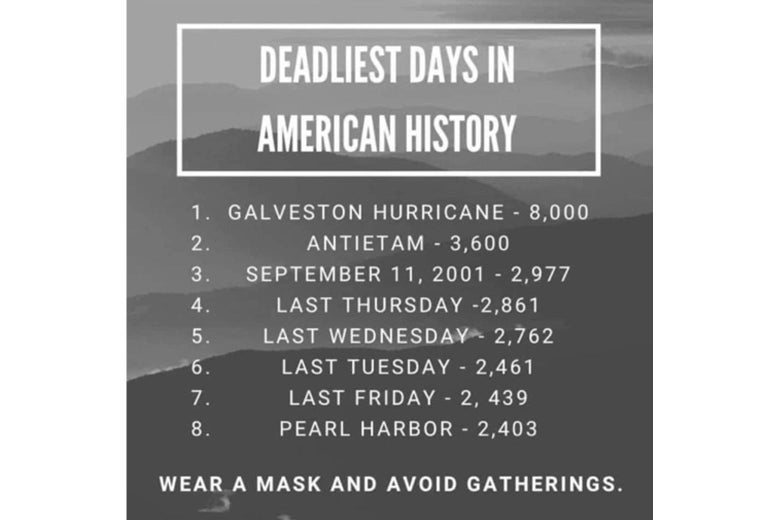
A list of the most deaths on a single day has been making the social media rounds. Titled “The Deadliest Days in American History,” spots #4-7 are recent days with COVID-19 deaths following the Galveston Hurricane, the battle of Antietam, and September 11, 2001. But, the numbers on the list are not what they seem:

An infographic listing the "Deadliest Days in American History."
I first saw the image on Facebook.

For one thing, a list of the “deadliest days” in American history would include days with the most deaths, not the most deaths from one discrete event. On all of the days included, more people in the United States died than the numbers listed. According to Reuters, 2,861 COVID-19 deaths were indeed reported last Thursday. But that doesn’t account for the number of people who died from heart disease (last week’s daily average was 1,532 deaths), lung and tracheal cancer (last week’s daily average was about 560 deaths), or chronic kidney disease (last week’s daily average was about 290 deaths). Deaths from drug overdoses have also been reaching record highs this year, a trend that may have been worsened by the pandemic. (Obviously, more people died on the days of the Galveston hurricane, the Battle of Antietam, 9/11, and Pearl Harbor, too.)

By its own rules, the list is also incomplete. More than 3,000 people died in the 1906 San Francisco earthquake, which isn’t mentioned, nor is the 1899 San Ciriaco hurricane, which killed more than 3,300 people in Puerto Rico over the course of six to nine hours. While we’re at it, the population of the United States is much larger now. The U.S. was home to about one-tenth of the current population during the Battle of Antietam. Losing 3,600 people back then would be like losing 36,000 people now.

But yes, the general idea behind this list—and other attempts to communicate the horrors of the pandemic as a set of digestible facts—is worthwhile. It can be helpful to compare the number of deaths specifically from the coronavirus to other historical events in which there were huge losses of American life. More than 286,000 people in the U.S. have died from COVID-19 thus far. Compare that to the 116,000 Americans who died in World War I; 405,000 Americans who died in World War II; 37,000 Americans who died in the Korean War; and 58,000 Americans who died in the Vietnam War. The 1918 flu pandemic killed 675,000 Americans, the 1968 influenza A pandemic killed 100,000 Americans, and the 2009 H1N1 pandemic killed 12,469 Americans.

The general idea may be a good one: similar numbers reported day after day lose their power. It can be hard for the general public to interpret large numbers in the abstract, as this earlier post about comparing an earlier death figure from COVID-19 to my community’s population. The list tries to place the daily death totals in historical context by noting that these are not just normal numbers; they are high numbers for any day in American history.

Yet, as noted above, the numbers do not quite work out. Perhaps the list should have a new title like “Days with the most deaths directly attributable to unusual causes” since it ignores all causes of death on particular days. And even then, other natural disasters are ignored and putting the numbers in a different context – as a percent of the population as a whole – also changes the list.

The list might still spur people to action, even if the list has flaws. And this was probably the goal of the list in the first place: it is not meant to be an academic study on the topic but a call to action. Like many statistics, these numbers are used in a way intended to nudge people toward different behavior.

Interpreting data: the COVID-19 deaths in the United States roughly match the population of my mid-sized suburb

Understanding big numbers can be difficult. This is particularly true in a large country like the United States – over 330,000,000 residents – with a variety of contexts. Debates over COVID-19 numbers have been sharp as different approaches appeal to different numbers. To some degree, many potential social problems or public issues face this issue: how to use numbers (and other evidence) to convince people that action needs to be taken.

This week, the number of deaths in the United States due to COVID-19 approached the population of my suburban community of just over 53,000 residents. We are a mid-sized suburb; this is the second largest community in our county, the most populous suburban county in the Chicago region outside of Cook County. The community covers just over 11 square miles. Imagining an entire mid-sized suburb of COVID-19 deaths gives one pause. I had heard the comparison a week or two ago to the deaths matching the size of a good-sized indoor arena; thinking of an entire sizable community helps make sense of the number of deaths across the country.

Of course, there are other numbers to cite. Our community has relatively few cases – less than hundred as of a few days ago. Considering the Chicago suburbs: “If the Chicago suburbs were a state, it would have the 11th-highest COVID-19 death toll in the nation.” The COVID-19 cases and deaths are scattered throughout the United States, with clear hotspots in some places like New York City and fewer cases in other places. And so on.

Perhaps all of this means that we need medical experts alongside data experts in times like these. We need people well-versed in statistics and their implications to help inform the public and policymakers. Numbers are interpreted and used as part of arguments. Having a handle on the broad range of data, the different ways it can be interpreted (including what comparisons are useful to make), connecting the numbers to particular actions and policies, and communicating all of this clearly is a valuable skill set that can serve communities well.


A nation beholden to cars: a record number of pedestrians die in US in 2019

A new report highlights the dangers to pedestrians in the United States:

Based on data from the first six months of 2019, the Governors Highway Safety Association predicts there were 6,590 pedestrian deaths that year, which would be a 5 percent increase over the 6,227 pedestrian deaths in 2018.

The 2019 figure is the highest number of such deaths in more than 30 years, according to the association…

While there’s been a significant increase in pedestrian deaths over the past decade, the number of all other traffic deaths increased by only 2 percent…

“Following 30 years of declining pedestrian fatalities, there has been a complete reversal of progress,” Retting said in the release. “Pedestrians are at an inherent disadvantage in collisions, and we must continue to take a broad approach to pedestrian safety.”

While there are particular aspects of driving and pedestrian behavior that could be debated and addressed, there is a larger point that can be made with such data: the priority on American roadways goes to vehicles. This has been the case for decades and will continue to be the case for years to come. While efforts to make streets more amenable to walkers and bikers, these efforts are often limited to only a few areas. The goal of roadways in many places, included dense, populated areas, is to move as many vehicles as quickly as possible to where drivers want to go.  Tackling specific issues may help reduce the number of deaths but still leave the larger problem: Americans like cars and driving and our lives are often organized around driving.

The case for a social problem: over 49,000 pedestrian deaths in the US 2008-2017

A new report addresses pedestrian deaths in the United States:

Harrowing data showed that between 2008 and 2017 the number of annual pedestrian deaths in the U.S. increased by 35.7 percent. A total of 49,340 died in that 10-year period. That’s more than 13 people killed per day or one person every hour and 46 minutes…

“Why is this happening?” authors of the report asked. “We’re not walking more and we’re only driving slightly more than we were back in 2008. What is happening is that our streets, which we designed for the movement of vehicles, haven’t changed. In fact, we are continuing to design streets that are dangerous for all people.”

Federal and state transportation policies, blueprints and funding are stuck in the age of the automobile, when sprawling growth patterns — especially in the Sun Belt — led to wider roads, longer blocks and street engineering that prioritized high speeds for cars over safety for people on foot, on bikes or using mass transit, the report says.

Among the victims, death rates are disproportionately high for the elderly, minorities and people walking in poor communities, data showed. Older adults are more often struck at an intersection or in a crosswalk than younger victims. In San Francisco, Pittsburgh and Milwaukee, residents organized marches, flash mobs and 20-second performances in crosswalks to campaign for longer signal times for elderly and disabled people.

The numbers are likely shocking for many readers: that many people died over a 10 year stretch from walking? The cause for many a social problem is advanced by such figures which reveal to the average person the scope of an issue they rarely consider.

But, put those figures next to those that died in car accidents and they pale in comparison. Are the two numbers combined – both primarily the result of an automobile dependent culture – more valuable? Or, are they simply what Americans are willing to do for the sake of driving?

To me, the next step is to ask what it would take to reach a critical mass of Americans to push against a car dominated society and press for better options for pedestrians and other non-vehicles on streets and roads. This is not an easy task; diverting resources and attention away from roads and highways is difficult.

Explaining why traffic deaths are up 46% since 2009

In 2016, 5,987 American pedestrians were killed. Why so many?

Distraction behind the wheel, texting while walking and even marijuana legalization have all been tagged as potential culprits in past research.

In addition, a new study released Tuesday by the Insurance Institute for Highway Safety shows an 81% increase in single-vehicle pedestrian fatalities involving SUVs between 2009 and 2016, based on federal records…

The USA Today Network is investigating the phenomenon of rising pedestrian fatalities, an urban problem primarily plaguing either cities with high poverty rates or warm-weather spots such as Florida and Arizona. Our analysis so far has found that African Americans are killed at a disproportionate rate compared with their population nationwide.

Nationally, more pedestrians die in collisions when they are jaywalking along busy arterial roads. More of those fatalities also occur at night and involve males. Many of these crashes also involve alcohol, though federal safety researchers say that does not explain the increase. In 2016, pedestrians accounted for 16% of traffic deaths; in 2007, that figure was just 11%, according to NHTSA.

I am a little surprised to see that increased driving is not cited here. While driving dipped during the economic crisis, it is up to record levels in recent years.

While the emphasis here is on the upward trend in recent years, the numbers overall are a reminder of the consequences of such a strong emphasis on driving in American society. Roadways are built primarily for cars. Even when there is infrastructure for pedestrians and other non motor vehicles, it can be daunting to not be a car. Countering this could require extensive marketing campaigns; this article discusses efforts in several large cities. But, a significant change in favor of non-vehicles would truly require not just publicity but redesign and the reshaping of lifestyles.


Traffic deaths increased in 2016

Explaining the rise in traffic deaths in the last two years may be difficult to explain:

Cars may be safer than ever, but 37,461 people died on American roads that year, a 5.6 percent hike over 2015. While fatalities have dramatically declined in recent decades, this is the second straight year the number has risen. It’s too early to say why, exactly, this is happening. Researchers will need much more time with the data to figure that out. But here’s a hypothesis: It’s the economy, (crash) dummy.

“People drive more in a good economy,” says Chuck Farmer, who oversees research at the Insurance Institute for Highway Safety. “They drive to different places and for different reasons. There’s a difference between going out to a party in the middle of the night in an unfamiliar area and driving to work—that nighttime driving to a party is more risky.”…

Researchers have long known that driving deaths rise and dive with the economy and income growth. People with jobs have more reason to be on the road than the unemployed. But this increase can’t be pinned on the fact of more driving, the stats indicate. Even adjusted for miles traveled, fatalities have ticked up by 2.6 percent over 2015. You can still blame the economy, because people aren’t just driving more. They’re driving differently. Better economic condition give them the flexibility to drive for social reasons. There might be more bar visits (and drinking) and trips along unfamiliar roads (with extra time spent looking at a map on a phone).

The DOT numbers seem to confirm that drivers involved in traffic deaths were doing different things behind the wheel last year. The feds say the number people who died while not wearing seat belts climbed 4.6 percent, and that drunk driving fatalities rose 1.7 percent. Contrary to what you might expect, the numbers show distracted driving deaths dropped slightly, but experts caution against putting too much faith in such info. The numbers are based on police reports. They’re reflections of what cops are seeing at crash sites, but also of what’s in the zeitgeist at the time. It could be that first responders weren’t, for example, looking out for distracted driving last year because it wasn’t in the news as often.

Official statistics do not provide all the information we might want. In this case, the figure of interest to many will simply be the total number of deaths. Is an increase over two years enough to prompt rapid action? If so, I would imagine the regulatory structures regarding driverless cars might attract some attention. Or, do car deaths continue to be the costs we pay for having lifestyles built around driving?

In one decade, major suburban areas go from lowest drug overdose rates to highest

A new report details the rise of drug overdose deaths in suburbs:

Released Wednesday, the Robert Wood Johnson Foundation’s 2017 County Health Rankings and an accompanying report analyze county-level data from all 50 states on more than 30 public health outcomes and behaviors. The report finds there’s been a clear flip in the geography of addiction: One decade ago, large suburban areas experienced the lowest rates of premature deaths due to drug overdoses. In 2015, they had the highest.

The Johnson Foundation’s analysis doesn’t pinpoint which counties experienced the most dramatic gains in drug-induced death. What it does is rank every county in the U.S., by state, using data that reflects local health conditions, such as diabetes and obesity, as well as measures that can predict health outcomes, including teen birth, smoking rates, and grocery store access…

Comparing those numbers to the Johnson Foundation report, I found startling disconnects between deadly drug problems and places that have an otherwise fairly “healthy” facade. For example, Essex County ranks sixth out of the 14 counties in the Bay State by the new report—middle-of-the-road when it comes to the chronic health conditions that normally wave red flags for public health researchers. Yet it’s increasingly afflicted by drug-related deaths.

On the fringes of Cincinnati, Boone County, Kentucky, ranks first out of 120 across its state on all other health rankings. As in Essex County, rates of diabetes, smoking, and teen births are relatively low; poverty is suppressed, and employment is solid. Yet a look at CDC data shows county saw its drug-related death rate leap from 26 in 2010 to nearly 46 in 2015. Ranked smack in the middle of Ohio’s 88 counties and also included in the Cincinnati metro area, Clermont County saw a similar leap. Another example: Clay County, part of the Jacksonville, Florida, metro area, is 11th of the Sunshine State’s 67 counties. But drug-related deaths increased from 14 in 2010 to 23 in 2015.

It has been interesting thus far and it will continue to be interesting to observe how this is treated by the media, government, and public. This would be a good case for studying how a social problem develops: American society is so large that not everything can receive the attention it deserves. For example, how do the reactions to suburban drugs differ to how Americans treat drug use in cities (or rural areas which rarely get any attention)? How is the drug use explained: as part of criminal activity, irresponsibility, broken down homes and/or neighborhoods, wealth, or addiction? Because these deaths are happening to suburbanites – who as this article notes, are supposed to be healthier and often are – the story will be different.