“McMansions are the largest physical boomer legacy soon inherited by their children”

A Connecticut architect considers the McMansion legacy left by a generation of homeowners and builders:

Skyscrapers are the image of New York. The White House is more America than a home. And McMansions have become a punchline. When I sought to find land in 1982, a broker pushed a building lot in a McMansion development, pushing its allure by flatly asserting, “We’re talking about some seriously beautiful homes here.”…

Time has not been kind to we boomers. We basically tanked the entire world’s economy with “irrational exuberance” that found its most publicly grotesque distortion in those McMansions. Make no mistake millions of less-than-McMansions had more distortional impact on the credit markets than the hundreds of thousands of McMansion, let alone the one-off attempts by individuals who try to buy social legitimacy by building large homes — the real mansions…

McMansions are the largest physical boomer legacy soon inherited by their children, the millennials, who have had the worst economic birthing since the Great Depression. Kate Wagner was barely in her 20s when she called out the final fruits of 40 years of serial housing booms that afflicted America. But the impact of in-your-face domestic chest-beating is especially present in Connecticut, which realtor.com trumpeted as having the “metro” with the third most McMansions in the country. And that impact was doubled down by the added insult of unending instant “tear-downs” of those homes built in the previous generation in the tight Northeast.

As an architect I have remade any number of these instantly dated ego vehicles. We have also revived any number of raised ranches, garrison colonials and Capes. Often those homes need strategic expansion. But with McMansions, removal of the offending detail and pretense is often the first remediation.

I like the idea that a social group – here the emphasis is on Baby Boomers – can leave a physical legacy for later members of the same society. People do not just pass down values, norms, and behaviors; they also leave a physical landscape and places that they have made and shaped. Even though we do not focus much on this in the United States, these places shape us and also provide inertia for what future residents will experience. McMansions have the potential to influence millions of lives even as the original designers, builders, and residents may no longer be present.

At the same time, I wonder how obvious the excesses of the McMansion were while they were being constructed in large numbers. It is relatively easy today to look at them with disdain or wonder at what prompted them. A blog like McMansion Hell has the benefits of hindsight as well as new eyes from a younger resident from a different generation. Did this architect call out McMansions back in the 1990s when wealthy Connecticut communities built them in large numbers? My own research suggests the tide starts to turn against McMansions in the early to mid 2000s as consistent critiques of their architecture and consumption arise as well as there are enough of them in communities across the United States to see them as a single phenomenon.

Going forward, I don’t think McMansions will disappear. There is plenty of money to be made in McMansions compared to building smaller housing units. It is not clear that all millennials or future homebuyers will see them as homes to be avoided. And many of the McMansions critics say are poorly built and designed will last for decades.
Building a 1,000+ foot skyscraper in a rural town of 7,000 residents

Skyscrapers and cities are tightly linked. Can one be built in a small town in the countryside?

Until a local company announced plans to send a 320-metre skyscraper soaring over the surrounding countryside, most people in Denmark had only the haziest idea where Brande, a town of 7,000 people in rural Jutland, even was.

The Bestseller Tower, designed by star architectural studio Dorte Mandrup, will not only be the tallest building in Denmark, but the tallest in western Europe, besting the Shard in London by a crucial 10.4 metres…

It won’t be the first rural skyscraper. At the height of Japan’s property bubble back in 1991, a 41-story residential tower, Sky Tower 41, was erected among fields.

But in Jutland, the surrounding landscape is so flat that the tower will be visible from 60km away. Visitors to Jelling, the royal seat of Harald Bluetooth, the Viking king who united Denmark, will see its slender form jutting up from the horizon, as will visitors to Legoland 30km away.

While the article suggests it will not be the only rural skyscraper in the world, they are certainly rare. They are rare enough outside of sizable central business districts that numerous tall buildings in the Chicago suburbs – probably in the 20 to 30 stories in height – attract attention as unusual and sticking out in the landscape in a metropolitan region that takes pride in its tall buildings and architecture.

It is certainly possible to build such a structure almost anywhere but I wonder how this will all work out in day-to-day life in this community. Small towns and rural areas have a particular scale that people are used to and that is human scaled or even dominated by nature and landscapes rather than human creations. Constructing a building over a 1,000 square feet disrupts all of this: it will be visible for miles, it will dwarf anything nearby, and it will cast shadows and block the sun from certain angles. It is not slightly out of scale for this community; it is a massive change. It could be beautiful, modern, and efficient and still have negative consequences for the community.


The bigger and feature-filled “New American Home”

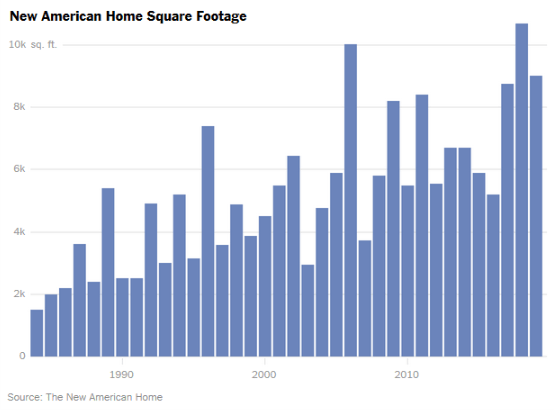
What the National Association of Home Builders displays as the “New American Home” just keeps getting bigger and bigger:

The first New American Home that N.A.H.B. built, in Houston in 1984, was 1,500 square feet and cost $80,000. By 2006, at the peak of the housing bubble, the N.A.H.B. home – a lakeside McMansion in Florida with a tri-level kitchen island and a waterfall off the master suite – was over 10,000 square feet and listed for $5.3 million in what is today one of the nation’s foreclosure capitals, Orlando.

That 1984 project was the smallest; square footage hasn’t dipped below 2,200 since 1985. The 2018 version, also in Florida, is “Tuscan”-inspired and is close to 11,000 square feet, with eight bathrooms and both an elevator and a car elevator in the garage. The 2019 version, to be unveiled soon, is 8,000 square feet and has an “inner sanctum lounge” and a view of the Vegas strip.

NewAmericanHomeSquareFootage

The N.A.H.B. house may be meant to highlight trends, but they’re not necessarily the trends homeowners want (and certainly not what most people need). Instead, they’re what builders, kitchen and bath manufacturers and real estate agents would like to sell them: Think cathedral ceilings, granite countertops, gift-wrapping rooms and, more recently, “smart” appliances like a refrigerator that can text you when you’re low on milk and eggs.

Many builders will tell you that though these houses are large, they are more efficient – even that they have a small carbon footprint. But this is like bragging about the good gas mileage of an S.U.V. While a 10,000-square-foot house built today uses less energy than a 10,000-square-foot house built a decade ago, a home of this size requires a phenomenal amount of energy to run. (And most likely has an S.U.V. or two in the garage.)

I see enough from the NAHB to guess that they have some influence in the housing industry, particularly among national or larger builders. That their show home put together each year keeps getting bigger on average and with more and more features suggests the emphasis is on new and profits. At the same time, it might be hard to show a direct causal link between these annual productions and what homes are actually built. Builders in the United States have constructed many large homes in recent decades but the median square footage has dropped slightly in the last few years.

I suspect it would also be interesting to analyze the architectural and design choices for the New American Homes. Americans may like big homes but not necessarily modern ones. How many of these homes are modernist, Craftsman, or Mediterranean (and which styles are studiously avoided)? Are they all open concept in the main living areas? Is storage a priority and/or large garages? This sort of project could then be expanded to model homes in different areas or among different builders to think about how what builders present influence buying patterns.

UX, sociologists and anthropologists, and changing cars

Design thinking has come to Ford and with it insights from sociologists and anthropologists:

So it came as a surprise last spring when Ford Motor Company selected a chief executive who hadn’t been reared in Detroit and didn’t easily fit established CEO molds. He was a furniture maker. Jim Hackett, 63, is a product of Michigan’s other corporate cluster—the three office-furniture companies around Grand Rapids, including Steelcase, which Hackett ran for two decades.

At Steelcase, Hackett became a devotee of an approach to product development known as design thinking, which rigorously focuses on how the user experiences a product. He forced Steelcase to think less about cubicles—its bread-and-butter product when he arrived—and more about the people inside them. Hiring anthropologists and sociologists and working closely with tech experts, he made Steelcase a pioneer in the team-oriented, open workspaces so common today. In effect, he transformed an office-supply company into a leader of the revolution in the way we work…

Our lives are made up of human-machine interactions—with smartphones, televisions, internet-enabled parking meters that don’t accept quarters— that have the power to delight and, often, infuriate. (“Maddening” is Hackett’s one-word description for 90-button TV remotes.) Into this arena has stepped a new class of professional: the user-experience, or UX, designer, whose job is to see a product not from an engineer’s, marketer’s, or legal department’s perspective but from the viewpoint of the user alone. And to insist that the customer should not have to learn to speak the company’s internal language. The company should learn to speak the customer’s…

This was a profound realization. “The phone was considered an accessory you brought into your vehicle,” says Ideo’s global managing director, Iain Roberts. “Now I think the relationship may have flipped—the vehicle is an accessory to the device.” That’s the kind of insight that previously would have surfaced late in the design process, when the company would ask for customer feedback on a close-to-finished product. Discovered early, it put the team on a path to build a prototype that was ready in an unheard-of 12 weeks.

Three quick thoughts:

  1. Both disciplines of sociology and anthropology could benefit from sharing how corporations use them. UX is a growing field and majors in these disciplines could offer unique skills in going after such jobs.
  2. This reminds me of the process social scientists often go through with new concepts. If they pronounce concepts or labels from above, they may then get pushback from those closer to everyday life. On the ground realities should influence how we understand larger patterns. At the same time, the reverse could be true: the user-experience/everyday realities could become so important that they overshadow the larger patterns or constraints.
  3. That Ideo is involved in this process does not surprise me. In class, I use an old Nightline clip of Ideo designing a shopping cart to illustrate how organizations could work.

Linking the uniformity in the architecture of new apartment buildings to stick framing

The architectural commonalities among new apartment buildings may be connected to how the edifices are built:

The number of floors and the presence of a podium varies; the key unifying element, it turns out, is under the skin. They’re almost always made of softwood two-by-fours, or “stick,” in construction parlance, that have been nailed together in frames like those in suburban tract houses.

The method traces to 1830s Chicago, a boomtown with vast forests nearby. Nailing together thin, precut wooden boards into a “balloon frame” allowed for the rapid construction of “a simple cage which the builder can surface within and without with any desired material,” the architect Walker Field wrote in 1943. “It exemplifies those twin conditions that underlie all that is American in our building arts: the chronic shortage of skilled labor, and the almost universal use of wood.” The balloon frame and its variants still dominate single-family homebuilding in the U.S. and Canada. It’s also standard in Australia and New Zealand, and pretty big in Japan, but not in the rest of the world.

In the U.S., stick framing appears to have become the default construction method for apartment complexes as well. The big reason is that it costs much less—I heard estimates from 20 percent to 40 percent less—than building with concrete, steel, or masonry. Those industries have sponsored several studies disputing the gap, but most builders clearly think it exists…

The advance of the mid-rise stick building has come with less fanfare, and left local officials and even some in the building industry surprised and unsettled. “It’s a plague, and it happened when no one was watching,” says Steven Zirinsky, building code committee co-chairman for the New York City chapter of the American Institute of Architects. What caught his attention was a blaze that broke out in January 2015 at the Avalon apartments in Edgewater, N.J., across the Hudson River from his home. “When I could read a book in my apartment by the flame of that fire,” he says, “I knew there was a problem.” Ignited by a maintenance worker’s torch, the fire spread through concealed spaces in the floors and attic of the four-story complex, abetted by a partial sprinkler system that didn’t cover those areas. No one died, but the building was destroyed.

Cutting building costs makes sense. Still: if the costs of construction are reduced, this means there could be more money for interesting architectural or design elements. Enhancing the building in this way could lead to higher rents. (Of course, this assumes Americans are willing to pay a little more for apartment buildings that look good. I could imagine why this may not be the case. See the appeal of ranch homes – though not modernist homes.) Are there some developers out there who see value, aesthetically or monetarily, in helping their “stumpie” complex stand out?

I still marvel at times at this ingenuity in building homes and houses with balloon frames and its descendents: take standardized sizes of mass-produced wood and millions of dwellings are born. The pieces of this supply chain that had to come into place for this to be possible is interesting to consider as is the permanence of such dwellings that are based on frames of two-by-fours.

“10 anti-McMansion design commandments”

Looking to avoid constructing or buying a McMansion? Here are four of “10 anti-McMansion design commandments”:

1. Thou shalt not build a house with turrets, as it is unlikely to be attacked by hostiles or provide shelter for a damsel in distress…

3. Thou shalt not build a house with a three-car garage as the dominant street-facing feature…

7. Thou shalt not build a house with seven gables when two would be more than enough.

8. Thou shalt not build a big, big house on a small, small lot.

There are two related themes in each of these commandments that goes beyond just avoiding features that are now associated with McMansions. Many of these commandments address two key issues: (1) proportionality and (2) unnecessary features. Regarding the first, specific features – windows, gables, garages – should not appear oversized compared to other features. (I supposed you could have a house where everything is outsized but then it could be criticized as cartoonish compared to normal-sized homes.) Additionally, certain features are not required such as turrets, tall columns, and expansive foyers.

The proposed solution to these McMansion sins is this: “good housing design really means keeping it simple, be the house big or small.” If this is followed to the letter, the simple counter to McMansions would be modernist houses or ranch homes. From the outside, these are simply boxes with limited ornamentation. But, for many, these homes may be too simple. They do not invoke traditional styles. Or, these simpler designs may be viewed as lacking character. They were built in large numbers during the postwar era and came to be associated with suburban sprawl. While McMansions are derided for their construction in more traditional neighborhoods, imagine a typical ranch plopped down in a neighborhood of Victorian homes or a modernist home within the typical suburban subdivision. Even with more reasonable sizes compared to McMansions, I would guess the neighbors would still have concerns.

Fast food restaurants move from one-size-fits-all architecture to “curated” design

Americans often can recognize a McDonald’s or Taco Bell anywhere in the country with their familiar architecture. This may be changing:

“What is different now from what we used to do is we are breaking away from a one-size-fits-all model and going to more flexibility, more variations, to end up with a more curated approach,” says Deborah Brand, Taco Bell’s vice president of development and design. Taco Bell has spent the past two years rethinking its restaurant design, and Taco Bell Cantina is just one result. “I think it’s a different approach to value,” Brand says. “We’ve always known that we have inexpensive food that is craveable, but we also look at value as serving the same food at the same price point in a potentially much more elevated dining environment.”…

Many other fast-food chains—“quick-service restaurants,” or QSR, in industry parlance—are doing the same. Restaurants from McDonald’s to KFC to Starbucks are rethinking their spaces inside and out, in a wave of design interventions that, given the sheer number of these restaurants, will spread throughout the U.S. These designs are setting a new standard for the commercial landscape, guiding the look and feel of the stores and restaurants on our streets and in our daily routines….

A quirk of designing for chains with thousands of restaurants and global marketing campaigns means that the design of the physical spaces often has to align with the image of the restaurant being portrayed in advertisements. In recent years, the KFC brand has built its advertising campaigns around an updated interpretation of the chain’s white-haired founder and human mascot, the long-deceased Colonel Harland Sanders, playing on his Southern gentleman character, while also making him, and the restaurant he represents, a little feisty. McCauley and FRCH were tasked with redesigning the restaurants to reflect this new attitude…

Today, in the era of the Taco Bell Cantina, the chain has diversified its approach to design, shifting far away from this signature building style. But branding through architecture is still a strategy used by some fast-food chains. Take the white castle-shaped buildings of the White Castle brand, for instance, or the sloping, hat-shaped red roof of the Pizza Hut chain. In its early years, McDonald’s required that its franchised restaurants use the famed “golden arches,” two parabola-shaped yellow bands on each end of the building that became a form of physical advertising. Now, for reasons such as cost and flexibility, brands are putting less emphasis on highly defined ornamental architecture and paying more attention to the experience of the customer, both in the drive-thru and inside the building.

This has the potential to both make the structures more attractive to certain demographics – and it sounds like the young adult consumer is in the crosshairs – while disrupting a common experience across locations. Are smaller branding elements like logos enough to carry the architecture if it varies quite a bit across locations? Might this chase away older consumers who are used to a particular aesthetic?

Another thought: some of this change may be in response to local guidelines where communities are more resistant to typical fast food restaurants which are viewed as lower-class. There are plenty of McDonald’s and other fast food locations that adhere to local design standards to fit in with the streetscape. Imagine you are a big city and McDonald’s wants to open a new location: would you prefer a standard looking restaurant or something unique that does not immediately scream McDonald’s?

Thinking through “architecturally ambitious” shopping malls

One writer suggests the shopping malls of the future will need to offer a unique architectural experience:

My version of the mall game would offer more aggressive architectural interventions. Pop the top, and change the air-conditioned, enclosed food court into an open courtyard with a creek running through it. Cover the tan stucco with silvery panels to give it that au courant “industrial” look. Turn one section of the parking lot into a food truck rodeo, local vendors only. Replace the Dillards with a Spa Castle, or a Nitehawk Cinema. The mall of the future is architecturally ambitious, includes plants and water features, judiciously sprinkled with local retailers and food options, and surrounded not by a donut of surface parking lot but with housing, hotels, even educational facilities.

Don’t get me wrong: Malls are still dying. Credit Suisse estimated that 220 to 275 shopping centers, 20 to 25 percent of the current stock, would close within the next five years. We built too many, too cheaply. And it would cost too much to make many of them a worthy destination in 2018.

But even in the age of Amazon, people still leave the house, still shop, still eat. Malls have generated their own version of industrial ruin porn, including video. But when I talked to Erik Pierson, the man behind YouTube channel Retail Archaeology, he freely shared that, while his video of Mesa’s defunct Fiesta Mall may have gone viral, SanTan Village in Gilbert is doing just fine.

In an experience based society, going to the mall needs to be an exciting or satisfying experience compared to shopping at a big box store or purchasing items online.

Three thoughts about this suggestion:

  1. Only certain malls (and in certain areas) will have the resources to try to be architecturally ambitious and not all of them will get it right. My guess is that shopping malls in less well off communities will die off while those in wealthier areas will continue and will be the ones that take more architectural risks.
  2. Shopping malls have been criticized over the decades for their crass commercialism and their fakeness (acting like public spaces when they are really not, simulating other environments). Would more ambitious architecture make them more or less acceptable to critics? Take water features: they may be interesting to patrons but are they authentic design elements or just another symbol of the artificiality of the setting?
  3. What about creating malls that have flexible or changing architecture? Designing malls so that they have regularly changing features – as cited above, the “silvery panels” that provide an industrial look could be swapped out every 6 months with different kinds of panels – could help provide an element of novelty and excitement.

As is suggested in the article, perhaps the real secret is to better embed these ambitious malls in already interesting architectural settings. Instead of having to build a destination in the middle of a suburban parking lot, take advantage of already lively spaces and put an interesting and unique mall there.

List of cities with the most McMansions does not actually look at McMansions

Realtor.com asks an intriguing question involving McMansions – “So which are America’s housing markets with the biggest cribs, and why?” – but then does not follow through because of a limited definition of which homes count as McMansions:

We sifted through realtor.com listings to figure out which of the 150 largest metros had the highest percentage of homes on the market that are 3,000 square feet and above. (The average square footage of a new single family home is 2,627, according to the National Association of Home Builders’ analysis of U.S. Census Bureau data.) Sure, this includes some tasteful, large homes and legit mansions. But it was impossible to separate those from the McMansions—it’s rare to see the word “tacky” in a home listing.

There are plenty of big homes in the United States – the median square footage of a new home is over 2,400 square feet – but not all big homes are McMansions. The article provides a different definition for McMansions than the one they actually use with the data:

The imposing, ostentatious structures looming over surprisingly wee plots of land. The crazily mismatched architectural styles. The hipped roofs, gabled roofs, and pyramidal roofs—all on the same house! The bank columns. The front yard Romanesque fountains. The puzzling profusion of window sizes and types. The gigantic, two-story front doors.

I can understand how the real estate listings do not easily allow for the easy categorization of homes as McMansions. Few, if any, homeowners and realtors want to advertise their homes using such a pejorative term. Yet, if you are going to use a headline involving McMansions and then talk about the poor architecture of McMansions, then your measure should take these features into account.

How might this be done? A few ideas:

  1. Take random samples within each metropolitan area and look for specific features.
  2. Do a survey of realtors, architects, and others who might be able to identify McMansions to get their sense of how many McMansions are in particular areas.
  3. Train a computer program to scan thousands of images of homes for sale and determine whether the homes are McMansions or not. (The coding scheme would be very similar to the one used in #1.)

These approaches are not necessarily easy but would be essential for actually getting at which AMerican cities have teh most McMansions.

For a more complete definition of a McMansion – including but also beyond their size and architecture, see my summary here.

Black Mirror portrays a future in sleek, modernist structures

In watching episodes of Black Mirror, I noticed a pattern in the buildings and streetscapes depicted on the show: they are often modernist. There could be multiple factors behind this:

  1. This is how Western society often portrays the future: in contemporary structures comprised of glass and steel and with sharp lines and minimalist decor. This trend goes back decades with modernist architects and culture producers from the early 1900s to today exercising a significant influence on what we think the future should look like.
  2. This particular vision of a future in modernist buildings also allows the show to hint at the problems with future technologies. While everything may look impressive, these modernist spaces can be perceived as cold and unwelcoming. When discussing the show’s title, creator Charlie Brooker said, “The “black mirror” of the title is the one you’ll find on every wall, on every desk, in the palm of every hand: the cold, shiny screen of a TV, a monitor, a smartphone.”
  3. Many of the episodes are set in England. Perhaps the architecture there is indeed different than what is found in many American locales. Perhaps local residents and organizations are more open to modernist architecture. I’ve argued several times before in this blog – here is one example – that average Americans tend not to like modernist architecture for their own dwellings.
  4. The plot lines for the episodes tend to involve futuristic technology created by tech companies. Tech companies in modernist buildings seems to make sense. The campuses of Silicon Valley, such as the new Apple headquarters, as well as their retail locations, such as the new Apple store on the riverfront in Chicago, reflect these design choices.

Could you have a show about futuristic technology that takes place in older homes and buildings? Would this seem too anachronistic? For better or worse, much of the near future (think at least the next few decades) will take place in structures built decades before the Internet, smartphones, and driverless vehicles. Indeed, some people may want to live and work in these older structures because of their character and history even as they also enthusiastically embrace the modernist dictates of new technologies to be thin, sleek, and modernist.