Growing real estate segment: commercial cannabis real estate

A new startup wants to help buyers and sellers identify properties that are eligible to grow and/or sell marijuana:

Chicago’s real estate industry is in the midst of a few building booms, but if a new startup has its way, another one is about to bloom: commercial cannabis real estate. HerbFront, co-founded by CEO Alan O’Connell and Matt Chapdelaine, head of business development, want to create the Zillow of marijuana-based real estate. Their concept, which they’re developing at the ElmSpring accelerator at 1871 and plan to release in February, is a tool that lets investors see where they can legally locate dispensaries and grow operations, and helps property owners discover if buildings in their portfolio qualify for this potentially lucrative market. According to O’Connell, zoning rules and regulations can make locating a dispensary or grow operation complicated, but the huge upside means entrepreneurs are looking for someone to help point them in the right direction.

“There’s a lot of murky water in the industry, right now,” says Chapdelaine. “A lot of people are looking to access real estate, and real estate people are looking to access the industry.”

HerbFront will offer an array of services, from listing a property for $50 on its database to leasing the software to providing specialized business intelligence to investors and municipalities, in effect becoming a consultancy as well as a marketplace for these industry-specific property transactions. Chapdelaine, who has background as a broker, saw what happened during the last permit application process in Illinois, and believes his program can fill an important gap, as well as provide a form of insurance for those spending at least $250,000 to obtain a permit. With that kind of down payment to start a small business, obtaining a guarantee from HerbFront that potential sites are properly zoned becomes valuable (or so the founders hope).

I could see how this service might be valuable. But, it seems less difficult to map the available properties than it will be to predict and/or know what these properties might be worth. How profitable are such facilities? Are there other businesses or services that want to be or are needed near marijuana facilities? More broadly, could these be tools for economic development? From what I read about planning for such facilities in different Chicago suburbs, there is still hesitation based on what kind of people and activity such facilities could attract as well as how they might affect the reputation and image of the community. But, if they became a unique opportunity for economic development, perhaps communities would be falling over themselves to attract one.

Miami fights climate change with fees derived from new waterfront condos

Miami can could lose big with the consequences of climate change but in order to fight the consequences, the city needs to approve more oceanfront development:

The more developers build here, the more taxes and fees the city collects to fund a $300-million storm water project to defend the shore against the rising sea. Approval of these luxury homes on what environmentalists warn is global warming quicksand amounts to a high-stakes bet that Miami Beach can, essentially, out-build climate change and protect its $27 billion worth of real estate.

The move makes budgetary sense in a state with no income tax: Much of South Florida’s public infrastructure is supported by property taxes…

By 2020, Miami Beach plans to complete 80 new storm pumps that will collect and banish up to 14,000 gallons of seawater per minute back into Biscayne Bay. Construction started in February. The goal is to reduce sunny day flooding — which frequently invades streets at high tide whether or not it is raining — and prepare the community for future ocean swell…

The $300 million project is ambitious for a city with a $502 million annual budget. A new stormwater utility fee on homeowners, hotels and stores helped Miami Beach save enough money to borrow the first $100 million.

The project started before planners worked out all the funding. It’s unclear how the city will raise the rest. “We don’t have time for analysis-paralysis,” said Levine. We are going to have to get creative.”

It is hard for cities to turn down development when the luxury market is hot. Not only does an overheated housing market attract new residents, a hip reputation, and the interest of developers, it can also generate money for the city through taxes, fees, and increased spending.

Yet, development isn’t simply a game where more equals better. Whether the consequences are flooding or gentrification or a lack of affordable housing, cities tend to approve such projects that bring in money and growth. But, this ignores the bigger picture and the broader consequences that could affect everyone. The money may be pouring in now but what happens if this leads to flooding and a hampered tourist and investor economy for decades to come? What if avoiding the question of affordable housing contributes to other social problems or causes needed workers and citizens to move to other communities? As urban sociologists have asked for decades, who wins when big development takes place? Usually not the normal citizens. Instead, the growth machines – the powerful businesspeople and politicians – tend to profit.

Of course, funding to combat future problems is not easy to obtain. No state income tax in Florida helps contribute to hot housing markets. Should the federal government help pay to alleviate climate change? Should there be state or federal policies that do not allow building such expensive developments right on properties near the ocean (similar questions are raised about floodplains around major rivers)? Cities and other governments have a long way to go in order to figure out this issue.

Plans for more mixed-income housing at Cabrini-Green site

New plans are in the works for more mixed-income housing on the site of the former high-rises at Cabrini-Green:

As Cabrini-Green continues its march into history books, new residential developments are springing up throughout the 65 acre site of the former public housing project. Enter the Parkside of Old Town development, which is bringing hundreds of new residences to the former Cabrini-Green site. The first couple of phases of the development started a few years ago, but now Holsten Real Estate Development and the Local Advisory Council of Cabrini plan on starting the next phase of the project, which will bring even more new apartments and townhouses to the area. In total, 106 apartments and seven townhouses will make up the new Phase IIB complex, with 36 units reserved for CHA residents, 27 units at affordable rental rates, and 43 apartments will be rented at market rate. 94 apartments will be housed in a nine story building, with the seven townhouses connected to the back of the building. A second three story building will be situated nearby, with the remaining 12 apartment units. Designed by Landon Bone Baker Architects, the new mixed-income development is certainly a departure from the monolithic towers that once stood at the site.

As some of the residents noted in response to plans from the city to tear down the high-rises, this is some valuable property. At the same time, this isn’t a “huge” development and one of the images showing the new buildings suggests there is still a good amount of land left in the area for even more development.

parkside-4.jpg

Building the world’s next 15.5 million miles of roads accounting for environmental concerns

Here is a quick look at the massive road-building in the world’s future:

According to a 2013 study by the International Energy Agency (pdf), humans are going to pave 15.5 million miles of road by 2050. Ninety percent of this is expected to take place in developing countries.

The researchers approached the problem initially by making two base maps. The first rated the world’s environmental value pixel by pixel taking into consideration things like biodiversity and proximity to protected areas. Using similar estimations they made another map that showed economic value of future roads based on the agricultural value of the lands they connected. (The maps to the left show each value in isolation.) Then, the researchers analyzed the overlap between the two layers.

The result is a color-coded map of ecological and economic value. Greener pixels indicate more environmental value, while red means there’s money in the banana stand. Darker pixels represent potential areas of conflict, where both values are high.

road-world

Of course, the assumption that environmental concerns should be taken into account when building roads is an interesting one. A good argument can be made that quickly building roads and ignoring environmental concerns will eventually lead to other increased problems down the road, including possibly declining productivity and growth. However, the short-term demand for economic growth in first-world or third-world countries is often a powerful motivating force. Roads are so basic to trade and movement of people that inevitably some roads will be constructed with less than ideal consequences for the environment.

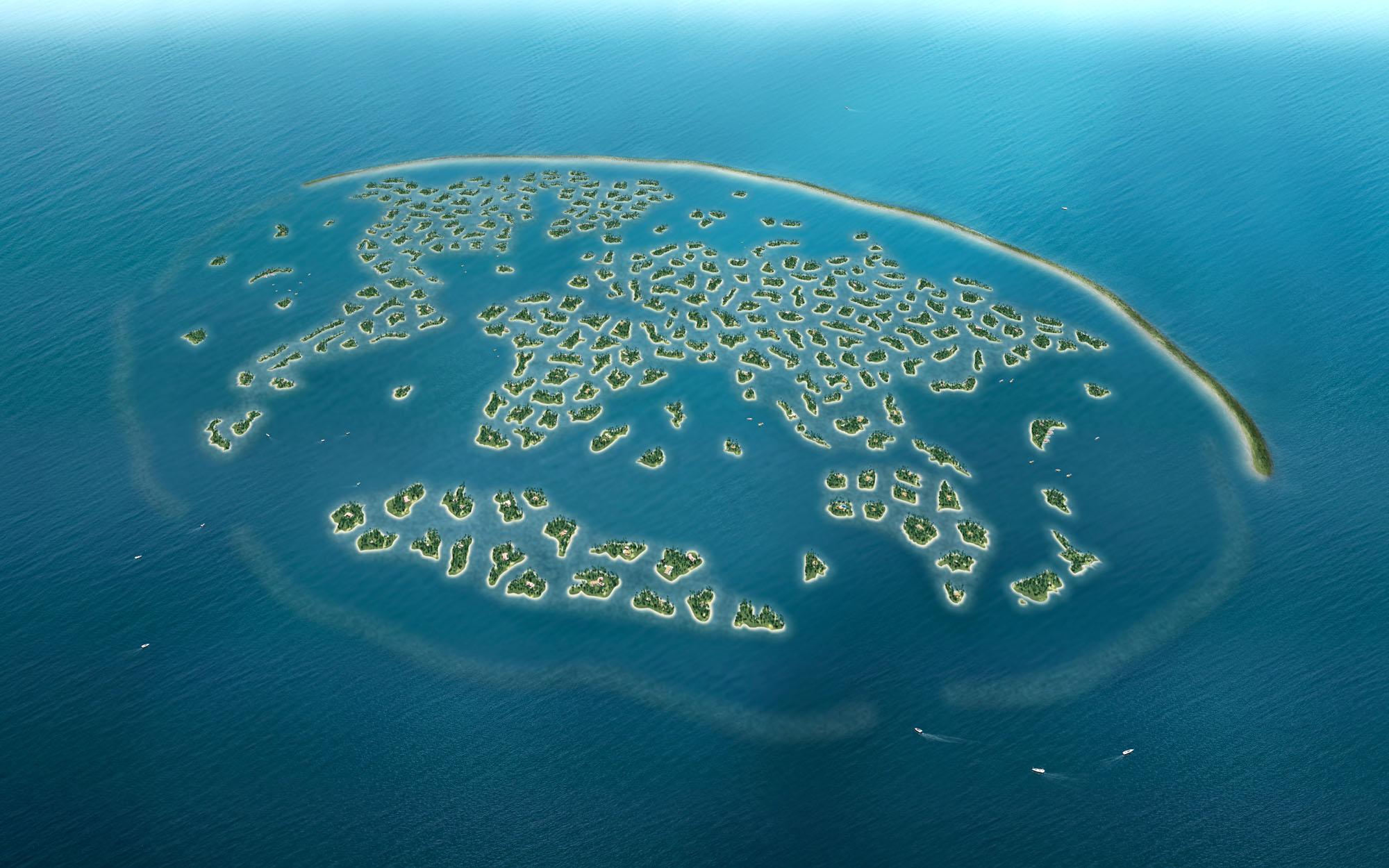
The Worlds islands in Dubai haven’t quite made it

A slideshow of failed tourist projects includes The Worlds project in Dubai:

The World Islands, Dubai

This artificial archipelago of small islands was dreamt up by Sheikh Mohammed bin Rashid Al Maktoum, the ruler of Dubai, to look like the map of the world. And his hope was to turn the World Islands into the playground for the rich and famous. Construction of the 300 islands — made entirely of dredged sand — began in 2003. But when the financial crisis in the real world, it brought production of this $14 billion-dollar fantastical world to a halt. To date only two of the islands have come to fruition.

The World Islands, Dubai

It looks cool but it is hard to imagine (1) how much money and work it would take to finish such a project and then (2) who might purchase all of these unique properties.

But, if it did all go forward:

1. Who would purchase what spots in the world? Who wants the awkwardly placed Antarctica?

2. Does the development allow connections between the locations? How about bridges only where Risk lines are drawn?

Tremendous amount of concrete used in China between 2011 and 2013

Here is another metric regarding the amazing pace of construction and growth in China: Bill Gates references a graphic showing China using 6.6 gigatons of concrete between 2011 and 2013, more than 2 gigatons over what was used in the United States between 1901 and 2001. I’m not sure why you would want to but all this concrete in China would build a giant concrete cube that would dominate the Chicago skyline.

While this is clearly a lot of concrete, it would be interesting to know where it has all gone. Is China using a lot of concrete as opposed to other building materials that might be more expensive or take more time to gather?

Why is Chicago building a new roadway between the Loop and Chinatown?

The Chicago Tribune presented this headline yesterday: “Mayor proposes new roadway between downtown, Chinatown.” When I first saw this, I thought this might be something along the lines of the Crosstown Expressway, a major new arterial roadway connecting two areas. However, the article seems to emphasize the importance of safety:

The $62 million project, called the Wells-Wentworth Connector, would also realign Wentworth Avenue between Archer and Cermak roads to bring this section of Wentworth in line with the portion of Wentworth south of Cermak, according to the Chicago Department of Transportation.

The Wentworth-Cermak intersection, which jogs in an offset alignment, contributes to a high number of crashes, according to a city analysis…

In Chinatown, the southern end of the new arterial road would offer access to the Dan Ryan Expressway, according to the city’s Central Area Action Plan, a list of proposals and specific projects, along with their construction timetables and estimated costs…

The city has slowly been planning improvements for more than a decade to boost safety and reduce traffic congestion in the area, especially among vehicles exiting the Ryan ramps at Cermak. In April 2008, a semitrailer truck that had just exited the Ryan barreled through a crowded intersection and slammed into the Cermak-Chinatown station, killing two people and injuring 21.

Improving a dangerous intersection, particularly in a higher-pedestrian area, would be helpful. It sounds like Wells and Wentworth could be connected between Roosevelt and 18th Street, providing another north-south route. Yet, the city’s explanation of the rationales for this change hint at another important factor:

1. Improved safety for vehicles, pedestrians and bicyclists. Within a wide study area, the offset intersection at Wentworth and Cermak had the highest number of crashes of any other intersection. In comparison, the number was almost double the number of crashes occuring at the intersection of the Dan Ryan off-ramps with Cermak. The realignment of Wentworth at Cermak is required to facilitate safer connections for all modes of traffic.

2. Construction of a new north-south collector street (Wells Wentworth) . This will allow for improved traffic flow throughout both TIF Redevelopment Areas by creating a coordinated series of intersections, as well as provide or improve pedestrian connectivity within the two project areas and to nearby destinations such as the new Ping Tom Park Fieldhouse, the proposed new Chinatown Library, the existing commercial areas, and transit stops.

3. Significant redevelopment opportunities. Improved connectivity between the Loop, the two TIF Redevelopment Areas, and the surrounding communities will promote the redevelopment of vacant land and expand economic development opportunites.

So the real reason may not be safety or providing another north-south thoroughfare to help relieve traffic. The primary reason, as it often is with urban changes, is development which means money and profits. Safety is good but safety plus new developments that bring in new money are even better. There is money to be made with a new street.

Chicago Symphony Orchestra seeking DuPage County outdoor venue

The CSO wants a permanent outdoor site in DuPage County but is having a hard time securing one of the four possible locations:

But two of those sites are on land owned by the DuPage Forest Preserve District and that will pose legal problems for those hoping to build an outdoor concert venue here.The district’s attorney, Jim Knippen, has researched the question and determined the forest preserve commission doesn’t have the legal authority to lease its land to a private entity for a private purpose. If commissioners want to pursue such an agreement, Knippen said, they will have to pursue changes to state law…

Pierotti said he met several months ago with representatives from the CSO and Choose DuPage, the county’s public-private economic development group. He then assigned forest preserve Commissioner Tim Whelan to participate in the discussions because the Danada Forest Preserve was the first district-owned site the CSO considered. Danada is located in Wheaton, which is part of the area Whelan represents…

During subsequent meetings, other district-owned sites were examined, including Hidden Lake near Downers Grove and St. James Farm near Warrenville.

I would guess this deal gets done, even if it takes some time to go through the state and get an exemption. While the Forest Preserve might be about conserving open land, an economic opportunity like this would be too hard for everyone to pass up. DuPage County, the most populous collar county and home to lots of jobs, would love to have such a permanent cultural presence. The CSO would love to have easier access to wealthier people in DuPage County. I imagine there would be some spillover sales tax dollars for nearby restaurants and stores. Additionally, the DuPage County Forest Preserve could probably easily spare the at least 40 acres required as the Forest Preserve was quite aggressive after World War II in securing land before the county was completely suburbanized.

One note: the three Forest Preserve sites mention in this article are all within a ten minute drive of I-88, providing easy highway access. The Danada site which appears to be in the running is a relatively undeveloped area between Wheaton and Naperville that could end up being quite scenic as well as have easy access to some major roads (I-88, Butterfield Road, Naperville Road).

Chicago’s once-thriving streetcar system

Like many American big cities, Chicago once had a large streetcar system:

Those cable cars were preceded by horse-drawn streetcars, which began service in 1859, and were replaced by electric-powered trolleys, beginning in 1890. By the mid-1930s, 3,742 streetcars were running on tracks laid along 529 miles of streets in a grid that provided Chicagoans a streetcar stop within a few blocks of where they lived, worked or shopped. Trolley wires extended into vast areas of the Northwest, Southeast and Southwest sides far from the nearest “L,” making it the adventurous Chicagoan’s system of choice for exploration…

For their part, aldermen and legislators knew the value of changing a “no” to a “yes” vote on a streetcar-line franchise. Each innovation in motive power brought with it safety concerns, upon which politicians could hang a price tag for overcoming their reservations.

The advantage of streetcars compared to the “L” or railroads, both of which helped make Chicago famous, was that it could cover more land and fill in the development gaps between the more infrastructure intensive types of transportation. While the streetcars were eventually replaced by cars, which could serve the same function and allow drivers more independence and privacy, streetcars helped kick off mass suburbanization in the late 1800s.

See more about Chicago streetcars here on this page about Chicago Surface Lines which operated Chicago’s streetcars until 1947. According to this, Chicago had quite the system that quickly went from peak to bust:

The continuous reorganization was finally completed by the Unification Ordinance of 1913, which stipulated that all lines would come under the management of a single operating association called the Chicago Surface Lines (CSL), and unified operations commenced in 1914. Four companies formed the CSL: the Chicago Railways Company, Chicago City Railway, Calumet and South Chicago Railway, and Southern Street Railway. At this time, Chicago had the largest street railway system, the longest one-fare ride, the longest average ride, and the most liberal transfer privileges in the world.

The 1920s saw continued growth despite the increasing competition from the automobile, and while the 1933-1934 World’s Fair and wartime demand supported ridership, the underlying companies were bankrupt. Creditors’ bills were filed against the Chicago Railways in 1926 and the Chicago City Railway and Calumet and South Chicago in 1930, resulting in the appointment of receivers and bringing their property into the custody of the Federal District Court. In 1944, the proceedings were converted to those under the Bankruptcy Act, and trustees were appointed. By 1958, the Chicago Transit Authority, which took over the Chicago Surface Lines in 1947, had abandoned the remaining trolley lines, which were “bustituted.” Before that, CSL had introduced gasoline buses for light routes in 1927,and trolley buses to the northwest side starting in 1930.

In Crabgrass Frontiers, a classic on American suburbanization, historian Kenneth Jackson gives reasons for the decline of streetcars: the automobile started taking away customers and many streetcar lines were locked into municipal contracts that didn’t allow them to raise fares even as they needed money to maintain infrastructure and compete with the automobile.

Just how do Americans do on an “ignorance test” about world development?

Hans Rosling, a guru of development data and TED star, has for decades asked people around the world what they know about international development. The results are not good:

In the 1990s, a professor at a medical university in Stockholm decided to test his students’ knowledge about the progress of global development. He was staggered to discover the class, some of the brightest people in Sweden, scored fewer than two out of five on average…

That academic was Hans Rosling, Professor of Global Health at the Karolinska Institutet and a medical doctor who had carried out decades of research in Africa, discovering the complexities of the continent (and a new disease) along the way…

Rosling has been on a mission to inform since the realization that his students — and his fellow professors — were somewhat woefully informed about the state of the world. Today CNN publishes Rosling’s latest survey of the United States which shows Americans, like most of the world, are far behind the reality in their understanding of world development but ahead of some — for example, Swedes…

In 2005, he co-founded the Gapminder Foundation, which aims to “promote a fact-based world view.” The following year, Rosling spoke at a conference run by TED — the non profit organization “devoted to ideas worth spreading.”…

Rosling realized the concept of “developed” and “developing” countries was hindering understanding of the emerging world, giving an impression of remaining homogeneity of a so-called “developing world”.

Nothing that an introduction to sociology course couldn’t help.

While Rosling wants to focus on facts (and there are some improving figures in the global fight against some major problems), I wonder if it isn’t also about getting people in the developed world to pay attention to the bigger picture. To be honest, many Americans, residents of Sweden, and people in other first-world countries don’t always have to know or consider what is going on in the rest of the world. For example, American media discussion of foreign countries is often pretty woeful and often presents a very American perspective. It is a luxury of being in a wealthier nation as your life is in decent shape (in global comparison).