Removing a mound and landmark to supply 1800s development

The landscape of the Chicago region has a limited range of elevation. One of the natural mounds and an early landmark disappeared at the hand of a local company for local building:

Photo by Photo Collections on Pexels.com

Long ago, a mound jutted up from the flood plain flatlands surrounding the Des Plaines River in what is now a mostly industrial area on the southwest side of Joliet.

It was a significant feature and guidepost for travelers plying the Illinois waterway in the earliest days of recorded history, and a mainstay on maps for decades. Some speculated it was a creation of the mound building civilization that had populated these lands for centuries, best known for its world class city at Cahokia.

Subsequent digging didn’t turn up valuable artifacts, but instead revealed valuable gravel and sand deposited during the ice age, and a short-lived company made quick work of Mount Joliet, dispersing its innards for use in roadways and other projects as the modern development of the region began in earnest in the second half of the 1800s…

Another feature used by centuries of travelers in the area has survived to the present day. In fact, besides giving river navigators a guide point, Mount Joliet may have been one of the landmarks as well along the Great Sauk Trail, an ancient roadway connecting the Mississippi River to what is now the Detroit area.

According to another source:

The mound was destroyed when it’s clay contents were mined to make sewer tiles by the Drain Tile Manufactory of the Joliet Mound Company in the 19th century.

White European settlers to northeast Illinois altered the landscape when they moved into the region in the 1830s. They altered waterways, cleared trees and forests, drained swamps, dug up prairie, made plowable farmland, laid railroad lines, and created plats for sale and development. It does not sound like this mound was in the way of anything; rather, it offered raw material for objects helpful to new development.

I am grateful for maps and other efforts that show what metropolitan regions looked like before white European settlers and then prior to all of the urbanization and suburbanization of the 1800s onward. For example, I have seen multiple versions of this for Manhattan and New York City, discussing and showing streams, hills, and habitats that are hard to imagine in such a large city. Likewise, maps and narratives of the Chicago region highlight a verdant area at the southwest edge of Lake Michigan – that just happened to be an easy portage point to connect the Great Lakes and the Mississippi. Today, it is hard to imagine significant hills or mounds in a region where the flat grid predominates.

Is this the path to “small-town democracy still works as intended”?

The village board of suburban Round Lake recently voted against a proposal to annex property and create a year-round ski hill. One representative of local opponents described the outcome this way:

Photo by cottonbro on Pexels.com

“It is heartening that small-town democracy still works as intended,” Ashman added.

What happened in this process of “small-town democracy?

Opponents who had coalesced into a large, multifaceted grass-roots force were uncertain of the outcome until Trustee Mark Amann, who was appointed earlier in the meeting to fill a vacancy, ended the speculation…

The opposition group started with about a dozen residents a few months ago but grew with a united goal and different areas of expertise.

A Facebook group ballooned to 779 members, 120 yard signs were posted, hundreds of fliers were passed out in town and a website was created. Nearly 2,000 signatures in opposition were gathered on an online petition, and a blog chronicled the issue…

“I had to go with my conscience and my gut,” he said after the meeting. “The bottom line was he (applicant Dan Powell) didn’t have any skin in the game. We were at more risk than he was.”

This exemplifies why suburban Americans like local control and local government. In a smaller community (Round Lake has over 18,000 residents), the closer connection residents have to the local board or council. If residents do not like something, it is easier for them to make their voice heard. Here, residents took advantage of social media and websites plus utilized yard signs and fliers. Those opposed felt this was not in the best interest of their community. If elected officials do not do what residents want, it can be easier to remove them at the next election.

Whether such a process leads to the “right” outcomes is another question all together. Such a process also makes it easy for communities to resist affordable housing, development or changes that might be good for an entire region, or protect a particular character or set of resources.

Sports teams want the state-of-the-art stadium – and all of the nearby mixed-use development – to profit

The conceptual plans released earlier this week from the Chicago Bears about what they might construct in Arlington Heights follows a recent trend: sports teams are interested in stadiums and all the other development around those facilities.

Photo by Mikael Blomkvist on Pexels.com

The plans revealed Tuesday by the Bears call for a multipurpose entertainment district anchored by a stadium that could host the Super Bowl, college football playoffs and college basketball Final Four, with an adjoining commercial/retail and housing district. While cautioning that the long-term vision for the entire property is a work in progress, the team said the site could include restaurants, offices, a hotel, fitness center, parks and open spaces.

The team’s open letter provided a series of economic projections, saying the large-scale redevelopment would provide “considerable” economic benefits to Cook County, the region and state.

For instance, construction would create more than 48,000 jobs, result in $9.4 billion in economic impact in the region, and provide $3.9 billion in labor income to workers, the team said.

The development would generate $16 million in annual tax revenue for the village, $9.8 million for the county and $51.3 million for the state, according to the Bears.

Yes, a stadium is necessary for football but teams now want to develop more land and generate additional revenues adjacent to the sports playing surface. If they help generate such development and/or retain an ownership stake in the surrounding development, this can both bring in significant annual revenue and further boost the value of their franchise.

This also follows on-trend development ideas where a mixed-use property helps ensure a regular flow of activity. Instead of separating land uses in different places, putting them all together can create synergy and additional revenues.

Another way to think about it is that a lot of sports teams are in the land development business. How exactly this fits with a goal of fielding a winning team might get complicated.

Teardown McMansions in Tampa

A large number of teardown McMansions have been constructed in recent years in Tampa:

Photo by Monica Silvestre on Pexels.com

Nearly 5,000 residential demolition permits have been issued in Tampa in the last decade — including 709 in 2021. That’s the most in any single year since at least 2005, according to city data.

“Having all of these homes torn down is a wrinkle we haven’t had before,” says Tampa historian Rodney Kite-Powell, “and the pace is really incredible.”

A blogger has tried to keep up with“The McMansioning of South Tampa.” About 2,700 razed dwellings are pictured. Some of the lost homes are majestic and sad. Many, though, were tired and untended. The sheer volume is beyond what a single blogger could chronicle. Ten of the 14 homes knocked down this century on Jerry’s block aren’t depicted on the site’s map. Even so, the layers upon layers of red pins are striking…

Not everyone is happy. Search the local Nextdoor site for the term “McMansions” and you’ll encounter one of the more passionate running discussions in the city. When a one-story home came on the market at the start of the pandemic, neighbors implored the owner to seek a buyer who would maintain it. “I beg you not to sell it to a builder that will level it and build a ridiculously oversized McMansion that ruins the charm of our neighborhood,” wrote Lisa Donaldson. “Please.”…

Others counter that the older homes are no longer functional and that the newer onesraise the value of those around them. “The curmudgeons will always complain … until they are ready to cash out,” posted Marc Edelman. “Tampa is progressing for the better.”

A few quick thoughts in response:

  1. If just looking at economic factors, teardowns tend to occur in desirable neighborhoods where the new homes can fetch a significant profit compared to the previous dwelling.
  2. Socially, teardowns are more difficult to navigate given the competing interests of property owners who want to make money, builders and developers looking for opportunities, neighbors who might be opposed to a changing neighborhood, those interested in local history and preservation who might prefer to keep older dwellings, and local leaders who may or may not support teardowns.
  3. Sunbelt cities and communities have experienced much growth in recent decades. People are used to change and growing populations. But, this is a different kind of change where existing homes are replaced rather than new subdivisions spreading across available land. There is now an established landscape that could look quite different in coming decades.
  4. Sunbelt communities are generally pro-growth. Does this change at some point given population sizes and composition, the availability of resources, and several decades of established history?

Amazon was opening a warehouse every 24 hours…but not now

Amazon was building warehouses at a rapid pace during COVID-19:

Photo by James Anthony on Pexels.com

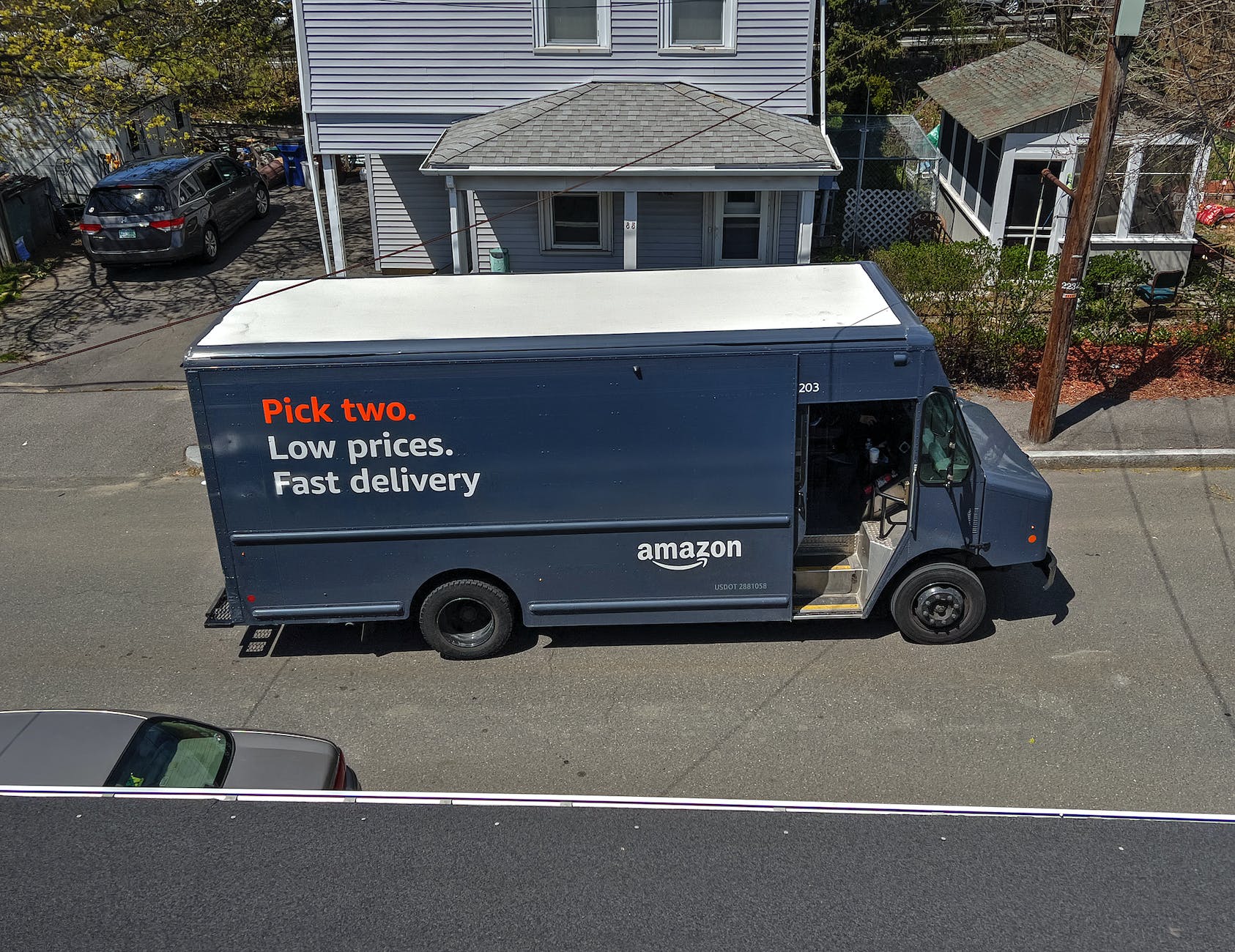
When homebound shoppers stampeded online during the pandemic, Amazon responded by doubling the size of its logistics network over a two-year period, a rapid buildout that exceeded that of rivals and partners like Walmart Inc., United Parcel Service Inc. and FedEx Corp. For a time, Amazon was opening a new warehouse somewhere in the U.S. roughly every 24 hours. Jassy told Bloomberg in June that the company had decided in early 2021 to build toward the high end of its forecasts for shopper demand, erring on the side of having too much warehouse space rather than too little. 

But, now the opposite is happening:

MWPVL International Inc., which tracks Amazon’s real-estate footprint, estimates the company has either shuttered or killed plans to open 42 facilities totaling almost 25 million square feet of usable space. The company has delayed opening an additional 21 locations, totaling nearly 28 million square feet, according to MWPVL. The e-commerce giant also has canceled a handful of European projects, mostly in Spain, the firm said.

The scale of this is worth marking: a new warehouse every day.

Companies act in such ways given economic conditions. Yet, these are not just business decisions; they affect communities. As Amazon rapidly expanded, many communities sought out such a facility and/or offered tax breaks and incentives. This happened in the Chicago region. If Amazon contracts, this affects local decisions and revenues.

As conditions change, will communities operate differently toward Amazon or will they reassess their approach to attracting businesses, jobs, and revenues? Many communities would still probably prefer to have an Amazon facility in the long run but they may be harder to entice or the competition might be stiffer. Or, if Amazon facilities come and go, they might be inclined to look toward other firms or industries.

A Brooklyn church pursuing a Jane Jacobs-inspired development

A plan is underway for a New York City church to work with a developer to construct a sizable development:

Photo by Pixabay on Pexels.com

A. R. Bernard, pastor of the largest evangelical church in New York City, has been working on a plan for more than 10 years. Now the proposal to build a $1.2 billion urban village and revitalize the struggling neighborhood around his church is progressing through the city’s approval process and closer to reality. The Christian Cultural Center (CCC) hopes developers could break ground in Brooklyn next year…

On 10.5 acres of church land, the proposed village would include thousands of units of affordable housing, a trade school, a supermarket, a performing arts center, 24/7 childcare for night-shift workers, senior living facilities, and other amenities designed to revitalize the East New York neighborhood…

“I’m a big Jane Jacobs fan, when it comes to understanding the urban landscape. And community means amenities are within a 1,000-foot walking distance,” Bernard said, referring to the urban planner who is famous for saving lower Manhattan from a highway and for her ideas on smaller-scale urban development focused on street life. “She was a genius. Absolute genius.” He sees this plan as a counter to the influence of the infamous urban planner and Jacobs nemesis Robert Moses, who had a history of dividing communities economically, including in this part of Brooklyn…

The church hopes this village can be a model for other cities and it could be scaled up or down, Bernard thinks. But he added that a church must be large enough, like CCC, to pull such a plan off.

As my research on religious congregations and zoning issues in the New York City region found, it is not necessarily easy for congregations to make significant changes to property. Lots of actors can express concerns.

But, some congregations have the resources and community presence to pursue projects like this and it might be difficult for others to propose and pull off the same plan. Affordable housing is needed all over and it sounds like the other parts of the project would also provide helpful facilities and services.

It would also be interesting to see how the congregation might serve as a physical and social anchor of a sizable new development as it matures.

Urban high-rises under construction, Los Angeles edition

In cities across the United States, the development and construction of downtown high-rises is ongoing. This was one of my views of Los Angeles this weekend:

Who is funding such development? Who will purchase the spaces in these new buildings? How does it all fit within a metropolitan landscape marked by uneven development and residential segregation? Located near L.A. Live, Crypto.com Arena, and downtown Los Angeles, this is desirable property.

Tax breaks and suburban and Sunbelt growth

Wells Fargo is seeking a tax break to construct a regional office in suburban Irving, Texas:

Photo by Tara Winstead on Pexels.com

The Irving City Council will vote Thursday on millions of dollars in economic incentives to support the huge campus that’s expected to house 4,000 workers…

The agreement with Irving calls for Wells Fargo to “occupy at least 800,000 square feet of office space in the newly constructed buildings by December 2026. The proposed new office development would serve as a regional hub for Wells Fargo.”…

Irving proposes in its economic incentive agreement to give Wells Fargo up to $19 million in tax increment finance district funds to build a 4,000-space parking garage and “to reclaim a portion of the lake between the two adjacent parcels on the south side of Promenade Parkway.”

A separate economic incentive of up to $12 million would support construction of the Wells Fargo offices.

The project will increase the city’s tax “property value by a minimum of $200,000,000,” according to the City Council filings.

I can imagine the argument from Irving and similar communities about why the tax breaks are worth it:

  1. Such a move helps entice national and international brands to your community.
  2. Such a move brings jobs to the community.
  3. The tax breaks will be outweighed by the tax and physical improvements to the property in question.

All of this helps boost the status of the suburb and the economic prospects in the community.

On the other hand, tax breaks have downsides:

  1. Lots of communities offer tax breaks. The company may be less interested in this specific community and more interested in how much money they can get from a community.
  2. Less money will come into the community than if no tax breaks were offered.
  3. At some point, the tax breaks run out and then what happens to the company and the newly developed property?

As the title of this post asks, how much development in suburban areas like Irving involves tax breaks? Would Wells Fargo locate in Irving or in the region without tax breaks?

Multifamily units construction highest since 1973 – but not for the part of the market that needs it most

More multifamily units are under construction than in any year since 1973 but more units are for a particular segment of the market:

Photo by SevenStorm JUHASZIMRUS on Pexels.com

Nearly 836,000 multifamily units are under construction, the most since 1973, according to Jay Parsons, chief economist at RealPage. But most new construction targets higher-income tenants and not the lower end, where supply shortages are most extreme, he said.

I have written about the dearth of starter homes and I would suspect a similar dynamic is at play here. Builders and developers can make more money on multifamily units with higher prices. If someone is going to go to all the effort for development and construction – and this can be quite a bit of effort in certain places – they would prefer to gain more financially in the end. The number of places that require the construction of affordable housing alongside market rate housing or seriously pursue cheaper housing are limited.

If these higher-income units come on line, it will add to a bifurcated housing market where those with enough resources have plenty of choices and those with fewer resources have limited and possibly unpleasant options.

Alphabet’s proposed Toronto “smart city” project vs. a new development more about nature and people

A new Toronto development is in the works where Alphabet once had plans for a “smart city” project:

Photo by Luis Ruiz on Pexels.com

In every way, Quayside 2.0 promotes the notion that an urban neighborhood can be a hybrid of the natural and the manmade. The project boldly suggests that we now want our cities to be green, both metaphorically and literally—the renderings are so loaded with trees that they suggest foliage is a new form of architectural ornament. In the promotional video for the project, Adjaye, known for his design of the Smithsonian Museum of African American History, cites the “importance of human life, plant life, and the natural world.” The pendulum has swung back toward Howard’s garden city: Quayside 2022 is a conspicuous disavowal not only of the 2017 proposal but of the smart city concept itself.

To some extent, this retreat to nature reflects the changing times, as society has gone from a place of techno-optimism (think: Steve Jobs introducing the iPhone) to a place of skepticism, scarred by data collection scandals, misinformation, online harassment, and outright techno-fraud. Sure, the tech industry has made life more productive over the past two decades, but has it made it better? Sidewalk never had an answer to this…

Indeed, the philosophical shift signaled by the new plan, with its emphasis on wind and rain and birds and bees rather than data and more data, seems like a pragmatic response to the demands of the present moment and the near future. The question is whether this new urban Eden truly offers a scenario that will rein in global warming or whether it’s “green” the way a smart city is “smart.” How many pocket forests and neighborhood farms will it take to cool the planet?

Whatever its practical impact, renderings of the new version of Quayside suggest a more livable place. The development promises something incredibly obvious that the purveyors of the smart city missed: a potential for daily life to be pleasurable. As MaRS Discovery District CEO and tech entrepreneur Yung Wu puts it: “What is the vision that inspires people to want to live here, to work here, to raise their families and children and grandchildren here? What is it that inspires that?”

“It’s not a smart city,” he concludes. “It’s a city that’s smart.”

I wrote about the earlier project here and it is interesting to see this update. I would guess the “smart city” will still come but perhaps through different forms including more incremental changes, smaller and less high-profile projects that test the concepts first, and perhaps through examples in other countries where guidelines and regulations are different.

Additionally, does this mean Alphabet and similar companies will no longer pursue such projects or will they seek more favorable conditions? Or, what happens if tech companies provide a more convincing argument that tech and nature can go together in urban forms?

At this point, it is hard to imagine tech retreating much but how exactly it continues to develop and merge with urban and built spaces remains to be seen. It is one thing to push technology through individuals or private actors but it is another level to build it in into the infrastructure from the beginning.