As a sociologist, I often am looking for patterns. In what is happening around me. In data. In books. I do not remember that I was told directly that this is the task of a sociologist but I do recall picking it up in school and work.
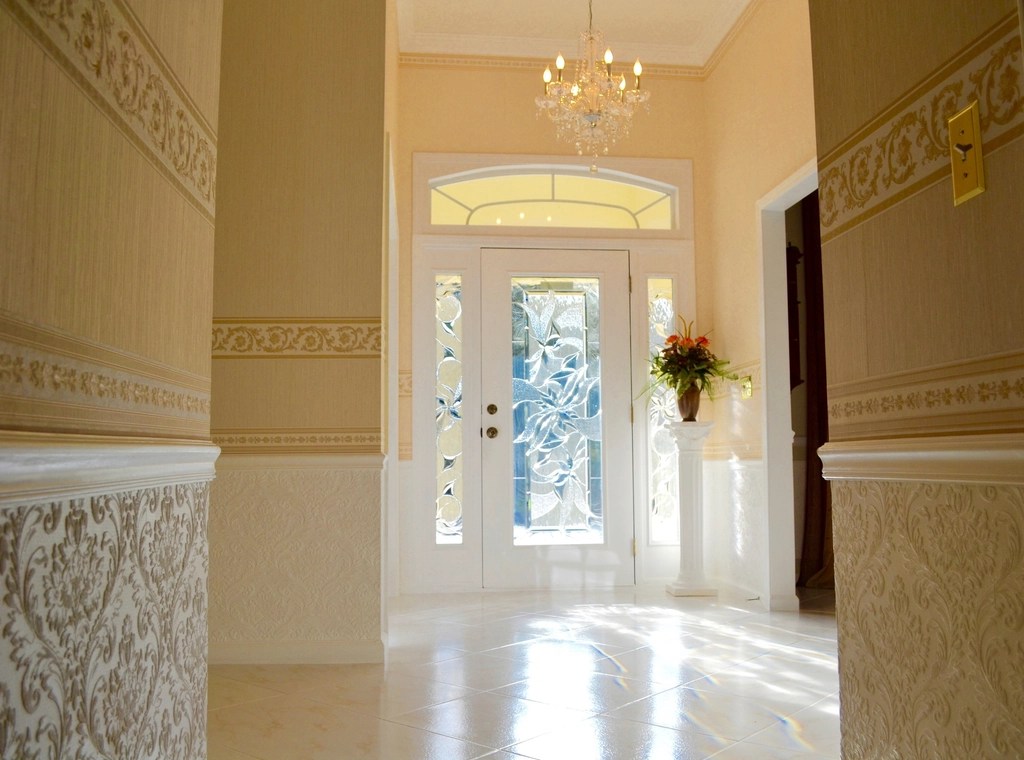
Above is an example of a more obvious pattern. Someone put a lot of thought and work into creating this pattern on the ceiling of a church foyer. They did not have to do this and many ceilings today are plain and devoid of patterns. Look up and you see this pattern.
Other patterns are less obvious. You may have a spreadsheet of data – and it takes work to collect and compile that data in the spreadsheet in the first place – but the patterns do not present themselves. You need a plan to look for patterns and then ways of organizing and explaining those patterns.
Or humans like to make meaning of the world around them and what happens to them. But we do not just file away random and disconnected data; we often try to fit what we experience into a meaning system that we have. We seek out patterns to explain the world and we can feel anxiety if our experiences do not quickly fit the patterns we expect.
Is life all about patterns? That might be going too far. But creating and seeing can be very human activities.
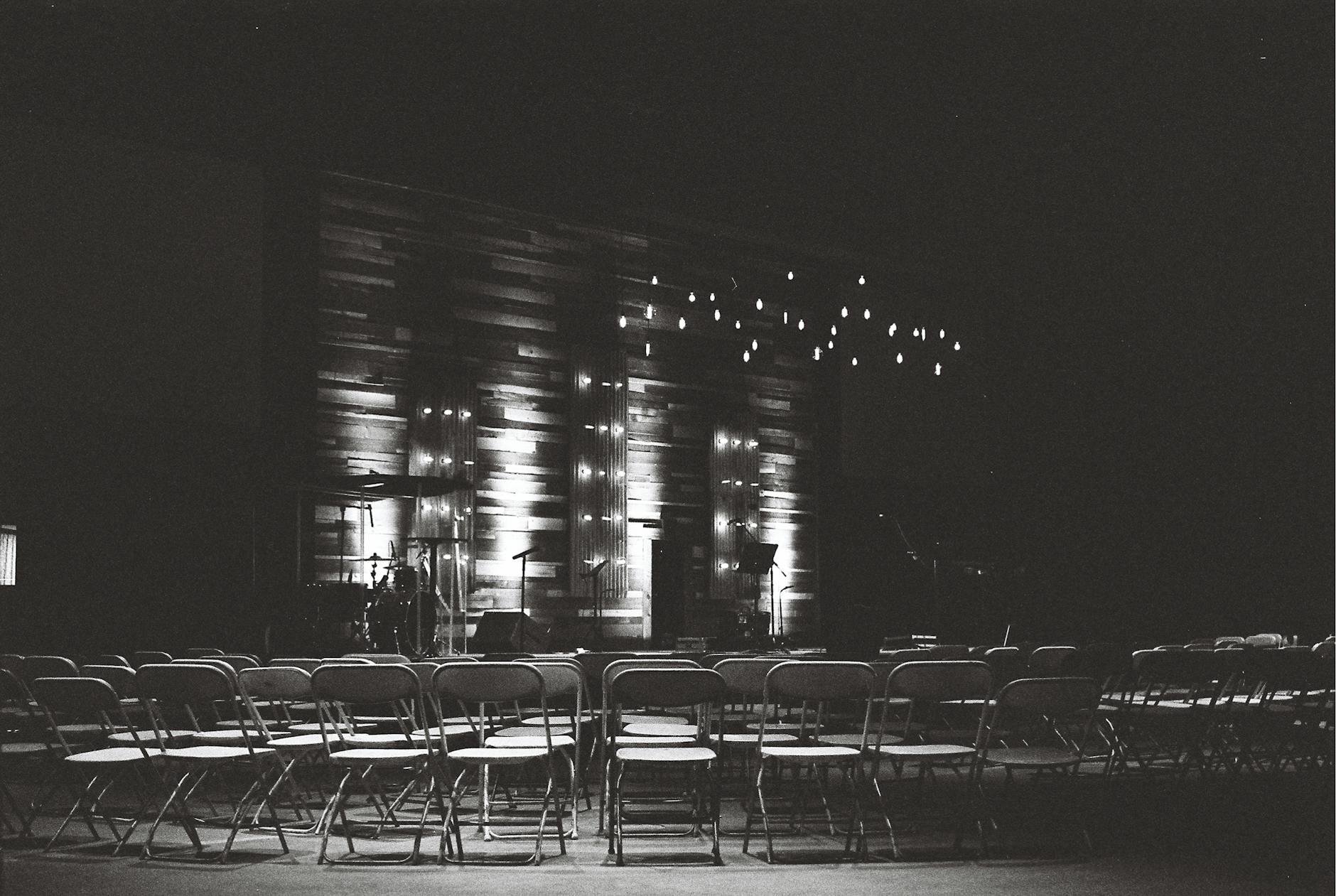
Newly built or remodeled churches typically have a space with a sink and a coffee pot, Slagill said. Possibly a microwave. But no expanse of countertop suitable for chopping carrots, potatoes, and onions to go into a big pot of soup. No oversized refrigerators for Jell-O salads. No industrial ovens large enough to cook three or four casseroles at once. Churches these days don’t have a lot of cupboards with drawers labeled “forks and knives,” “spoons,” and “serving utensils.”…
A recent exhibit of religious architecture in the 21st century curated by architect Amanda Iglesias included more than 40 churches from around the world. Only five had dedicated spaces for gathering around food.
“Culture has changed,” said Katie Eberth, an architect with Aspen Group, a leading firm in the field of church design. “It’s not part of the culture now, the church culture, where you have 20 women who come together and make a meal. Today we order Panera or Jimmy John’s.”…
Hospitality comes up a lot, according to Eberth. But when people talk about what that should look like in the physical construction of a building, they don’t talk about fellowship halls with long folding tables where everyone can sit together. They talk about a café serving coffee and pastries in the foyer…
The age of church kitchens didn’t really get going until rapid urbanization started in the 1880s.
“The city offered saloons, amusement parks, and pool halls, places designed to attract and corrupt young minds with fun,” historian Daniel Sack writes in Whitebread Protestants. “Churches were just one competitor in the free market of entertainment. . . . The church had to use every tool at hand, including food.”
Three thoughts in response:
It sounds like food and drink will continue to be a staple of church interaction, just not food prepared in a church kitchen. Food continues to help facilitate conversation and interaction.
Comparing the physical spaces of a fellowship hall versus a cafe is interesting. The first is likely a large space that can be used in many different ways. Are the cafes cozier and more fixedly set up for socializing? In other words, is it just the food that is different or is there a different ambience in a foyer or cafe compared to a large room?
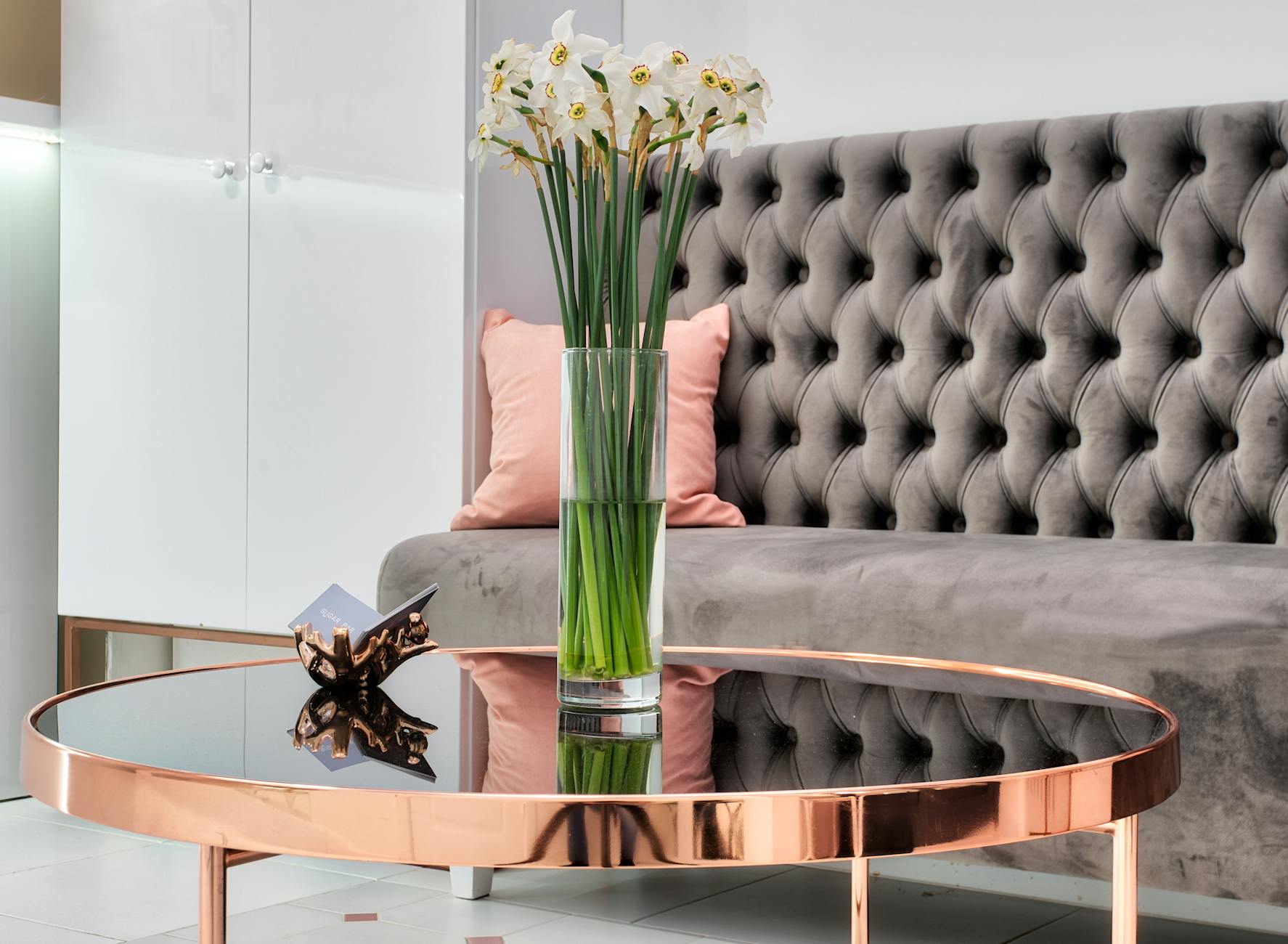
Everyone loves a good feature in a house. Wainscotting adds texture to a boring room, stone on a fireplace makes a living room cozier, and a simple ceiling beam can elevate an entire room. These architectural flairs make a house feel more memorable. Without them, a space can feel like a developer rather than an architect created the design, building something of a McMansion. But while it’s important to add thoughtful features, HGTV’s Drew Scott points out that there can be too much of a good thing. While one of those accents can help make a house feel special, muddling them all together can make everything too busy.
Often, the features of McMansions are visible from the outside: a large size, a mish-mash of architectural styles, and/or a location in a suburban subdivision of similar mass-produced homes.
But could a McMansion be redeemed if the inside does not look like a McMansion? Or could a home be a McMansion if the outside does not look like it but the interior has McMansion features? Imagine a 2×2 table:
McMansion interior
Not McMansion interior
McMansion exterior
Not McMansion exterior
The “typical” McMansion is in the top left cell: the outside and inside shows McMansion traits. The mixed categories are what is at stake here with the emphasis on interior spaces. Have the right design element inside and it could push a home out of the McMansion category.
I am not sure how this works. Who gets to render the ultimate McMansion judgment? Since McMansion is a negative term, does any shade of McMansion-ness mean the home is a McMansion?
In 1959, the Chicago Tribune first coined the word “bachelor pad,” marking the emergence of a newly modern male homemaker. Where once family heirlooms and mounted animal heads had reigned supreme, a new visual language for masculine status had emerged. The bachelor pad was sophisticated, seductive. It was, in the words of Hugh Hefner, a place for drinking cocktails, “putting a little mood music on the phonograph and inviting in a female acquaintance for a quiet discussion on Picasso, Nietzsche, jazz, sex.”…
From the very beginning, man caves have been defined in terms of their resistance to femininity. The phrase was first used in the Toronto Star in 1992, when Joanne Lovering conjured up a “cave of solitude secured against wife intrusion,” marked by “musty smells and a few strategic cobwebs.”
That year, John Gray’s Men Are From Mars, Women Are From Venus popularized the man cave as a metaphor for the privacy and solitude that all men crave. “Men have had an identity problem since the women’s movement,” Sam Martin, author of Manspace: A Primal Guide to Marking Your Territory told the Denver Post in 2007. “Our premise is that women have control of the look and the feel of the house and that left guys wanting more.”
Interesting look at how these terms emerge and then are part of Reddit conversations today about male spaces.
Three additional thoughts:
Does the rise of the smartphone and electronic devices change the scale and feel of male spaces? If all one needs is a phone or a gaming console or an internet connection to access all sorts of things, does this change the need for other items?
These named spaces seem to go along with consumerism: buying stuff to fill a space and show off. Might there be a shift back to minimalism and away from owning more if people prefer to spend on experiences? (Of course, owning less could mean paying more for higher-cost items.)
Particularly as marketers and companies looked for ways to appeal to male consumers, what terms for male spaces did not catch on?
What terms will emerge next to define male spaces?
As homes shrink in size, hallways could be one of the first casualties. Eliminating these liminal spaces would decrease the number of interior walls and allow for more condensed homes, the survey found.
“Essentially, we’re Tetris-ing the functional rooms together, avoiding wasted square footage on non-functional areas like hallways,” the report said.
Other tactics Arroyo has noticed designers employing to save on space include eliminating a formal dining room, adding storage in unused spaces (under the staircase, for example), three-story homes with the living space on the second floor, and tandem garages.
Could a hallway be expanded a bit and instead be claimed as another room? (I am thinking of the rooms sometimes found on the second floor at the top of stairs where you might fit a small desk or one chair and it is called an “open space” even though it is really a wider hallway.)
If there are not hallways, where will children run back and forth between walls or family members learn to walk past each other in a confined space? Or wonder which room is which when seeing several doorways at the end of the hall?
Since the 1980s, the percentage of homes being constructed with four bedrooms has on the whole grown, while the percentage of two-bedroom homes have fallen. In 2022, nearly half of all homes constructed had four bedrooms, compared to two-bedroom homes at 9%.
This trend of larger homes is also shown through the number of bathrooms in new houses, with over a third having three or more baths, slightly more than the percentage of homes with two baths.
If you have more square footage, people might want more of these kinds of rooms. Who wants to share a bathroom? Can’t additional bedrooms be repurposed for other uses like an office or workout space? Haven’t all the shows on HGTV convinced viewers that more bedrooms and bathrooms increase the resale value of a home? Too bad we do not have a measure of the number of open concept living areas. Or, how many square feet are allocated to the kitchen, the space where Americans spend a lot of their time?
One more interesting chart regarding basements:
Basements have also become much less popular over the last five decades— the percentage of new homes with a full or partial basement in 1974 was 45%, compared to just 21% in 2022. Slab and other types of foundations have become the sweeping majority for new homes.
I wonder if this has more to do with more new homes constructed in places, like the South, where basements are less common as opposed to a declining interest in basements. This also suggests newer homes have less space underground and have more of their space above ground.
Are these changes due solely to the spread of McMansions? The headline may invoke McMansions but they were not the only style of larger home constructed in recent decades. As many new homes added square feet, their features shifted. McMansions may have had plenty of bedrooms and bathrooms but so did other new homes.
Other stores will have a different look. The design of a new location in Brooklyn reveals the polished concrete floors from its past life as a Barneys New York. A Barnes & Noble recently opened in California with cerulean walls, and an experiment in robin’s egg blue is in the works for some East Coast locations…
The result has been an idiosyncratic approach to mass retail. Mr. Daunt, who describes himself as “an independent bookseller in background and ethos,” is pushing the chain to act more like the indie stores it was once notorious for displacing — and to embrace lighter, brighter interiors with modular shelves designed for maximum flexibility…
In its darkest hours, the stores began to resemble the discount aisle at Spencer’s. A layout known as “the racetrack prototype” — which Ms. Flanigan identified as “my least favorite design” — borrowed from big-box stores like Target, with cash registers by the door and impulse-purchase temptations around the perimeter. Only after wading through a sea of tchotchkes would customers encounter books…
The new look aims to encourage browsing, which Mr. Daunt believes improves customer satisfaction. “If you just want to buy a book, the guys in Seattle will sell you a book,” Mr. Daunt said. “The enjoyment and the social experience of that engagement with books in a bookstore? That’s our game.”…
Bookstores, in Mr. Daunt’s view, are fundamentally different from other retail businesses, partly because of the range and variability of the products. Under his leadership, local managers are given a free hand, meaning that the Upper West Side store may offer a shopping experience quite different from the one in Spanish Fort, Ala.
If the primary competition is not other retailers but rather an online store, this might make some sense. The hopefully pleasant idiosyncrasies of different locations provide an alternative to an app or website experience.
By definition, can a chain retailer express itself this way? If this is successful, I suspect others might follow, even if they are not engaged in selling books.
What’s the biggest TV you can buy? If we’re talking about conventional televisions, the TCL 98R754 is a staggering 98-inches wide. But if you’re willing to consider a laser or short-throw projector TV, Samsung’s The Premier is capable of showing a screen up to 130 inches. But unless you live in a cavernous McMansion with 18-foot cathedral ceilings and a sprawling layout, you won’t be able to get them to fit in your living room, let alone be able to take full advantage of their features.
How can I know if an 85-inch TV will fit in my room?
The best way to find out is to measure (in inches) from where the TV will be wall mounted or placed on a stand to where you will be sitting, and then divide that measurement by 2. If your couch is anywhere from 150 to 170 inches (12.5 to 14 feet) from the TV, an 85-inch screen will be an almost perfect fit. You can, of course, go a bit bigger (if possible) or smaller depending on what your budget is and what is available from each brand. But a screen that is too big can overwhelm your space and even cause motion sickness while one that is too small will make it feel cavernous and force everyone to crowd around in order to see.
Presumably, there is some limit to how big a television can or should be. Perhaps this is about the ability to see what is happening on the entire screen. Perhaps rooms truly can only be so large. Perhaps screen technology will be replaced by an entertainment chip in glasses. Or, people might get tired of important rooms in their house being dominated by a gigantic screen.
On the other hand, perhaps this helps signal a shift away from homes leading with their garages – the so-called “snout houses” – and instead leading with a giant screen. Imagine walking in the front door and the major room is devoted to the biggest possible screen. The screen is something to show off and impress visitors with. Homes could even be designed so that the outside would make clear the giant screen and the room it sits in.
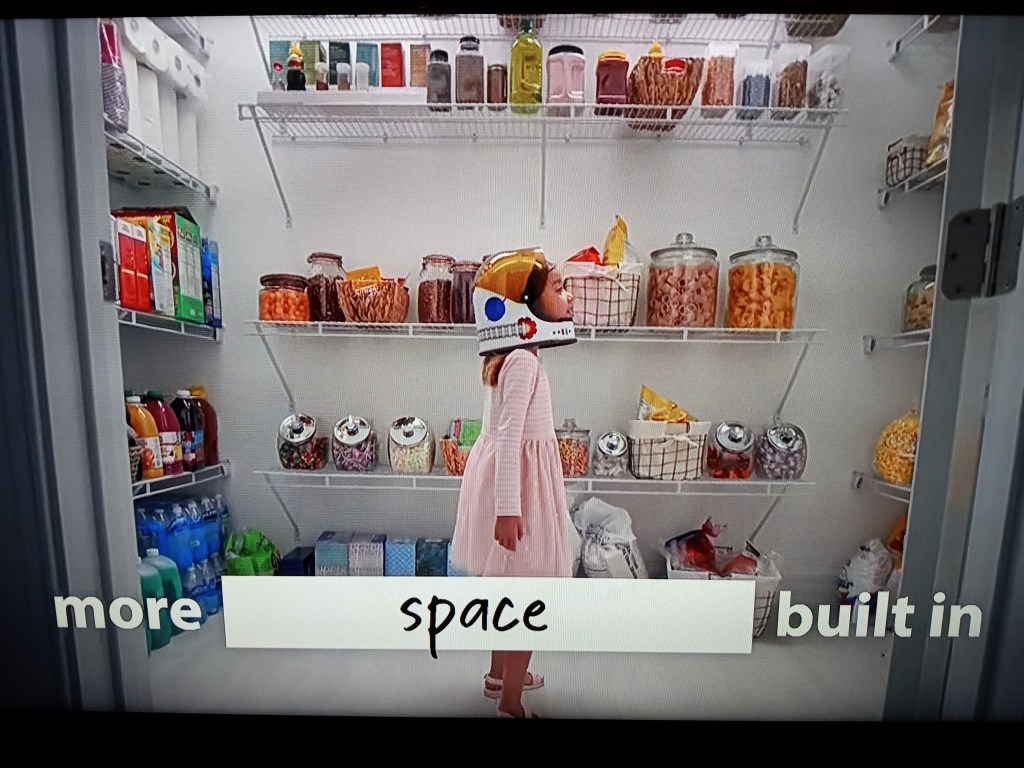
A commercial from Pulte Homes touts unique features in the houses they build. For example, they have large pantries:
The pantry is large, the stuff on the shelves is well-organized, and the shelves themselves are…mediocre. Builder-grade. Why show off such a large pantry with basic shelves?
Perhaps this accurately reflects the shelves Pulte includes in its homes. This kind of shelves might be found in closets throughout many new homes in the United States. They are usable shelves, after all. If the first homeowner wants something more complicated, they have plenty of options ranging from Ikea designs to those who can custom-fit shelves and all sort of options.
Or, perhaps I am only supposed to notice the space in the pantry. The girl has so much room to move. There are so many shelves. The Costco shopper has somewhere to put all of their bulk purchases.
Even with these explanations, I find it a strange image. I see the space…and the shelves.
As the spring home-selling season gears up, homeowners who installed temporary or permanent amenities to accommodate COVID-19-era living now must navigate a maze of no-win decisions. Should they leave as-is the bedrooms converted to offices, the chest freezers parked in the garage, the bidet toilet seats warming their bathrooms, the bulky exercise equipment flexed in the basement — in hopes that buyers can look past the COVID clutter to see the bones of the house? Or must they dismantle it all, potentially subjecting themselves to additional chaos if another virus variant forces yet another retreat?
According to an analysis released in April by construction equipment firm Bid-on-Equipment, 89% of homeowners nationally have tackled home improvement projects since the COVID-19 virus began forcing many Americans to spend more time at home for work and leisure. The average cost of those projects was $3,797. Illinois residents made bathroom renovations their top priority, the analysis found…
Now, all that extra gear is part of their everyday lives and they have no intention of letting a new buyer have it, she said. Customers would rather put their top-end appliances in storage and swap in new, but lower-end, appliances, for the duration of a sale, Hood said. Then, they reinstall their coveted appliances in their new houses…
The pandemic also amplified the long-term preference for flexible rooms that can be easily be devoted to a single purpose, such as a second home office or even an isolation bedroom for a quarantined family member.
For sellers, it seems like a key would be to present the kinds of flexible options with the space that buyers might want. Do they want an office setup? A workout space? This might requires playing to some categories but I would guess that the price of the residence and the surrounding community provide plenty of clues about what potential buyers might want.
More broadly, if homes and residences need to be more flexible in the future, this could lead to significant changes. Imagine less permanent walls and more dividers. Or, fixtures, appliances, furniture, and rooms that can be more easily altered by the typical resident. This does not necessarily mean people will live in the larger equivalent of a studio apartment – or the giant kitchen/living space combo – but many rooms may also not be the answer.






 Legally Sociable