A growing shortage of starter homes

Those looking for smaller homes to purchase are facing a limited supply:
Photo by RODNAE Productions on Pexels.com

The first rung on the homeownership ladder has long been an affordable “starter home.” These houses, with their smaller footprints and selling prices, allowed young homeowners to build wealth and upsize as they started their families…

Supply of “entry-level housing”—which Freddie Mac defines as homes under 1,400 square feet—is at a five-decade low.

Surging prices and stiff competition mean there aren’t enough smaller, more affordable starter homes to go around in many regions. The pandemic and subsequent recession, along with the student debt crisis and delayed family formation, contributed to frustration and despair among younger house hunters…

Lately, data from the National Association of Home Builders shows new construction is again giving priority to higher square footage for single-family homes, a trend likely spurred by the widespread shift to working from home and house hunters’ need for more space.

This has been building for years now with the factors cited above (and more – and it may not be the fault of millennials). Builders prioritized larger homes as they can profit more from each units and buyers wanted more features and/or larger homes.

I wonder about the role of local governments. How many urban neighborhoods and suburban communities allow for or encourage the construction of smaller homes. It might take some extra work for a community to work with a developer who is willing to construct smaller and cheaper homes. At the same time, some of the existing members of the community might not be happy about the change as smaller homes are often interpreted as dragging down values and the character of the community. At the least, wealthier communities are unlikely to encourage such homes unless they are at a higher price point – and then it is no longer a starter home.

The article also mentions the financial ramifications of not getting into a house earlier: on average, this lowers the amount of house wealth generated decades later. Might then then shift the emphasis of recent decades away from seeing homeownership as a financial nest egg or requiring a necessary return on investment?
The power of local politics to shape national outcomes

A deep look at the changing political tides in suburban Oakland County, Michigan ends with this:

Photo by cottonbro on Pexels.com

Such a post-mortem would likely reveal that the party’s disinterest in holding onto the suburbs prevents the rise of new Pattersonian Republicans with their own identities separate from Trumpism and that this will have long-term historical consequences.

“There are dozens, if not hundreds of these local or regional-level political power brokers who shape the outcomes of how our cities and regions function in ways that just aren’t visible to most people,” says Delmont, the Dartmouth historian. “We spend so much time talking about who’s in the White House or even who’s in Congress. But it might be the L. Brooks Pattersons of the world who actually determine, like: Do we have affordable housing? Do we have segregated cities? Do we have police forces that are militarized? The people who actually operate the levers of power are probably much more positioned like a Brooks Patterson than a President Trump or President Biden.”

National politics are indeed often built on smaller units of government. While a lot of attention goes to presidential elections (and this article also focuses on Donald Trump and how this connects to local politics), there is a lot of work that happens at the Congressional, state, and other levels that undergird the larger outcomes. A candidate or political party is going to struggle without grassroots, lower-level support.

This reminds me of my blog post Thursday about addressing housing issues municipality by municipality. We often look at particular issues at a national level. How to provide affordable housing? How to explain the rise and fall of Donald Trump? There are multiple levels of analysis possible and needed. In this post and on Thursday, the reminder is that the local level matters. Does Oakland County and all the local machinations about county seats and redestricting determine who will be president or which political party will control Congress? No, but add up a lot of counties in important areas – particularly with suburban voters who can be swayed election to election – and this can start to matter.

Another side to this is how American residents approach local government. Particularly in suburban areas, they like the idea of local control. Yet, local voting can be very low with turnout around 15-20%. If elections for county boards in places like suburban Detroit matter for national outcomes, shouldn’t suburbanites pay more attention local elections?

Involving public comment in a revision of the Manual for Uniform Traffic Control Devices

There is a federal government manual that guides decisions for transportation engineers regarding roads. While it is notable that it is going to be revised for the first time in eleven years, there is also a process for public comment:

Photo by Matheus Bertelli on Pexels.com

The Federal Highway Administration released a draft of proposed changes late last year. The last time the manual got an update, a few thousand people, mostly transportation professionals, submitted comments. This year, 26,000 comments poured in from all over the country.

Some arrived from big companies, including the ride-hail and mobility company Lyft, the Ford-owned scooter-share company Spin, and the Alphabet company Sidewalk Labs. Each asked for a major rewrite that would, as Sidewalk Labs put it, “more closely align with the equity, safety, and sustainability goals of American cities, as well as those of the Biden administration.”

Others came from individuals. “There’s a broader set of people who see that these streets don’t work, that there are too many people getting killed, that they’re too unpleasant. It’s not consistent with what a place or a community should be,” says Mike McGinn, a former mayor of Seattle and executive director of the group America Walks. He credits those everyday activists with the new interest in the design document—and his own group, which urged thousands of people to submit comments to the federal agency…

The last time the manual got an update, the process took more than a year; with the volume of comments this year, it may take longer. A spokesperson for the Federal Highway Administration says the agency “needs to carefully consider all comments before determining next steps and the timetable for updating the manual.” Given the interest, that might take a while.

One of the reasons Americans like local government is that it is easier to interact with the officials who are making the decisions. For example, in a small town to a moderately sized suburb, a resident who has feedback on a municipal decision can probably even convey this face-to-face or in a public meeting. As the size of the municipality grows, it becomes harder to meet with local officials.

At the federal level, some might feel that decisions are made by an abstract group of people in a place far away. This idea has been expressed regularly in recent years: Washington D.C. is out of touch with the rest of the country.

However, this process of public comment described above offers an opportunity for people around the United States to comment on federal guidelines for roads. In the age of the Internet and social media, this is even easier to do: people can hear about it through email or social media feeds and submit comments online.

How exactly the federal agencies in charge here work through all of these public comments would be interesting to examine. Assuming they are all read or analyzed, do they look for the most common themes? Or, are some comments weighted more than others? This sounds like an important qualitative research process in order to find the patterns in all of the comments, discuss, and then incorporate (or not) into a revised manual.

Become suburban village president by 2 votes in the era of low local election turnout

Local election turnout in 2021 was low in the Chicago area. And the final results of the village president race in one Chicago suburb illustrates one of the consequences of low turnout:

Photo by cottonbro on Pexels.com

On Wednesday, Khokhar was claiming victory in the village president race after unofficial results show him with 475 votes and Ontiveroz with 473.

A two vote margin of victory would be interesting in many elections, local or otherwise. Yet, the vote totals here are striking. The top two candidates received less than 500 votes each, fewer than 1,000 total.

Here is more information on the community in question: the Village of Glendale Heights. According to 2019 Census estimates, the community has 33,617 residents. Nearly a quarter of the population is under the age of 18. I do not know how many people are registered to vote. But, let’s say that roughly half of the adults (18+ years old) are registered to vote. This means the winning candidate for village president had roughly 3.9% of possible voters elect him (475/12,000 possible voters). If we take local turnout to be in the 15-20% range, 16.9% of voters elected the President (475/2,800 possible voters). The numbers suggest that not a whole lot of local residents cast a vote for village president.

The village president of Glendale Heights may not be able to, on their own, to make much change. On the other hand, communities elect such leaders for a reason. And Americans tend to like suburban local government and the ability of local citizens to help determine their own fate. So why don’t they turn out in greater numbers to vote for such officials? The fate of many suburbs and communities could hinge on this question.

Turnout for local Chicago area elections low again: under 20% in counties

Americans have regular opportunities to vote in local elections and Chicago area voters did not turn out in large numbers in this week’s election:

Photo by Polina Kovaleva on Pexels.com

At the county level, voter turnout mostly hovered in the low to midteens, typical for many counties in consolidated elections. On the lower end, McHenry County reported a voter turnout of 9.5%, and Kankakee County topped voter turnouts across the counties at 18.6%. The pandemic didn’t have a significant effect on voter turnout, according to county clerks’ offices, with sufficient alternative options for people to vote early or by mail instead of in person.

In Cook, DuPage and Lake counties, turnout was 14.7%, 15.6% and 13.7%, respectively.

In Will County, southwest of Chicago, 15.8% of voters cast a ballot Tuesday. That’s nearly 3 percentage points higher than the previous consolidated election in 2019, which had a voter turnout of 13.2%, said Charles Pelkie, chief of staff for the Will County clerk’s office…

Finding information on local candidates presents a challenge for voters, Pelkie said, confined mostly to mailed flyers and local radio or television ads. In general elections, Will County voter turnout can reach about 80%, Pelkie said, but local races don’t “inspire” voters in the same way as presidential or gubernatorial races.

I think this explanation is correct in that residents have to do a lot of work to find out about all the candidates and races. See my post on this yesterday.

But, there are other factors at work as well. As noted in the article, national races drive up turnout. I wonder if national politics has now completely overshadowed local and state politics through the last few presidential cycles. Americans often say they like local government but many eyes are now only turned to Washington.

Big issues in communities can drive up turnout. County level data can obscure higher levels of turnout for intriguing races. Yet, even interesting or important local issues might be drowned out by larger politics or the overwhelming number of choices.

A little thought experiment. Imagine a local government unit decided elections are no longer necessary or will not take place as frequently. They could cite the amount of money that is needed to run elections. Lots of energy is expended from both winning and losing candidates. I would guess there would be local protest; how can you have local government without regular elections? Would it prompt people to vote more often in local elections?

Or, could eliminating government bodies or consolidating such bodies in Illinois help? Reduce the number of candidates to choose from. Limit the number of taxing bodies that local funds go to. Focus some of the positions on broader issues rather than details of particular institutions. Again, this could be viewed as being anti-democratic but the current system does not seem to interest many voters.

The difficulty of keeping up with all the choices in local elections

I voted in the local elections held yesterday. I study suburbs and am aware of the fondness many Americans have for smaller and/or local governments. And I find it difficult to know who or what I am voting for in local elections.

In class yesterday, I started by talking about the importance of local elections. If residents care about their community, they can run for local offices or serve on volunteer committees. Without all of this important work that can require high levels of commitment for limited compensation, things would not get done. Because turnout can be low in local elections, candidates can be elected with relatively few votes.

Photo by cottonbro on Pexels.com

In certain elections, certain parts of the ballots stand out. Perhaps it is a development issue. Perhaps it is a referendum on a local tax increase to fund local schools. Perhaps it is a particular race, like a heated mayoral election or a pandemic facing members of the school board.

Beyond those more noteworthy circumstances, there are many choices. Forest Preserve commissioners. County Board members. Local judges. Township leaders. And so on. Sometimes, I know something that helps me make a choice. I read local news that helpfully presents local candidates. I watch some local forums where candidates talk. I am aware of some of the local concerns. I may know someone or know of someone. But, I cannot keep track of everything. Hence, the popularity of just voting a slate or a party for particular positions. Or, a set of endorsements from local media. This is all on top of what might be happening at the state of federal level.

This problem might be exacerbated by the number of units of local government Illinois has. However, I suspect this is a larger issue among Americans. Having many choices for many offices may help lead to lower turnout. Only some people have the motivation and wherewithal to find all of the information needed on local issues and candidates. People are disconnected from local groups and institutions through which they might hear about candidates and issues.

Americans like the idea of local elections but it is hard to keep up with all of the local government activity.

Searching for the perfect name for a slate of candidates in local elections

Keeping in mind regulations, non-partisan traditions, and what might appeal to voters, candidates running for local elections in the Chicago area come up with some clever names for their slate:

Photo by Element5 Digital on Pexels.com

A court ruled in 2017 that candidates in Illinois don’t need to be part of a slate to run under the banner of a political party. So Dubiel decided to create a party of which he would be the only member — LZ Thrive…

When the calendar turns to the spring municipal elections, political passions are no longer contained to Republicans and Democrats. In suburb after suburb, you’ll find parties with monikers like People Before Politics, We’re in This Together, You Are the Village’s Heart, the Common Sense Again Party, the United Party for Progress or, most expansive of all, the Party of the Past, Present and Future…

One way to avoid such complications is to change the party’s name for every election, thereby making it a brand-new entity that can control its slate. That has been a routine practice in Bolingbrook, which for more than three decades was run by former Mayor Roger Claar under a variety of party names…

Those included Citizens for Bolingbrook First, the Bolingbrook First Party, Bolingbrook First and, in its most recent iteration following Claar’s 2020 retirement, the First Party for Bolingbrook.

I imagine there is an art to this. What exactly can capture a particular local spirit? Many of the names quoted above emphasize a bright future or emphasize a collective community spirit. There is a sense of optimism or forward momentum. (There could be the occasional anti-growth or preserve the community slate names in there as well – just not quoted above.)

If many of these are in the suburbs, other names might fit with the broad themes of suburbia: Making the Best Suburb for Your Children! Boosting Your Property Values! Keeping Certain Land Uses (and People) Out! Maintaining Our Lead Over Other Nearby Suburbs! And so on.

What if this was possible at the national level? What could Democrats and Republicans come up with every two and/or four years to really emphasize their particular focus in that election? Since each party does reconfigure their platform each election to fit current priorities, perhaps this would make some sense. It could also help eliminate the confusion over long-term shifts where one party used to support something but now it is the other party that pushes it.

Residential segregation – by political party

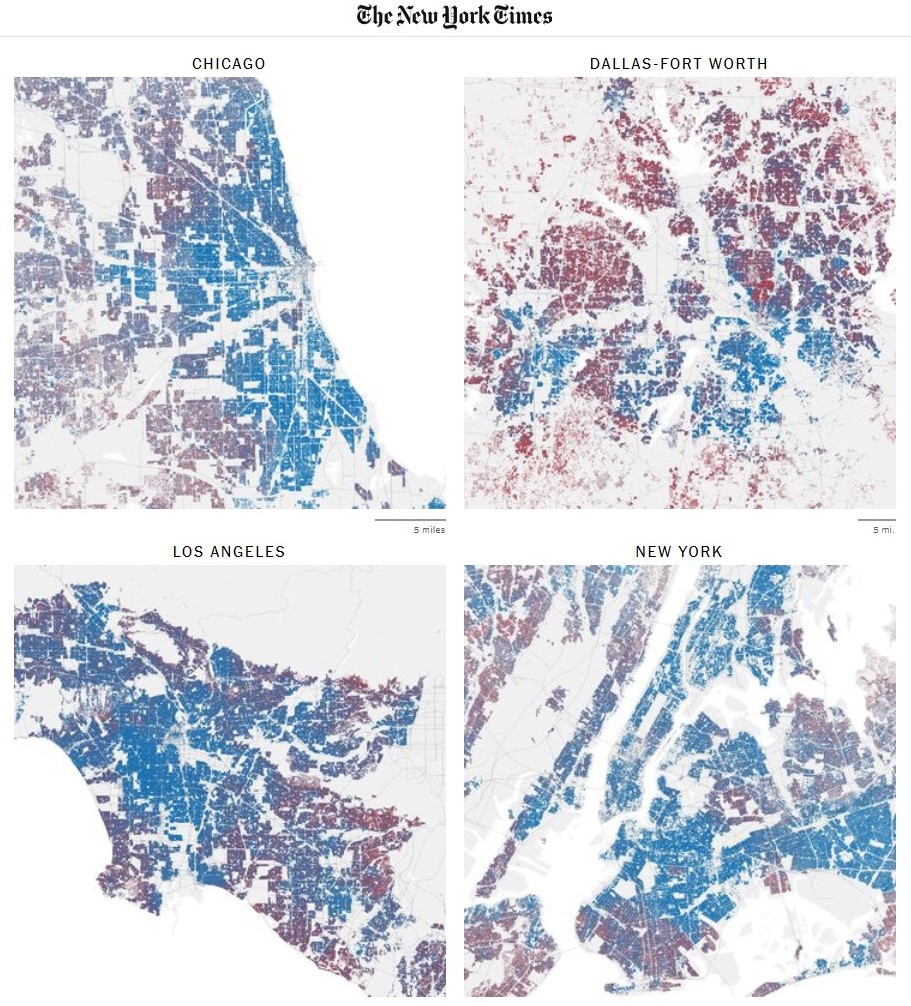
Residential segregation by race is a large issue and voting patterns in recent elections generally show Democrats winning in cities and close suburbs and Republicans winning in outer suburbs and rural areas. Put these two ideas together and you have residential segregation by political party.

https://www.nytimes.com/interactive/2021/03/17/upshot/partisan-segregation-maps.html

As new research has found, it’s not just that many voters live in neighborhoods with few members of the opposite party; it’s that nearly all American voters live in communities where they are less likely to encounter people with opposing politics than we’d expect. That means, for example, that in a neighborhood where Democrats make up 60 percent of the voters, only 50 percent of a Republican’s nearest neighbors might be Democrats.

Democrats and Republicans are effectively segregated from each other, to varying degrees by place, according to the Harvard researchers Jacob Brown and Ryan Enos. And at least over the past decade, they believe this partisan segregation has been growing more pronounced…

For each individual voter, tied to an address, the researchers looked at their thousand nearest voters, weighting those next door more heavily than those a mile away. Drawn this way, about 25 million voters — urban Democrats especially — live in residential circles where at most only one in 10 encounters is likely to be with someone from the opposite party. Democrats in parts of Columbus, Ohio, and Oklahoma City live this way. So do Republicans in the reddest parts of Birmingham, Ala., and Gillette, Wyo…

These studies together suggest that as places become more politically homogeneous, people there are more likely to conform and to publicly signal their partisanship. Maybe no one says, “I want to move here because of all these Biden yard signs.” But perhaps one neighbor is swayed by the people who put them up, and another neighbor concludes, “This isn’t the place for me.”

Lots of confounding variables to examine across a lot of locales. But, the underlying patterns are fascinating to consider: do geographic communities, even in an era of reduced neighborly contact and participation in local institutions, influence people’s political belief and behavior? With more focus in recent years on how online and social media behavior influences politics, this connection to geography has the opportunity to reinvigorate conversation about the power of local communities.

I would be interested to see how this plays out among local governments of communities with similar traits. Take a suburb closer to a big city that leans Democrat and a suburb further out that leans Republicans. Are the local decisions made that different? Do local elections look different?

Or, how often are there tipping points across communities and neighborhoods where a majority of voters are of one party or another? The patterns now show some stability but these have changed in the past and could change again in the future. What happens when they do change and does the character of the community change?

The later costs of sprawl

One writer suggests the sprawl of the Sun Belt leads to significant costs down the road:

Photo by Life Of Pix on Pexels.com

Over time, growth has reduced those advantages. Jobs and people moving to states like Texas and Georgia slowly bid up the price of land and labor. Ample spare capacity for land and transportation infrastructure — think six-lane highways — let sprawl be a growth outlet for decades, but over time congestion and distance from airports and job centers raised the cost of sprawl as well. The 2008 financial crisis arguably busted the sprawl model in the largest Sun Belt metros of Houston, Dallas and Atlanta, where until the onset of the pandemic single-family building permits had lapsed to 35% below the 2006 highs, despite those metros still having reputations for sprawl and fast growth…

What’s needed to maintain past growth momentum and meet the expectations of these new populations is a continued push up the value chain towards local economies based on knowledge work, with higher-paying jobs and college-educated workers. The specific services or investments needed to lure these types of jobs and workers will shift with the political winds — it might be a greater investment in schools and universal pre-K programs today, and transportation infrastructure tomorrow. It’s the same kind of policy arms race these communities have been accustomed to for decades, only with more services replacing low taxes as the policy lever.

For now, the most likely tweaks to the governance model will probably be incremental — stormwater improvements, sidewalk construction and other “complete streets” projects, modest increases to educational funding — simply because the votes aren’t there to raise taxes enough for the kind of revenue needed for bigger changes.

But these tensions aren’t going away. It’s eventually going to require larger investments than current leaders and older voters are willing to make. Ultimately, the choice for these communities is to spend the money needed to stay competitive in the new arms race, or lose out to places that will.

In the United States, growth is good. Communities need to grow to show that they are exciting, thriving places. New residents and businesses signal good things to come.

But, the piece quoted above notes the longer-term possibilities of such growth. What happens after the fast growth slows or ends? Is it sustainable? How do communities switch from fast growth to mature growth or stability? My own research in the Chicago suburbs suggests this is not necessarily an easy switch. When the land starts to or does run out, communities have to make important decisions. Should they grow through increased density and/or allow taller buildings? How much will it cost to maintain all of the existing infrastructure? How much redevelopment or teardowns will take place? Even during the high growth periods, the costs can increase – see battles within sprawl over the costs for new schools and who pays – let alone as the sprawling areas age.

More broadly, what happens to sprawling suburbs decades after the sprawl has ended? We can now look back at numerous postwar suburbs and see what happened. The Levittowns always draw some attention for the ways they changed and are still the same. Many of these suburbs are over a half century old (though others are newer). These communities revolve around single-family homes and driving, among other things, and this might continue for decades. Or, it might not if conditions and ideologies change.

Abolish townships or worry about turning them blue (or keeping them red)?

Illinois has many taxing bodies and government units. Illinois moved to stop creating new government bodies and DuPage County resolved several years ago to work to reduce the number of government bodies. Townships are a common target; they exist above municipal governments and below counties so are they necessary?

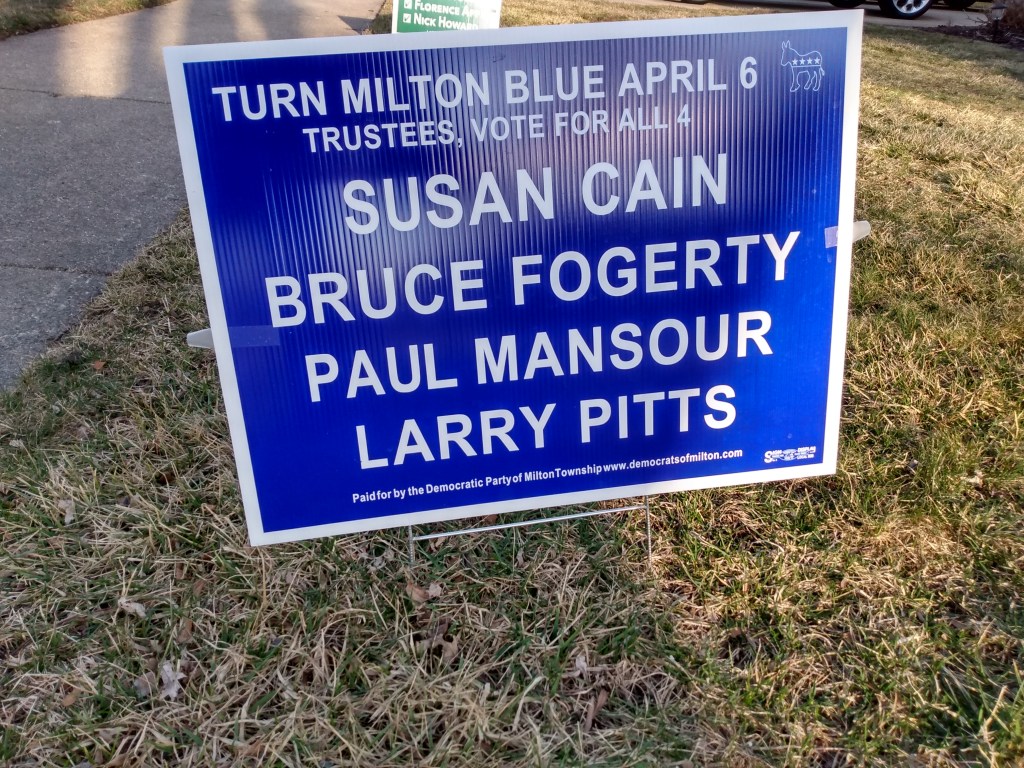
I thought of this recently with the lead-up to the upcoming local elections. On one side, I have seen signs urging voters to “Turn Milton Blue.”

This might be a strategy to boost local turnout and connect to broader political patterns. But, I do not know what these candidates want to do at the township level. What significant changes are needed?

On the other hand, I have seen campaign material for Republican candidates for Milton Township. This material listed all the things that the township does, presumably because of the Republicans there. For a party that at least talks sometimes about limited government, should they argue townships are unnecessary rather than fighting for political seats?

More broadly, how much do these township races benefit the people and communities of Illinois? In a time of budget deficits before COVID-19 plus further issues because of COVID-19, is it more important that one party or another holds the majority of seats in townships?