State of emergency over increasing homeless population in LA

The city of Los Angeles is trying to respond to a rise in homelessness:

Los Angeles recently declared a state of emergency over the city’s growing homeless population – up 12% in two years. Residents of the city’s main homeless encampment say a mix of drugs and rising rents are driving the problem…

At the last count there were 44,359 homeless people in Los Angeles County and 25,686 in the city itself, according to the Los Angeles Homeless Services Authority (LAHSA), an agency set up in 1993 to find a solution to the problem…

“Affordable housing in LA is almost non-existent,” says Mr Smith who points to recent data that suggests that the average two-bedroom unit in the city now costs more than $2,600 (£1,700) per month to rent…

“We have become a city of shanties,” says Mr Bonin, noting that homelessness has not only increased by “a whopping 12%” over the past two years but is now spreading out across the city…

Declaring a state of emergency could make it easier to find homes for residents by easing some housing restrictions and fast-tracking permits for more affordable housing.

This is a consistent issue in many American cities though few present the contrast of a glittering city – skyline, money, Hollywood, attractive weather, beaches – quite like Los Angeles. Imagine the view from afar: the same place that is home to Hollywood can be so close to skid row?

The issues here seem to be one that tend to come up in discussions of homelessness: a lack of positive ways to deal with drug use and a lack of transitional or permanent housing. It is interesting to think how the particular issue of homelessness intersects with these two other issues. Does it take an increase in homelessness for people to seriously think about affordable housing in the Los Angeles region? And what exactly does it take for a city to declare a state of emergency in this area (a certain percent increase, a total number of homeless, a certain number of other residents irritated or inconvenienced)?
When a neighborhood doesn’t want a budget version of Whole Foods

Whole Foods has selected a LA neighborhood for its first Whole Foods 365 and residents are not happy:

Let’s take a quick trip to Los Angeles’ bourgeois-hip Silver Lake neighborhood, where more than a few residents are up in arms over Whole Foods’ recent decision to not go through with a planned full-service Whole Foods but rather to build the first store in the chain’s new line of budget outlets aimed at millennials, 365 by Whole Foods Market. “Whole Foods! We want the REAL thing,” reads a Care2 petition recently posted by neighborhood resident and music executive Dawn White. “People in this neighborhood are desperate for a local high end market with the best quality foods, which are often not the 365 brand,” White wrote. Online, commenters began to call the proposed store “Half Foods.”

What is behind this reaction?

Silver Lake is not the first nor likely the last enclave where residents are literally begging for a Whole Foods. Online petitions asking for stores frequently read like crosses between market research reports, sales pitches, and letters from spurned would-be lovers. “Between the families, the young professionals, long-time residents and university students in the neighborhood, we have more than enough demand to satisfy Whole Foods,” went one 2013 plea out of Washington, D.C. As for White, her missive told the organic superstore that it was “wholly wrong” about who lived in the neighborhood. “Residents of this neighborhood can afford this,” she added.

In a world where all too many people define themselves by what they can afford to purchase and do actually buy, Whole Foods gives the sort of person David Brooks so memorably labeled bobos, short for bourgeois bohemians, validation, not to mention a bit of convenience in a busy life. It endorses that decision to drop more than $800,000 on a tiny two-bedroom Spanish or craftsman bungalow with a Viking stove or a Brooklyn brownstone that’s located near a Superfund site. A local Whole Foods is a stamp of approval from the United States’ greater corporate culture, but one that at the same time allows the people who crave it to still believe they remain just a bit outside the mainstream.

Up and coming or hip or gentrifying neighborhoods are interesting places. On one hand, they want to live on the edge with lots of cultural opportunities and relatively cheap housing. They don’t want to be conventional, typically associated with higher incomes and less nightlife. They want to be authentic, gritty, and real. On the other hand, they often want to have some markers of their success as well as amenities. This could come in the form of Starbucks, rising housing values, or even grocery stores. The presence of these upscale places or items hints at the wealth in the neighborhood and suggests it is a place worth investing in.

But, these two competing forces are difficult to reconcile. Is having a Whole Foods hip? What kind of people shop there as opposed to those who shop at budget grocery stores? Do national retail chains hint at rising land values, eventually putting pressure on lower-income residents to move? There are likely more neighborhood discussions to come as residents try to exert their influence in the direction they would like their community to go.

LA plans to add bike lanes, reduce driving lanes

The city of highways has approved plans to reduce driving lanes and provide space for biking and other transportation options:

The City Council has approved a far-reaching transportation plan that would reshape the streetscape over the next 20 years, adding hundreds of miles of bicycle lanes, bus-only lanes and pedestrian safety features as part of an effort to nudge drivers out from behind the wheel.

Not surprisingly, in the unofficial traffic congestion capital of the country, the plan has set off fears of apocalyptic gridlock.

“What they’re trying to do is make congestion so bad, you’ll have to get out of your car,” said James O’Sullivan, a founder of Fix the City, a group that is planning a lawsuit to stop the plan. “But what are you going to do, take two hours on a bus? They haven’t given us other options.”

For Mayor Eric Garcetti, the Mobility Plan 2035, as the new program is being called, is part of a larger push to get people out of their cars and onto sidewalks that began with the expansion of the mass transit system championed by his immediate predecessor, Antonio R. Villaraigosa…

Mr. Garcetti compared people who fear that removing lanes will make the streets horrific to lobsters boiling slowly in a pot: The changes may make traffic 15 percent worse instead of just 5 percent worse each year, he said, but the situation is already becoming untenable.

Perhaps only in Los Angeles would residents file lawsuits to ensure their ability to sit in big traffic jams. According to one recent study, LA area residents lose on average the second most hours a year to traffic (first is the Washington D.C. area). Of course, there is no guarantee that these changes will quickly make things easier for drivers as well as for all travelers. Yet, adding more lanes does not usually help traffic; it simply serves to add more drivers to the road.

There are some allusions in the article to the issue of social class. We might think that more mass transit options would help lower-income residents as owning a car is expensive (maintenance, insurance, gas, parking). And bicycles are pretty cheap. Yet, is urban biking primarily something desired by middle- to upper-class residents who could afford cars but want greener options? Biking often also requires a certain density so that rides aren’t too long. Thus, even good bike options may not help many people who have to travel more than 10 miles each way to work. It can also be difficult to get wealthier residents to ride buses.

While it would take much more than this plan to transform LA’s transportation network and self-understanding away from the car and highways, it will be interesting to see if this plan can keep nudging the needle toward other options.

LA may be the only US city that wants the Olympics

The Los Angeles City Council just voted to go forward with a 2024 Summer Olympics bid:

Los Angeles, which will be competing against Paris, Rome, Hamburg and Budapest among other potential cities, got the formal USOC endorsement after city council members voted 15-0 to support the bid.

The move comes after the USOC’s calamitous initial selection of Boston as its 2024 bid city, which resulted in massive public opposition and ultimately a reversal of the decision.

The potential for cost overruns that would have had to be covered by the city, in line with an agreement that the International Olympic Committee forces host cities to sign, was one of the principal concerns for Boston 2024 opponents. According to the Los Angeles Times, the new bid city’s mayor, Eric Garcetti, has promised to sign such a contract.

Recently, numerous cities have turned down opportunities to bid for the Olympics as the costs don’t seem to justify being a host. Yet, LA may have some unique advantages including a number of stadiums and venues, some mass transit, and a sprawling region that would spread out the events and locations. Could its other amenities – location in southern California with warm weather, the ocean, and nearby attractions (ranging from the desert to Las Vegas) along with being the home to Hollywood – also boost the city’s chances of being selected?

LA: both mass transit and sprawl help make the case for hosting Olympics

Gizmodo makes the case for Los Angeles hosting the 2024 Summer Olympics by noting its transportation and geographic advantages:

A transportation boom will prevent logistical nightmares

One of the most legendary tales of the 1984 Olympics was that people were so afraid of getting trapped in one of LA’s famous traffic jams that everyone stayed home or left town, allowing athletes and spectators to zip around town on empty roads. Officials could scare Angelenos off the road again (remember Carmageddon?) but they likely won’t have to: LA is in the midst of a public transit renaissance, building out several critical rail lines faster than any other American city. An accelerated timeline would mean many of those major lines will be completed right around the time of the Olympics, including a rail connection and people mover to efficiently deliver riders to and from LAX (finally). The plan says it will deliver 80 percent of spectators by transit. I think that’s totally doable.

Sprawl actually works in LA’s favor

Speaking of traffic, that’s one of the reasons Boston residents were terrified of hosting the games. Boston’s proposal centered around walking and transit, and yes, everything would have technically been very close and convenient. But that’s actually problem when you look at how dense the city is. Imagine hundreds of thousands of people trying to move around such a limited geographical area—it’s destined to be claustrophobic. Los Angeles is about 400 square miles and the venues will be clustered into four major nodes, some of them 30 miles apart. There won’t be a particular part of the city that will be completely incapacitated due to crowds.

Generally, urbanists don’t have much good to say about the current state of mass transit in Los Angeles (except perhaps pining for the extensive streetcar system that disappeared decades ago) or its famous sprawl. Thus, it is interesting to see that it could work in the city’s favor for the Olympics. It may just have enough mass transit to relieve some of the traffic and the sprawl allows for multiple sites that don’t have overlapping footprints. It could lead to other issues such as possible negative effects on residents (as noted above, both Carmageddon and Carmageddon 2 were successful) and whether it is possible to have central Olympic facilities including an athlete’s village and central gathering site.

Think of the possible slogans: “We have the sprawl the Olympics need!” Or, “Police escorts along LA highways for all Olympic athletes!”

Photo essay demonstrating LA’s mansionization

Here is a photo essay that shows the incongruity of a number of teardown McMansions in Los Angeles:

A developer wants to make as much money as he can as quickly as he can, where the only people whose feelings or quality of life he cares about are himself and whoever buys his newly-built mansion. A normal, thinking, feeling person could find many reasons why she would not want to rob her neighbor of privacy or sunlight by building a looming addition onto her house, with perhaps the most powerful reason being that her neighbors would hate her for it. A developer who will never live in a house he has built doesn’t have any relationships with neighbors to preserve. He actually stands to benefit from being indifferent/contemptuous to neighbors’ concerns, especially if it means he is able to build a bigger, more expensive, more obtrusive structure without the impediment of a guilty conscience. And don’t forget the long, noisy, messy, utterly unpleasant experience of living near a house under construction…

And that’s perhaps the biggest danger of mansionization. Regardless of what you think about mansionization and how it should or shouldn’t be regulated, there’s something about it that I’ve found to be consistently true.

When the first mansion goes up on a block of more modestly-sized homes, it sticks out like a garish eyesore. But if a second mansion is built on the same block, that first mansion suddenly doesn’t look nearly as big and out of place as it did before…

2015-07-01-1435742962-2381680-3inaRowGOOD.jpg
Three of a kindAnd at that point, the entire block might as well be mansionized — and chances are it will be. Having one mansion next to you is bad enough, but if the house on the other side of you gets mansionized, blocking sun and privacy from two sides, who would want to stay? Better to take what you can get and sell, leaving the house to a developer or new buyer who would inevitably go big — and another reminder of the now “old” neighborhood will be gone.

The critique of these new homes focuses on three areas:

1. It is often developers, and not neighbors, who go forward with the oversized homes. Neighbors might be more sensitive to the needs of others but developers are simply trying to maximize the property for profit. This may be true though there are plenty of cases where people buy properties with smaller homes and then make the decision to build a huge home. Developers aren’t the only ones to blame here.

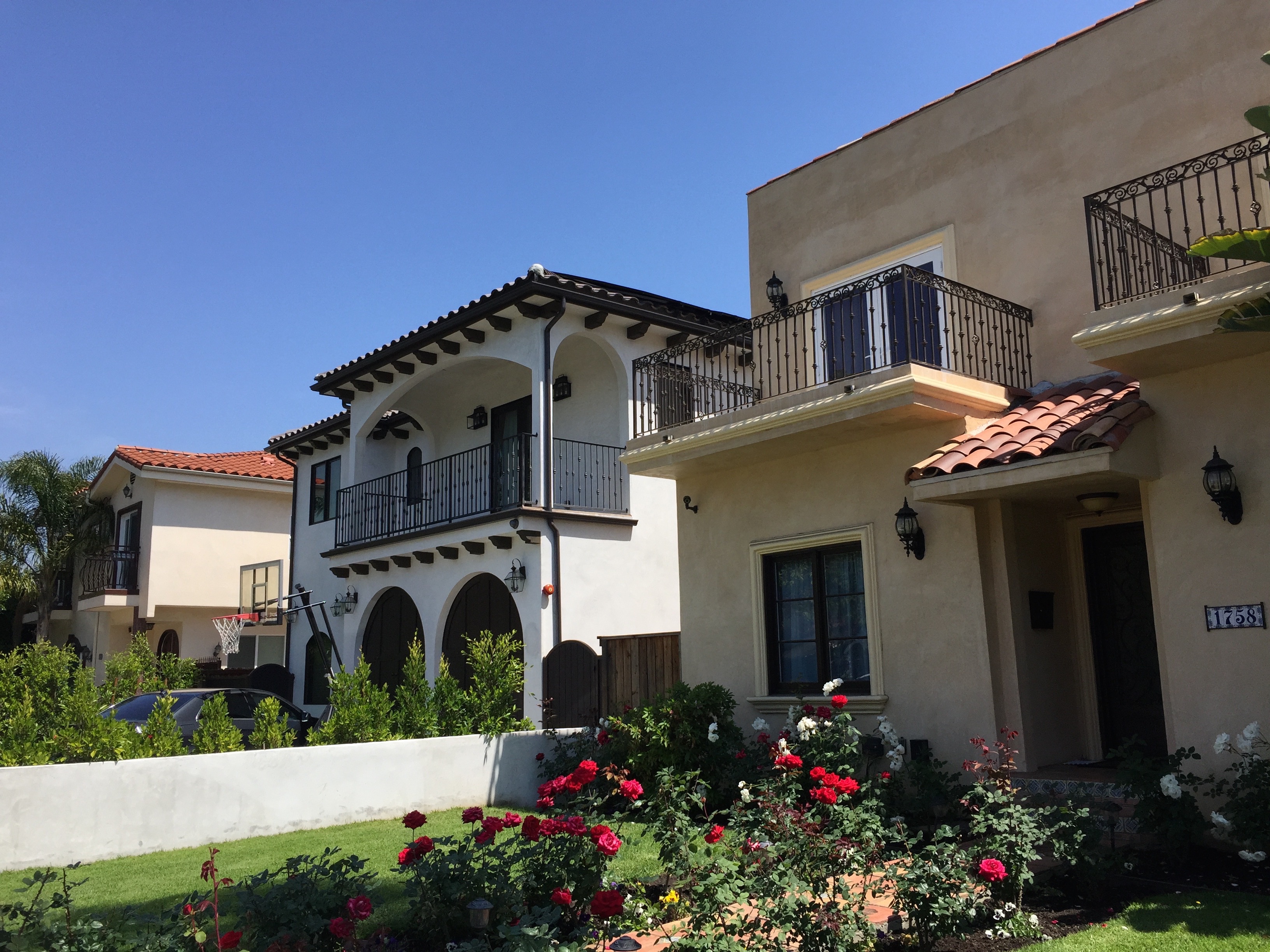
2. The architecture and design of these new large homes are lacking. The homes are unnecessarily large and depart from traditional Southern California styles (stucco, clay tile roofs, etc.). These new homes clash with the older, smaller homes.

3. McMansions spread like a contagion: once a neighborhood or block has one, newer ones are soon to follow. The hint is that the teardowns need to be stopped at the start. A number of LA neighborhoods have been pushing for housing restrictions. But, it may be that one of these homes has to be built before neighbors really rally around the cause.

Trying to move Los Angeles toward a less auto-dependent, greener, more sustainable city

To say the least, Los Angeles has a reputation as a car-friendly (and/or dominated) city. Some people are hoping to change that:

The most explicit attempt to capture the shift in the zeitgeist is the notion of the “Third Los Angeles,” a term coined by Los Angeles Times architecture critic Christopher Hawthorne. In an ongoing series of public events, Hawthorne has proposed that L.A. is moving into a new phase of its civic life. In his formulation, the first Los Angeles, a semi-forgotten prewar city, boasted a streetcar, active street life, and cutting-edge architecture. The second Los Angeles is the familiar auto-dystopia that resulted from the nearly bacterial postwar growth of subdivisions and the construction of the freeway system. Now, Hawthorne argues, this third and latest phase harks in some ways back to the first, in its embrace of public transit and public space (notably the billion-dollar revitalization of the concrete-covered Los Angeles River). Hawthorne’s focus is not specifically environmental. But a more publicly oriented city also tends to be a greener one. This is partly because mass transit and walking mean lower carbon emissions. And more broadly, willingness to invest in the public realm tends to coincide with political decisions that prioritize the public good, including ecological sustainability…

On all of those fronts, there are signs of change. One of the most obvious counter-examples is CicLAvia, the kind of phenomenon that makes Jacobs acolytes swoon. Launched in 2010, it’s a festive event during which miles of streets are closed to cars and swarmed by bikes. Taking place every two to three months, and rotating among different neighborhoods (Echo Park, the Valley, South L.A., etc.), each occasion attracts a diverse crowd of tens of thousands of people. They are the type of feel-good events—some might even call them utopian moments—where strangers smile at each other and ordinary life feels suspended. Traffic lights blink, and even cops whiz by on two wheels, wearing endearingly dorky helmets. In every sense—the car-shunning, the enthusiastic proximity to strangers, the exploration of different parts of the city—CicLAvia is antithetical to the guarded, privatized, auto-carved Los Angeles of lore.

CicLAvia remains a special occasion, but everyday transit is slowly improving as well. Banham wrote that the freeway “is where the Angeleno is most himself, most integrally identified with his great city,” and he predicted that “no Angeleno will be in a hurry to sacrifice it for the higher efficiency but drastically lowered convenience and freedom of choice of any high-density public rapid-transit system.” In 2008—pushed in part by unbearable traffic—Angelenos proved him wrong. On that Election Day, citizens of Los Angeles County voted for Measure R, which imposed a half-cent sales tax to support funding for transportation projects, including the expansion or construction of 12 rail and bus rapid transit lines. It is expected to generate $40 billion in revenue over 30 years. This choice stands in stark contrast to the famous Proposition 13, the 1978 California anti-property-tax law which has wreaked havoc on the state’s budget for public investment ever since. Jonathan Parfrey, executive director of the L.A.–based organization Climate Resolve and a former commissioner at the Department of Water and Power, told me, “The day we voted for Measure R, we voted for a new Los Angeles.”…

Starting in the early ’80s, the city got more serious about conservation, as seen in its mass conversion to low-flow toilets. The city has been responding to the current drought on a number of fronts. It has significantly reduced its own water use, especially in the Parks Department. It has offered a rebate to homeowners who replace their lawns with drought-tolerant landscaping, as well as rebates for installing rain barrels, among a variety of other measures. (It remains to be seen how the city will implement the new mandatory state restrictions.) The Department of Water and Power is also preparing a new Stormwater Capture Master Plan, and L.A. has a target of reducing imported water use by 50 percent by 2025. According to Andy Lipkis, executive director of the influential nonprofit Tree People, even in a drought, the proper technology can capture significant amounts of water—3.8 billion gallons per inch of rainfall. Mayor Garcetti just launched a corny public awareness campaign urging conservation. Contra Mulholland, the new slogan is “Save the drop.”

Early Los Angeles was a streetcar leader and the metropolitan region today is the densest in the United States (meaning that it is spread out but it is pretty dense in its spread). Yet, truly transforming the region away from reliance on cars requires a lot of work including: building mass transit (buses might be best given the roads but building light rail and subways could be more powerful in the long run even if they are incredibly expensive at this stage), approving denser development (not an easy task in a region where property values are incredibly important), developing a vibrant downtown that also includes housing units, and perhaps finding ways to deincentivize development on the metropolitan fringes.

Perhaps the best thing that could happen to Los Angeles in this area of green sustainability is the continued improvement in vehicles. Radically transforming Los Angeles may be a hard sell but slowly increasing MPG, introducing new power sources (fuel cells, hydrogen, etc), getting older cars off the road, and eventually having autonomous cars could be very helpful. Of course, those changes are not ones really made at the city or metropolitan region level but the guidelines of the state of California and the federal government may just go a long way.

Experimental no parking signs in LA replace text with graphics

Instead of relying on text to delineate times of no parking, a new design has emerged in Los Angeles:

LA's new proposed parking sign design, inspired by the work of Nikki

Nearly two years later, LA is rolling out a pilot program of signs that may do exactly that. Over the next six months, the city will install 100 new signs around downtown to test a design that condenses a hodgepodge of regulations into one easy-to-read grid.

You might recognize the design. The original concept is the work of Nikki Sylianteng, a Brooklyn designer whose day planner layout blew up on the Internet last year. Her design made the rounds on blogs, garnering attention from commiserating drivers and, evidently, city officials. She’s now working with transportation officials in Vancouver to create new parking signs. She’s also heard from officials in Columbus, Ohio, and some cities overseas. And she heard from Los Angeles councilman Paul Krekorian…

Husting thought Sylianteng’s design was a good concept to run with (Sylianteng wasn’t paid for the project). It smartly transformed a handful of text-heavy restrictions into a color-coded blocks of time that tell you exactly what you need to know: Can I park here? Green means yes, red means no. Subtle diagonal striping helps those who are color blind differentiate between the colors. It was strikingly simple. “I didn’t even consider it would get to this level of the city,” Sylianteng says. “I figured if it ever did someone would say, ‘This is such a naive idea and these are all the reasons why this can’t happen.’”…

As a technological backstop of sorts, the city has been attaching Bluetooth beacons to every new sign erected with the hope developers eventually create an app that makes parking signs irrelevant. Husting calls this “phase two” of LA’s parking overhaul. Imagine pulling up to a parking spot and having your phone simply say “yes” or “no.” Or better yet, having your car tell you. “What we ultimately hope to do—and I know this is still far out in the future—is we want to be able to go ahead and connect with your vehicle,”Husting says. Until then, signs based on Sylianteng’s design would be a big improvement.

It is interesting to think about why certain kinds of road signs do or don’t change much over time. Some become so recognizable that to change them might create all sorts of difficulty. (Imagine redoing the basic stop sign or traffic light.) But, many others could be up for reinterpretation. Here, the shift is away from text to visuals – does this only work now because the visual reigns supreme in American society?

As the final paragraph above suggests, perhaps this is just the last gasp of the parking sign until autonomous vehicles simply communicate with the parking indicators and refuse to let you park in certain places.

Wealthier LA neighborhoods use on average three times as much water

As California faces a major water shortage, a new analysis shows wealthier Los Angeles neighborhoods use much more water:

Residents in communities such as La Canada Flintridge, Newport Beach, Malibu and Palos Verdes all used more than 150 gallons of water per capita per day in January. By contrast, Santa Ana used just 38 gallons and communities in Southeast L.A. County used less than 45.

Water usage in Los Angeles was 70 gallons per capita. But within the city, a recent UCLA study examining a decade of Department of Water and Power data showed that on average, wealthier neighborhoods consume three times more water than less-affluent ones.

With Gov. Jerry Brown’s order requiring a 25% cut in water consumption, upscale communities are scrambling to develop stricter laws that will work where years of voluntary standards have not. Many believe it’s going to take a change in culture as well as city rules to hit the goal…

High water use by upscale cities is about more than lifestyle. These communities tend to have fewer apartments and less dense housing. The dwellings tend to be larger and include sprawling grounds in need of water. The UCLA study found that owners of single-family homes often over-water when restrictions are not in place.

One suggestion I’ve seen in multiple places is that municipal water in the United States is much too cheap so rates should be raised to help customers think twice. Yet, this cost wouldn’t be as much of a hindrance to wealthier residents as the wealthy can move more easily or purchase water from elsewhere. Additionally, using more water may just be seen as a necessary part of life, particularly if they see water usage as part of the good or high status life with amenities like fountains and pools or it is tied to property values. Does this mean we need regressive water rates that can be adjusted for different income levels so that the prices can properly prompt second thoughts?

More broadly, this hints at one of the less-discussed benefits of being wealthy: paying less attention to basic needs for resources like electricity, water, and gas or natural gas. Plus, they may have opportunities to profit off these resources – such as through investing in energy companies or influencing local design-making – in ways that lower or middle class residents cannot.

Temporary McMansion control in 20 LA neighborhoods

The Los Angeles City Council recently passed an ordinance limiting the construction of large homes in a number of Los Angeles neighborhoods:

The City Council unanimously passed the Neighborhood Conservation Interim Control Ordinance, which put a two-year ban on the size of new, single-family dwellings in some neighborhoods.

The ordinance temporarily limits the size of single-family dwellings in 15 neighborhoods: Valley Village, South Hollywood, La Brea Hancock Neighborhood, The Oaks of Los Feliz, Miracle Mile, Larchmont Heights, Lower Council District Five, Beverlywood, Inner Council District Five, Fairfax Area, Bel Air, Faircrest Heights Neighborhood, Kentwood, Mar Vista/East Venice and Old Granada Hills.

The law also puts a temporary moratorium on the issuance of building and demolition permits in five proposed Historic Preservation Overlay Zones: Sunset Square, Carthay Square, Holmby-Westwood, Oxford Square and El Sereno-Berkshire Craftsman District…

Los Angeles city planners are crafting new zoning codes for development in the city. Updated regulations are expected to be released in about 18 months.

The key in this ongoing battle is what the updated regulations look like. At the moment, this ordinance slows down large teardown houses in certain neighborhoods. Yet, it will still be difficult to balance property rights versus the wishes of the neighborhood groups in a few years.

Two other possible side effects:

1. I wonder if this will lead to teardowns and McMansions in neighborhoods outside these boundaries. While these neighborhoods are off-limits to some degree, the demand for housing doesn’t disappear.

2. What will happen to both the population and character of these protected neighborhoods in the next few years? Will there be population increases or decreases? Will builders and developers take their projects elsewhere? Will these places be held up as paragons of citizens rallying together to save something?

If you want a few visuals of the homes that cannot be built in the next few years, check out these five recently constructed homes at Curbed LA.