Another fear regarding outside basketball courts: spreading COVID-19

The closing of parks and recreation spaces has come as part of restrictions put in place to limit the spread of COVID-19. In reading online discussions regarding these closings and observations that some people continue to engage in group activity, multiple sports have come up. One stuck out to me: playing basketball.

I have argued in previous posts (see here, here, here, and here) that there is a lack of basketball courts in parks and community areas in many places. Even though basketball is a popular sport, there are not as many courts as there could be. Why? The people who often use such facilities are young men, not a demographic many communities are looking to see congregate regularly.

Now, there is a new reason to conspire against building basketball courts: they are public health risks when diseases like COVID-19 are present. If social distancing helps stop the spread, basketball as a sport does not lend itself to this with its close contact and relatively small playing surface. Shooting hoops in the driveway with family members is one thing; courts in parks could attract up to ten players at a time (more if halfcourt games are in process) plus whoever else might be waiting. Add in that schools are in remote learning mode and the crowds that might end up at basketball courts could prove worrisome.

Other sports regularly played in parks or other recreational activities could face the same issue. Baseball and softball games generally provide some space yet the batter, catcher, and umpire are regularly close, runner and fielders end up near other, and then there is the matter of dugouts. Soccer games take place on large fields yet chasing the ball presents problems in getting near other players. Tennis is often played at a distance but players have to occasionally come to the net. People walking, running, and biking can adjust to put more distance between them and others (unless the sidewalks or paths do not allow this).

Yet, these other sports and the spaces needed to carry them out do not always receive the same negative attention as basketball courts. In a post-COVID-19 world, will outdoor basketball courts become even more scarce in favor of recreation activities that give participants more space?

Following (or not) the latest fashionable way to revive urban spaces

Blair Kamin dismisses a proposal to create a High Line like park along LaSalle Street in the Loop in part by appealing to history:

In 1979, as America’s downtowns struggled to meet the challenge of suburban shopping malls, the flavor of the month was the transit mall. Make cities more like suburbs, the thinking went, and they’ll be able to compete. So Chicago cut the number of traffic lanes on State Street from six to two— for buses only — and outfitted the ultrawide sidewalks with trees, flowers and bubble-topped bus shelters…

A recently issued study of the central Loop by commercial real estate brokers Cushman & Wakefield floats the idea of inserting a High Line-inspired elevated walkway through the heart of LaSalle Street. But unlike the High Line or Chicago’s 606 trail, which exude authenticity because they’re built on age-old elevated rail lines, the LaSalle Street walkway would be entirely new — more wanna-be cool than the real thing…

The pathway would combat the perception that LaSalle is a stuffy, “old school” street lined by intimidating temples of finance, the study claims. “With thoughtful modification,” it goes on, “LaSalle Street can become the live-work-play nucleus of the Central Loop.”

Kamin summarizes his proposed strategy:

In short, the way to confront the central Loop’s looming vacancies is to build carefully on existing strengths, rather than reach desperately for a hideous quick fix that would destroy one of the city’s great urban spaces.

A few thoughts in response:

1. Kamin cites two previous fashions – transit malls, linear parks – and cautions against following them. But, certainly there are other fashions from the urban era after World War Two that could be mentioned including: large urban renewal projects (often clearing what were said to be “blighted” or slum areas), removing above ground urban highways (see the Big Dig, San Francisco), mixed-income developments (such as on the site of the former Cabrini-Green high rises), transit-oriented development, waterfront parks, and more. Are all of these just fashions? How would one know? Certainly, it would be difficult for every major city to simply copy a successful change from another city and expect it to work in the same way in a new context. But, when is following the urban fashion advisable?

2. How often does urban development occur gradually and in familiar ways versus more immediate changes or disruptions? My sense is that most cities and neighborhoods experience much more of the first where change slowly accumulates over years and even decades. The buildings along LaSalle Street have changed as has the streetscape. But, the second might be easy to spot if a big change occurs or something happens that causes residents and leaders to notice how much might change. Gentrification could be a good example: communities and neighborhoods experience change over time but one of the concerns about gentrification is about the speed at which new kinds of change is occurring and what this means for long-time residents.

3. As places change, it could be interesting to examine how much places at the edge of change benefit from being the first or in the beginning wave. Take the High Line: a unique project that has brought much attention to New York City and the specific neighborhoods in which the park runs. As cities look to copy the idea, does each replication lose some value? Or, is there a tipping point where too many similar parks saturate the market (and perhaps this would influence tourists differently than residents)? I could also see where other cities might benefit from letting other places try things out and then try to correct the issues. If the High Line leads to more upscale development and inequality, later cities pursuing similar projects can address these issues early on.

Fewer outdoor basketball courts, more courts in private backyards

Along my regular running routes in the suburb in which I reside, I have seen something interesting in several backyards: a private basketball court. Here is one of them:

BackyardBasketball1

I can see how these might be appealing:

1. The basketball hoop is always available for use by the people who live in the home.

2. Players do not have to go to a park or facility to play; it is convenient and easier to monitor.

3. The court can be used for other sports with a little bit of work (such as hanging a net).

4. It eliminates some grass from the backyard that would otherwise require mowing.

5. An addition like this to the lot could be viewed as good for property values in the long run.

On the other hand, this turns basketball (and other sports) into private activities. It removes the players from interactions with others in a park or more public space. It turns a leisure activity with the potential to bring people together into yet another activity Americans have taken to private spaces.

Couple the addition of private courts to backyards with a wariness about constructing basketball courts in public parks (or the addition of strange courts) and basketball – like many other sports – may be more of a private or organized activity in many suburbs rather than a spontaneous and creative activity.

SimCity, Jane Jacobs, and real estate values near the High Line

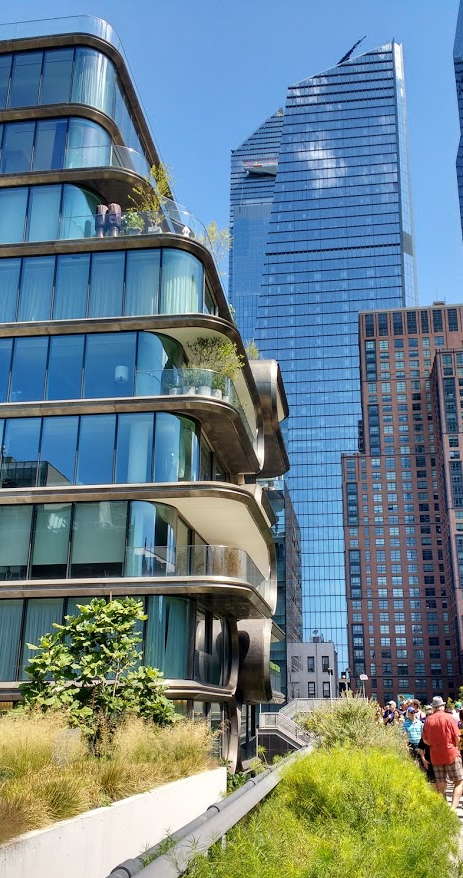
In a recent walk along New York’s High Line, I was reminded of two competing claims about how parks enhance nearby land uses.

In SimCity’s take on urban planning, building a park was a good way to help adjacent properties. If nearby residential and commercial properties suffered from low property values – perhaps due to higher crime rates or locations near industry – building a park could help enhance their values. This seems to make intuitive sense: people like being near greenery and this land use can distract or suppress less desirable land uses.

Jane Jacobs, in contrast, suggests parks are not the automatic panacea some planners suggest. More important than simply having green or recreational space is having a steady mix of people flowing through and around the park. It is human activity that makes the park, not just green space. Indeed, negative activity can thrive and recreational space can easily become part of a dull or blighted area.

HighLineAug19

In a simplistic take, the High Line seems to support both of these views. The conversion of an unused railroad line to a thriving park has enhanced nearby property values. The park is regularly filled with people – from tourists to local walkers to vendors – during much of the day. This is a success story for both the SimCity and Jane Jacobs school of urban planning.

Yet, how exactly such an urban space came about and has both positive (new development!) and negative (those same values limiting who can live nearby!) consequences is more than just plopping a park into an area that could use more development. If it worked this way, every city would have such a successful project.

HighLine2Aug19

In a complex environment like Manhattan where land is highly prized and regulated, putting together such a project takes collective efforts spanning activists, residents, local officials, developers, and others who have an interest in this land and who may have competing interests. Property values may indeed be high and the park full but the long-term effects of this on the neighborhood and the city are harder to assess.

Finding an incomplete (circular) basketball court in the suburban wild

Years ago, I wrote a piece about how communities build small, unusually-shaped, or incomplete basketball courts in an effort to limit basketball players from congregating. I recently drove by one such court in Naperville – see the unique shape of this basketball surface.

BasketballCourtCircle

The park has a circular court with three hoops. Each 120 degree segment barely has enough room before its three-point lines coincide with the lines of the other segments.

The setting of the park: surrounded on all four sides by nice houses; multiple baseball fields; a soccer field in the middle.

Why set it up this way when the park appears to have plenty of room for a larger court (I would guess there is room for at least one full-size court roughly parallel to the east-west road)? Such a court limits play largely to shooting around as any game with more than two people per side is likely going to infringe on other parts of the court. It is very difficult to use two hoops for a game.

There could be multiple answers to this. The park district wanted to make sure multiple sports were available in the park and a larger basketball court would infringe on this. Other parks provide larger basketball courts. One request for public comment from the Naperville Park DistrictOne request for public comment from the Naperville Park District suggests 13 neighborhood parks have basketball facilities (including the one depicted above). Perhaps more basketball players prefer indoor facilities (understandable given the Chicago region’s climate).

It still is an unusual court. Could a community build an irregular shaped baseball field or tennis court and get away with it?


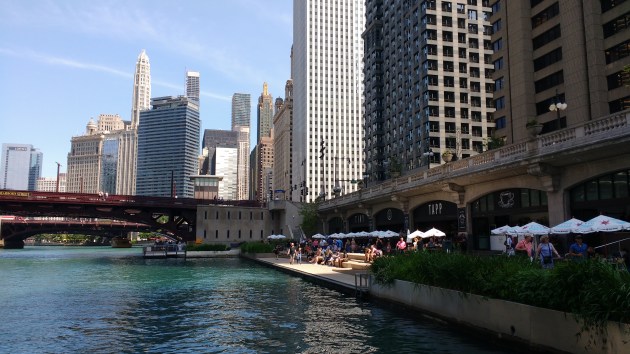
Chicago’s beautiful Riverwalk…what took so long to put it together?

On a recent beautiful summer afternoon, I had my first chance to walk the full Chicago Riverwalk.

ChicagoRiverwalk1ChicagoRiverwalk2

The city’s website suggests the plans for the Riverwalk started in the late 1990s. Why did it take so long for the idea to come together? For a city that has so much pride in its lakefront parks and protected areas, the river was overlooked for decades. In much earlier decades, economic activity was centered on the riverbanks: rail lines brought goods from throughout the region to ships and counting houses. But, it has been a long time since this activity ended and important buildings have lined this stretch for decades. If a Riverwalk can do much for places like San Antonio and Naperville, what took so long for Chicago to enhance this stretch?

If golf and football are dying sports, what would happen to that land?

I recently discussed NIMBY responses to redevelopment of golf courses but this had me thinking more broadly about land dedicated to sports and recreation: what happens to the land if the activity becomes less popular?

Golf was the sport cited in the CityLabs article:

Golf is dying, many experts say. According to one study by the golf industry group Pellucid Corp., the number of regular golfers fell from 30 to 20.9 million between 2002 and 2016. Ratings are down, equipment sales are lagging, and the number of rounds played annually has fallen.

Part of the bust can be blamed on the fallen fortunes of a single person: Tiger Woods. Golf boomed in the 1990s and early 2000s as the charismatic superstar raked in titles. Then, beginning in 2009, it faced a one-two punch of recession and bad press when its star golfer’s chronic infidelity came to light.

But the bigger story involves the sport’s aging demographics and the athletic tastes of Millennials, who just aren’t that into an expensive, poky sport that provides few health benefits. Unless the golf industry can change its ways, the decline will mean a lot of empty greens across the country. How that land is used—or isn’t—could reshape America’s suburbs for decades to come.

Beyond golf, the next sport that comes to mind is football. If youth leagues continue to see a decline in participation, less park and school land would be needed for football fields. What would then happen to that space? For a good number of high schools, that land is already shared with sports like soccer and lacrosse. Park space could simply become large fields again. But, some football facilities could be turned over to other uses (and cause NIMBY issues similar to those faced by golf course redevelopment).

What other sports could be next? Baseball still has a lot of young players but imagine that participation dries up in a few decades. Baseball fields can take up a lot of space. Could there be sports that arise and take up some of this space? Nice basketball courts would be welcomed in many places but neighbors and communities often have concerns about building these. I can think of several lesser known sports but cannot realistically imagine they would become so popular as to take up public park space or space at schools. But, perhaps parks in a few decades will include a much wider variety of sports fields and spaces to better serve a fragmented sports playing populace.

Sports spaces come and go over time. Bowling alleys thrived decades ago but now are more sparse. Skate parks started a few decades ago and now are found in many American community. Large cities have spent millions on helping to fund sports arenas but this could stop as communities realize who benefits from the stadiums. Is it too far-fetched to imagine that in a few decades very few people will play sports outdoors due to a combination of a lack of interest in physical activity, inside facilities, e-sports, and simulators that could provide similar experiences? Could parks and outdoor spaces become exclusively about “natural settings” and open land?


Testing play streets in Los Angeles

The city of Los Angeles, known for its highways and roads, is trying to turn some of its streets into areas for fun and community activity:

There are roughly 7,500 miles of streets in Los Angeles, and Fickett Street is only one of them. But in this predominantly Latino neighborhood where parks are scarce, residents and activists have begun a design intervention to reclaim streets for civic life, kibitzing and play. From London to Los Angeles, the play street concept, known as “playing out” in England, has become an international movement of sorts, especially in low-income communities that lack green space and other amenities.

The efforts in Boyle Heights, a 6 ½-mile area bisected by six freeways, is a collaboration between Union de Vecinos, a group of neighborhood leaders, and the Kounkuey Design Initiative, or KDI, a nonprofit public interest design firm that helps underserved communities realize ideas for productive public spaces.

The Los Angeles Department of Transportation has invested $300,000 on 15 KDI-designed pilot play streets this year in Boyle Heights and Koreatown, another heavily trafficked neighborhood. Seleta Reynolds, the general manager of the LADOT, first became aware of the concept while visiting Copenhagen…

On a recent Sunday, Kounkuey unveiled its “playground in a box.” Shade structures stretched across Fickett Street, affixed to loquat trees and no-parking signs, and the plastic “wobbles” created by KDI doubled as Tilt-a-Whirls, BarcaLoungers, and formidable hurdles for teenage skateboarders. Nine-year-old Amanda Alvarado built a McMansion. “Ava, lookit!” she exclaimed to her 4-year-old sidekick in pink pom-pom slippers.

This is a clever idea for two reasons. First, it transforms what is typically a thoroughfare for cars into a space for community life. Many American neighborhoods and communities are full of roads and planning that emphasizes the efficiency of getting vehicles from Point A to Point B. Even if the effort is temporary, the transformation can be a powerful symbol. Second, it does not require long-term investments into new spaces or architecture. The road already exists. Bringing in the equipment takes some work but it is portable and can also be used elsewhere.

At the same time, this seems like an incomplete concept. It feels like a small band-aid for larger issues. As the article goes on to talk about, in a neighborhood bisected by highways, lacking green space, and pushing back against gentrification, couldn’t more be done? How about permanent parks?

How skate parks became normal in America

There are skate parks in many American neighborhoods and communities and this was not necessarily a sure thing decades ago:

The Tony Hawk Foundation, a leading partner in the construction of skate parks in the United States, estimates that there are roughly 3,500 skate parks in the country now — still about a third of what it says the country needs…

In a different time, hoping for city officials to get on board with building a skate park seemed like an impossible task. Mr. Whitley said a great deal of Nimby-ism once plagued developments.

But aging Gen X grew up alongside skateboarding’s ascent in popular culture, from Bart Simpson plonking down onto the roof of the family car in the opening sequence of “The Simpsons” to blockbuster video game franchises like Tony Hawk’s Pro Skater. Skateboarding is no longer something people fear. The skate punk of the late 1980s is now a suburban dad. Across runways, and in music videos and film, subtle influences of skate culture are noticeable. Everyone wears Vans sneakers…

Iain Borden, a professor of architecture and urban culture at University College in London, wrote the book “Skateboarding, Space, and the City” in 2000. He also sees the growth of skate parks as a social phenomenon. “They’re places of social exchange,” he said. “You could argue that they’re not sports facilities, they’re social landscapes in which skateboarding and riding and scootering and blading are some of the activities that you might do.”

The recreational activities of one generation do not necessarily endure over decades so the spread of skateparks is an intriguing subject. I would be interested to see in what kinds of neighborhoods these parks exist: are they as prevalent in poorer neighborhoods or the wealthiest communities (who might opposed them on NIMBY grounds)?

I also wonder how much race plays a role in this in the United States. The examples of skateboarding cited above – Tony Hawk, Bart Simpson – are white and more middle-class. Come to think of it, many of the X Games competitors fall into this group. Since these are not exactly mainstream sports (compared to the big four of football, baseball, basketball, and hockey) plus they require a few resources (at least a skateboard while other X Games sports require more), these may not be available to all. While skateboarding might the punk music of the sports world, is it still more palatable to the white middle-class compared to having basketball courts nearby?

Adding a “highway cap” to make highway expansion more palatable

Several recent urban highway expansion projects include a new twist: putting some green space around and over the new highway.

Wheeler didn’t hesitate to acknowledge that adding lanes never helps congestion, thanks to the principle of induced demand. Instead, what he emphasized about the project is its progressive window-dressing: its cap. A few blocks of the highway would be lowered below grade and planted with a bit of Chia fuzz, with a new bike-ped crossing on one of the sides. This is the grid “restoration” of which the mayor speaks—essentially, a minor diminishment of a roaring, stinking concrete channel that will roar and stink all the more with this added capacity.

Highway caps are an ever-more common feature of 21st century urban highway projects, and this project sounds a lot like some others we’ve heard of recently—namely, the Colorado DOT project that promises to triple I-70’s footprint through two of Denver’s last working-class neighborhoods and cover a small section with a park. The project has been mired in controversy for years, with lawsuits and pleas to the governor to halt it on environmental and social justice grounds.

Ironically, the 800 square-foot “cap park” proposed for the Denver boondoggle stemmed from early community advocates who pushed back against CDOT’s original plans to simply widen the existing elevated structure. The introduction of the cap a few years ago was heralded as a victory by some residents of the neighborhoods, which have been passed over for local investments for years. But the I-70 project, with its attractive grassy mask, has since been corralled into a suite of plans to redevelop huge swaths of the affected neighborhoods.

Now, the fear of displacement, underscored by the property-value increases that highway cap parks can bring, has driven many longtime Denverites to bitterly oppose the construction. “I just hope my kids will get to play there,” said one local mom who regretted ever advocating for the project, which a Denver public policy expert compared to “old-fashioned 1950s slum-clearance.”

Parks can only do so much to cover up that highways take up a lot of space, bring noise and traffic, and can either help contribute to disinvestment or gentrification.

This sounds like greenwashing. It can take many forms in trying to beautify or distract from uglier elements of the built environment. Does a few bushes in planters in the parking lot really transform the setting and allow a visitor to escape into nature? This is the subject of part of James Kunstler’s TED talk “The Tragedy of the Suburbs” – with roughly 8:00 minutes remaining – where he dissects such parking lot plantings. Even expanding the size of the nature area, such as park in these examples, may not be enough if the surrounding land use is even more sizable.