American communities with population loss and East St. Louis

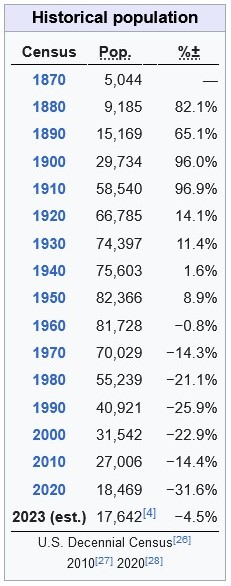
I was recently doing some research involving East St. Louis, Illinois, specifically considering the 1917 race massacre as part of a longer history of racialized property in Illinois. While doing this work, I noticed the population of the community. Here are the numbers (from Wikipedia):

As an industrial suburb across the Mississippi River from St. Louis, the community grew from a very small community to over 82,000 residents in 1950. Then came population decreases, leading to a population of under 18,000 today.

In the United States, population growth is good. It signals success and status. East St. Louis had this for the first eighty years or so of its history. But population loss is then bad. It hints that there are problems, that the community is losing status. A number of American cities and communities have experienced this since the middle of the twentieth century, often in the Northeast and Midwest and connected to the loss of manufacturing jobs. Think Detroit or Cleveland or Baltimore.

For a suburb to lose this many people also cuts across a narrative of suburban success. The endlessly growing suburbs does not apply to all communities. In inner-ring suburbs, communities with growing numbers of Black residents, and suburbs facing other concerns, the population could drop over time. Suburbs elsewhere might be growing but not in all suburbs.

How many suburbs have similar stories to East St. Louis and how do these narratives get told alongside the typical stories of suburban growth?

Questioning Census population estimates when they show declines in Illinois

A story on Census population estimates for Illinois’ communities includes some pushback against the numbers:

Photo by Thiago Matos on Pexels.com

While the 2020 census counted responses from household surveys, the annual estimates between the 10-year counts are based in part on counting births, deaths, and moves in and out, using the number of tax returns and Medicare filings.

The numbers do not reflect the recent influx of 41,000 migrants bused and flown to Chicago since August 2022. Census methodology does not account for migrant arrivals. Immigrants are typically hard to count because they may be transient, may not speak English and may want to stay under the radar, researchers said.

Oak Lawn Mayor Terry Vorderer, for one, didn’t buy the new estimates, noting that his town has added new townhomes while not losing housing stock…

Gov. J.B. Pritzker’s office also threw water on the results, highlighting past faulty counts made by the Census Bureau.

“For the last decade, the narrative that Illinois is losing population was fed, by what turned out to be, inaccurate annual preliminary estimates,” Pritzker spokesperson Alex Gough said in a statement. “Illinois remains one of the most populous states in the nation and is on the rise.”

International migration — which has risen nationwide — has nearly tripled in Illinois since 2021, Gough said. The state is in the process of challenging census data to ensure it receives adequate federal funding for programs like Medicare, affordable housing and homeland security, he added.

Is this about methods for counting populations or is this more about politics? For better or worse, these annual estimates have become media stories. Some places are gaining residents, others are losing. Communities with population loss have a hard time shaking all the associations that come with it. The implication is that population loss indicates decline and problems while growth is good.

On the other side, measuring populations is a sizable task. This is why so much effort is expended every ten years. The annual estimates have their own methodologies. They are estimates. This means there is some margin of error. These margins of error should be reported, even if the emphasis in the media continues to be on a concrete number of people gained or lost.

Census numbers might not be perfect but I would be interested in seeing the compelling evidence to suggest their estimates of population declines in some Illinois communities are far off or completely wrong.

A declining urban population does not necessarily lead to a “ghost town”

Some American cities are predicted to lose residents in the coming decades:

Bodie is ghost town Bodie by Carol M Highsmith is licensed under CC-CC0 1.0

Many cities across the United States could become ghost towns by 2100, according to new research published Thursday.

“Close to half of the nearly 30,000 cities in the United States will face some sort of population decline,” researchers from the University of Chicago in Illinois wrote in a journal article published in Nature Cities.

Major cities in the Northeast and Midwest are already slowly losing population. While cities in the South and West regions are experiencing a population increase, some major cities in Alabama, Georgia and Tennessee are slowly depopulating, the researchers found.

Cleveland, Buffalo, and Pittsburgh could see depopulation of 12 to 23 percent by 2100 while cities like Louisville, New Haven and Syracuse — not currently showing declines – likely could soon.

Many cities in the Northeast and Midwest peaked in population decades ago. This is not good for communities in the United States; population loss or even stagnation is viewed as a problem or failure. The reminder here that there are some cities with growing populations could feed into this. (Extrapolate from here and Dallas-Fort Worth will lead the country in residents soon!)

But, even more interesting is the use of the term “ghost town” in the headline and opening paragraph. Losing 20% of residents over the next 80 years is undesirable but this is different from making these communities a ghost town. These are typically empty communities. Perhaps they are communities wiped off the map.

Take Cleveland since it is cited above. If it loses 20% of its population by 2100, it would lose 75,000 residents. Even after these loses, roughly 290,000 residents would still live there. Is this a ghost town or a significantly changed city? Cleveland will continue to be a major regional center and the region has over 2 million people.

I wonder if being less sensational about population loss figures and exhibiting willingness to be adaptable to changing conditions could go a long way toward adjusting to these realities. Some cities will lose people and some will grow. Both kinds of changes mean communities change.

Evaluating population loss figures for California and its cities

Since growth is good in the United States, news that California populations are decreasing is a newsworthy item. But, how bad are the numbers? Let’s start with the absolute numbers:

Photo by Roberto Nickson on Pexels.com

Citing changes in work-life balance, opportunities for remote work and more people deciding to quit their jobs, the report found that droves of Californians are leaving for states like Texas, Virginia, Washington and Florida. California lost more than 352,000 residents between April 2020 and January 2022, according to California Department of Finance statistics.

San Francisco and Los Angeles rank first and second in the country, respectively, for outbound moves as the cost of living and housing prices continue to balloon and homeowners flee to less expensive cities, according to a report from Redfin released this month.

Angelenos, in particular, are flocking to places like Phoenix, Las Vegas, San Diego, San Antonio and Dallas. The number of Los Angeles residents leaving the city jumped from around 33,000 in the second quarter of 2021 to nearly 41,000 in the same span of 2022, according to the report.

The American Community Survey estimates California’s population at 39,237,836 at July 1, 2021. If the state lost 352,000 residents in nearly two years, that is less than a 1% population loss. Not much.

If Los Angeles lost roughly 120,000 to 160,000 residents in a year out of a population of 3,849,297 (ACS estimates) that is a 3.1-4.2% population loss. A bit more.

Perhaps the real question is how the population growth in California compares to other places. Here are the numbers:

While California experienced a major population boom in the late 20th century — reaching 37 million people by 2000 — it’s been losing residents since, with new growth lagging behind the rest of the country, according to the Public Policy Institute of California. The state’s population increased by 5.8% from 2010 to 2020, below the national growth rate of 6.8%, and resulting in the loss of a congressional seat in 2021 for the first time in the state’s history.

No population loss for the state over a decade. In fact, 5.8% growth, 1% less growth than the country as whole. Not much. The more interesting comparison might be to the state’s own population growth rate, which prior to 2020 was over 10% for every decade since it joined the United States.

In sum: the pandemic might provided several unique years for population in particular places and the state is still growing overall even as it lags slightly behind the whole country and lags more compared to its historical percentage growth. So the real problems here are (1) that there might be any population loss at all in populated parts of California and (2) the state is not experiencing a population boom like it did for much of its history. Are these truly huge causes for concern?

In the consternation over Caterpillar moving from Illinois to Texas, a reminder that the company moved from Peoria to a Chicago suburb in 2017

Caterpillar Inc. recently announced plans to move from Deerfield, Illinois to Texas. This prompted concerns about another big company (following the announced exit of Boeing’s headquarters) leaving the Chicago area and Illinois.

Photo by The Vien on Pexels.com

While this fits one narrative of Chicago, the region, and Illinois losing residents and companies to places with growing populations and more conservative business climates, this is not the only move Caterpillar has made in recent years. The company started in 1910 in Peoria and stayed there for a long time before relocating to Deerfield in 2017. Here is how the Chicago Tribune described that move:

Caterpillar will take over the former headquarters of premium spirits maker Beam Suntory, which announced plans last year to move its 450 employees and global headquarters to Chicago’s Merchandise Mart, joining corporations including McDonald’s, Motorola Solutions, Kraft Heinz, Wilson Sporting Goods and Conagra Brands that have recently moved or made plans to relocate downtown. Beam Suntory’s move will be completed by the end of June.”

“Following a thorough site selection process, we chose this location because it is approximately a 20-minute drive to O’Hare airport and convenient to the city of Chicago via commuter train, achieving our goal to be more accessible to our global customers, dealers and employees,” Caterpillar CEO Jim Umpleby said in a news release Wednesday. “This site gives our employees many options to live in either an urban or suburban environment. We know we have to compete for the best talent to grow our company, and this location will appeal to our diverse, global team, today and in the future.”…

In 2011, Caterpillar’s then-CEO Doug Oberhelman talked of moving jobs out of Illinois because of the state’s tax and spending policies. But in 2015, the company said it would stay in Peoria and build a new corporate headquarters, reassuring employees worried about a move. That changed again in January, when the company said it was abandoning plans for the new downstate headquarters.

So is this a story about Chicagoland and Illinois losing important companies or a broader example of companies responding to global markets and leaving behind long roots? Caterpillar is a company started and based in a smaller Rust Belt city for decades and now will move to two of the biggest metropolitan areas in less than a decade. How long will it be in Irving, Texas before again seeking greener pastures and business advantages?

View housing – and America? – as “a country of 384 metro areas”

Housing is all about location so why not view it as a metro by metro issue?

Photo by Maria Orlova on Pexels.com

When it comes to housing, it might be better to think about the U.S. as a country of 384 metro areas (plus 50 million Americans who don’t live in places big enough to qualify as a metro area) rather than one continuous country. In 2021, the U.S. population grew just 0.1% – the lowest annual expansion rate since our nation’s founding. But housing dynamics are best viewed through the different metro areas that are growing and shrinking. Of the 384 metro areas, 72 had declining populations in the decade leading to 2020, according to the Census.

The general argument makes some sense: supply and demand for housing depends on the metropolitan region. I have lived in one of these regions that has very limited demand for housing and experienced numerous foreclosures in the late 2000s. In places such as these, housing is cheap and plentiful – but there are relatively few people who want to move there and, if they do, there is limited desire to rehab older homes. On the other hand, the activity in particular housing markets – such as the coverage of housing and population in Manhattan and San Francisco during COVID-19 – draws all sorts of attention because of the prices and demand. All of this contributes to why housing is difficult to address at a national level.

More broadly, seeing the United States as a collection of metropolitan regions (or expanded city states?) may make some sense. For example, the 9+ million people in the Chicago region may see themselves as more of a collective than describing people from Illinois or people from the Midwest. These people share a particular housing and jobs market, common sources of information, entertainment options, a transportation network, and regional forces.

Of course, some regions may be more like other regions. Scholars have examined some of these broader collections, such as Rust Belt or Sunbelt regions or immigrant gateways, or used particular cities as models – particularly Chicago, New York, and Los Angeles – by which we can better understand all cities and regions. Yet, even these regions that share common characteristics have particular histories and current realities that would help set them apart from other.

All of this gets at an ongoing issue in sociology and other disciplines: at what point is it worthwhile to group phenomena together because of common traits or is it better to leave them as distinct entities because of their differences? There are both common traits in and a lot of variation among the 384 metro areas (plus all the other people living outside metro areas). At least for housing, it is tempting to treat each market as unique even as there are common patterns.

An additional reason to dislike Chicago McMansions: contributing to lower population density

One Chicago observer suggests teardown McMansions impoverish the city in three ways: they suburbanize neighborhoods, they are poorly built and do not fit in with the architectural context of the city, and help lower the population density of neighborhoods. More on this third point:

Photo by Jona on Pexels.com

But Chicago’s density is declining, and some of the city’s most prominent neighborhoods have actually started to lose residents. Lincoln Par, once home to 102,000 people, barely housed 70,000 in 2020. Lakeview, once holding 124,000, was at 103,050 around the same time. North Center had decreased from 48,000 to 35,114, and nearby community such as West Town and Bucktown had similar fallen in scale.

These neighborhoods are becoming more expensive, and much of this de-densification may be due to a “spreading out” of sorts; wealthier people are moving in and are able to afford more space.

But there’s more to it than that. Previously, when a neighborhood in Chicago was in demand, builders capitalized, and the housing stock swelled. Chicago’s zoning laws, however, have changed, and while they allow for high-rise development in various downtown areas, they prohibit this same approach in neighborhoods. One thing is for sure, though: No matter how strict the zoning ode is in residential areas, single-family homes are pretty much always allowed.

One theory, termed “The homevoter hypothesis,” speculates that this is due to the control that homeowners have on urban development. Their interests have the most influence on local aldermen and, therefore, residential development. The good of the community and the city is not a factor in their agenda, which instead focuses on home value growth, and how to wield zoning changes in order to achieve it.

The argument seems to make sense: those who want to live in more well-off Chicago neighborhoods bring resources and an interest in larger homes. This could mean converting structures to single-family homes or tearing down older structures and starting over from scratch. If there is indeed an increase in larger single-family homes in Chicago, there should be data to support this. Anecdotally, my occasional travels in some of these neighborhoods suggests a good number of new homes nestled between two-flats and three-flats.

Additionally, there may be other forces at work that could also be leading to de-densification in Chicago neighborhoods:

  1. Chicago residents are leaving neighborhoods faster than people want to come in, regardless of what housing stock is available. The population is down in a number of neighborhoods across the city.
  2. The demand for new housing is higher in locations in and around the Loop because of the concentration of jobs and cultural opportunities plus the activity of developers. While Chicago has been known as a city of neighborhoods for a long time, the neighborhoods might not be as hot as the center.
  3. Developers and builders also want these new single-family homes because they can make a lot of money on each property.

Put all of this together and the new Chicago McMansions represent a change to numerous streets and neighborhoods.

Fighting the 2020 Census population count in Aurora, Illinois

Leaders in Aurora, Illinois are not happy about the 2020 Census results that suggest the second largest city in Illinois lost 17,000 residents:

Aurora Mayor Richard Irvin said this week the city will continue its fight to get what it considers a more accurate census count…

[The 2020 Census] showed Aurora had lost about 17,000 residents during the past 10 years – about the equivalent of one of the city’s 10 wards – and officials have said they doubted that kind of population loss would have gone unnoticed among other city metrics, such as housing stock, water customers and traffic counts…

The big concern is that the city has estimated the new count could cost Aurora about $31 million a year in lost distributions of motor fuel tax, sales tax, income tax and money from federal programs for housing and education…

He has called for a review of the numbers by the government, and has even said the city could call for a special census down the line.

Another loss for the large suburb: no longer being able to highlight the growth of the community. Looking at the dicennial Census figures on Wikipedia, Aurora has never lost population over a decade until the 2020 count. And the growth has been particularly strong since 1990; the city had 99,581 residents then before growing to 142,990 in 2000 (43.6% increase) and then to 197,899 in 2010 (38.4% increase). In American communities, “growth is good” so a population loss is a sign of something wrong.

A special census could be worth calling for given the money and status at stake. I recall that neighboring Naperville had at least a few special censuses in recent decades as they sought to benefit from a rapidly growing population. The goal would be similar here – acquire more resources – but also different in that the population may have dropped rather than increased.

Given my own knowledge of the area, a drop of 17,000 residents does seem large. This could go against the larger trends of the region – Chicago suburbs and the City of Chicago – which slightly gained population in the 2010s.

Ghost town, suburban O’Hare industrial property edition

Ghost towns in the American West are well-known. Recognized less frequently are suburban communities or neighborhoods that disappear. A neighborhood of over 100 homes in Bensenville will be demolished to expand industrial facilities near O’Hare Airport:

Photo by KoolShooters on Pexels.com

The 106 houses where people had raised families since 1956 will be gone.

Rising in their place will be 1.2 million square feet of top-of-the-line industrial space in four buildings…

By knocking down the houses, the new owners will have a 68-acre site in a very hot O’Hare International Airport industrial real-estate submarket…

When the project was proposed, “I thought about what happened to Bensenville with the O’Hare project,” DeSimone said. He means the loss of about 600 homes and businesses near York and Irving Park roads in 2009 when Chicago bought the properties to expand the airport.

The area surrounding O’Hare Airport is desirable because of the amount of passenger and freight traffic that goes through the airport each year. Because of its particular location, the airport is near all sorts of land uses, including residences. This has caused noise problems over the years and this agreement seems to be a mixed bag: the residents got a lot of money for their money and they were not forced into the change but an established neighborhood of 65 years will be gone and the suburb of Bensenville continues to lose residents.

How will the neighborhood be remembered? Will it be commemorated in any physical way beyond the memories of the residents who used to live there? This is the opposite of what many assume will happen with suburbs and American communities. The expectation is for continual growth while population stagnation or loss is seen as undesirable. To have a neighborhood with its homes, families, and activity disappear is not a thought many would want to dwell on.

Illinois lost residents 2010 to 2020; discrepancies in year to year estimates and decennial count

Illinois lost residents over the last decade. But, different Census estimates at different times created slightly different stories:

Photo by Nachelle Nocom on Pexels.com

Those estimates showed Illinois experiencing a net loss of 9,972 residents between 2013 and 2014; 22,194 residents between 2014 and 2015; 37,508 residents between 2015 and 2016; about 33,700 residents between 2016 and 2017; 45,116 between 2017 and 2018; 51,250 between 2018 and 2019; and 79,487 between 2019 and 2020…

On April 26, the U.S. Census Bureau released its state-by-state population numbers based on last year’s census. These are the numbers that determine congressional apportionment. Those numbers, released every 10 years, show a different picture for Illinois: a loss of about 18,000 residents since 2010.

What’s the deal? For starters, the two counting methods for estimated annual population and the 10-year census for apportionment are separate. Apples and oranges. Resident population numbers and apportionment population numbers are arrived at differently, with one set counting Illinois families who live overseas, including in the military, and one not.

Additionally, the every-10-years number is gathered not from those county-by-county metrics but from the census forms we fill out and from door-to-door contacts made by census workers on the ground.

The overall story is the same but this is a good reminder of how different methods can produce different results. Here are several key factors to keep in mind:

  1. The time period is different. One estimate comes every year, one comes every ten years. The yearly estimates are helpful because people like data. That does not necessarily mean the yearly estimates can be trusted as much as the other ones.
  2. The method in each version – yearly versus every ten years – is different. The decennial data involves more responses and requires more effort.
  3. The confidence in the two different kinds of estimates is different because of #2. The ten year estimates are more valid because they collect more data.

Theoretically, the year-to-year estimates could lead to a different story compared to the decennial estimates. Imagine year-to-year data that told of a slight increase in population while the ten-year numbers provided a slight decrease in population. This does not mean the process went wrong there or in the narrative where the yearly and ten-year estimates agreed. With estimates, researchers are trying their best to measure the full population patterns. But, there is some room for error.

That said, now that Illinois is known as one of the three states that lost population over the last decade, it will be interesting to see how politicians and business leaders respond. I can predict some of the responses already as different groups have practiced their talking points for years. Yet, the same old rhetoric may not be enough as these figures paint Illinois in a bad light when population growth is good in the United States.