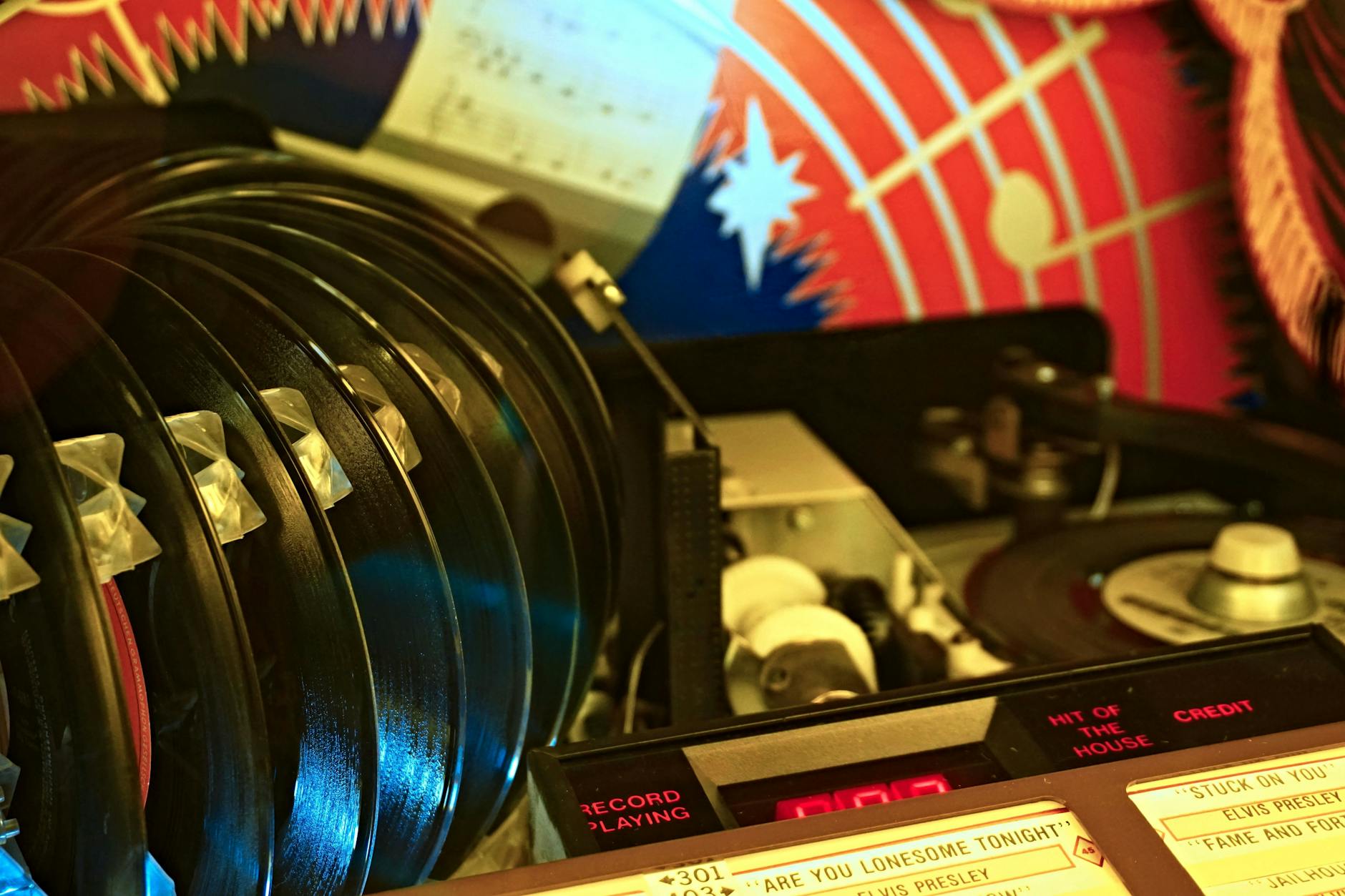
By the early 1940s, about 500,000 jukeboxes dotted the country, sometimes inspiring too much of a ruckus: Newspapers frequently reported on bar fights over music selections and complaints about noise. Snootier critics, meanwhile, voiced more petulant grievances: “The contrivance is everywhere and is always booming its inanities,” one Los Angeles Times writer lamented in 1941.
Private spaces have multiple options for providing music. They could use a speaker system to play music (radio, recordings, etc.). They could have live music. They could go with silence. A jukebox puts the control of the music into the hands of the visitor or customer, letting them select songs.
Alternatively, consider the options visitors to spaces have in more recent decades. Each person can choose their own music without subjecting others to it. A Walkman allowed for hearing the radio or a cassette, a portable CD player for a CD. The spread of digital music – MP3 player, smartphone with built-in storage or streaming music – provided even more private options. Go with headphones or earbuds and someone could be in their own aural world even with a blaring jukebox.
Could having a common aural experience bring people together in ways that separating them into their podcast/music/Youtube streams does not? Not everyone would necessarily like what was playing on the jukebox near them but they would be exposed to the same music as everyone else. And then they could put something on the jukebox for others to hear. Of course, the limited selection of the jukebox and the processes that go into getting records into the jukeboxes might lead to a more homogeneous musical experience.
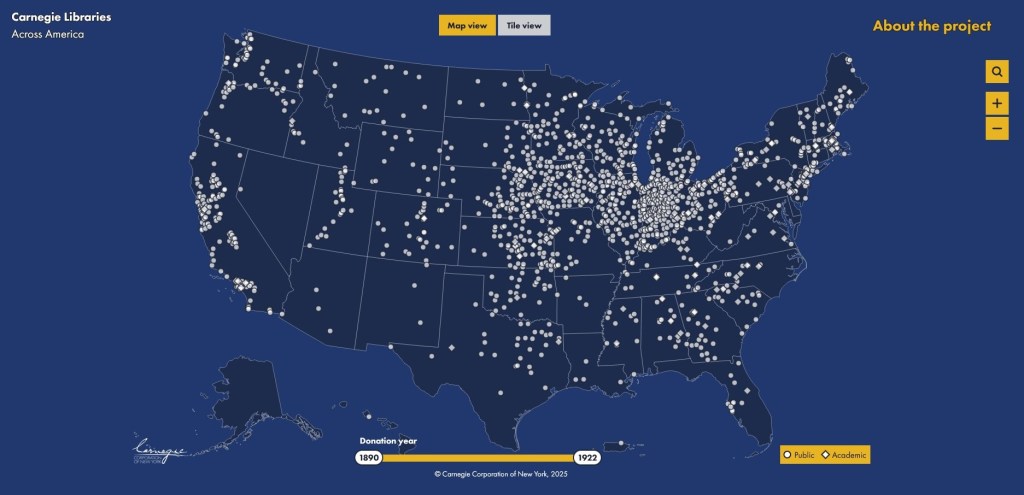
I have not studied this beyond the map but I am intrigued that the map seems to show a lot of libraries between roughly western Pennsylvania through Nebraska. The Midwest has a lot of libraries, except for Missouri which seems to have fewer. There are some pockets of libraries elsewhere; northern California, the Northeast. But Indiana, Illinois, Ohio, Minnesota, and other midwestern states have a lot of libraries.
Why the Midwest? A few ideas come to mind:
Its population is growing rapdily at this time. (Population growth in the South and West would come later and the East Coast already had established communities.)
Did Carnegie’s life in Pittsburgh connect him to life in other midwestern locales or familiarize him with midwestern values?
These communities valued civic institutions, like libraries.
If someone had come along in the 1960s and wanted to help fund civic buildings, how much different would the map look?
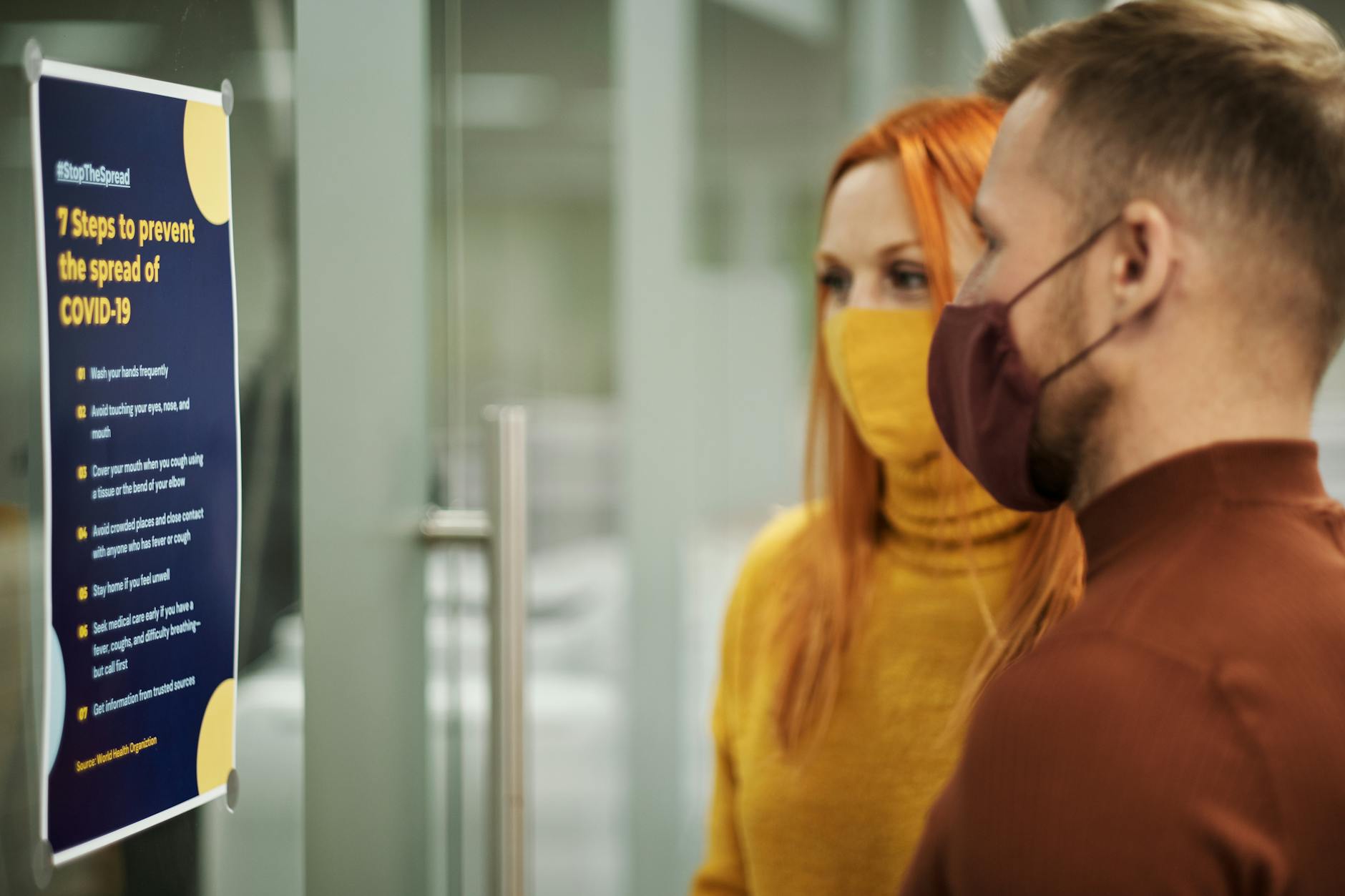
Beginning in 2020, COVID signage and equipment were everywhere. Stickers indicated how to stand six feet apart. Arrows on the grocery-store floor directed shopping-cart traffic. Plastic barriers enforced distancing. Masks required signs dotted store windows, before they were eventually replaced by softer pronouncements such as masks recommended and masks welcome. Such messages—some more helpful than others—became an unavoidable part of navigating pandemic life.
Four years later, the coronavirus has not disappeared—but the health measures are gone, and so is most daily concern about the pandemic. Yet much of this COVID signage remains, impossible to miss even if the messages are ignored or outdated. In New York, where I live, notices linger in the doorways of apartment buildings and stores. A colleague in Woburn, Massachusetts, sent me a photo of a sign reminding park-goers to gather in groups of 10 or less; another, in Washington, D.C., showed me stickers on the floors of a bookstore and pier bearing faded reminders to stay six feet apart. “These are artifacts from another moment that none of us want to return to,” Eric Klinenberg, a sociologist at NYU and the author of 2020: One City, Seven People, and the Year Everything Changed, told me. All these fliers, signs, and stickers make up the “ghost architecture” of the pandemic, and they are still haunting America today…
The contradiction inherent in ghost architecture is that it both calls to mind the pandemic and reflects a widespread indifference to it. Maybe people don’t bother to take the signs down because they assume that nobody will follow them anyway, Fessler said. Avoidance and apathy are keeping them in place, and there’s not much reason to think that will change. At this rate, COVID’s ghost signage may follow the same trajectory as the defunct Cold War–era nuclear-fallout-shelter signs that lingered on New York City buildings for more than half a century, at once misleading observers and reminding them that the nuclear threat, though diminished, is still present.
I have noticed these leftover signs as well. I recently spotted a retail shop with a sign saying that people without masks were not allowed inside.
There are numerous ways to pass along a message in a large complex society and signs are one way to do so. But, this assumes people will read the signs and then act on them. I have read a little about road signs and how too many signs can make for clutter and less attentive drivers. Is the same true for public health warnings in every public space? How well did people follow these directives? How many people follow the hand washing signs when they are posted in many restrooms (with specific warnings for employees)?
Another way to address this would be to redesign spaces so that there are fewer opportunities to be within such proximity to others or to limit the possible problems of proximity. However, many of our public and private spaces are pretty open. A bank lobby has lots of open space. Grocery stores have rows but these do not go up to the ceiling and checkout areas are right next to each other. Entertainment spaces, like movie theaters and stadiums, put people in proximity to others. And so on. It would be very difficult to address all of these and try to retain some sense of public interaction and space.
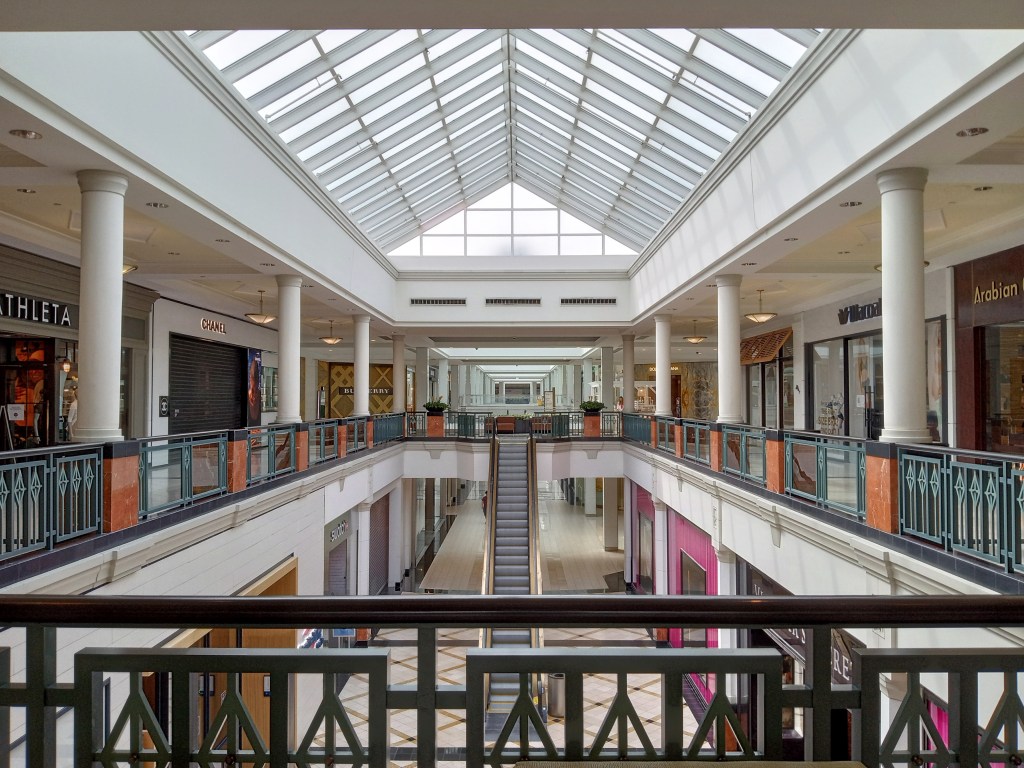
Meet Me by the Fountain challenges the dominant narrative. Lange wants us to consider how in prematurely writing off the mall as dead, or in thinking of it as “a little bit embarrassing as the object of serious study, ” we neglect the important role these buildings have played in our lives. At their best, malls have always been more than just sites of conspicuous consumption and leisure, but places for communities to gather, to see and be seen, fulfilling a “basic human need.” Lange’s book reminds us that the mall has helped shape American society, and has evolved with our country since the 1950s. And she posits that there’s still a place for malls in our society, as long as they adapt to better serve their communities.
Malls grew alongside—and because of—the federally subsidized postwar expansion of the suburbs. “The late-twentieth-century United States doesn’t make sense without the mall,” Lange writes. If the American dream was owning a detached house for your nuclear family, the mall was where you bought the goods to fill your home and clothe your kids. Malls became the suburban equivalent of downtown shopping districts. But while malls, like their city counterparts, serve as public spaces, they are privately owned and policed, and any sense of community that one gets from spending time at them is always secondary to the primary pursuit of consumption…
And yet, despite these problems, Lange reminds us what the mall gave us in the past and explains why she sees in its form hope for a future of adaptive reuse, in which these spaces will “embrace their public role” rather than try to privately control who can use them and how. Lange argues that malls should be repurposed for walkable mixed-use developments that combine the residential, commercial, and public. The behemoth shells of anchor stores—the department stores that sat at the ends of corridors—could enclose food halls, entertainment-centered businesses like trampoline parks, or public libraries; parking lots could be repurposed for senior-housing units. These places would still be malls, but ones that are more experience-driven and less shopping-centric…
This kind of ambivalence is all over Meet Me by the Fountain. Lange’s ultimate vision for reusing the space of malls might be one that largely repudiates a singular focus on commercialism, but she doesn’t discount shopping and what it can do for us. She argues that we “find freedom in shopping” for our “true selves,” and that malls have given us more than just self-expression. They are what Ray Bradbury, in a 1970 essay in West: The Los Angeles Times Magazine, called “Somewhere To Go”: a place that draws people together, that creates a de facto community.
Two features of this summary stand out:
The shopping mall as it is known in the United States is part of suburbia. Even though malls can be found in major cities, they started in suburbs and are primarily found there.
If this was a “chicken and the egg” question, the answer seems clear: suburbs came first and then shopping malls developed in that context. The shopping mall even co-opted the department store, the urban shopping emporium that emerged decades earlier in rapidly growing cities.
The enduring tension, described in this review, seems to be this: can malls ever truly become places for the whole community or are they primarily profit-centers where some enjoy shopping together and gathering around other shoppers? Or, to put it in other terms, can shopping malls ultimately serve people and not just markets?
When an anonymous Black person enters the white space, often the people there immediately try to make sense of him or her – to determine “who that is”, or to figure out the nature of the person’s business and whether they need to be concerned. When the Black person is unknown, stereotypes can rule perceptions, creating a situation that can estrange the Black person. In these circumstances, almost any Black person can experience distance, especially a young Black male – not as a measure of his merit as a person but because of his Black skin and its indication of “outsider” status in the white space. Thus, such a Black person is burdened with a deficit of credibility, especially in comparison with their white counterparts.
Strikingly, a Black person’s deficit may be minimized or tentatively overcome by a performance, a negotiation, or what some Blacks refer to derisively as a “dance”, through which individual Blacks may be inclined to show white people and others that ghetto stereotypes do not apply to them personally; in effect, they perform for credibility or for acceptance. This performance can be as deliberate as dressing well and speaking in an educated way or as simple as producing an ID or a driver’s license in situations in which this would never be demanded of whites…
In the minds of many of their detractors, to scrutinize and stop Black people is to prevent crime and protect the neighborhood. Thus, for the Black person, particularly young males, virtually every public encounter results in a degree of scrutiny that a “normal” white person would certainly not need to endure.
A more subtle but critical version of this kind of profiling occurs in the typical workplace. From the janitor to a middle-level manager, Black people, until they have established themselves, live under the tyranny of the command performance. Around the office building, the Black male worker comes to be known publicly as “the Black guy in my building”, and if there are a few such “Black guys” working there who “roam” the premises, white workers at times confuse one with another, occasionally misidentifying the person by name. Given such racial ambiguity, the string of white people standing in line to witness the Black person’s performance, or “dance”, may encourage those who were once approving or convinced to demand an encore. Thus, as long as the Black person is present in the white space, he or she is likely to be “on”, performing before a highly judgmental but distant audience.
While I have not read this forthcoming book, this strikes me as a companion work of sorts to The Cosmopolitan Canopywhere Anderson examined spaces where people of different racial and ethnic backgrounds could regularly interact. In those relatively rare settings, people could encounter each other and generally enjoy it.
In contrast, Anderson now highlights the ways in which Black people are not welcomed in numerous spaces. This is not just about abstract spheres in society; this is about physical arrangements and the ways that race matters for who can be there.
There is a lot to explore here and I look forward to the book. In a typical city or suburb, how much space is primarily for whites and policed in the ways Anderson cites above?
Each of these metrics basically reports the same thing: A huge and prolonged decrease in the total number of hours people spent out and about in the American city. This decline peaked in April 2020, but urbanites stayed sedentary throughout the year, relative to 2019.
For crime data, the duo used statistics from New York, Los Angeles, and Chicago, which enabled them to sort for violent crime that occurred in public—a category that included streets, parks, alleyways, commercial establishments, and offices.
The results: From March to December, 2020, public violence in the three cities was 19 percent lower than it had been in 2019. But when put into the context of how little Americans left the house that year, that data takes on a different significance. In April, for example, violent street crime fell by 30 percent—but the risk of being a victim of such a crime rose by almost 40 percent. A similar pattern held for the whole year: Even as street crime fell, the risk of being a victim of a crime rose between 15 and 30 percent over the previous year, depending on which measure of “outdoor activity” was used. In short, if you spent time in public, you were more likely to be robbed or assaulted in public in 2020 than in 2019.
For what it’s worth, that risk remained very, very small: 12 violent crimes per million outdoor hours, or more than 80,000 safely-spent outdoor hours for each violent crime.
This is an interesting way to think about perceptions of crime: even if fewer crimes were committed, they might feel like more if there was less activity. This reminds me of some of the images going around from the early days of the COVID-19 pandemic of empty streets and cities. Once busy places simply did not have people. How did this affect perceptions of safety in public settings?
Would the same idea apply to media reporting on crime: because of a lack of other public activity (beyond COVID-19), did crime receive more attention even if there were fewer crimes? Perceptions of crime might be more important than the actual statistics themselves. Americans can be fearful even as numbers go down.
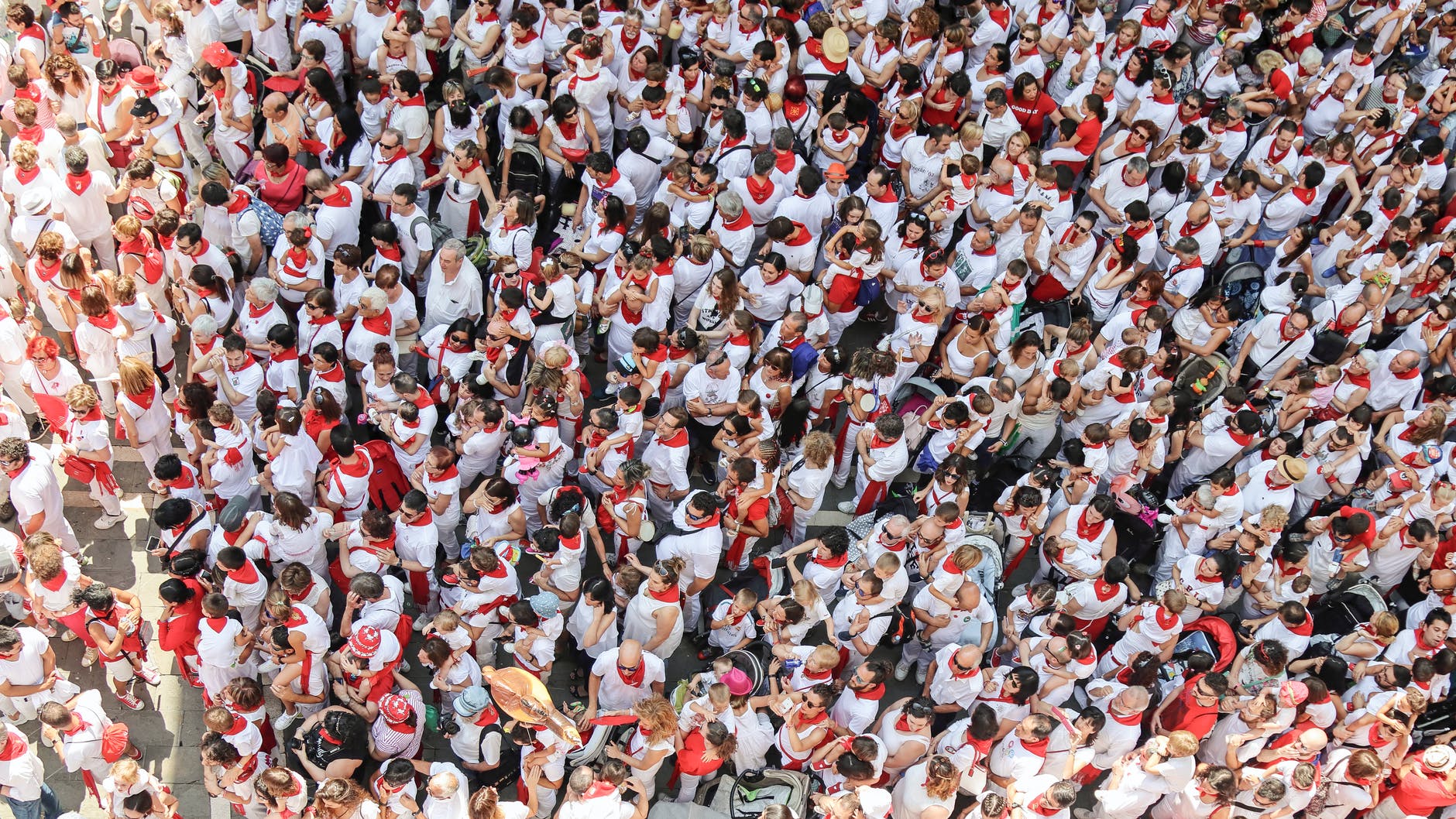
I don’t know what to make of all this, and I doubt if there is anything to be made. But the behavior on display is, if nothing else, a product of a lack of sense. It’s the agitated, aimless buzzing of the type of crowd that gathers in the aftermath of some bewildering catastrophe. Social scientists have a name for this mode of chaos: They call it “milling.” We are all just chattering away in restless and confused excitement as we try to figure out how to think about what’s happening. We want to understand which outcomes are most likely, and whether we might be obligated to help—by giving money or vowing not to share misinformation or learning the entire history of global conflict so as to avoid saying the wrong thing. We are milling.
The word comes from the mid-20th-century American sociologist Herbert Blumer, who was interested in the process by which crowds converge, during moments of uncertainty and restlessness, on common attitudes and actions. As people mill about the public square, those nearby will be drawn into their behavior, Blumer wrote in 1939. “The primary effect of milling is to make the individuals more sensitive and responsive to one another, so that they become increasingly preoccupied with one another and decreasingly responsive to ordinary objects of stimulation.”
These days, we mill online. For a paper published in 2016, a team of researchers from the University of Washington looked at the spread of rumors and erratic chatter on Twitter about the Boston Marathon bombings in the hours after that event. They described this “milling” as “collective work to make sense of an uncertain space” by interpreting, speculating, theorizing, debating, or challenging presented information.
To apply the term to the current moment may be a little sloppy—for a sociologist, milling would be the precursor to meaningful group action—but it gets across, you know, the current mood. We’re emoting, lecturing, correcting, praising, and debunking. We’re offering up dumb stuff that immediately gets swatted down. (We’re getting “ratioed,” as it’s called on Twitter.) We’re being aimless and embarrassing and loud and responding to each other’s weird behavior. “People are kind of struggling to figure out appropriate ways of responding to this really uncertain situation,” Timothy Recuber, an assistant sociology professor at Smith College, told me. Recuber, who is also the author of Consuming Catastrophe: Mass Culture in America’s Decade of Disaster, is an expert on the role that media play in what he calls “unsettled times.” And in these unsettled times, he said, we’re engaged in something like what Blumer had in mind.
The wisdom of crowds as an emergent property in the midst of uncertainty?
I wonder how this milling has changed over time. Specifically, I am thinking about spatial changes in the United States over the last century or so. Milling could work better when people live either in denser areas or small towns. This could lead to having “the public square” described above for people to gather. In a more suburban setting, where a majority of Americans now live, where would milling take place? Walking outside their house or residence might put them in contact with some neighbors but it would take some driving for many to get to a location where people might gather. Go to the shopping mall? The local library? Walmart?
If suburbanization reduced public spaces for gathering and add to this fewer people going to work during COVID-19, the online sphere offers more opportunities. The physical geography matters less when people can enter an online public square from anywhere. Now, there are numerous public squares available online with certain platforms or sites offering different opportunities and population with which to interact.
How effective is this online milling as opposed to milling in a offline location? In the offline public square, there is an embodied experience with people. The online public square is different with fewer cues from other actors and someone has to say/do something to be recognized.
One risk is that the infusion of tech money winds up making these independent businesses look and feel a lot more like chains. “The more you become digital, the more connected you are to the internet,” Lehr said. “The more connected you are to global trends, the more pressure you feel to do certain things.” The Indian start-up Jumbotail allows shopkeepers the opportunity to open one of the company’s branded J24 convenience stores, and S. Karthik Venkateswaran, Jumbotail’s co-founder and CEO, told me he envisions a world where consumers pass four different J24 stores throughout the course of their day. “Ubiquity is extremely important to us,” he said, but added that owners can still customize many aspects of their operations. “Every single store is different.”
But the other possibility is that by partnering with tech companies, these mom-and-pop shops might avoid the fate of getting squashed by giants like Walmart and Amazon, which can afford to sell the same goods at lower prices. To a certain degree, that’s already happened in the U.S., where Americans have been lured away from small businesses by the conveniences of Amazon Prime. “We would love to have Morocco and developing countries have a different fate,” Belkhayat said.
In the global South, millions of these beloved stores could one day end up part of a new digital economy that looks distinctly different from that of the West. Instead of transitioning to big-box retailers, communities will continue relying on the same shops they have for generations, but they’ll have evolved into futuristic outposts that double as tiny warehouses, banks, and grocery-delivery hubs. At least for now, the global tech industry has landed on the oldest trick in the book: If you can’t beat ’em, join ’em.
This choice – either partner with the big retailers or with the tech, finance, and other industries – is an interesting one. It certainly speaks to globalization in multiple ways. In terms of goods, these corner stores sell numerous important items and can provide key hubs for goods or services within a community. As those on the global scene look for ways to invest and make money, the corner store might be a goldmine. And the reach of products and finance and tech around the globe speaks to the numerous connections between people, organizations, businesses, and more. Then, each individual store might have the opportunity to stand out within its particular setting and because of the proprietor even as it slots into a global system.
I would also be interested to hear more about corner stores as local community institutions. In a private society like the United States, there are limited public spaces and shops are not always local or inviting. While a store involves private business transactions, it may also be a regular place for people to interact or utilize important services. If it provides local banking functions, this might involve might private individuals and communal activity.
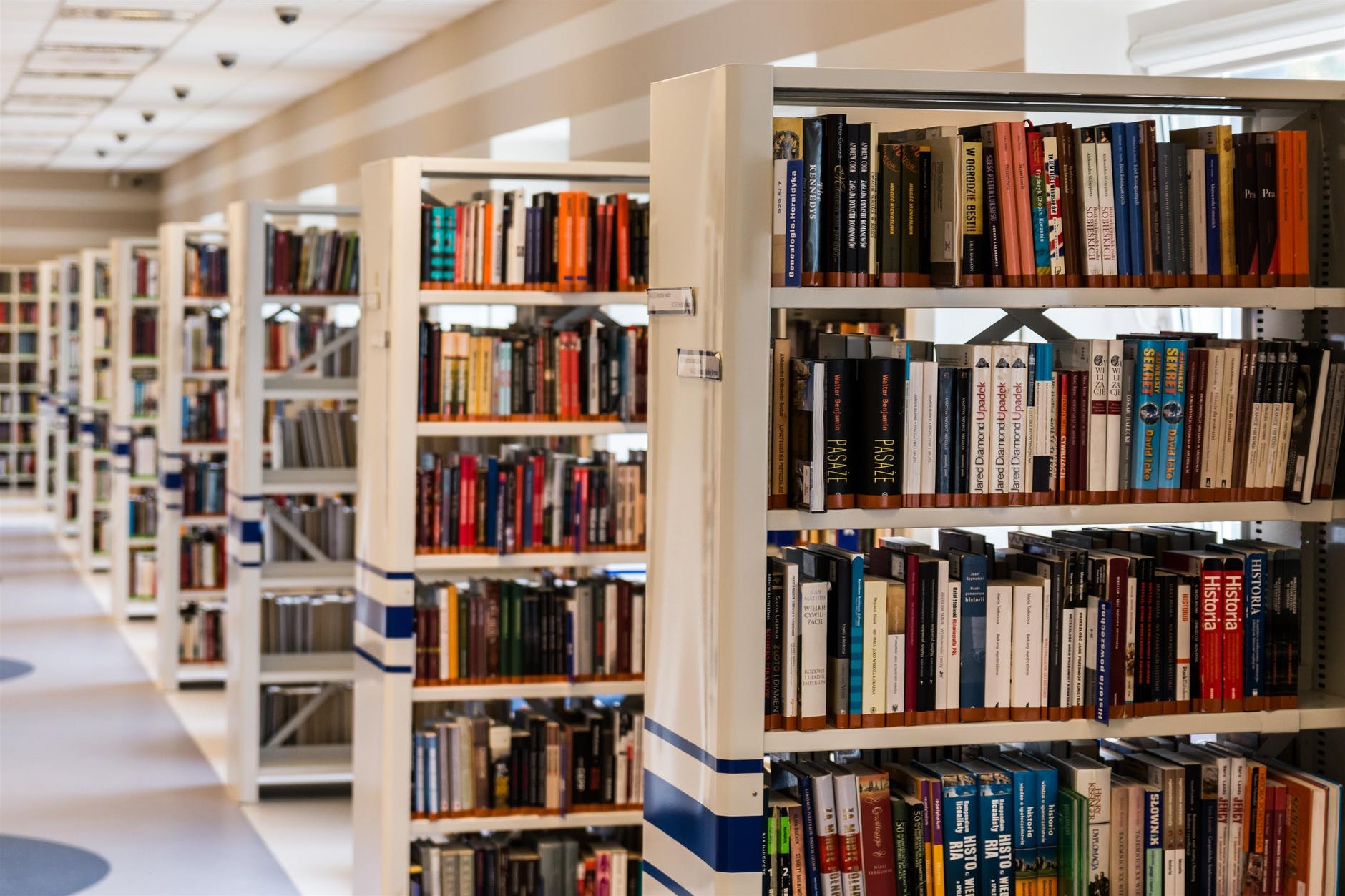
This Thanksgiving, I am thankful for libraries. Throughout my life, public libraries and school libraries have provided endless hours of reading, learning, entertainment, and programs. While sociologist Eric Klinenberg celebrates libraries as important public spaces, I am grateful for their physical presence as well as the knowledge they contain and provide for users in a variety of formats. Here are some ways libraries have mattered in my life:
-As a kid, my family would go to the public library in our community once a week. The first public library was a home that had been converted into a library. It had did not have much open space but there were plenty of books to pique my interests. I recall leaving with large stacks of books to read. The second and current public library was a completely new space with more openness that enabled larger collections, providing plenty of material for me to find.
-I have experience with two academic libraries and have benefited greatly from my interactions with both. One of the underestimated perks of involvement with colleges and universities is the ability to access so much material, both on-site and from other libraries. I have used these borrowing privileges a lot, enabling research and learning from thousands of materials that would have been difficult or impossible to obtain otherwise. While I have not used library space for studying as much as some, it is always helpful to have a place to go where learning is encouraged.
-Now with my own kids, the library provides learning, opportunities, and materials to enjoy at home. The fun it is to browse through books, new areas of knowledge, and activities all in one building. I hope they enjoy both the library as a space different than other spaces and a place to enjoy learning.
In sum, I think libraries are worth every penny of my individual tax dollars as well as deserve the support of the full community. Even in a world of smartphones and computers that can provide you access to information and material in no time, having a physical space dedicated to learning and books remains very important.
(One note: none of my school libraries pre-college stand out to me. This could be partly due to my reading choices when younger which veered more toward non-fiction. Or, perhaps because of my time in them was part of organized activity as opposed to operating on my own.)
“Our democratic heritage goes back to ancient Greece, and so it stands to reason that when America was born, so to speak, in the late 18th century, municipal buildings referred to the Greco-Roman architecture, with the pillars and pediments and cornices,” he says. But as the country matured, different forms of architecture began to emerge. “Then it becomes, ‘Do we still embrace the neoclassical style architecture, or do we start embracing our own time?’” he adds. (That argument more recently played out at the federal level, when former President Donald Trump tried to make neoclassical architecture the default style for all national buildings in his controversial “Making Federal Buildings Beautiful Again” effort.)…
In many of these examples, governments used their city halls to express civic pride, and to be “at the forefront of progressive building technologies and changing architectural styles,” architectural historian Thomas Mellins writes at the beginning of Drooker’s book…
Regardless of the architecture, there is a recognition among mayors and architects that municipal buildings are ultimately places for the people, and that the designs need to convey a message of approachability. In San Jose’s new city hall, which opened in 2005, Richard Meier’s postmodern design made extensive use of glass, making a statement about government transparency as well as energy efficiency. The building’s unusual three-part structure emphasized that theme: There’s the rotunda and the city council chamber, and in between them at the heart of the complex is an open plaza that then-mayor Ron Gonzales and his administration wanted toserve as the “people’s living room.”
Public or civic buildings present a unique opportunity to highlight particular values and create public space to be used and enjoyed. This can be done in a variety of architectural styles or forms, affected by trends in architecture, regional differences, the size of the community, the resources available, and more.
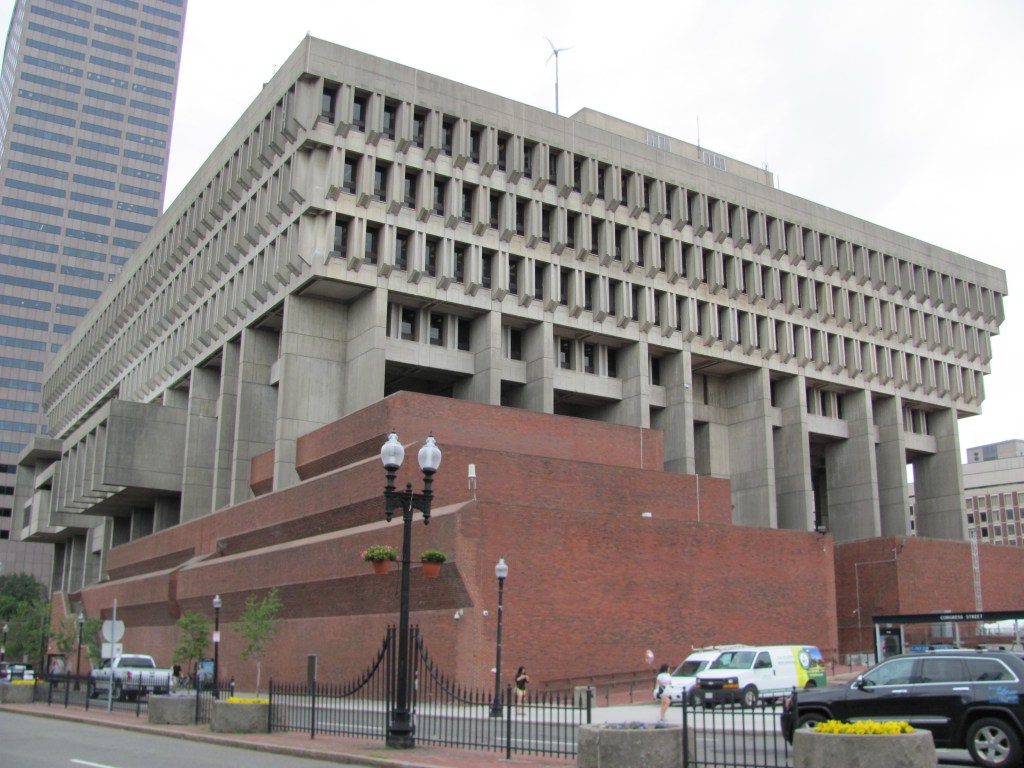
This reminds me of James Howard Kunstler’s critique of Boston’s City Hall, a building designed by noted architect I. M. Pei. Kunstler argues that the space is not inviting and not a worthy public space. The Brutalist architecture does not necessarily invoke warm fuzzies about local government.
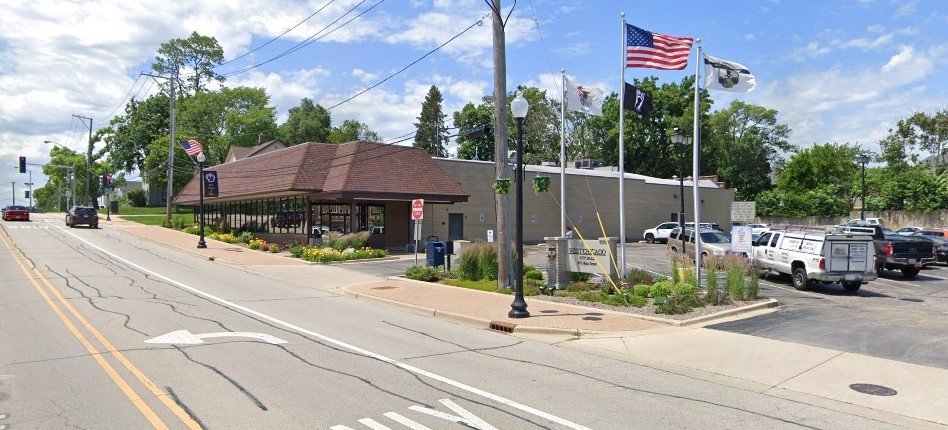
In contrast, many suburban communities opt for modest city halls in either more traditional styles or simpler postwar forms. Many suburbanites like the idea of smaller local governments and the suburban structures can highlight tradition and/or efficiency.
West Chicago City Hall depicted on Google Street View.
Part of the approachability of these a city hall or civic building involves how well they fit with the surrounding landscape. A Brutalist building could be more approachable with lush greenery around it. A plain suburban city hall could be more inviting if it did not sit behind a large parking lot. More broadly, American communities would benefit from inviting public spaces that are connected to civic buildings.

 Legally Sociable