Growing up in the era of peak suburban shopping malls and movie theaters

Growing up in the 1990s, I and other residents of my suburb did not lack for choices when it came to shopping malls and movie theaters. While our suburb itself was not home to a theater or shopping mall, within a 10 mile drive, we could access at three shopping malls (with several more within a few more miles) and numerous smaller shopping centers and at least five first-run movie theaters and several additional second-run theaters (with more just beyond those 10 mile boundaries).

Photo by Pavel Danilyuk on Pexels.com

This provided lots of options. Did we want to see the latest blockbuster (with a good string of these in the mid to late 1990s) at a new 16 or 24 theater location? What kind of store – national chain, anchor department store, local business – did we want to visit at the mall and perhaps we could find food there?

This era is over. There are still shopping malls and movie theaters around. I do not lack for options if I were to look up theaters and malls near me. But, there are fewer within that ten mile radius: two of the three malls closed and multiple movie theaters closed or downsized from megaplex size.

And if I go to these places, the experience is different and the world has changed. Both are often less lively. People have more options, particularly at home. They can shop with their smartphones and computers and order goods and food right to their doorstep. They can skip theaters for movies, streaming them on their own screens. I am guilty of this as well; partly due to being in a different stage of life, partly because I have other options, I do not frequent malls and movie theaters.

Some shopping malls and movie theaters will hang on in the suburbs. They have been around for decades. They are part of the suburban landscape. They continue to offer unique experiences, even if people can shop and watch movies elsewhere. There just will not be as many of them in the future and people may have to drive a little further to find what used to be more plentiful.

The suburbs and television helped decrease American social engagement

By the 1970s, Americans engaged less with others compared to previous decades:

Photo by Huu1ef3nh u0110u1ea1t on Pexels.com

But in the 1970s, the U.S. entered an era of withdrawal, as the political scientist Robert D. Putnam famously documented in his 2000 book, Bowling Alone. Some institutions of togetherness, such as marriage, eroded slowly. Others fell away swiftly. From 1985 to 1994, active involvement in community organizations fell by nearly half. The decline was astonishingly broad, affecting just about every social activity and every demographic group that Putnam tracked.

What happened in the 1970s? Klinenberg, the sociologist, notes a shift in political priorities: The government dramatically slowed its construction of public spaces. “Places that used to anchor community life, like libraries and school gyms and union halls, have become less accessible or shuttered altogether,” he told me. Putnam points, among other things, to new moral values, such as the embrace of unbridled individualism. But he found that two of the most important factors were by then ubiquitous technologies: the automobile and the television set.

Starting in the second half of the century, Americans used their cars to move farther and farther away from one another, enabling the growth of the suburbs and, with it, a retreat into private backyard patios, private pools, a more private life. Once Americans got out of the car, they planted themselves in front of the television. From 1965 to 1995, the typical adult gained six hours a week in leisure time. They could have devoted that time—300 hours a year!—to community service, or pickup basketball, or reading, or knitting, or all four. Instead, they funneled almost all of this extra time into watching more TV.

Television transformed Americans’ interior decorating, our relationships, and our communities. In 1970, just 6 percent of sixth graders had a TV set in their bedroom; in 1999, that proportion had grown to 77 percent. Time diaries in the 1990s showed that husbands and wives spent almost four times as many hours watching TV together as they spent talking to each other in a given week. People who said TV was their “primary form of entertainment” were less likely to engage in practically every social activity that Putnam counted: volunteering, churchgoing, attending dinner parties, picnicking, giving blood, even sending greeting cards. Like a murder in Clue, the death of social connections in America had any number of suspects. But in the end, I believe the likeliest culprit is obvious. It was Mr. Farnsworth, in the living room, with the tube.

There are more details on this in Bowling Alone. This also reminds me of the famous sociology Middletown studies that found the widespread adoption of the automobile allowed people to drive off and do their own thing. For example, they could take a drive into the country on a Sunday morning rather than go to church.

This is also something Jonathan Haidt tried to get at in The Anxious Generation: take away smartphones and you have preexisting social issues in the United States where social interaction had already changed. Yes, the smartphones may affect people and interactions but they are not the only or initial culprits to changing social conditions.

So would the answer then be to limit or eliminate cars or television? I have heard this argued before. Would these changes limit individualism in significant ways or would the trends in that direction just find other outlets?

Argument: you cannot understand the attachment to smartphones and social media today without accounting for the decline in community life starting in the 1960s

Jonathan Haidt, author of the recent book The Anxious Generation, argued the recent development of a phone-based childhood was preceded by a decline in childhood play. He now wants to add to this argument: both of these followed a decline in local community.

Photo by Matheus Bertelli on Pexels.com

When I was writing The Anxious Generation, I thought of it as a tragedy in two acts: In Act I, we took away the play-based childhood (1990-2010), and in Act II, we gave kids the phone-based childhood (2010-2015). Teen mental health plunged in the middle of Act II. 

But as Zach and I were finishing up the revisions of the book in the fall of 2023, and Zach was running additional analyses and making additional graphs, we began to realize that there was a third act, which predated Act I and caused it: the decline of local community, trust, and social capital. That’s the long process charted in Robert Putnam’s 2000 masterpiece Bowling Alone: The Collapse and Revival of American Community and updated in his more recent book, The Upswing: How America Came Together a Century Ago and How We Can Do It Again.

This is an argument about historical change and processes emerging from existing conditions. Put in other words, the United States had close-knit local communities and many local organizations which then declined which led parents and communities to pull back on children playing which created a vacuum into which smartphones and social media stepped into.

In Bowling Alone, Putnam describes multiple factors at work in the decline of community and local organizations. This includes the expansion of suburbs and the spread of television. And in The Upswing, Putnam argues civic participation and community life of the mid-twentieth century arose from lower levels earlier in the twentieth century.

All this suggests social capital and community life can rise and fall over longer periods with numerous social forces at work. What is going on now may not be what is happening in 20 years or 50 years and these future permutations may not look like the past. With smartphones, the emergence of artificial intelligence, and all the other social conditions of today, what kind of community life might emerge?

Does smartphone use while driving make traffic worse?

Driving while texting and/or using a smartphone could lead to more unsafe driving but might it also make traffic worse? Here are a few things I observed recently:

Photo by Aayush Srivastava on Pexels.com

-The delayed start from a traffic light. Vehicles at the start of the line may not move for a few seconds after the light turns green, even when the path is clear. This slows down the rest of traffic, particularly when there are a lot of traffic lights in a row.

-The increased distance between vehicles. If drivers think they need more margin because they are not fully paying attention to the road, vehicles will be further spaced out.

-Not paying attention to directions or turns might mean people have to cut across lanes or make alternative paths.

Since traffic can act like waves, then even a slight disruption can have a ripple effect.

If all drivers took the “most efficient” or “fastest” routes according to their apps, would these hits to traffic be cancelled out?

It might also be worth remembering that one of the appeals of self-driving vehicles is that they could better address these issues. They could better safe themselves and adjust to changes in conditions around them.

Building up mental maps with paper maps and atlases

Paper maps and atlases may be more than just backups to digital navigation tools:

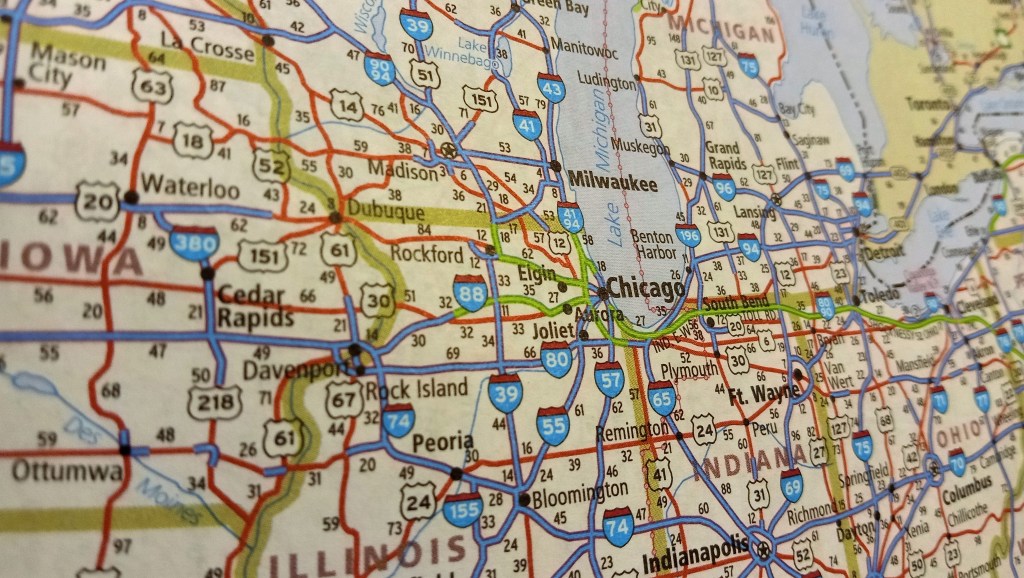
Apps are invaluable when you miss your exit on the interstate or need the quickest route through gridlock. But dispensing directions in 10-mile increments on a tiny screen is not the same as spreading a U.S. map out and visualizing a journey.

Everyone has a “mental map … made up of both factual information about a place and also our own understanding and imagination about the place,” Maitha said. Paper maps help build that mental map and provide spatial awareness, he explained.

All of these options are aids to help humans. With a paper map or Waze, the external object is helping a person make sense of the physical world around them. Our brains could use the help as we get our bearings.

My sense is that the digital devices are very helpful in immediate information – what is the next step I take? – but not so great in providing the big picture. You can see a list of turns or a broad map. But, their primary value is right in front of the vehicle. The paper atlas or road map provides the big picture while not saying as much about what is right outside the vehicle.

Just recently, I spent some time examining a 1718 map of North America made by a French cartographer. In working on some research involving these areas, the paper map provided a sense of how the French viewed this part of the world. It does not provide granular detail but it hints at what they thought was important.

Like some of the people interviewed in this article, I will keep both my atlas and my devices with me while driving. Until the device can unfold a larger image of the full scope of a journey, I want that option and will continue to enjoy maps and atlases.

Want to see adults attached to their phones? Go to a local park

I am at neighborhood parks quite a bit with my kids. I have noticed that while kids are playing, the adults there with them are often on their phones.

Photo by Ju00c9SHOOTS on Pexels.com

I get why. It is indeed tempting. The kids are running around and occupied. Their activity means that parents might have a few moments to themselves. The park often has benches or places to relax. Why not catch up on some texts or social media activity?

Even without kids around, parks feature plenty of phone use. Walk the dog and read the phone along the way. Try biking and phone use together. Lots of walking with earbuds in or headphones on.

However, parks can be inherently interesting places without phones. Kids are learning and developing skills. There are often hints of nature around, birds to spot, bodies of water to observe. There is plenty of people-watching to be done. If the park is a lively one, perhaps one envisioned by Jane Jacobs where people are using it in multiple ways and it is situated among other interesting uses, there is plenty to see and do.

Additionally, if people are concerned with phone and social media use for kids and adults, could parks be phone free zones or at least spaces where we work to use them less? It is not because it is immediately dangerous in parks – at least, not at the level where I consistently look around and spot drivers around me with their heads tilted down to their phones – but because good parks offer the potential for a respite from other parts of life. If parks, preserves, and green spaces can help restore our minds and bodies, are smartphones part of that equation?

(To be fair, adults are on their phones all over the place. I have just noticed it recently in parks amid my own efforts to use my phone less in this setting.)

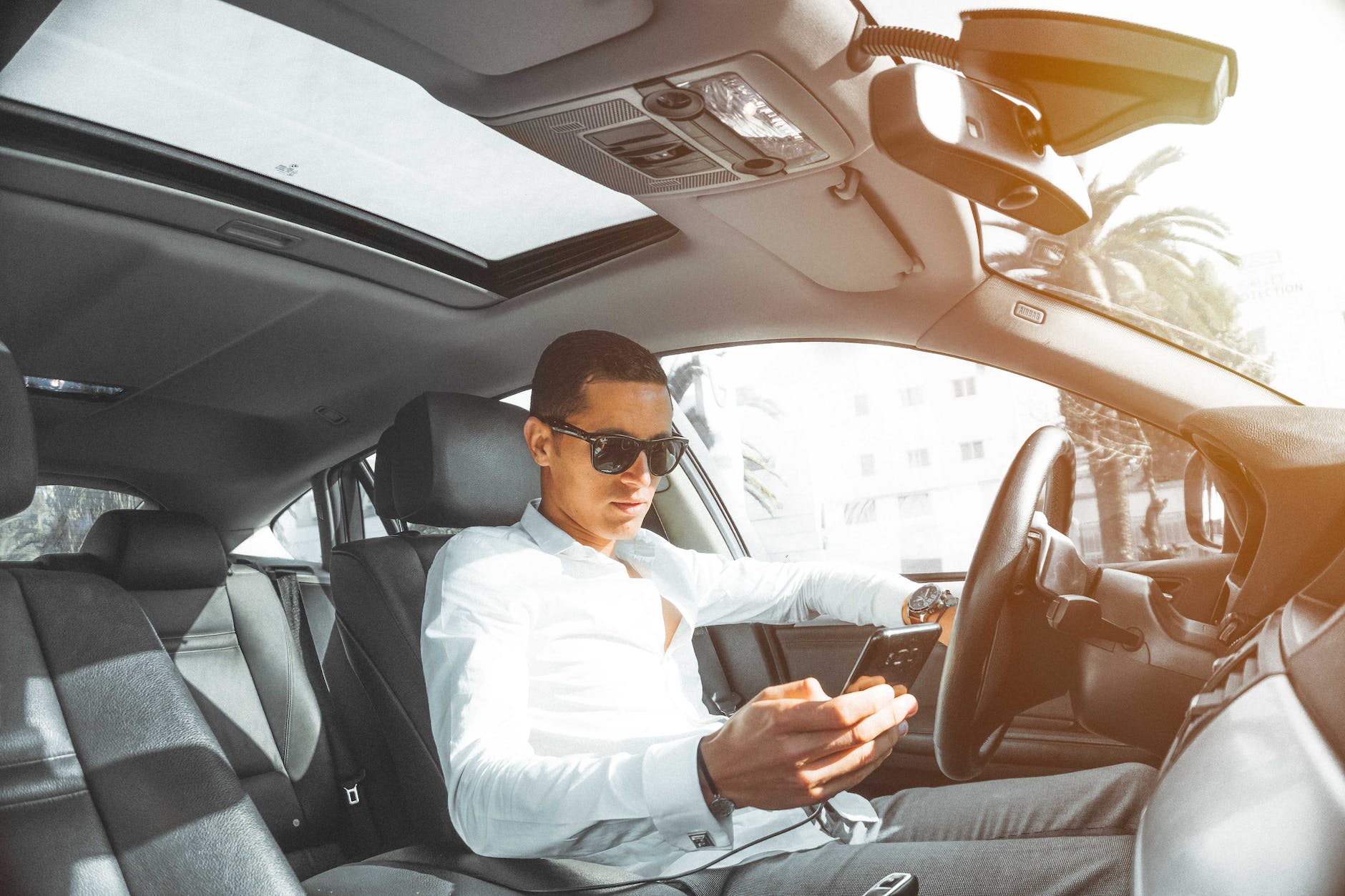
Looking at the driver next to you who is clearly looking at their phone

How often do you pull near another vehicle and take a quick look over? These days, you will often see a driver looking at their phone. Recognizing phone use while driving is relatively easy to spot: the driver’s head is tilted down, not looking at the road. There is a particular posture, as illustrated in the photo below:

Photo by Hassan OUAJBIR on Pexels.com

This can occur while accelerating in leaving an intersection or driving at high speed down the highway. Many drivers appear unable to keep their eyes off their phone while their vehicle is in motion.

Perhaps this is just a sign of our era? Americans love driving and love smartphones. Even as deaths while driving increase, phone use continues. The acknowledgment of a public problem with phone use while driving from years ago seems to have faded away a bit.

From a driving norms perspective, is there a polite way to signal to another driver that you can see their phone use and request they pay attention to their safety and your safety?

From a social perspective, is the smartphone the new car in that we are willing to reorganize society around using smartphone use rather than fitting smartphones into our existing social order?

A more interactive and informational street sign

A new kind of street sign is in downtown Arlington Heights:

Photo by Jens Johnsson on Pexels.com

With three movable LED signs atop the 10-foot pole, the panels display real-time messages pertinent to their surroundings, from how many tables are available at a nearby restaurant, to Metra train timetables. Any governmental emergency alerts, like weather and Amber Alerts, get precedence.

“The sign would orient itself and say, at Salsa 17 starting at 6 o’clock, there’s $7 margaritas or something. And then later it would spin around and say there’s a band playing at Peggy Kinnane’s. There’s a lot of different inputs on this,” said Arlington Heights Village Manager Randy Recklaus. “It’s a thing that people would be drawn to, and it would be yet another thing that would kind of set our downtown experience apart because it’s not something that anyone’s seen before.”

The village would have control of the sign and approve all messages — done through a secure portal on a tablet, PC or Mac as part of a cloud-based system. And the cost of the sign would be recouped by selling advertisements to local business who want their messages on the street panels, under a lease-to-own arrangement that’s part of the Points Sign’s business model.

Pedestrians also will be able to search for things like local events and shopping and dining locales by turning and pushing a streetside dial.

The sign is customizable; some municipalities in talks with Optimal Design want to put a camera atop the pole for public safety purposes. And while the sign has sensors to know how many people are at a given intersection at one time, it doesn’t have facial recognition technology, Patel and Ottoman said.

The two keys to this sign seem to be that it is interactive and it pushes out information rather than standing passively. It does not necessarily replace static street signs, but it can help point people to opportunities. People can approach it and find something new. Such a sign could work well in locations with plenty of foot traffic and lots of local activity.

This reminds me of what I saw on my most recent trip to a shopping mall. The mall appeared to have fewer directory signs and instead I saw multiple recommendations to download the app for the mall. When I did use the interactive directory sign, I could search within certain categories and then it offered directions to the selected retailer.

Are we any closer to a more immersive sign experience that can provide an overlay of information on a 3D view of a landscape? Imagine going up to an interactive sign, searching for something or selecting something presented to you, and then seeing a 3D image of the landscape with paths and information.

Or, are we close to a time when signs are not necessary as everyone with a smartphone or smart glasses or similar devices interacts through the world through that?

AIM away messages and a “basic form of social liberty”

AIM away messages provided a way for users to show that they were not available:

Photo by Porapak Apichodilok on Pexels.com

Sometimes you had to step away. So you threw up an Away Message: I’m not here. I’m in class/at the game/my dad needs to use the comp. I’ve left you with an emo quote that demonstrates how deep I am. Or, here’s a song lyric that signals I am so over you. Never mind that my Away Message is aimed at you.

I miss Away Messages. This nostalgia is layered in abstraction; I probably miss the newness of the internet of the 1990s, and I also miss just being … away. But this is about Away Messages themselves—the bits of code that constructed Maginot Lines around our availability. An Away Message was a text box full of possibilities, a mini-MySpace profile or a Facebook status update years before either existed. It was also a boundary: An Away Message not only popped up as a response after someone IM’d you, it was wholly visible to that person before they IM’d you.

Messaging today, whether through texting or apps, does not work the same way:

Catapulting even further back into the past for a moment: Old-fashioned phone calls used to, and sometimes still do, start with “Hey, you free?” Santamaria points out. “You were going to tell me if you could talk before we started the conversation.” There’s a version of this today—someone might preface their message with “Not urgent, respond when you can,” for example—but for the most part, we just send the text message without consideration, Santamaria says. Interruption is the default.

The ability to walk away from communication and the demands it makes on a person struck me as similar to one of the three “basic forms of social liberty” humans had before settling in cities and large societies. Anthropologists David Graeber and David Wengrow say the second form was “the freedom to ignore or disobey commands issued by others.” Text messages, emails, and messages in apps create a pressure for someone to respond. To not have these digital “commands,” one practically not use apps and devices.

Is this the freedom we have traded to use social media, the Internet, and smartphones? People can unplug but it is difficult to do that and still participate in regular social life today. Saying no to messages or refusing to respond will likely not garner many friends or close connections. And related to the first form of freedom, “the freedom to move away or relocate from one’s surroundings,” the messages and apps can follow us anywhere there is Internet access or cell coverage.

These platforms succeed by encouraging messaging and connections. But, what if a basic human freedom is the one to say no to that interaction when desired?

Social isolation and anomie during COVID-19

One possible explanation of the weird behavior of people during COVID-19 draws on the work of sociologist Emile Durkheim:

Photo by Joshua Miranda on Pexels.com

The pandemic loosened ties between people: Kids stopped going to school; their parents stopped going to work; parishioners stopped going to church; people stopped gathering, in general. Sociologists think all of this isolation shifted the way we behave. “We’re more likely to break rules when our bonds to society are weakened,” Robert Sampson, a Harvard sociologist who studies social disorder, told me. “When we become untethered, we tend to prioritize our own private interests over those of others or the public.”

The turn-of-the-20th-century scholar Émile Durkheim called this state anomie, or a lack of social norms that leads to lawlessness. “We are moral beings to the extent that we are social beings,” Durkheim wrote. In the past two years, we have stopped being social, and in many cases we have stopped being moral, too.

“We’ve got, I think, a generalized sense that the rules simply don’t apply,” Richard Rosenfeld, a criminologist at the University of Missouri at St. Louis, told me. In some places, he says, police arrested fewer people during the pandemic, and “when enforcement goes down, people tend to relax their commitment to the rules.”

This perspective is interesting to consider alongside the millions who did follow national and local guidelines regarding masking and behavior. A lot of attention has been paid to those refusing to comply but many did; does the weirdness stand out even more because of this?

To take the Durkheim reference further, he thought the breaking of the rules and the subsequent reaction and sanctions could help reinforce the original rules.

I might add to the list of explanations in the article the influence of smartphones and social media. These could matter in multiple ways. First, the weird behavior can easily be recorded by others. People may have been weird in the past but was there such a visible record of that behavior? Second, the people with the weird behavior may be recording and sharing their own behavior. Overall, what may have been more private behavior in the past or actions limited to a relatively small set of people or closely connected set of people are no longer kept from a broader audience.