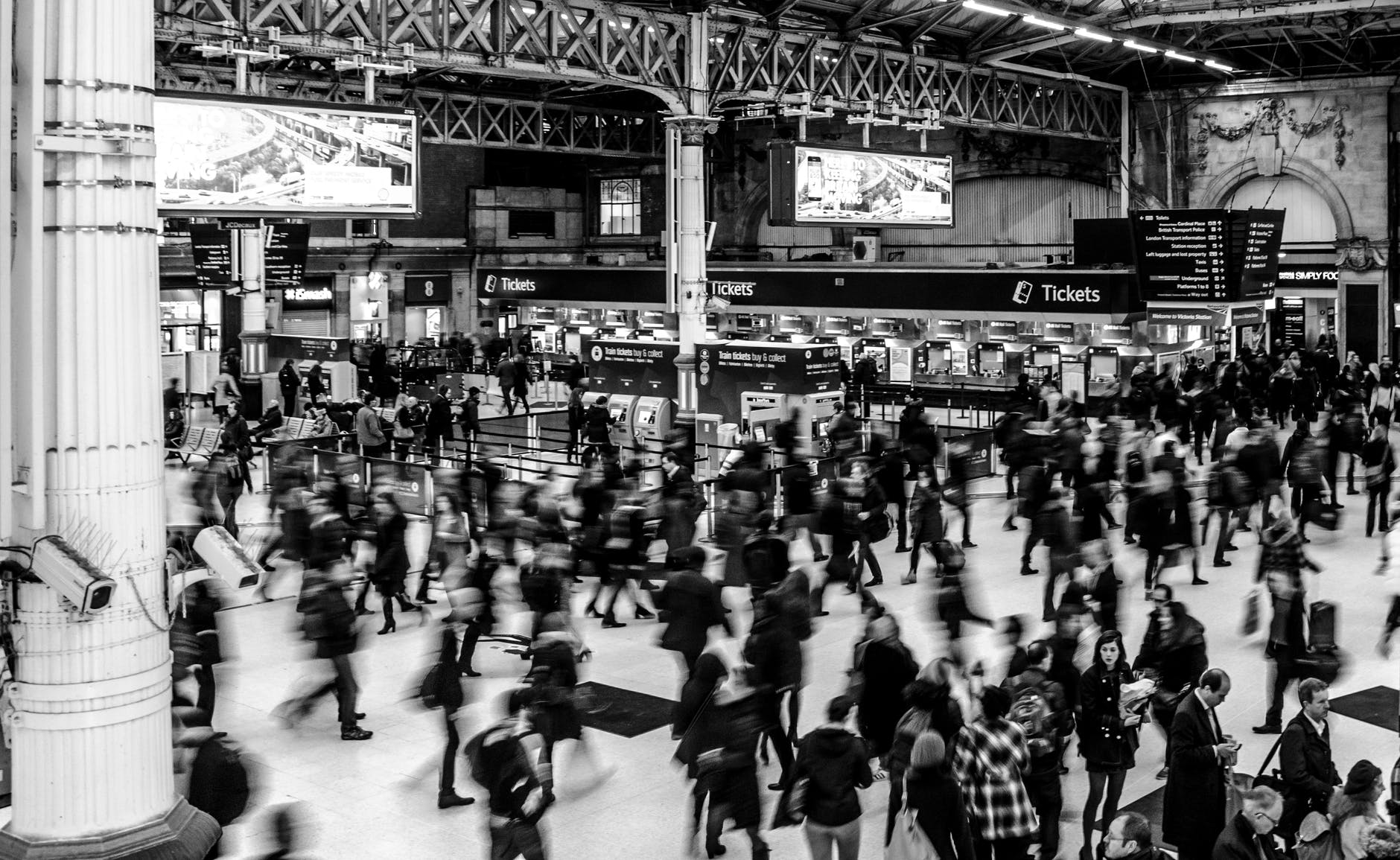
Can we now regularly compare NYC, LA, Chicago, and Houston?

Comments from the newly-elected mayor of Houston compare the four largest cities in the United States. The Chicago Tribune editorial board thinks this is a problem for Chicago.

Photo by Nick Bee on Pexels.com

“We’re not New York. We’re not L.A. We’re sure not Chicago. We fix our problems.”

Quick quiz: Who recently said that? Ron DeSantis? Greg Abbott? Nikki Haley?

The answer is John Whitmire, a Democrat who over the weekend resoundingly won election as mayor of Houston, the nation’s fourth largest city and on track to overtake Chicago as third largest if present demographic trends continue…

Politically, Chicago comes across to much of the rest of the country as a city that’s off course, focusing not on the issues at the top of residents’ priority list (public safety, jobs, public transit, for example) but on progressive to-do lists. Not only are Johnson and his City Council allies choosing to spend their time and political capital on issues the majority of Chicagoans view as less than pressing, they’re doing a poor job even when it comes to their own priorities.

Several factors appear to be at work. First, as noted, Houston is approaching Chicago’s population. Chicago was once the second city, then became the third city, and likely will soon be the fourth city. This means a decline a status, both internally and from the outside.

Second, Chicago has long had a reputation as “the city that works.” It might have all sorts of problems but things got done. If the perception inside and outside is that things do not get done, then people might have concerns.

Both of these might be existential issues for a city that is regarded as a global city and has always been behind at least one other major American city.

Additionally, are New York and LA ready to be mentioned in the same breath as Houston?

How many suburbanites settle for a “bridesmaid suburb”?

I discovered the term “bridesmaid suburb” used in an Australian context:

Photo by David McBee on Pexels.com

A “bridesmaid suburb” is a second-choice postcode and could become a strategic buying trend as ballooning interest rates bite into borrowing capacity…

“Buyers will still have to consider alternatives or the bridesmaid suburbs to their first preference, possibly not because of price but because of diminished borrowing capacity.

”Bridesmaid suburbs are adjacent to higher-profile neighbouring suburbs. They cost less to buy into but share many similarities to the first-pick suburb next door, including access to public transport routes, schools and major shopping hubs…

“A bridesmaid suburb can still allow you to secure a lifestyle with comparable amenities and appeal, and only a short drive down the road.”

While this is used in Australia- a quick Google search suggests this term has been around there for several years – I wonder if it might also apply to suburbs in the United States. Are there many homeowners who would have preferred to live in the most desirable suburb but could not afford it and so settled in nearby communities? There are several assumptions at work here:

  1. Many people want to live in the most desirable suburbs. If supply and demand is the only factor at work, more people wanting to live in desirable suburbs drives up home prices so much that there is not enough housing. Additionally, my own sense of American suburbs is that some of the most desirable and exclusive suburbs also intentionally limit their housing supply to help maintain their character and status. Are there such suburbs that always stand out above any other location in the region and where most people would want to live?
  2. Suburban homeowners want to max out their borrowing capacity and get the most they can – a more expensive home – through their mortgage. People can borrow up to a certain point decided by lenders, but how many go all the way to the maximum allowed?
  3. The exact community in which you live matters less than the clusters of suburban communities you can access. It is less about a particular zip code and more about a cluster of adjacent zip codes. Suburbia offers driving access to a lot of communities so perhaps you do not have to live in a particular place to enjoy the benefits. At the same time, communities that appear similar on certain factors can be quite different in terms of character and everyday experiences.

Populations – national or local – can grow or decline through births, deaths, and immigration

While the focus here is on the United States as a whole, this is also worth considering at the community level:

Photo by Skitterphoto on Pexels.com

A country grows or shrinks in three ways: immigration, deaths, and births. America’s declining fertility rate often gets the headline treatment. Journalists are obsessed with the question of why Americans aren’t having more babies. And because I’m a journalist, be assured that we’ll do the baby thing in a moment. But it’s the other two factors—death and immigration—that are overwhelmingly responsible for the collapse in U.S. population growth…

As recently as 2016, net immigration to the United States exceeded 1 million people. But immigration has since collapsed by about 75 percent, falling below 250,000 last year. Immigration fell by more than half in almost all of the hot spots for foreign-born migrants, including New York, Miami, Los Angeles, and San Francisco…

The implications of permanently slumped population growth are wide-ranging. Shrinking populations produce stagnant economies. Stagnant economies create wonky cultural knock-on effects, like a zero-sum mentality that ironically makes it harder to pursue pro-growth policies. (For example, people in slow-growth regions might be fearful of immigrants because they seem to represent a threat to scarce business opportunities, even though immigration represents these places’ best chance to grow their population and economy.) The sector-by-sector implications of declining population would also get very wonky very fast. Higher education is already fighting for its life in the age of remote school and rising tuition costs. Imagine what happens if, following the historically large Millennial cohort, every subsequent U.S. generation gets smaller and smaller until the end of time, slowly starving many colleges of the revenue they’ve come to expect.

Even if you’re of the dubious opinion that the U.S. would be better off with a smaller population, American demographic policy is bad for Americans who are alive right now. We are a nation where families have fewer kids than they want; where Americans die of violence, drugs, accidents, and illness at higher rates than similarly rich countries; and where geniuses who want to found new job-creating companies are forced to do so in other countries, which get all the benefits of higher productivity, higher tax revenue, and better jobs.

This matters for communities and cities in at least a few ways:

  1. The “growth is good” model in the United States assumes continued population growth. This is good for status as well as for other things (see #2).
  2. When populations are growing, the incoming revenues help pay for existing infrastructure and services as well as suggest money will be there in the future. In contrast, stagnant or declining populations can require cuts or reductions.
  3. The role of immigration cannot be understated and it affects population as well as demographics and local economics. For example, Chicago would have likely had more population loss over recent decades without immigrants coming to the city.

It will be particularly interesting to see what happens if more major population centers experience relatively little or no population growth while a few continue to grow rapidly. Does this change the balance of power and status among places?

Why people do not flock to the American cities that keep showing up in the most affordable places to live

I recently saw another list of the most and least affordable metropolitan areas in the United States with a key metric of how many families in the region could purchase a home at the median price. Here are the five most affordable places:

Photo by Ketut Subiyanto on Pexels.com

Home prices and incomes vary widely, and there are oases of affordability, mainly in the Rust Belt and Midwest. The top five most affordable places among metro areas with population of 500,000 or more:

Lansing, Michigan: As a result of modest home prices, 90.6 percent of all new and existing homes sold in the fall months were affordable to families earning the area’s median income of $79,100. The median home price was $155,000 in the fourth quarter of 2021, the builders’ index says.

Scranton-Wilkes Barre-Hazleton, Pennsylvania: Wages here are below national levels, but so are home prices — the median sale price was $150,000 in the fourth quarter. As a result of rock-bottom prices, 88.5 percent of all new and existing homes sold in October, November and December of 2021 were affordable to families earning the area’s median income of $70,600.

Pittsburgh: This metro area has a median family income of $84,800 and a median home price of just $166,000. As a result, 88.4 percent of homes were affordable for typical earners.

Indianapolis. This metro area has a median family income of $81,600 and a median home price of $215,000. As a result, 87.6 percent of homes were affordable for typical earners.

Akron, Ohio: With a median family income of $83,300 and a median home price of $165,000, fully 86.5 percent of homes were in reach of median-income families in the state capital.

Two features quickly stand out: the homes in these regions really are cheap (particularly when compared to local earnings) and they are all in the Midwest/Rust Belt.

Still, I have seen some version of this list many times now and I am not sure what to make of them. Why aren’t people moving to these locations?

The most obvious answers to me: it is not necessarily easy to move and these cities are perceived to have a lack of opportunities (economic, cultural, housing, etc.). American geographic mobility as a whole is down but do people actually move just for cheaper housing? What this list does is highlights that median income families can access median level housing in these five places. Get a decent job and owning a house is possible.

There are other possible answers that get more complicated:

  1. People just do not think of the Midwest/Rust Belt when thinking of places to live. Lack of opportunities, the weather, the middle of the country, a Midwestern blah-ness, etc.
  2. It is not just about a lack of opportunity; these are places seen as on the decline. Even if they are cheaper, who wants to live in a place that has already seen its best days when “growth is good” is a key marker of communities?
  3. These communities are lacking incentive campaigns to try to attract new residents.
  4. These communities may not want too many people to move in because it could drive up prices and bring in outsiders. (Yet, growth is good and many declining communities would do a lot to become a destination again.)

In sum: some American metropolitan areas are much cheaper than others, they have common characteristics, and there are a number of compelling reasons why people do not move to the places with cheaper housing.

Naperville’s status and Farley’s “Van Down by the River” performance inspired by Naperville bridge over the DuPage River

According to Naperville native Bob Odenkirk, he was inspired by his hometown when writing Chris Farley’s famous SNL skit “Matt Foley: Van Down by the River.”

Q: Speaking of “SNL,” that famous sketch for Chris Farley you wrote, about him living in a van down by the river — were you writing with Naperville in mind?

A: There is the DuPage River, and when I was writing that I did picture the bridge in Naperville over the DuPage. It was a bridge for stoners when I was a kid. Stoner kids hung out there. So this guy parking his van by a river — yes, that was the image I had.

There are several bridges Odenkirk could be referring to. Could it be this bridge (in a picture from nearly a decade ago)? This is a little removed from the busier downtown area and the more manicured areas of the lively Riverwalk.

Naperville has a reputation as a wealthy and large suburb with a thriving downtown and numerous high-status jobs. Does the image of a guy living in a van down by the river fit this or kids smoking pot by the DuPage River? Probably not and the city in recent years was not interested in marijuana dispensaries.

I cannot imagine a statue of Matt Foley near the DuPage River in downtown Naperville among the suburb’s collection of public art...but perhaps Odenkirk could eventually make the cut?

Design standards, paint, and appearances in a suburban downtown

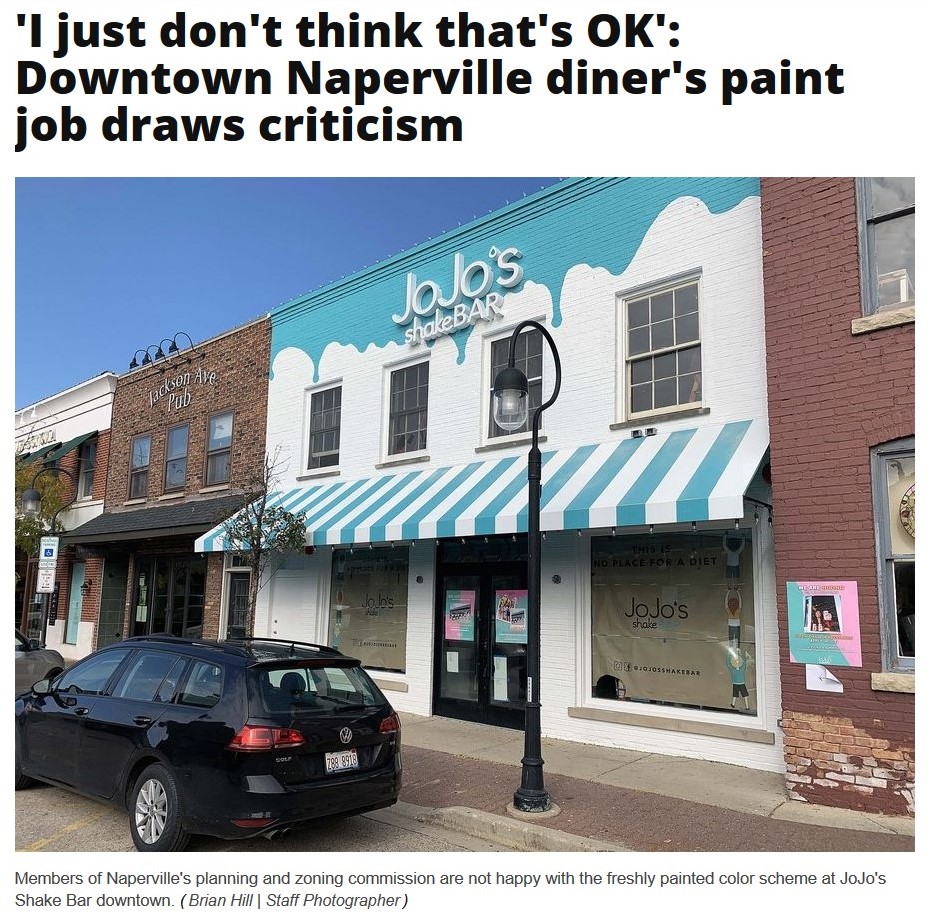
A new business in downtown Naperville chose a different paint job compared to nearby establishments and this led to some discussion:

Members of the city’s planning and zoning commission gave a chilly reception to the freshly painted exterior at JoJo’s, a self-described “next generation diner” with milkshakes, milk and cookie flights and diner classics that’s scheduled to open this month at 5 Jackson Ave.

But because JoJo’s adhered to city codes regarding its main color choice and the amount of accent color it used, there’s not much the commission or the city can do except possibly ask JoJo’s to change the facade and create stricter guidelines for the future…

Behind white raised letters reading “JoJo’s Shake Bar” is a turquoise background stretching across the two-story building that looks like dripping ice cream extending down past the top of the second-floor windows.

Commission members said a uniform block of turquoise across the top would have been acceptable. They believe the dripping effect, however, isn’t appropriate for downtown Naperville…

The issue came up at the end of Wednesday’s meeting when Commissioner Anthony Losurdo said he saw the facade while driving by, labeling it a “sore thumb.” Stressing he wouldn’t have approved the look had it been subject to a vote, Losurdo said he has received complaints about the paint scheme from residents.

Many communities have guidelines for signs and facades. This helps create a more uniform look, ensures that no single property sticks out too much from others, and can limit concerns from nearby residents (such as signs that are too bright or too big). The aesthetics help contribute to an overall character the community wants to promote.

Naperville’s downtown is important for the community. With its revival in recent decades, the city is proud of the bustling business and social activity downtown. It wants to both nurture and protect that for the future. The downtown helps the community stand out from other suburbs and generates revenue.

So, protecting the look of downtown buildings makes sense. On the other hand, concerns about this new business could send out other signals. It sounds like JoJo’s followed existing guidelines. The end result may not be what some leaders and residents desire but it was within regulations. This commission is supposed to talk about issues like these; their task is to see how properties align with the city’s guidelines. The regulations can be changed to prevent such outcomes.

Even having an article with a headline like this might contribute to perceptions that Naperville is a snobby place. The appearance of dripping paint is a big problem for the community? Does a negative reaction welcome the new business? Is it helpful to have these conversations through a local newspaper?

It is unclear how many people and leaders in Naperville have concerns with the paint job. Will it soon be changed and/or the regulations updated to avoid a similar case? Or, can one building stand out a little in a successful downtown?

What does it mean if the suburb of Naperville is the first US community to have two Amazon Fresh locations?

Signs point to a second Amazon Fresh store in Naperville and if it comes to reality, the suburb will be the only community in the country with two locations.

Photo by Sagar Soneji on Pexels.com

All signs point to a second Amazon Fresh grocery store opening soon in Naperville.

While city officials haven’t been notified of definitive plans for the site at 1351 E. Ogden Ave., Naperville Director of Communications Linda LaCloche said Amazon Fresh recently applied for a liquor license at the location. An opening date is unknown, but the building is currently being renovated and looks similar to the city’s other Amazon Fresh location on Route 59.

Naperville would become the first city in the country with two Amazon Fresh grocery stores…

According to Amazon’s website, there are only four Amazon Fresh locations in Illinois. In addition to Naperville, there are stores in Bloomingdale, Oak Lawn and Schaumburg.

Naperville may not be the only two store location for long and being the first means something. What is so attractive about Naperville as a location? Here are a few possible reasons:

-It is a wealthy and large community: over 148,000 residents with a median household income of nearly $126,000 (both 2019 estimates). This adds up to a lot of potential customers. Naperville is known for high white-collar jobs and tech jobs. These could also provide a good customer base.

-Naperville as a community has received many accolades. It has a high quality of life, high performing schools, and a vibrant downtown. It is a high status community and companies like to associate with such communities.

-Naperville is in favor of business and growth. This dates back decades with pro-growth decisions in the postwar era, includes tax incentives for corporations, and a desire to improve the streetscape along Ogden Avenue, a major roadway.

-Naperville is outside Chicago and in the Midwest, “normal America” locations for testing new concepts and ideas.

Put this all together and Amazon finds it worthwhile to go forward with two locations in Naperville.

Fighting the 2020 Census population count in Aurora, Illinois

Leaders in Aurora, Illinois are not happy about the 2020 Census results that suggest the second largest city in Illinois lost 17,000 residents:

Aurora Mayor Richard Irvin said this week the city will continue its fight to get what it considers a more accurate census count…

[The 2020 Census] showed Aurora had lost about 17,000 residents during the past 10 years – about the equivalent of one of the city’s 10 wards – and officials have said they doubted that kind of population loss would have gone unnoticed among other city metrics, such as housing stock, water customers and traffic counts…

The big concern is that the city has estimated the new count could cost Aurora about $31 million a year in lost distributions of motor fuel tax, sales tax, income tax and money from federal programs for housing and education…

He has called for a review of the numbers by the government, and has even said the city could call for a special census down the line.

Another loss for the large suburb: no longer being able to highlight the growth of the community. Looking at the dicennial Census figures on Wikipedia, Aurora has never lost population over a decade until the 2020 count. And the growth has been particularly strong since 1990; the city had 99,581 residents then before growing to 142,990 in 2000 (43.6% increase) and then to 197,899 in 2010 (38.4% increase). In American communities, “growth is good” so a population loss is a sign of something wrong.

A special census could be worth calling for given the money and status at stake. I recall that neighboring Naperville had at least a few special censuses in recent decades as they sought to benefit from a rapidly growing population. The goal would be similar here – acquire more resources – but also different in that the population may have dropped rather than increased.

Given my own knowledge of the area, a drop of 17,000 residents does seem large. This could go against the larger trends of the region – Chicago suburbs and the City of Chicago – which slightly gained population in the 2010s.

Starchitect Jahn’s buildings in the Chicago suburbs

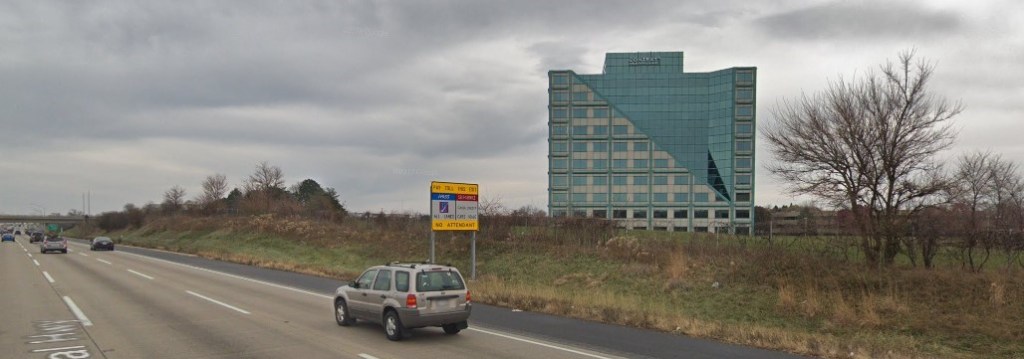
World famous architect Helmut Jahn died over the weekend. He built iconic buildings in major global cities and several notable buildings in the western suburbs of Chicago.

A native of Germany, Jahn won international recognition and awards for projects around the globe, including United Airlines Terminal 1 at O’Hare International Airport, the former Citigroup Center (the main entrance to the Richard B. Ogilvie Transportation Center) in Chicago, and the Sony Center in Berlin.

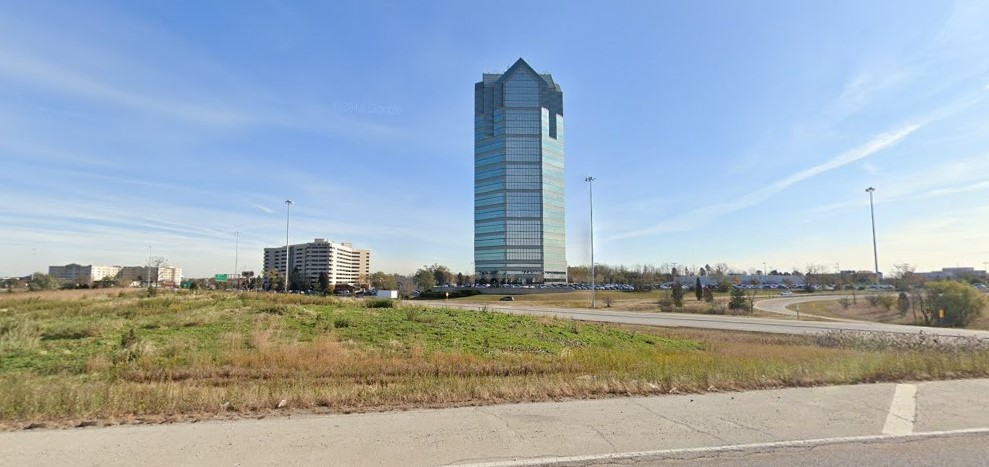
Besides MetroWest in Naperville, his suburban work includes the Oakbrook Terrace Tower in Oakbrook Terrace.

Here are images of the two buildings referenced:

Both buildings are interesting structures to see in their suburban settings. They would not be out of place in a major city. They are full of steel and glass. They have sharp angles. They can be seen from a distance and are of a height beyond most suburban buildings.

But, they also stick out. They are right next to major highways. They are not surrounded by other tall buildings; the size of the Oakbrook Terrace Tower is particularly notable. Instead, they are surrounded by parking lots and smaller suburban office parks. They are in the suburbs but they are not of the suburbs; few residents would want these structures anywhere near their single-family homes.

In other words, a starchitect can build in the suburbs. In many parts of the United States, they are growing and a majority of Americans live in suburban settings. Interesting buildings help add to the status of certain suburbs as job centers. Yet, the interesting buildings by a famous architect can only go so far in sprawling settings: they do not really fit in even as they provide something different to view at 70 miles per hour.

Target on The Magnificent Mile is preferable to empty retail space

With reports of Target’s interest in moving to Macy’s former space in Water Tower Place along Michigan Avenue in Chicago, I heard some concern about such a normal big box retailer moving into a prestigious retail space. Here is the problem for Chicago and many other communities facing retail vacancies: filling space can be really hard.

Google Street View image August 2019

Brick-and-mortar retailers are not doing well overall. This extends from suburban shopping malls to high-status locations like Manhattan or downtown Chicago.

And this issue is not just about shopping and what people can purchase. Busy retail anchors a number of important activities: sales tax and property tax revenue for municipalities; tourism or visitors from other communities who want to come spend money because of the scene; restaurants and other land uses that cater to those out for a shopping trip. Vacant structures do not just lack these features; their emptiness is also a blight, a suggestion that corporate and visitor interest is low, a reminder that the property is not generating the kind of revenue it could.

Filling large retail spaces is no easy task. Many communities are struggling with this and seeking other land uses (recent examples here and here). A building with some sort of activity, even if it is a downgrade in terms of status, is preferable to no activity. The Magnificent Mile might not seem so magnificent with Target – people can find this shopping all over the place – but it beats becoming The Vacant Mile.