Suburbs buying vacant malls to try to simplify redevelopment process

Two Chicago suburbs are purchasing mostly empty malls with the goal of redeveloping the properties:

Photo by Pixabay on Pexels.com

West Dundee and Bloomingdale officials have similar visions for the mall properties in their towns.

West Dundee sees a mixed-use development with residential, office, retail and entertainment. Bloomingdale’s consultants have drawn up conceptual plans showing residential, commercial and recreational development in place of the mall’s former retail buildings and parking lots.

Typically, villages stay out of the real estate business and leave redevelopment of retail centers to developers. But for West Dundee and Bloomingdale, taking ownership of their malls and clearing some obstacles, such as multiple property owners or restrictive covenants, were deemed essential for future redevelopment.

“Almost uniformly, every developer with whom we spoke stated that the site has too many complications ­— too many owners, too many covenants, too many uncertainties,” Nelson said last year. “The village’s aim is to bring simplicity to the process so reliable developers with established track records will be interested in partnering to reformat the area. Without municipal intervention, that simply won’t happen.”

Two thoughts come to mind:

  1. It is not too surprising that suburban communities want to guide the redevelopment. Suburban residents and suburban community leaders are often picky about what they might want to replace a shopping mall. By purchasing the property, the suburb can choose the developer and the zoning while also setting a vision.
  2. I wonder if this is an instance where a large property owner – the owners of these malls – can afford to sit on these properties for a while to see if there will be a bigger financial return later. I remember reading in the past about parking lots in downtown areas; they are not flashing and they are not the preferred land use but the company who owns that lot can wait until there is significant demand for the property and then make a lot of money on selling the parking lot. Compared to these suburbs, the property owners may be less interested in moving quickly on a redevelopment plan. (This could also apply to recent conversations about suburban office parks and downtown office buildings: even vacant buildings might not need to be sold or redeveloped if an owner can afford to hang on to them.)

Are peripheral suburbs really “the most boring places in the world”?

Looking at data on where millennials are moving includes an evaluation of those places:

Photo by Helena Lopes on Pexels.com

To Lee and his colleagues’ surprise, millennials aren’t moving to nearby dense, walkable exurbs. They’re getting way out to peripheral suburbs.

“It turned out that millennials are moving to the most boring places in the world,” says Lee, who’s now a professor at Seoul National University. “They’re moving to really single-family-dominated areas with very few urban amenities.”

What might make these places less boring?

It’s expensive to live in the places millennials prefer: walkable communities with lots of shops, restaurants, and public space. An analysis published last year found that homebuyers in the 35 biggest American metropolitan areas paid 34% more to live in walkable neighborhoods, while renters paid 41% more. Paul Stout, a millennial landscape-architecture student with a popular urbanist TikTok account called Talking Cities, says he constantly hears from followers who wish they could afford a home within walking distance of places like coffee shops…

But while millennials wallow over the choice between a tiny apartment in a dense city and a lonely, sidewalk-less subdivision, urbanists insist any place can be dense and walkable as long as land-use laws allow it and people want to live there.

“There’s a lot of places in the suburbs that could be really lovely to live if you could only put a grocery store or a coffee shop on the corner,” Stout says. “I’m optimistic that you could actually make living walkable almost anywhere in the US, given the right package of zoning reform.”

America is not known for its walkability (see the dangers to pedestrians) or its third places. Instead, Americans often promote and move to suburbs built around single-family homes and driving.

Does this mean suburbs further out from the city are really “the most boring places in the world”? Or are millennials and many others pushed into binary choices where they prioritize cheaper and larger housing and thus give up other community features? In many American communities, they cannot have both cosmopolitan street life and ample affordable housing they can own.

And I would venture to guess that at least a few of American suburbanites do not find them to be boring places. (One could argue they were pushed into this option rather than chose it but that is a different argument.) Millennials and Gen Z may find them more boring than older adults and this would be interesting data to compare.

A $100k welcome sign within a $600+ million suburban budget

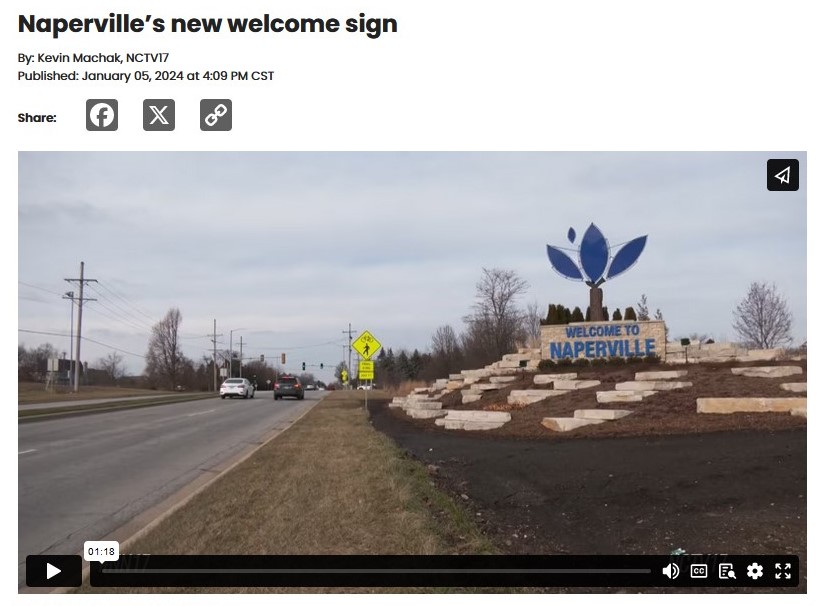
Naperville spent $100,000 for a unique sign welcoming people to the community along its border with Bolingbrook. Amid some concerns from residents about the price, here is information about the sign and the overall budget of the city for 2023. First, the sign:

A freshly-completed “Welcome to Naperville” sign sits along the entry route, just next to the trails among DuPage River Park and just across from DuPage River Sports Complex.

The design stems from the city of Naperville’s official logo of 50 years, which depicts a tree with water running underneath. Surrounding the sign are limestone slabs.  The city plans to add fresh vegetation to the area in the spring.

The new greeting, which costs $100,000, is just one of a number of beautification projects that have been planned for since 2021 and officially budget-approved for since the fall of 2022.  At that time, the city council approved of $250,000 for the Department of Public Works to make multiple improvements throughout the city…

Second, the 2023 budget:

Keeping the current economic climate, our mission, and strategic priorities in mind, the 2023 City of Naperville budget is recommended at $603.46 million, an overall increase of 11.6% from the $540.58 million 2022 budget. Additional capital expenses are the primary driver behind this increased investment in our organization and community. It is worth noting that the 2023 budget leverages existing revenue streams and fiscal policies. No new taxes, fees, or other revenues are recommended to support the 2023 budget proposal.

From my math, this means the sign cost less than one-tenth of one percent of the city’s budget. Even building one of these on each other side of the city – north, east, west – would not take much money.

Is this an unnecessary expenditure? That is a different question. Signs are not necessarily cheap and they can be bland or strange. For example, see this recent one in Naperville for a new subdivision. This new one welcoming people to the suburb is unique with its 3D form and landscaping. Naperville has a history of spending money for parks and beautification: just look at the Riverwalk over time (and I would guess many would say this was a good investment). Additionally, Naperville is a unique suburb that sees itself as having a particular status.

If the goal is to continue to brand the community in a particular way, this sign stands out and is a small fraction of the budget.

Writing the best suburban stories and acknowledging real suburban life

What makes for a good suburban story? A review of one suburban memoir makes an argument of what needs to be present:

Photo by Kindel Media on Pexels.com

The best suburban stories, on the page or on-screen, are deceptively complex, affixing irony or self-knowledge to what may initially appear to be mere scathing social criticism. Take Revolutionary Road, the searing 1961 Richard Yates novel adapted to the big screen by Sam Mendes in 2008. This is the tragedy of Frank and April Wheeler (played in the film by Leonardo DiCaprio and Kate Winslet), average New Yorkers in the ’50s who move to a tree-lined Connecticut suburb to start a family and watch their dreams die. Frank commutes to the city for a sales job he loathes. April whiles away her days with the kids, forgoing whatever ambitions she might otherwise have had.

Here’s the catch: As April and Frank plan a move to Paris—where Frank will do an unspecified creative something—then retreat back into a domestic existence both tortured and predictable, it becomes clear that they would live quotidian lives no matter where they laid their heads. Paris. Connecticut. New York. The suburbs just happen to be the perfect venue for their smallness, the place where their silent scream can disappear between the hedges. In this sense, Yates’s suburban critique carries a strong whiff of irony. After all, it’s hard to blame the perfect lawns and fake smiles when you carry your misery the way a turtle carries its shell.

The only truly honest person in these suburbs is John, the adult son of the community’s busybody real estate agent. John is a mathematician who has undergone extensive shock treatment for his mental illness, a spirit stifled by his family’s shame and hyperconformity. (Michael Shannon plays him in the film and walks away with the whole thing.) John might actually be happier in Waldie’s Lakewood, where strange behavior, including obsessive hoarding, arguably becomes part of the town’s beautiful fabric, the answer to any easy assumptions of conformity…

The naked reality Waldie depicts subverts any impulse to indulge dystopian visions or Twilight Zone–like allegories. (The suburbs, incidentally, provided a feast for The Twilight Zone. Take 1960’s “The Monsters Are Due on Maple Street,” in which a bland collection of suburban neighbors, walled off from the rest of the world, become a self-immolating mob when they suspect an alien invasion.) Waldie doesn’t need such devices to conjure his uncanny suburbia. He accentuates minute details of housing and neighborhood construction—drywall, crape myrtle, layers of stucco—with philosophical musings and remembrances that sometimes cross over into the macabre. “In the suburbs,” he writes, “a manageable life depends on a compact among neighbors. The unspoken agreement is an honest hypocrisy.”

Is the suggestion here that the problems people face in the suburbs are the same sorts of problems they would face in other settings? Or that people in the suburbs are idiosyncratic just as they are elsewhere?

I wonder if the difference is that the American Dream placed a large burden on suburbs: life had to be good, not just normal. The sparkle of the new home and suburban lifestyle were not just to be settled into and lived in; it had to be the apex of American, and perhaps global, life.

On the whole, the standard of living in American suburbs is pretty high compared to historic and global settings. But, could any place easily be the promised land? It is probably not a coincidence that this book is titled Holy Land.

What will nearby suburban residents accept for redeveloped office parks?

Suburban residents often do not like the idea that a nearby office park will soon be a warehouse or logistics center. But, what will they accept?

Photo by Egor Komarov on Pexels.com

If I had to guess, I would go with open space or park space. Suburbanites would like this for multiple reasons: little noise and traffic, increased recreational opportunities, this limits future development on the location, and improved property values. Suburban homeowners do not want properties next to them to have more intensive land uses; they would prefer less activity.

At the same time, this puts communities and these suburbanites in a predicament. These office parks served particular purposes. They brought in tax revenues. They provided jobs. They provided status (particular if a big name company occupied the offices). Empty buildings are an eyesore and wasted opportunity. Warehouse and logistic parks would bring in money and jobs. Parks and open space do not generate their own revenues.

Before resisting everything that could replace suburban office parks, the suburban neighbors might want to consider what they would be willing to accept. Are there land uses that could aid the community and preserve some semblance of residential suburban life? Is there any room for compromise?

Studying both individual communities and patterns across communities

In considering places in the United States, is it better to study a community in-depth and get at its uniqueness? Or, is it better to look for patterns across places, focusing more on what joins types of communities compared to other types?

Photo by Nataliya Vaitkevich on Pexels.com

The last two posts have introduced this question through an unusual place in western Pennsylvania and all the histories communities across the United States have. And this is a common issue in urban sociology and among others who study cities and places: should we seek to adopt model places that help us understand sets of places – think of the odd quote that “There are only three great cities in the US and everywhere else is just Cleveland” – or focus on all of the particularities of a particular place or region?

I have tried in my own work to do some of both when studying places and buildings. Two examples come to mind. In 2013, I published an article titled “Not All Suburbs are the Same: The Role of Character in in Shaping Growth and Development in Three Chicago Suburbs.” I built off in-depth research on three suburbs to compare how internal understandings of character affected how they responded differently to changes in the Chicago region and changes to suburbs more broadly. On one hand, these suburbs that shared important similarities have different character and on the other hand they still fit within the category of suburbs that sets them apart from different kinds of places.

As a second example, take the book Building Faith I co-authored with Robert Brenneman. We provide case studies of particular religious congregations as they navigate constructing and altering buildings as those physical structures shape their worship and community. These case studies among different religious traditions and in different locations highlight unique patterns in these congregations and places. Yet, we also look across places, considering patterns of religious buildings in suburbs, in Guatemala, and a few other places.

In both works, knowing the particulars and examining the broader patterns are helpful. Different researchers might go other routes; why not investigate even further in these particular cases? What else is there in archives, interviews, ethnographic observation, etc. that could reveal even more details? Or, go the other direction: look at patterns in hundreds or thousands of places to find commonalities and differences across more settings.

But, I find that the particularities of a certain place make more sense in light of broader patterns and those broader patterns make more sense knowing some local or micro patterns. Having a sufficient number of cases or a varied enough set of cases to make these links can be tricky. Yet, I enjoy approaching places this way: digging into both the histories of particular communities and seeking broader patterns that hold across communities.

How many communities in the United States have histories we should know?

After seeing SNPJ, Pennsylvania on the map and recently reading Radical Suburbs by Amanda Kolson Hurley (recommended), I thought about this question: how many more histories of communities in the United States should we know? SNPJ appears to have a unique background and purpose and Hurley considers multiple suburbs with different visions of what a suburban community could be. But, there are thousands of communities in the United States – are they all unique enough to pay attention to?

Photo by Engin Akyurt on Pexels.com

One way to consider this is to think about patterns in we might pay attention to some communities and not others. In the United States, population size and growth is often emphasized. Bigger places often receive more attention and their unique histories and features are more known. At the same time, it takes efforts by numerous actors for history to become known and narrated over time. Discrimination, a lack of power, and limited resources mean some histories are not as known.

There is certainly value for people living in a community to know their own local history. I have written about seven steps for knowing your suburb and how to take additional steps. This local knowledge can help longstanding members of a community, new residents, and visitors. It can take some digging to hear multiple voices, see what is told and not told, and think about how a community came to be.

In the next post, I will explain why I see value in both larger categories – such as examining suburbs as distinct places compared to cities and rural areas – and looking at specific histories and characters of communities. In my own work, I found linking these two levels can provide further insights into places and experiences within them.

Hub-and-spoke railroad systems, buses, and migrants getting to Chicago

If Chicago makes it harder for bus companies to bring migrants to the city, where else can they drop them off? In suburbs with train connections to Chicago:

Photo by Chris Duan on Pexels.com

Naperville is one of a growing list of suburban cities that have seen buses ferry migrants to their communities — unannounced — over the past few weeks. The spread of migrant-carrying buses to collar communities comes in the wake of more stringent rules for migrant drop-offs adopted by the city of Chicago earlier this year…

In an effort to hold bus owners accountable to the November policy, Chicago aldermen on Dec. 13 approved tougher penalties for rogue arrivals. Essentially, buses face seizure, impoundment and fines for unloading passengers without a permit or outside of approved hours and locations…

Instead of more coordination, Chicago officials have said that bus drivers, in direct correlation with tighter drop-off rules, have started to unload migrants in unauthorized places — including suburban train stations — to work around penalties…

Migrants reportedly have been left in Lockport, Kankakee, Fox River Grove and Elmhurst.

Last week, five buses stopped at Aurora’s Transportation Center. In response, the Aurora City Council Friday passed an ordinance regulating buses coming to the city to drop off migrants who are en route to Chicago.

Chicago has long had a hub-and-spoke railroad system where lines radiating out from the city bring passengers downtown. This system has been around for over a century as lines coming out of Chicago connected surrounding counties to the growing city.

This same system that enable commuting to the Loop makes it possible for migrants to get to Chicago without having buses dropping them in the city proper. There are numerous trains stations spread throughout the suburbs that could serve as points where people can board trains for Chicago.

How many suburbs will end up restricting buses from dropping migrants off at suburban train stations? Some have already moved to limit migrants. Few seem interested in joining the efforts of Oak Park.

Barbie could only live in the Los Angeles region

Barbie is one of the most famous toys and she resides near Los Angeles. Could she live anywhere else? I pondered this when seeing Barbie:

This scene, along with others in the movie, firmly place Barbie in and around Los Angeles. There are palm trees. Beach scenes along the ocean and boardwalk. The mountains looming in the background. A replacement for the “Hollywood” sign. Her dreamhouse is in Malibu.

Could Barbie live in other locations? How about Manhattan Barbie? Atlanta Barbie? Omaha Barbie? These are harder to imagine. Barbie has a lifestyle tied to a postwar vision of the American Dream exemplified by life in Los Angeles. She was not alone; TV shows endlessly showed life in southern California, Disneyland first opened there, and sprawling suburbia became a model.

A new city and/or region could become the marker of a new era and new toys. Perhaps Houston? A different city that will grow rapidly and look different or exhibit different patterns of life and development?

Another technique to limit migrants coming to suburbs: fine bus companies

As several Chicago suburbs consider the possibility that migrants might arrive in their community, they have another technique for limiting their presence: fining bus companies who bring migrants.

Photo by Jakob Scholz on Pexels.com

Rosemont could cite and fine bus companies from Texas, impound their vehicles, and arrest drivers for dropping off migrants in town, under an ordinance approved Monday.

The new rules — which are similar to ones in Cicero and tighter penalties being considered by the Chicago City Council this week — come after about a half dozen buses started bringing asylum-seekers to Rosemont last Wednesday.

Each bus had about 40 to 50 people, who were being let off in front of the Donald E. Stephens Convention Center, the Metra Rosemont station on Balmoral Avenue, and the Metra O’Hare transfer station on Zemke Boulevard on airport property next to Rosemont.

“We’re not going to let them just drop people off and drive away,” Mayor Brad Stephens said Monday. “It’s inhumane dropping them off on a concrete sidewalk on a day like today.”

Add this to restrictions on housing migrants long-term.

Chicago has added similar penalties to buses:

Migrants are no longer being dropped off at the city’s landing zone on buses from the southern border, causing people to wander with no direction looking for shelter, according to an aide to Mayor Brandon Johnson.

Cristina Pacione-Zayas, Johnson’s deputy chief of staff, said the lack of communication is directly correlated with the city’s harsher penalties for bus owners whose vehicles violate rules to rein in chaotic bus arrivals from the southern border. She suspects bus companies are finding other ways to get migrants into the city. As of Saturday, more than 25,900 migrants had arrived in Chicago since August 2022, according to city records.

Under revised rules Wednesday, buses face “seizure and impoundment” for unloading passengers without a permit or outside of approved hours and locations. Violators will also be subject to $3,000 fines, plus towing and storage fees.

If this “works,” how many suburbs and cities will adopt similar approaches?