How to (not?) add a parking garage to a charming suburban downtown

The suburb of Wheaton, Illinois is considering adding another parking garage to its downtown. How does one add a large parking structure to a quaint downtown?
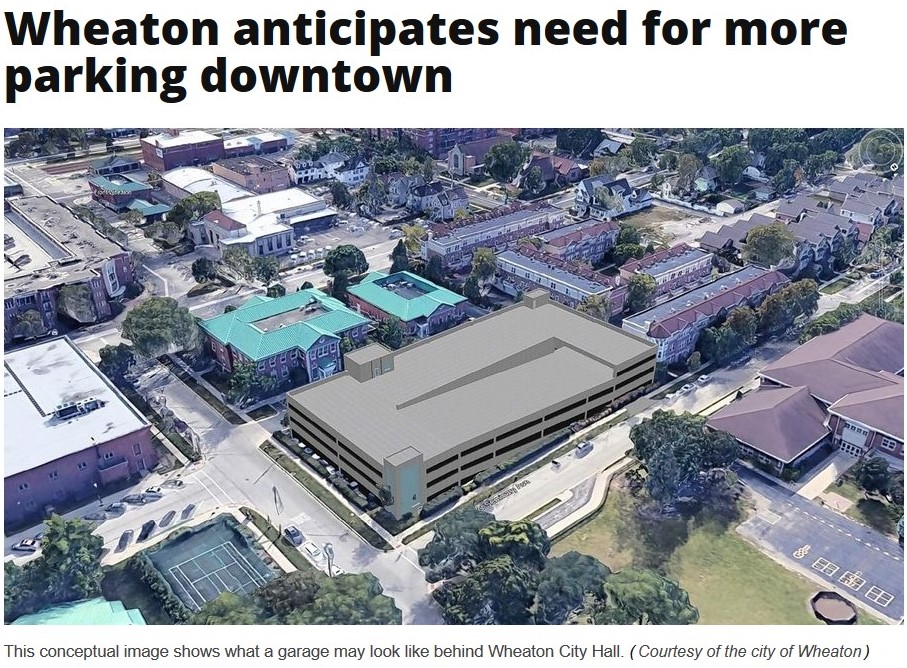
The idea of a parking garage is highly conceptual, one element of a broader study on parking needs, restrictions and the existing inventory downtown. The goal is to stay ahead of parking issues as new businesses take over long-vacant properties and bring more visitors to the shopping and dining district, especially on weekend nights…

City planners say replacing a surface lot behind city hall with a parking garage is a viable option because it’s city-owned property, eliminating the cost of land acquisition. It’s also tucked away from the main downtown arteries but still within walking distance of a Hale Street restaurant row.

Suess said a city hall garage would address neighborhood concerns about overflow parking on residential streets around Memorial Park, a summer magnet that recently underwent a $5 million restoration, the centerpiece of which is a new band shell…

Other council members said they still want to consider another location that’s been floated for a parking structure over the years: the east surface lot of the Wheaton Public Library.

There are practical matters that any community would need to consider: how much parking is needed? What is the cost of the structure? Is this the right location?

There are also bigger questions about what a suburban downtown is supposed to be. Many downtowns would like to have more people visit and spend money in shops, restaurants, and festivals. But, more people and traffic can change the atmosphere. This means more cars. Where to put them?

Parking garages offer a possible solution as multiple stories can pack in more cars than street parking. Wheaton already has a few parking garages so this is not a new idea. But, parking garages are rarely attractive structures. Do they fit in with the surrounding streetscape?

The proposed location above tries to mitigate some of these issues. Wheaton has done this with other parking garages; tuck them behind other buildings so they are not as visible. The proposed garage would be behind City Hall, hiding is from a main stretch of Wesley Street. Yet, it then backs up to residences on the west side, is on a different scale than City Hall to the south, is visible from Memorial Park (site of festivals and events that would drive people to the garage), and is across the street from a school and its green space to the north.

The other proposed site mentioned above has some similar issues. While it would be next to the library on one side and across the street from a multi-story apartment building on the other side, it faces single-family homes on the other side and smaller apartments on another.

Wheaton wants its downtown to exist on a particular scale so that it remains an attractive place for residents and visitors. More broadly, the community protects its character as a quieter, single-family home community (see how a discussion about zoning along a main thoroughfare played out). The city also wants to bring in people and address parking issues which can mar the experience on streets and in nearby residential neighborhoods. Is a four story parking garage the answer? Local leaders and the community will have time to discuss and decide.
White flight spontaneous or planned?

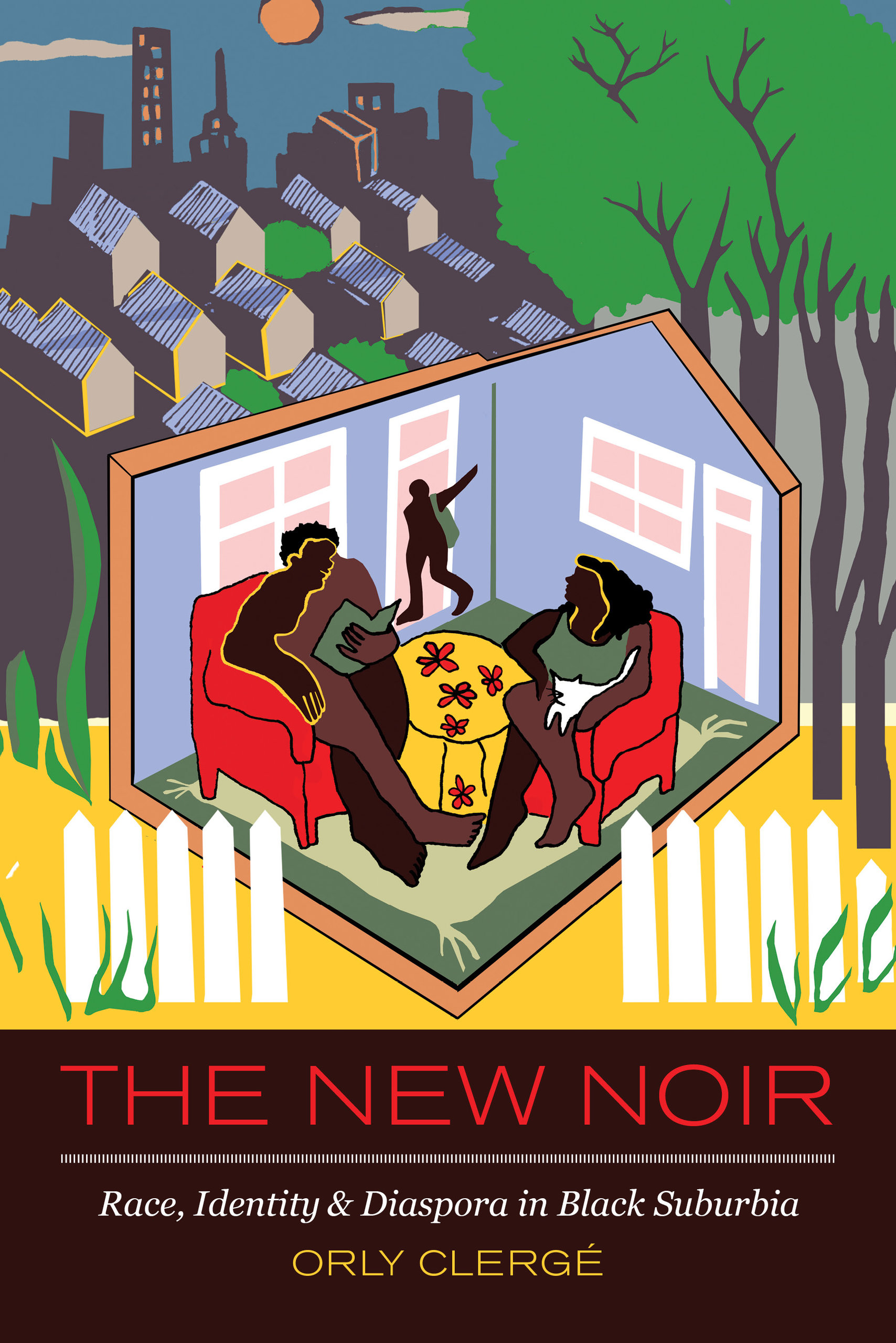
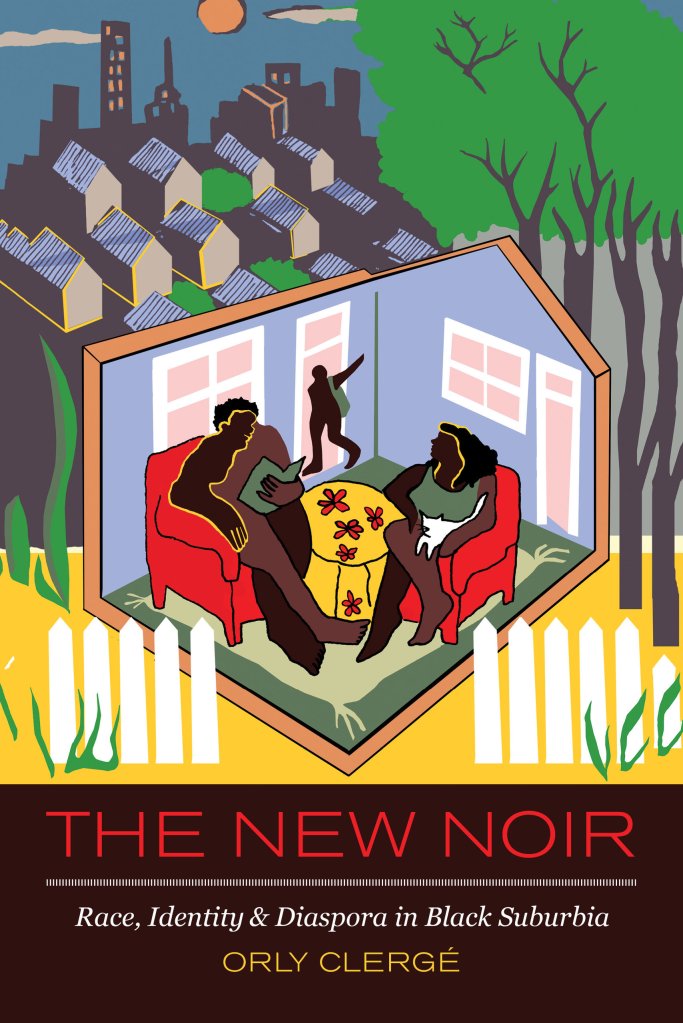
Sociologist Orly Clergé’s 2019 book The New Noir: Race, Identity & Diaspora in Black Suburbia includes the history of Blacks moving to New York and its suburbs. In her study, Clergé talks to both Black residents and white residents of suburban communities. Here is how Clergé responds to the claim by some white residents that their families left neighborhoods spontaneously as Black residents moved in:

Although White flight is discussed as a spontaneous response to Black in-migration, White fight and flight were well thought-out, collective, strategic, and immoral acts against Black people condoned by the state. (101)

White flight is the American phenomena where white residents left urban neighborhoods for the suburbs when Blacks and other racial or ethnic minorities moved in. This is most common in the decades after World War Two when government policy and community changes combined to lead to often rapid turnover in cities. In some Chicago neighborhoods, the population moved from +90% white to a significant Black majority in just a decade or two.

A number of studies explain how white flight happened in particular cities such as in Detroit as detailed by Sugrue in The Origins of the Urban Crisis or Atlanta as discussed by Kruse in White Flight. White flight affected all areas of life, ranging from the suburbanization of jobs as Wilson highlights in When Work Disappears and the move of white churches to the suburbs (an area I have done a little work in with a study of Protestant denominations in the Chicago region).

What the quote above highlights is just how prepared white residents were regarding potential changes in their neighborhood. Over the course of at least a few decades, whites deployed a range of techniques that culminated in white flight: restrictive deeds and covenants, blockbusting, redlining, and threats and violence. As each of these techniques was rendered illegal or went against public opinion, white residents moved onto the next option. And white flight was eventually the choice as white residents left en masse. It did not just happen; it was part of well-established patterns of exclusion that would then continue in suburban communities.

The difficulty of keeping up with all the choices in local elections

I voted in the local elections held yesterday. I study suburbs and am aware of the fondness many Americans have for smaller and/or local governments. And I find it difficult to know who or what I am voting for in local elections.

In class yesterday, I started by talking about the importance of local elections. If residents care about their community, they can run for local offices or serve on volunteer committees. Without all of this important work that can require high levels of commitment for limited compensation, things would not get done. Because turnout can be low in local elections, candidates can be elected with relatively few votes.

Photo by cottonbro on Pexels.com

In certain elections, certain parts of the ballots stand out. Perhaps it is a development issue. Perhaps it is a referendum on a local tax increase to fund local schools. Perhaps it is a particular race, like a heated mayoral election or a pandemic facing members of the school board.

Beyond those more noteworthy circumstances, there are many choices. Forest Preserve commissioners. County Board members. Local judges. Township leaders. And so on. Sometimes, I know something that helps me make a choice. I read local news that helpfully presents local candidates. I watch some local forums where candidates talk. I am aware of some of the local concerns. I may know someone or know of someone. But, I cannot keep track of everything. Hence, the popularity of just voting a slate or a party for particular positions. Or, a set of endorsements from local media. This is all on top of what might be happening at the state of federal level.

This problem might be exacerbated by the number of units of local government Illinois has. However, I suspect this is a larger issue among Americans. Having many choices for many offices may help lead to lower turnout. Only some people have the motivation and wherewithal to find all of the information needed on local issues and candidates. People are disconnected from local groups and institutions through which they might hear about candidates and issues.

Americans like the idea of local elections but it is hard to keep up with all of the local government activity.

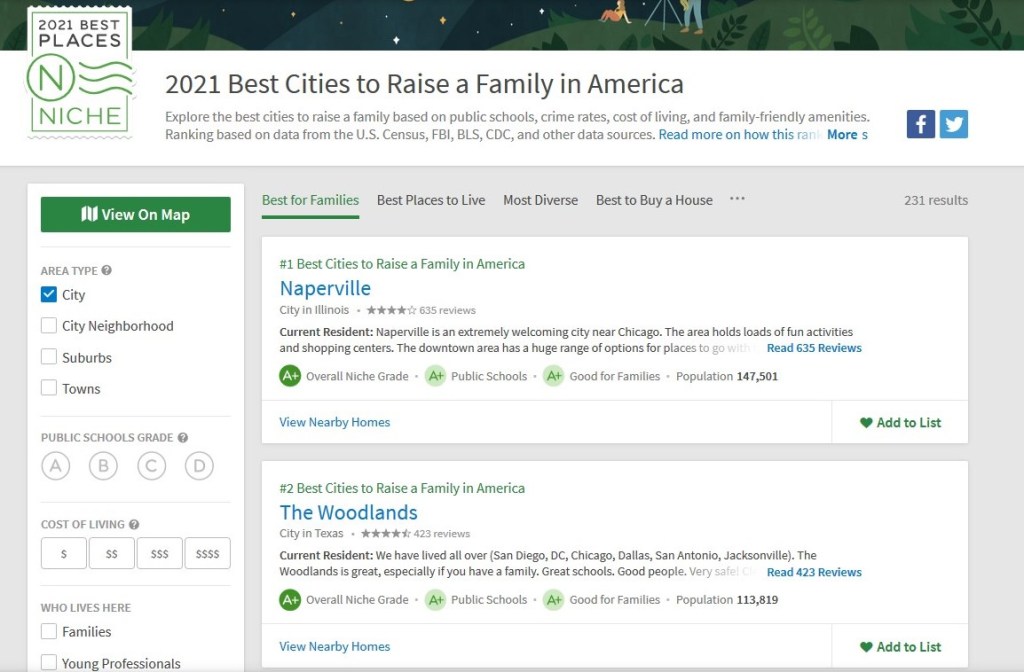
Naperville at #1 on several Niche.com Best Cities lists

Naperville adds to its rankings accolades with the new 2021 Niche.com lists:

Naperville was also ranked #1 for Cities with the Best Public Schools and #3 for Best Cities to Live in America. See previous posts about Naperville’s rankings: “wealthiest city in the Midwest” and “safest city over 100,000 residents.”

This ongoing praise for Naperville makes sense both for knowing the suburb as well as what sorts of communities make it to the top of these kinds of lists. Naperville grew tremendously in the final decades of the twentieth century but it also developed a high quality of life: vibrant downtown, highly-rated schools, local recreation opportunities, wealthy, and safe. The accolades have changed to some degree because the size of the community changed; for example, Naperville is the list of “cities” for Niche.com while the Best Places to Live in America tend to be smaller communities.

If you browse the Niche.com rankings just a little bit, you see wealthy suburbs from certain metro areas in the United States. That the same communities keep popping up on these lists year after year suggests they have an ongoing high quality of life but also it hints at what Americans – and people who make these rankings – think are desirable communities. Is the goal of American life to ascend to one of these well-off communities, most of them relatively white and wealthy suburbs?

In a land of driving, both a bifurcated housing market and car buying market

Americans like to drive and have structured much of daily life around driving. This means many people need a reliable car to get to a decent job, which then enables them to buy a decent home in a place they want to live. But, what if both the house and car buying markets do not provide a lot of good options at lower prices? From the auto industry:

Photo by Pixabay on Pexels.com

Yet that increase was nothing next to what happened in the used market. The average price of a used vehicle surged nearly 14% — roughly 10 times the rate of inflation — to over $23,000. It was among the fastest such increases in decades, said Ivan Drury, a senior manager of insights for Edmunds.com.

The main reason for the exploding prices is a simple one of economics: Too few vehicles available for sale during the pandemic and too many buyers. The price hikes come at a terrible time for buyers, many of whom are struggling financially or looking for vehicles to avoid public transit or ride hailing because the virus. And dealers and analysts say the elevated prices could endure or rise even further for months or years, with new vehicle inventories tight and fewer trade-ins coming onto dealers’ lots…

Charlie Chesbrough, senior economist for Cox Automotive, predicted a tight used-vehicle market with high prices for several more years…

In recent years, automakers had set the stage for higher prices by scrubbing many lower-priced new vehicles that had only thin profit margins. Starting five years ago, Ford, GM and Fiat Chrysler (now Stellantis) stopped selling many sedans and hatchbacks in the United States. Likewise, Honda and Toyota have canceled U.S. sales of lower-priced subcompacts. Their SUV replacements have higher sticker prices.

On the housing side, builders and developers have devoted less attention to starter homes. It can be difficult for some workers to find housing near where they work. The ideal of the suburban single-family home is not attainable for all.

On the driving side, cars are not cheap to operate and maintain. Moving to the suburbs and many American communities requires a commitment to driving to work. A reliable car at a reasonable price could go a long ways to keeping transportation costs down and freeing up household money for other items.

These issues require longer-term planning and attention: how can people with fewer resources still obtain decent housing and decent transportation options? COVID-19 may have exacerbated these issues but the article about the auto industry suggests these trends were already underway; car prices were on the upswing. Trying to tackle density issues or providing more mass transit are difficult to address in many communities and regions. A conversion to electric cars in the next decade or two sounds good but imposes new costs on drivers.

In the meantime, those with resources can likely pick up better options for both cars and homes. These choices can then have positive cascading effects on future spending and outcomes.

Will turnout increase for upcoming local elections?

Election season is near in our area. Local elections often have really low turnoutsuburban municipal officials can be elected by just a small fraction of the population. But, perhaps this year will be different for a few reasons:

Photo by Element5 Digital on Pexels.com
  1. Local battles over COVID-19. With disagreement with and mistrust of national responses, local elections offer an opportunity to weight in on local responses. In particular, decisions about school reopenings are hot issues in elections for school boards. Add in debates about local businesses and eateries and voters might want to weigh in.
  2. Carryover from national elections and political polarization. Traditionally, local elections are non-partisan. Yet, the rancor at the higher levels could carry over. For example, I saw a large sign today looking to turn township positions blue. How much local officials might actually be able to do in regards to these debates is likely limited but it could help some voters and officials feel better.
  3. The activism of Black Lives Matter in suburbs plus responses to it could send more voters to the polls. How should communities address inequalities or disparities?
  4. Concern about municipal budgets. COVID-19 has created new problems and a number of communities already faced issues. How should money be spent and what could be done to bring in more revenue? The competition might just be heating up among suburbs to find government and tax revenues.

In other words, these are not typical local elections during good times. The local election turnout malaise might not be there. Since suburbanites tend to like local government, will they turn out this time when there are multiple pressing issues?

The Limbaugh soundtrack to suburban life

For decades, the suburbs were said to be more politically conservative. One writer describes hearing Rush Limbaugh in his suburban childhood:

Photo by rikka ameboshi on Pexels.com

As a kid growing up in Sacramento, I had a few friends I liked, but dreaded going to their houses to play. I suggested riding bikes, playing tag or hide and seek — anything to avoid their homes. I avoided their houses because their families usually had the radio tuned to KFBK, listening to a guy who was always furious about nothing, as though he was pleasant background noise — elevator music for single family, one story homes in the suburbs.

To my young ears, there was an uncanny vibe about his voice. He sounded like Santa Claus if Santa swallowed another Santa whole, but that Santa got stuck in his throat. Boots, beard, and furry coat, all jammed against his larynx as he croaked on and on, complaining about “illegal” elf workers wanting fair pay, health care and for him to stop grabbing their tiny butts.

My friends’ “nice” families had him on, all the time, stinking up their homes with hate the way others baked to make homes smell like cookies.

I wondered what that did to us, constantly breathing in his vitriol — for non-white people, for women, for gay people, especially if they were richer, smarter or more powerful than him. I wondered what he’d think of me, what they all think me — a Black kid with a working mom and absent dad — skin so light it sometimes camouflaged me from their sight.

The main contrast here is between the “nice” suburban families and the constant sounds of Rush Limbaugh. On the whole, the suburbs are often pitched as idyllic: single-family homes for families, middle-class people who have made it, green lawns and a quieter life compared to cities. The suburbs are supposed to be the retreat from the difficulties of the world.

Yet, from the beginning, whether the suburbs have delivered on these claims is debatable. Who could make it to these locations? How idyllic was it really or was it perceived to always be under threat? Did the gloss of suburbia cover up darker truths involving race, class, gender, broken families, and more?

It would be interesting to back and see if there is evidence of suburban talk radio listening patterns. Or, to mirror current political patterns, was Limbaugh more popular in exurbs and the outer suburbs and his listernship dwindled closer to the big city?

One way or another, suburban sidewalks will be cleared of snow

Because of different regulations and community guidelines, sidewalks in the suburbs could be cleared quickly of snow – or not. Of course, they all will be clear eventually as the weather warms up.

The continued onslaught of heavy, back-straining snow was hard enough to tackle. When a deep freeze solidified it, many people surrendered their shovels in defeat.

The result left sidewalks covered with snowdrifts in neighborhoods and along busy streets. Some pedestrians could be seen walking on busy roads rather than wading through sidewalk snow, a risky strategy at best…

Across the suburbs, “there’s no uniform code” for sidewalk snow removal, Czerwinski explained. “Some communities have an ordinance, which sets in place whose responsibility it is, and it’s usually the property owner, and it’s a requirement. Other municipalities only encourage residents to shovel snow. Some municipalities say nothing.

“It’s not the norm in the metro region, but some cities such as Highland Park do plow sidewalks, taking a tiered approach. The city plows 32 miles of sidewalks near schools, Metra stations, public buildings and shopping districts — no matter how much snow falls, according to Highland Park’s website.

Given the unique snowfall in the last month or so in the Chicago area, there were several keys to keeping sidewalks and driveways clear:

-Keep up with the various snowfalls. If you let multiple snows happen or do not clear the snow completely each time, it piles up, melts in layers and then freezes, and takes longer to clear.

-Use a shovel with a steel edge. This helps scrape the surface clear rather than just gliding over the top.

-Snowblowers cut down on the physical effort needed but they do not always get to the bottom of the snow. They instead can leave an inch or two at the bottom that becomes tramped down and stays on the surface longer.

More broadly, I wonder if the sociologists who study collective efficacy would see snow removal as a reliable marker. Do people go out of their way to help each other? Is the block or community more important than just clearing individual driveways and sidewalks? The Chicago system of “dibs” where people physically mark off their cleared parking spaces for their own use is interesting to consider in this light. But, so might be the suburbanites who leave their own property immaculate but nearby paths are not cleared. In this case, does the snow clearing become more of a status symbol like a dandelion-free lawn or yard free of leaves rather than an interest in public welfare?

(With all the snow that fell and is now melting, it is also time to consider drainage issues present in many suburban areas. Where can all the water go?)

The evangelical books on suburban life recommended for devotional reasons

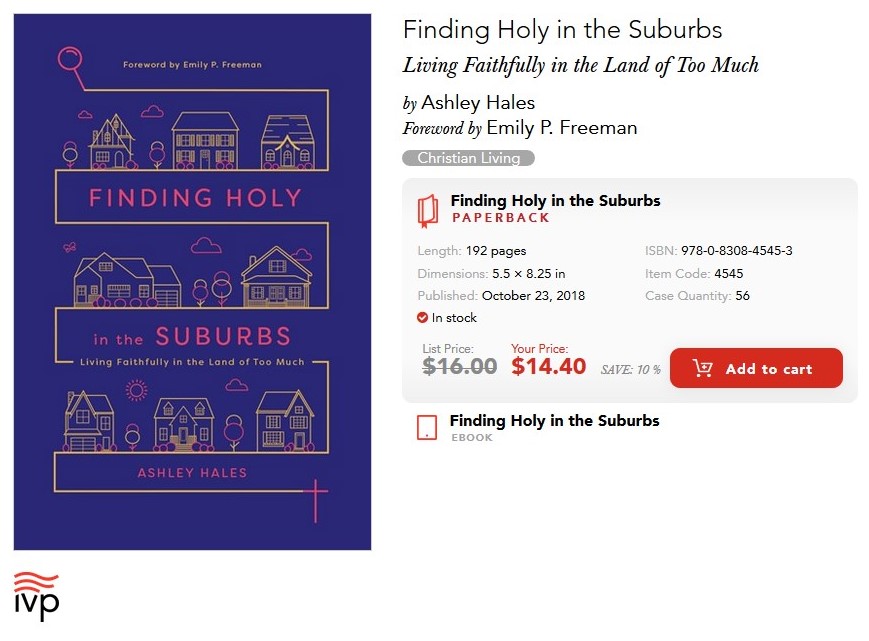
Following up on Friday’s post on a recent publication titled “Faith in the Suburbs: Evangelical books about Suburban Life” and yesterday’s recommendation of The Suburban Christian for a more scholarly approach among evangelical books that discuss suburban life, today I highlight two books that stand out in taking a more devotional approach to evangelical life in the suburbs.

As I noted yesterday, the books I examined all had an interest in helping Christians grow in faith and practice and live in the suburbs at the same time. Both Dave Goetz’s 2006 book Death by Suburb: How to Keep the Suburbs from Killing Your Soul and Ashley Hales’ 2018 book Finding Holy in the Suburbs: Living Faithfully in the Land of Too Much stand out for their mix of advice for and insight into the everyday suburban religious life and the spiritual practices they recommend for a changed suburban life.

They approach these practices in slightly different ways. In the opening chapter, Goetz sets up the problem:

I think my suburb, as safe and religious coated as it is, keeps me from Jesus. Or at least, my suburb (and the religion of the suburbs) obscures the real Jesus. The living patterns of the good life affect me more than I know. Yet the same environmental factors that numb me to the things of God also hold out great promise. I don’t need to the escape the suburbs. I need to find Jesus here. (5)

harpercollins.com

Subsequent chapters then each start with a listed environmental toxin of suburban life and then a practice in response. The material for each chapter then discusses these two features. Pursuing these practices will help readers find the thicker life he describes this way:

This much thicker world is a world in which I am live to God and alive to others, a world in which what I don’t yet own defines me. (13)

Hales puts the problem this way:

More than 50 percent of Americans live in suburbs, and many of them desire to live a Christian life. Yet often the suburbs are ignored (“Your place doesn’t matter, we’re all going to heaven anyway”), denigrated and demeaned (“You’re selfish if you live in a suburb; you only care about your own safety and advancement”), or seen as a cop-out to a faithful Christian life (“If you really loved God, you’d move to Africa or work in an impoverished area”). From books to Hollywood jokes, the suburbs aren’t supposed to be good for our souls. Even David Goetz’s popular book, Death by Suburb, though helpful, presumes suburban life is toxic for your soul – as if suburbia were uniquely broken by the weight of sin. The suburbs – like any place – exhibit both the goodness of God’s creative acts (in desiring to foster community, beauty, rest, hospitality, family) and sin (in focusing on image, materialism, and individualism to the exclusion of others). We cannot be quick to dismiss the suburbs out of hand. (8)

ivpress.com

The practices and counterliturgies Hales recommends would help Christians see suburbs and their role their differently:

This book is about coming home, about finding ourselves in the story of God and rooting ourselves in our places. It’s a bold look at the culture of affluence as expressed in suburban life. My hope is that is challenges your idea of belonging and also shows you a more beautiful story to root yourself in. As individuals, families, and churches commit to love and sacrifice for our neighborhood and subdivisions, we will find our place. (14-15)

If an individual, church group, or religious organization wants to consider evangelical life in the suburbs, both of these books could be a good starting point for conversation and action.

The evangelical book on suburban life recommended for scholarly reasons

Following up on yesterday’s post about a recent publication titled “Faith in the Suburbs,”” I wanted to highlight the one text that best connects readers to scholarly discussions of and existing research on suburbs.

One of the features of the books I examined is their focus on everyday Christian/evangelical life. On the whole, these texts are part of a larger category of books where evangelicals wrestle with current social issues and consider Christian approaches. Across the books, the goal is help readers build their faith and draw on evangelical and biblical resources.

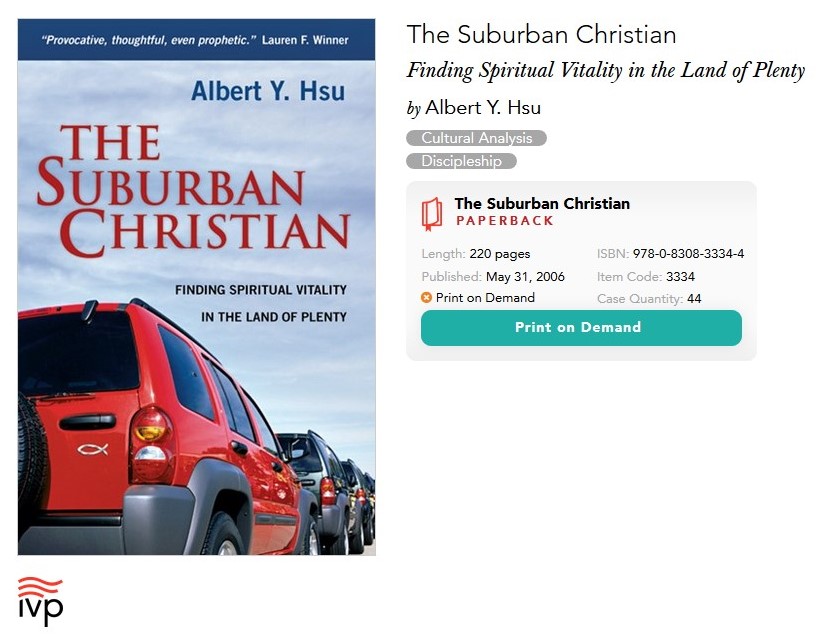
Al Hsu’s 2006 book The Suburban Christian: Finding Spiritual Vitality in the Land of Plenty is the best on drawing on existing historical, theological, and other scholarly research on suburbs and places. There is a full chapter on suburban development that draws on a number of well-cited texts about how the American suburbs came to be. While some books I studied cited no scholarly works, Hsu cites numerous works and the discussion and footnotes could provide a good starting point for a reader who wants to engage the decades-long scholarly discussion.

ivpress.com

The engagement with a wider academic conversation may be connected to other unique features of Hsu’s text. He considers how Christians could engage race and social class in the suburbs. In the final chapter when discussing solutions, Hsu connects religious activity and structural activity:

While we must never neglect the significant of evangelizing individuals, equally important is transforming societal, organizational and municipal structures. (188)

Hsu also helps individual Christians think about their beliefs and practices in the suburbs. For example:

Behind the readers’ comments is a tacit assumption that the Christian life simply can’t be lived in certain environments…But for Christians, nothing is beyond redemption. (13)

For individuals, church groups, and religious organizations looking for an evangelical book addressing suburban life with a more scholarly angle, this would be a good starting point.