Political ads are everywhere this time of year and they are hard to avoid:
-During all TV broadcasts. Whether watching football games or news broadcasts or sitcoms, candidates are all over the screen.06
-Internet and social media ads. I do not see many of these due to using adblockers but the ads are over the place.
-Mailings as candidates flood mailboxes with appeals and glossy photos and policy positions.
-Texts asking you to vote for candidates or support a candidate. How many of these numbers do we need to block?
-On the radio. Perhaps not as pervasive as TV but still there.
And I do not even live in a battleground state where I would guess there are even more ads.
The political ads must work to some degree as millions are spent on them. Who exactly is convinced by them? Do they primarily rile up a base who then votes in larger numbers? At the same time, I remember hearing a talk by a sociologist who interviewed campaign managers who reported that social media ads are preferable because it is easier to measure who responds or engages compares to mass media ads.
Commercials are part of the American way of life. Anywhere you turn, you see brands, logos, and appeals for particular products. Given that landscape where we see thousands of ads, why not throw in politicians and parties and issues as just another brand or product to sell?
Like the political yard signs, the ads will disappear after Election Day. They will be back for the next races as different actors try to position their candidates in front of the public in a truly American way.
Specifically, it has everything to do with LKFS, which stands for “Loudness, K-weighted, relative to full scale” and which, for the sake of simplicity, is a unit for measuring loudness. Traditionally it’s been anchored to the dialogue. For years, going back to the golden age of broadcast television and into the pay-cable era, audio engineers had to deliver sound levels within an industry-standard LKFS, or their work would get kicked back to them. That all changed when streaming companies seized control of the industry, a period of time that rather neatly matches Game of Thrones’ run on HBO. According to Blank, Game of Thrones sounded fantastic for years, and she’s got the Emmys to prove it. Then, in 2018, just prior to the show’s final season, AT&T bought HBO’s parent company and overlaid its own uniform loudness spec, which was flatter and simpler to scale across a large library of content. But it was also, crucially, un-anchored to the dialogue.
“So instead of this algorithm analyzing the loudness of the dialogue coming out of people’s mouths,” Blank explained to me, “it analyzes the whole show as loudness. So if you have a loud music cue, that’s gonna be your loud point. And then, when the dialogue comes, you can’t hear it.” Blank remembers noticing the difference from the moment AT&T took the reins at Time Warner; overnight, she said, HBO’s sound went from best-in-class to worst. During the last season of Game of Thrones, she said, “we had to beg [AT&T] to keep our old spec every single time we delivered an episode.” (Because AT&T spun off HBO’s parent company in 2022, a spokesperson for AT&T said they weren’t able to comment on the matter.)
Netflix still uses a dialogue-anchor spec, she said, which is why shows on Netflix sound (to her) noticeably crisper and clearer: “If you watch a Netflix show now and then immediately you turn on an HBO show, you’re gonna have to raise your volume.” Amazon Prime Video’s spec, meanwhile, “is pretty gnarly.” But what really galls her about Amazon is its new “dialogue boost” function, which viewers can select to “increase the volume of dialogue relative to background music and effects.” In other words, she said, it purports to fix a problem of Amazon’s own creation. Instead, she suggested, “why don’t you just air it the way we mixed it?”
This change in how television audio works contributes to needing subtitles to understand what is being said.
I wonder if the bigger question is whether this significantly changes how people consume and are affected by television. If we are reading more dialogue and descriptions, does this focus our attention on certain aspects of shows and not others? Could this be good for reading overall? Does it limit the ability of viewers to multitask if they need to keep up with the words on the screen? Do subtitles help engage the attention of viewers? Do I understand new things I did notice before in the world with fewer subtitles? Does a story or scene stick with me longer because I was reading the dialogue?
Does this also mean that as Americans have been able to buy bigger and bigger TVs for cheaper prices, they are getting a worse audio experience?
And if the “Succession” audience is smaller, the money is, pointedly, bigger. Rewatched in 2023, the idea of luxury in “Dallas” looks quaint, almost dowdy. The aesthetic is Texan country club; the Ewing homestead, the size of a decent suburban McMansion, is a toolshed next to the Manhattan aeries, Hamptons manors and Italian villas that the Roys flitter among.
Some of this is a matter of modern premium-cable budgets vs. the grind of old-school network-TV production, of course. But it also reflects the changed, distorting nature of modern riches. In 1980, American wealth inequality was still near its postwar lows. Since then, the wealth of the top .01 percent has grown at a rate roughly five times as much as that of the population overall. Today, the very rich are very, very, very richer.
The holdings of Waystar Royco — Hollywood studios, cruise lines, newspapers, amusement parks, a king-making right-wing news channel — make Ewing Oil look like a franchise gas station. We know only vaguely how Logan Roy built his empire, but it was enabled partly by the media-consolidation and antitrust deregulation, beginning in the “Dallas”/Reagan era, that allowed his real-life analogues like Rupert Murdoch to make their own piles.
On the other hand, mansions are even bigger, more extravagant, and can be of better build quality. Having multiple such dwellings extends far beyond the McMansion owner in the suburbs.
Another question: do the super wealthy make use of all that square footage and the features or are these part of a real estate investment? The McMansion owner is also hoping to get a return on their investment but the amount of money involved with extra-large properties is at another level.
Courtesy of Architectural Digest, see more about some of Succession’s dwellings here.
I don’t want this attention. Jersey’s bad reputation for being America’s garbage dump has done a great job of keeping people out and our blocks relatively affordable. For years, Jersey City was protected by a forcefield of bad representation. Jersey is by far America’s favorite punchline of a state. Futurama imagined America’s founding fathers dubbing New Jersey “our nation’s official joke state.” Movie after movie refers to Jersey as “the armpit of America.” Even in Marvel’s What If…?, Harold “Happy” Hogan laments the only escape from a zombie apocalypse: “Just when you thought things couldn’t get any worse, we gotta go to Jersey.” MTV’s Jersey Shore continues to do a fantastic job of finding the best cast to represent the state and all it has to offer folks on the outside. Snookie and J-Wow knew exactly how to lay out the red carpet. The Sopranos also knew exactly how to showcase Jersey’s finest hospitality. Come for the bar fights, stay for the gabagool.
I would argue few places are depicted well on television or in films where the emphasis is usually on character and plots rather than on places, neighborhoods, and communities.
At the same time, certain locations can acquire a particular character through the way they are depicted over the years. Viewers might see only a particular perspective on or a portion of a place.
What would the average American think New Jersey is like based on what they have seen on screen?
Village trustees Monday voted 4-2 to approve the 5% entertainment tax as part of its upcoming budget. The tax would take effect July 1.
Village officials budgeted $25,000 in revenue from the new tax, which would tack 77 cents onto a standard monthly Netflix subscription costing $15.49 or 15 cents to an Amazon video rental costing $2.99.
“This is a modern version of the original telecommunication tax,” Village Administrator Erika Storlie said, adding that the village has seen a decrease in taxes collected from cable subscribers as more people drop cable television in favor or streaming services…
Chicago adopted an entertainment tax charging 9% on streaming services in 2015. In March, a judge dismissed a lawsuit filed by Apple Inc. challenging the tax. Though Apple’s complaint was dismissed, the judge left the door open for Apple to file an amended complaint.
Evanston, where Storlie served as city manager before coming to East Dundee, has charged a 5% entertainment tax on streaming services since October 2020.
Several thoughts about this:
-This is a relatively small tax in this community: the story above suggest its will generate $25k in revenue. Even in a small suburb, the money this generates will only do so much?
-I could imagine the argument that infrastructure is required to provide streaming services and taxes like these would help communities cover these costs. (I could also imagine – very faintly – the logic of a vice tax to limit the hours upon hours that Americans spend in front of televisions and screens…but limiting television watching via taxation seems somehow un-American. )
-I do not recall seeing much about public discussions of such taxes within communities. Is the tax so small that it does not attract much attention? Do residents not have a compelling argument against a streaming tax?
-Entertainment taxes are sometimes used for visitors or more public activities such as tickets for sporting events or theater shows. A streaming tax is aimed more at residents than visitors.
Many municipalities need consistent tax revenue streams as they look to provide services and balance budgets. This is one way to help achieve that goal.
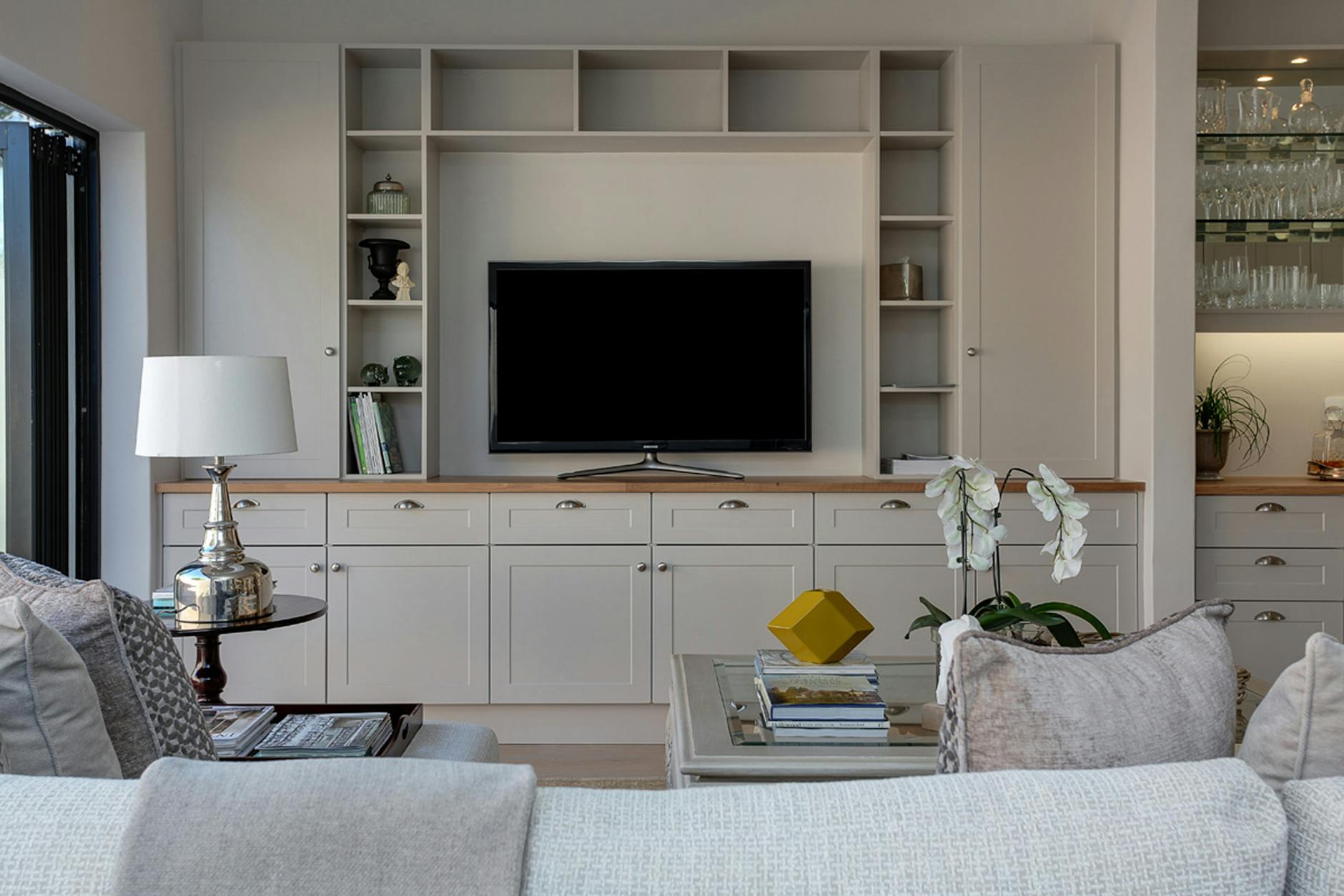
What’s the biggest TV you can buy? If we’re talking about conventional televisions, the TCL 98R754 is a staggering 98-inches wide. But if you’re willing to consider a laser or short-throw projector TV, Samsung’s The Premier is capable of showing a screen up to 130 inches. But unless you live in a cavernous McMansion with 18-foot cathedral ceilings and a sprawling layout, you won’t be able to get them to fit in your living room, let alone be able to take full advantage of their features.
How can I know if an 85-inch TV will fit in my room?
The best way to find out is to measure (in inches) from where the TV will be wall mounted or placed on a stand to where you will be sitting, and then divide that measurement by 2. If your couch is anywhere from 150 to 170 inches (12.5 to 14 feet) from the TV, an 85-inch screen will be an almost perfect fit. You can, of course, go a bit bigger (if possible) or smaller depending on what your budget is and what is available from each brand. But a screen that is too big can overwhelm your space and even cause motion sickness while one that is too small will make it feel cavernous and force everyone to crowd around in order to see.
Presumably, there is some limit to how big a television can or should be. Perhaps this is about the ability to see what is happening on the entire screen. Perhaps rooms truly can only be so large. Perhaps screen technology will be replaced by an entertainment chip in glasses. Or, people might get tired of important rooms in their house being dominated by a gigantic screen.
On the other hand, perhaps this helps signal a shift away from homes leading with their garages – the so-called “snout houses” – and instead leading with a giant screen. Imagine walking in the front door and the major room is devoted to the biggest possible screen. The screen is something to show off and impress visitors with. Homes could even be designed so that the outside would make clear the giant screen and the room it sits in.
Reddit user PixelMagic has revealed (in a post we first came across at Indy100) the dark lie of Seinfeld. Jerry’s home can’t exist in the real world. Not if you believe in basic rules of time and space. You can see why in an overhead rendering of the apartment. If you actually built it to these specifications, the outside hall would need to run through Jerry’s kitchen.
Your instinct might be to say the hallway must have been curved. That was my first reaction. Lots of other Reddit users said the same thing too. If you look at screenshots of certain episodes, that does seem plausible. In certain moments the area between Jerry and Kramer’s apartments seems small enough that it could form a little cove. As you walk away from Jerry’s door, the hall could bend away from the kitchen.
But once again, “The Strongbox” is here to ruin Jerry’s life. That was the episode when Jerry kept inadvertently torturing his building mate Phil. Poor Phil owned a parrot that choked to death on the strongbox key Kramer hid in his food dish.
As PixelMagic showed, that episode provides indisputable evidence that Jerry’s hall did not curve away from his door.
At the same time, consistent hiccups between what is depicted and what is actually possible can create issues down the road for viewers. Even if those watching to not consciously spend time dwelling on the physical spaces of a show or start drawing up floor plans to explore the particulars, spending all of those hours watching Seinfeld could shape how one views apartments and cities. Is this how people live in apartments? Is this what New York City is really like?
Through the trade group Video Advertising Bureau, the networks are perplexed by Nielsen statistics that show the percentage of Americans who watched their televisions at least some time during the week declined from 92% in 2019 to 87% so far this year.
Besides being counter-intuitive in the pandemic era, the VAB says that finding runs counter to other evidence, including viewing measurements from set-top cable boxes, the increased amount of streaming options that have become available and a jump in sales for television sets…
The number of families, particularly large families, participating in Nielsen measurements has dropped over the past year in percentages similar to the decrease in viewership, Cunningham said. Nielsen acknowledges that its sample size is smaller — the company is not sending personnel into homes because of COVID-19 — but said statistics are being weighted to account for the change…
More people are spending time on tablets and smartphones, which aren’t measured by Nielsen. The podcast market is soaring. Sports on television was interrupted. Due to production shutdowns, television networks were airing far more reruns, Nielsen said.
This sounds like a coming together of long-term trends and short-term realities. The long-term trends include people engaging with media across a wider range of devices, it takes work to measure all of their viewing and finding people to participate in any data collection, and there are a lot of entertainment choices competing with television. In the short-term, COVID-19 pushed people home but it disrupted their typical patterns.
At the same time, how TV is consumed and how this affects what television means could be quite different moving forward. Watching streaming television on a smartphone while commuting is a very different experience than sitting on the couch after dinner for an hour or two and watching a big-screen TV. Teasing out these differences takes some work but a new and/or younger generation of TV viewers might have quite a disparate relationship with television.
A recent WBEZ story highlighted the country’s first juvenile institution in Chicago. Here is the front of the building:
As soon as I saw this image, it reminded me of something I had seen on a tour years ago of the Warner Brothers backlot. Here is what I saw:
These buildings are not the same. But, their spirit is similar. They sit at an oddly-angled corner that gives the front entrance of the building a unique look. There are columns or pillars at the front. The buildings have a similar shape and set of materials even though they are slightly different. The backlot building has a subway entrance (from New York?) in front.
My experience with these structures hints at two larger processes at work:
My memory is not quite perfect yet it is grouping similar buildings together. How many buildings in major American cities have this kind of look on this kind of corner?
Linking to some of my research, how much do television and film depictions of place interact with our corporeal understandings of places? I can see a building on a screen, experience that same place or a similar place, and our brain and understandings then interact. Or, perhaps we may only know of a place through screen depictions and this backlot building in various forms stands in for all sorts of real settings.
I will keep looking for the Warner Brothers building on screen and continue to think through what it means for my understanding of Chicago, New York, and other places.
To go back to the beginning, how does Gill conclude her study of poetry and the suburbs? Here is the final paragraph:
Postwar suburbia has been understood and depicted as a place where little of significance can be said, where there is a profound absence of meaning, where communication is stylized, superficial, muted almost into silence. Yet as the poems discussed in this study indicate, suburbia is replete with meaning. Its poetry is bold, innovative, and engaging – both formally and thematically – in its evocation of this space and time. Indeed, the suburbs we know are known to us, in part, because of the ways in which poetry has constituted and mediated them. In turn, this poetry shows the signs of its own discursive, spatial, and historical contexts. As Doreen Massey has argued, “Social space is not an empty arena within which we conduct our lives; rather it is something we construct and which others construct about us” (49). For Roger Silverstone, suburbia is a “geographical, an architectural and a social space,” but it should also be understood as “an idea and ideology, as form and content of texts and images and as product of a multitude of social and cultural practices” (ix). Poetry, as this book has demonstrated, plays a vital – if until now overlooked – role in these processes. It offers a startling lens through which to view suburban landscape and architecture and to understand the nuances of the suburban everyday, and it demands of us that we read it with acuity and sensitivity. In its diversity and frequent ambiguity, poetry breaks the stranglehold of polarized thinking or, what Robert Beuka calls, “our continued cultural reliance on a restrictive binary system in defining the suburban milieu” (10). The Poetics of the American Suburbs has argued that the poetry of this time and place is critical, interrogative, evocative, expansive, and suggestive in turn. Most importantly, it is a poetry that is often skilful, occasionally luminous, always intriguing. The song it sings is sometimes familiar, sometimes subtle, sometimes discordant. As I hope this book has demosntrated, it deserves a hearing, and rewards attentive listening. (Gills 2013: 181)
This is a good description of what Gills does throughout the book, analyzing both popular and more literary poetry, showing how the constraints and possibilities of poetry help lead to insights about the suburbs, and how poetry reacted to and was shaped by suburbia. I recommend the book for those interested in studying the interaction of cultural works and the suburbs.
As I reviewed this academic work, it led to a few more thoughts on patterns within the work:
One idea that emerges from a number of these texts: understanding the suburbs requires analyzing what they mean and how narratives about them develop. Cultural narratives are influential and these cultural works contribute to an ongoing conversation about what the suburbs are and how they are to be regarded. For sociologists, both the facts about the suburbs – how did they arise, how are they changing, what social forces affect life there – and the interpretation of the suburbs – what are the processes of meaning-making around them – matter.
The academic literature addresses both works that praise or celebrate suburbia and works that critique suburbia. There are many works in this latter category, particularly in more recent years.
This is truly an interdisciplinary endeavor with scholars across a number of disciplines – Communications, English, Geography, Sociology, History, and more – contributing. These different perspectives help illuminate varied aspects of the cultural works and what they mean.
Related to #2, much of the work I have seen in this employs close readings or case studies of particular works or collections of works. There is less work that takes a quantitative approach to such cultural works.
In sum, I am grateful for all of this good academic work. It has helped me think more comprehensively about the suburbs and be more aware of how cultural works contribute to and/or challenge my and our perceptions of the suburbs. I am sure the academic conversation – and the public conversation about suburbs as well – will continue as suburbs change, new cultural works are produced, and the larger social context evolves.







 Legally Sociable