McMansions as short-term rentals, fake images of downtown Chicago, and news about housing

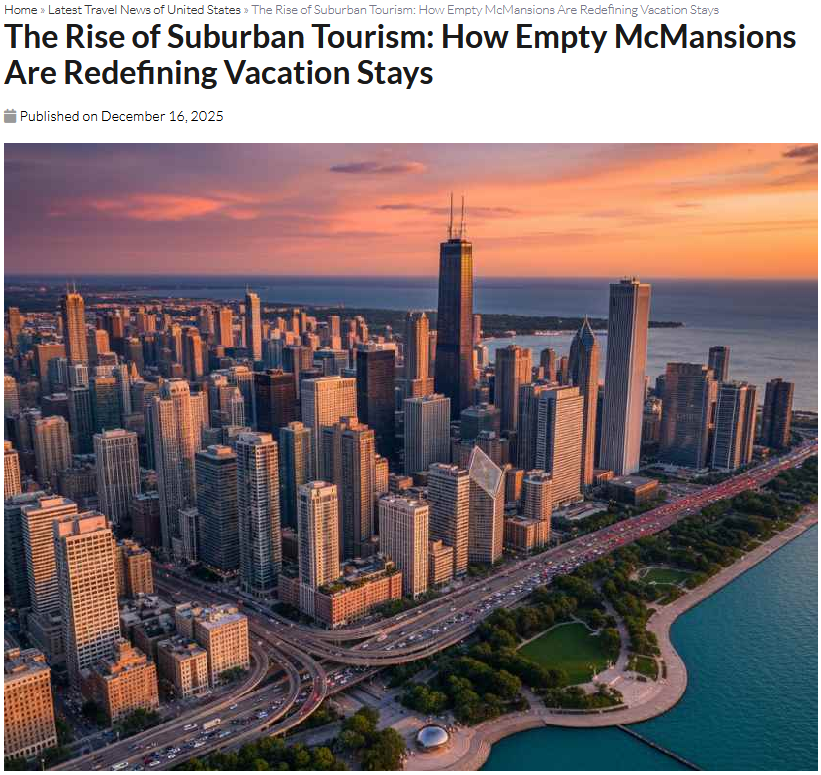
I search regularly for interesting news about McMansions. I recently ran across a headline that seemed plausible: “The Rise of Suburban Tourism: How Empty McMansions Are Redefining Vacation Stays.” But the headline was paired with a particular picture:

Image at link

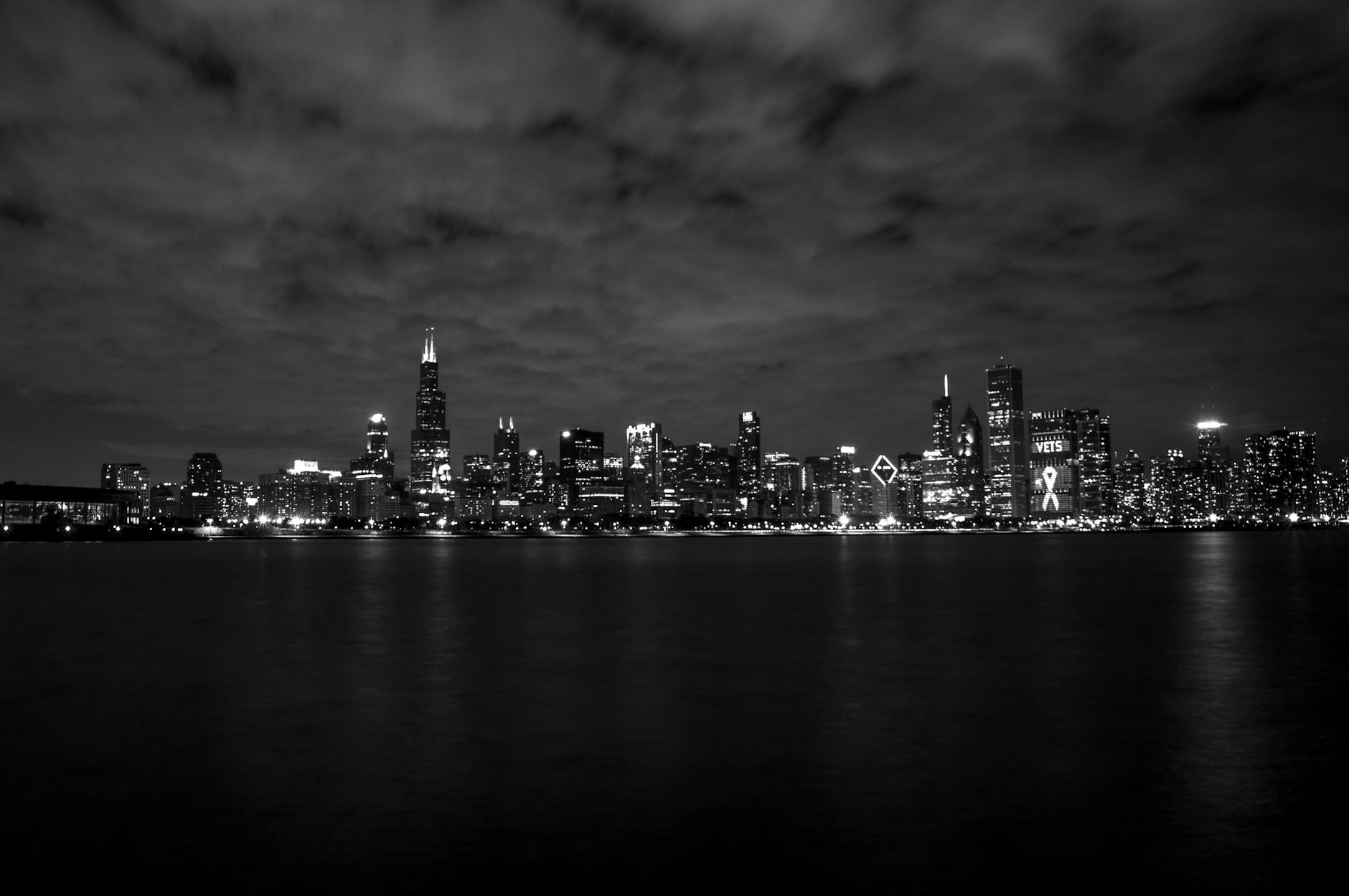
I am familiar with the Chicago skyline and lakefront. This image is…interesting. It has elements of the Chicago lakefront. A big body of water. Some iconic buildings. The Bean. Jean Baptiste Pointe du Sable Lake Shore Drive and parks along the water.

But it is also clearly wrong. The buildings are not where they should be. The lakefront is not in the right pattern. The Bean is not located on a pedestal next to the water. The local highway does not empty onto the lakefront road in that manner. And so on.

So is the McMansion story true? The summary/conclusion:

Empty McMansions in the suburbs of the United States are reshaping tourism patterns, with many tourists now seeking more dynamic urban destinations. However, these empty homes also present new opportunities for suburban areas to adjust and offer new experiences for visitors. Through creative uses of space, a focus on sustainable tourism, and rebranding efforts, suburban regions can continue to evolve as attractive destinations for a new generation of travelers.

Are more McMansions being rented out? Is this changing tourism patterns in metropolitan regions? is there any evidence of this happening? There is little in the story to provide evidence for the argument.

I will keep my eyes open for similar news but the fake image of Chicago does not inspire confidence.

How much some major US convention cities spend on attracting visitors

How much Chicago spends to try to attract conventions and visitors is less than some other American cities:

Photo by Nate on Pexels.com

Choose Chicago has been laying the groundwork to create a so-called Tourism Improvement District that would more than double the marketing agency’s annual budget by increasing the tax on rooms in Chicago hotels with 100 or more rooms by 1.5 percentage points — to 18.9%.

The Las Vegas Convention and Visitors Authority has an annual operating budget of $457 million, according to a comparison prepared by Choose Chicago. That’s followed by Visit Orlando ($116 million); Discover Los Angeles ($62 million); the San Diego Tourism Authority ($57 million); and New York’s NYC & Company ($45 million).

Choose Chicago is dead last among major convention cities, with a projected budget of $33 million for 2024…

Choose Chicago, which has yet to release data for 2024, said Chicago had 52 million domestic and international visitors in 2023. The number has increased steadily in recent years, but Chicago has struggled to match the 61 million visitors of 2019, the last full year before the pandemic. Worries about high taxes and crime hurt perceptions about Chicago as a place to visit or do business.

All cities have to brand themselves to compete in the competitive market. But, apparently, they do that with different amounts of money. Does spending more money necessarily net more visitors? Not necessarily. But the budgets do look quite different. So some additional information might be helpful:

  1. How much money is spent per visitor?
  2. How much of that money is spent directly targeting certain visitors or groups – think like conventions that then come with a certain number of attendees – versus mass media appeals?
  3. And then how much money do those visitors put back into the local economy?
  4. How do these different cities fund these marketing arms? Is it primarily about taxes visitors pay or are there other significant money streams?

Let’s see what Choose Chicago does with its increased revenue.

Chicago suburb Oak Park named in list of global places to visit in 2025

On the Travel Lemming list of “Our 50 Best Places to Travel in 2025,” one suburb makes the list of global destinations:

Photo by Element5 Digital on Pexels.com

At first glance, you may think that Oak Park is nothing more than an affluent suburb of Chicago. But it’s so much more.

Stunningly beautiful, Oak Park is the birthplace of American author Ernest Hemingway. Meanwhile, prominent architect Frank Lloyd Wright lived and worked here. A casual stroll around the suburb will take you past numerous examples of his work.

Come in the fall to watch or run in the Frank Lloyd Wright races. These 5K, 10K, and youth mile races weave through some of the suburb’s most notable architecture.

Even among this global range of destinations – cities, natural spots, beaches, mountains, etc. – this one suburb stands out. It may be the only suburb on the list. Oak Park is unique in several ways. As noted above, it does have some unique architecture and the ability to learn more about Frank Lloyd Wright. Hemingway was born there. It is also a suburb that has pursued racial and ethnic diversity for decades.

At the same time, is one reason an American suburb could make such a list is that visitors get to experience a suburban lifestyle? If they went to Oak Park, beyond some of the unique features discussed above, would they have a sense of what American suburban communities are like?

What other American suburbs might make a global list of top travel destinations?

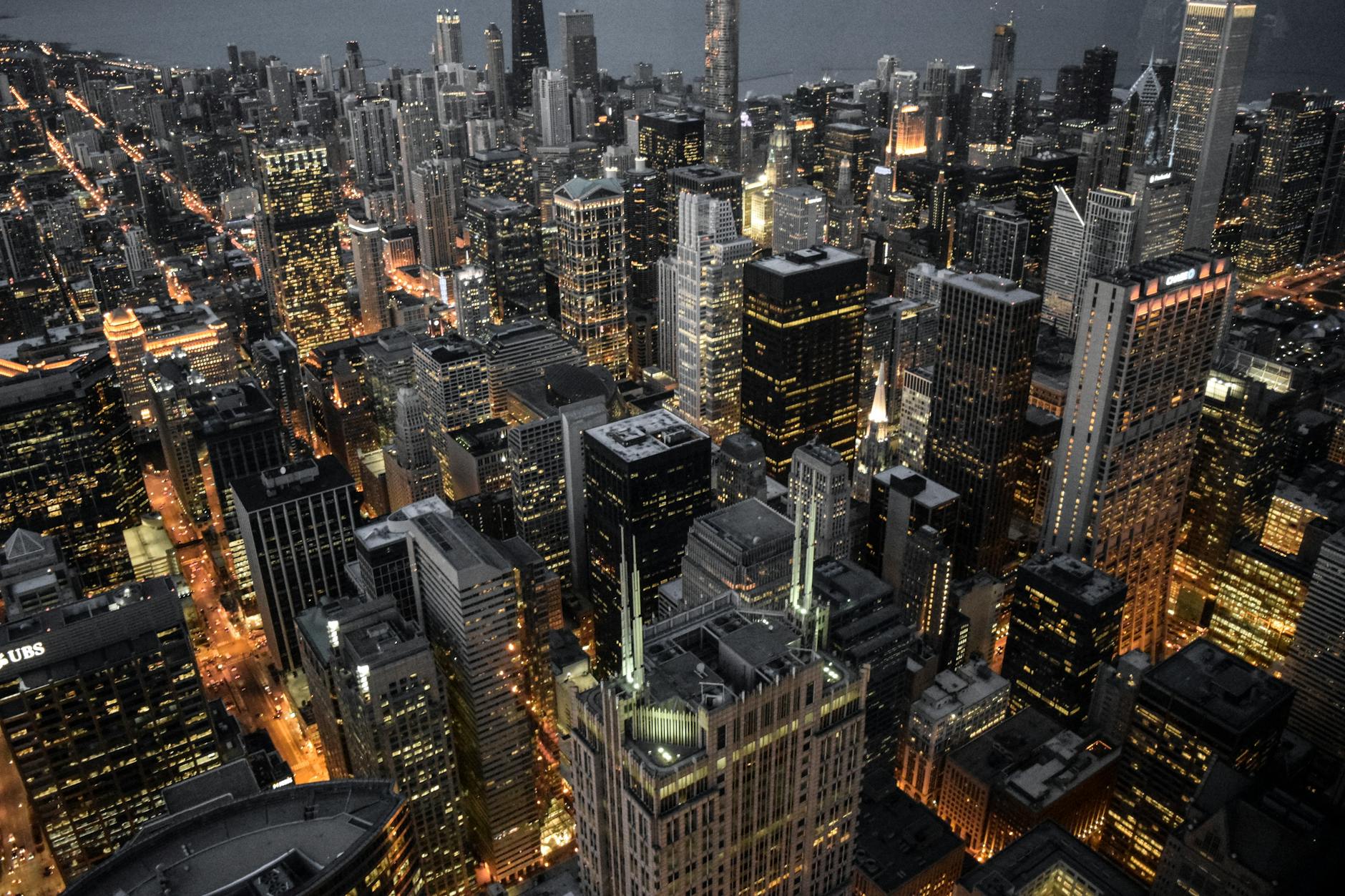
How to rank skylines – with Chicago finishing 3rd in the world

Architectural Digest has a new ranking of city skylines. Here is their methodology:

Photo by Pixabay on Pexels.com

The world’s most beautiful skylines are more than just collections of buildings placed close together: They’re the façades of entire cities, the front doors to many of the earth’s most vibrant metropolises. It’s these man-made horizons that often offer the first impression to visitors and imbue a sense of home to returning locals. But what exactly makes a beautiful skyline? One that is immediately recognizable? Those that are the most harmonious? The cities with the greatest number of individually striking buildings? The answer, is of course, some collection of all of the above. Like when discussing most aesthetic disciplines, visual examples are far more powerful than description will ever be. To that end, AD has rounded up 17 of the world’s most beautiful skylines, covering notable favorites like New York City and Shanghai as well as some lesser-known stunners that deserve more acclaim.

I do not know if it is better to simply make a subjective ranking or to have a pseudo-scientific ranking of weighted factors. As noted above, there are at least a few factors that could be considered. Here is what I might include:

  1. The most tall buildings. Would places with more tall skyscrapers automatically rank higher?
  2. The most lauded buildings. Does this come back to you particular architectural styles? Or the architects connected to them? Or the number of social media images with each building in them?
  3. The setting of the skyline. Does the view of the buildings include water or mountains or another impressive natural feature or other built features (the rankings above mention bridges)?
  4. The age of the skyscrapers. Does it matter if many of the buildings are older or if many are newer?
  5. The tourism connected to the skyline. Do people come to this place to see the skyline? Would someone go out of their way on a visit to try to take in the whole skyline?
  6. The opinions of a range of experts. What do they see as the best skylines? It could be interesting to see who is considered a skyline expert.

And among these possibilities, Chicago ranks #3. Here is the description:

Hugging the shores of Lake Michigan, Chicago is the third most populated city in the United States. The Midwest metropolis is made famous by many striking supertalls, such as Willis Tower, Vista Tower, and Marina City.

Several factors stand out: a setting on a vast body of water, a large population center, and multiple “striking supertalls.” Does Chicago get more points because of the number of tall buildings or the architects and styles connected to the skyscrapers or the longevity of the skyline or the tourism in the city?

“While in the Chicago area, Naperville is a must-see tourist destination”

Naperville is the third largest city in the Chicago region and in Illinois. It is wealthy and has a thriving downtown. Is it also a tourist destination?

Photo by Tim Gouw on Pexels.com

Naperville, a charming western suburb of Chicago, Illinois, offers many activities catering to locals and visitors alike. Illinois is a well-known destination for tourists, but this area of the state has more to offer than meets the eye…

While in the Chicago area, Naperville is a must-see tourist destination. From beaches to museums to parks, and tasty pizza, Naperville, Illinois, can’t be beaten.

The ten recommended things to do are: Naper Settlement, the DuPage Children’s Museum, Morton Arboretum, the Millennium Carillon, iFly indoor skydiving, McDowell Grove Forest Preserve, BrightSide Theatre, Centennial Beach, Hollywood Palms Cinema, and RiddleBox Escape Room.

Several quick thoughts in response to this list:

-Nine of the ten are in Naperville while Morton Arboretum is outside city limits in Lisle.

-I am surprised the Riverwalk is not a must-see on its own. It is not along the biggest river but it is a popular spot with food, music, civic buildings, and people-watching all available.

-Of the ten things to do, some are more unique to the community than others. For example, escape rooms can be unique but they are available in lots of places. It is harder to find the particulars at Naper Settlement or a carillon tower or a large public pool near downtown made out of a quarry.

-How many people each year visit Naperville to see the suburb?

-More broadly, how many suburbs in the United States are tourist destinations?

Tiny homes for vacations – but for full-time living?

Tiny houses are popular for vacations and getting away from daily life:

Photo by Maria Orlova on Pexels.com

Along with housing a growing number of thrifty millennials and ever-wise minimalists, tiny homes are becoming go-to lodging for travelers looking to embrace that simple-living mindset or get up close and personal with their destination.

They are used as getaways or guesthouses from the Catskills in New York to Vail ski trails in Colorado. Some companies, like Tiny Home Vacations in northern Texas, feature clusters of tiny homes that cater directly to tourists. Airbnb dedicates a section of its website exclusively to its finest tiny home listings.

In the Northwoods of Wisconsin, ESCAPE Homes founder Dan Dobrowolski and his wife, Lisa, have constructed a finely outfitted fleet of petite dwellings near Rice Lake as part of their burgeoning tiny home empire. What began as a lodge built on the site of an abandoned church camp near Chetek, Wisconsin, in 1993 has morphed into high-end Canoe Bay Resort, with accommodations designed by Frank Lloyd Wright protégé John Rattenbury. Most expensive is the 2,000-square-foot Edgewood Villa, $999 per night, but smaller rentable homes start at $348.

How’s business? “It’s exploding — like a bonfire,” says Dobrowolski, who fished on the 280 acres of northern Wisconsin land as a boy (and worked long ago as a weatherman for WFLD-TV in Chicago). The pandemic “was gas on the fire” of the trend, because “people want to feel safe” yet have a vacation spot or accommodate visitors, he says.

I have argued before that tiny homes often appear to appeal to wealthier Americans who want mobility, minimalism, or a chance to get away. Some escape McMansions for tiny houses and others do not want tiny houses to be associated with lower classes.

Of course, one of the big possibilities of tiny houses is that they offer cheaper housing. Whether they provide housing for the homeless or affordable housing, they can provide options for those who would struggle otherwise to find housing.

If tiny houses become associated with tourism, does this mean they are for those who have the income to spend on getaways? This would make tiny houses a luxury item, not one that could help people.

While the tiny house movement is still small, there is still time to find builders and others who can make tiny homes affordable and common and not just tourist destinations.

City government funded by cryptocurrency

At least one leader in Miami thinks the city can raise substantial revenue through partnerships with cryptocurriencies:

Photo by David McBee on Pexels.com

The lofty idea is the byproduct of a cooperation with CityCoins, a nonprofit that allows people to hold and trade cryptocurrency representing a stake in a municipality. By running software on their personal computers, CityCoins’ users mint new tokens and earn a percentage of the cryptocurrency they create. A computer program automatically allocates 30 percent of the currency to a select city, while miners keep the other 70 percent.

Since the nonprofit unveiled “MiamiCoin” in August, it has sent about $7.1 million to Miami. (City commissioners agreed to accept the donations on Sept. 13.)

While the program is still in its infancy, Suarez (R) estimates the effort could generate as much as $60 million for Miami over the next year and ultimately “revolutionize” how the city funds programs that address poverty and other societal issues…

Over the past year, several financial and tech firms set up offices in the city, including Goldman Sachs, SoftBank and Blackstone, according to Suarez. In June, the crypto wallet Blockchain.com announced it was moving its headquarters from New York City to Miami, citing the city’s “welcoming regulatory environment serving as a hotbed of crypto innovation,” the company revealed in a news release. That same month, the stock-trading platform eToro announced plans to establish offices in the city.

In many ways, this is a continuation of what cities have tried to do for decades: diversify their tax base and/or become a leader in a certain industry or sector, particularly in a new area. All of this helps bring in new tax revenues, jobs, and provides a certain status for the city.

Because of its growth in recent decades plus expectations that it will continue to grow, many American cities want to attract tech companies and grow the tech sector in their own community. If cryptocurrency is the new hot thing, everyone wants that.

On the other hand, chasing after the new thing does not always work out. Some cities will succeed in becoming cryptocurrency hubs, others will not. In a few years or decades, we can better assess Miami’s efforts. How much does cryptocurrency, or any tech business, need to be anchored in a particular place as opposed to conducting their business online or through a more distributed set of locations?

Additionally, cities are also interested in ways to generate easy revenue. When I read this article, I also thought of tourism. Many cities want to play in this game because there is a lot of money involved and visitors come, spend money, and then go home and do not require the long-term services that come with population growth. But, tourism is also dependent on factors like weather, pandemics, broad economic patterns, and more. Is cryptocurrency the newest easy money?

The two best pools I have seen in California

I have made a number of trips to California, usually visiting family or for vacation. And while I do not typically seek out pools on my vacation, with the end of summer I was reminded of two pools I really enjoyed seeing.

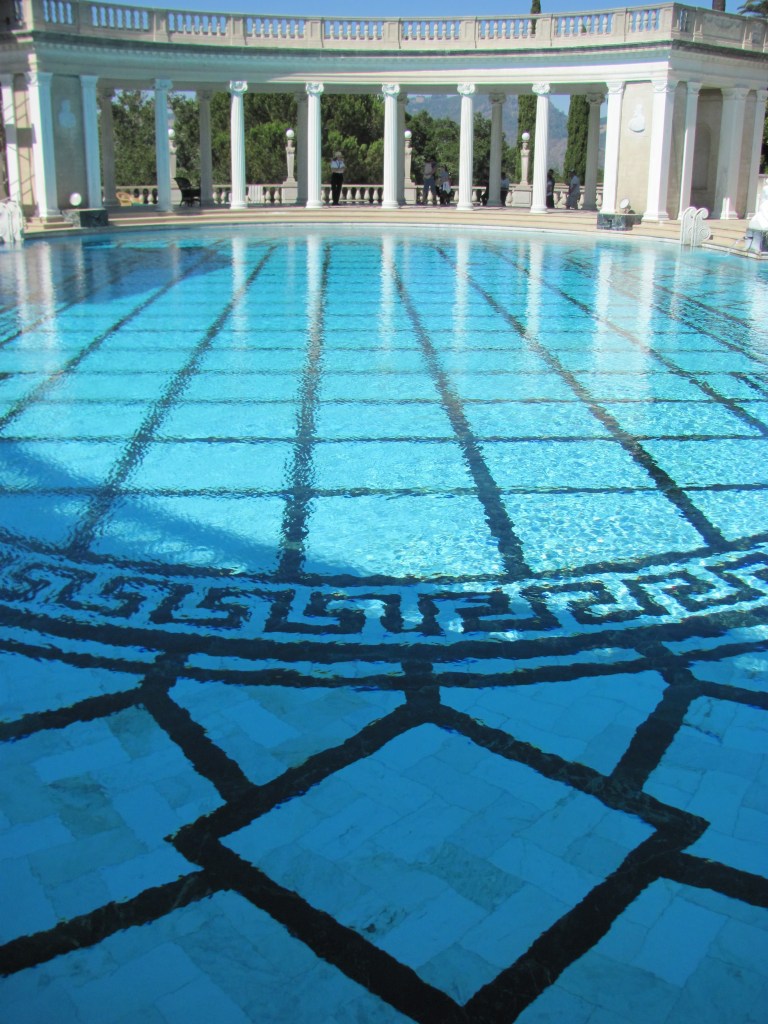
The first is at Hearst Castle. The house is fun to tour with its unique features and location up on a hill that offers great views all around. The indoor pool is impressive but the outside pool is even better:

Columns, large pool, a sunny day. Although it was the first thing on the property we saw on our tour, I could stopped there.

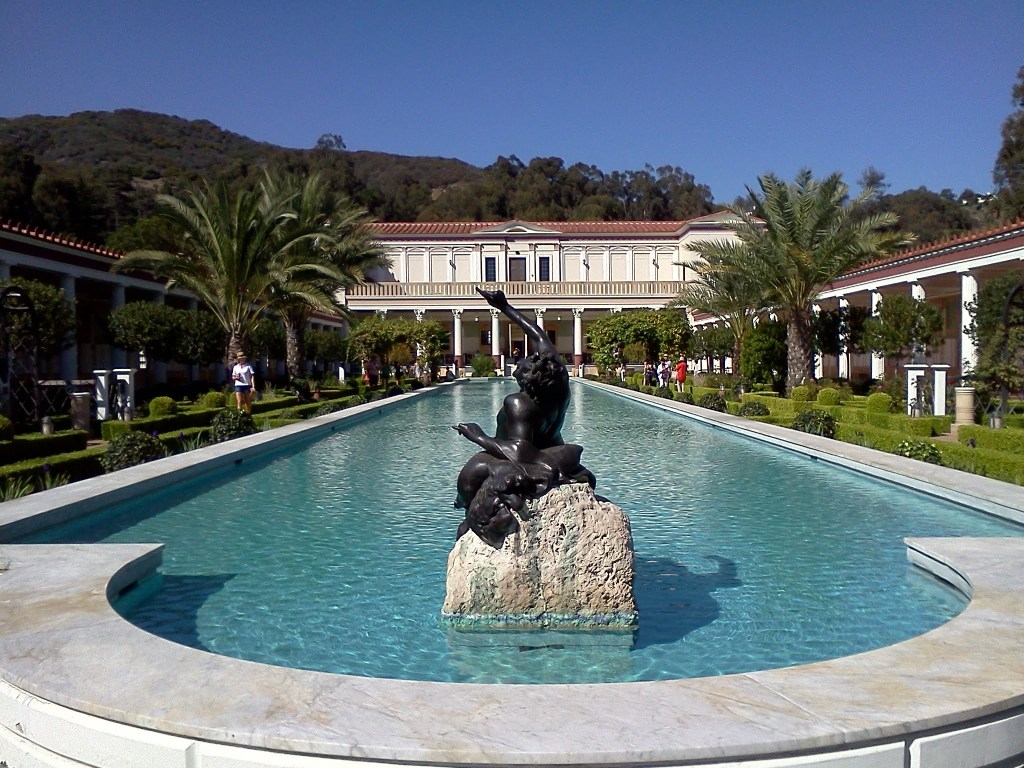
The second pool is further south at The Getty Villa. In what looks like a Roman villa filled with art, there is a long courtyard with this:

While this pool is only a few feet deep, I could still imagine floating around in this great setting surrounded by palm trees and art.

It may not be a coincidence that both pools are surrounded by classical columns. This is not just swimming, this is fun in the water surrounded by the aura of history (even if these buildings are relatively recent constructions that evoke tradition and opulence). The contrast here would be some of the ultra-modern skyscrapers topped with infinity pools; they sell a pool at the top of the urban world amid steel and glass.

Or, perhaps the lure of the pool knowing that visitors cannot swim in them helps make them attractive. They are part of the scenery – even as they likely cost quite a bit to maintain – that cannot be touched. And with visitors coming on a number of hot days, these pools look refreshing.

In the end, I would be happy to go back and sit by these pools. And if there is ever an event that allows people to use them, I would be interested.

The coming budget reckoning for big cities

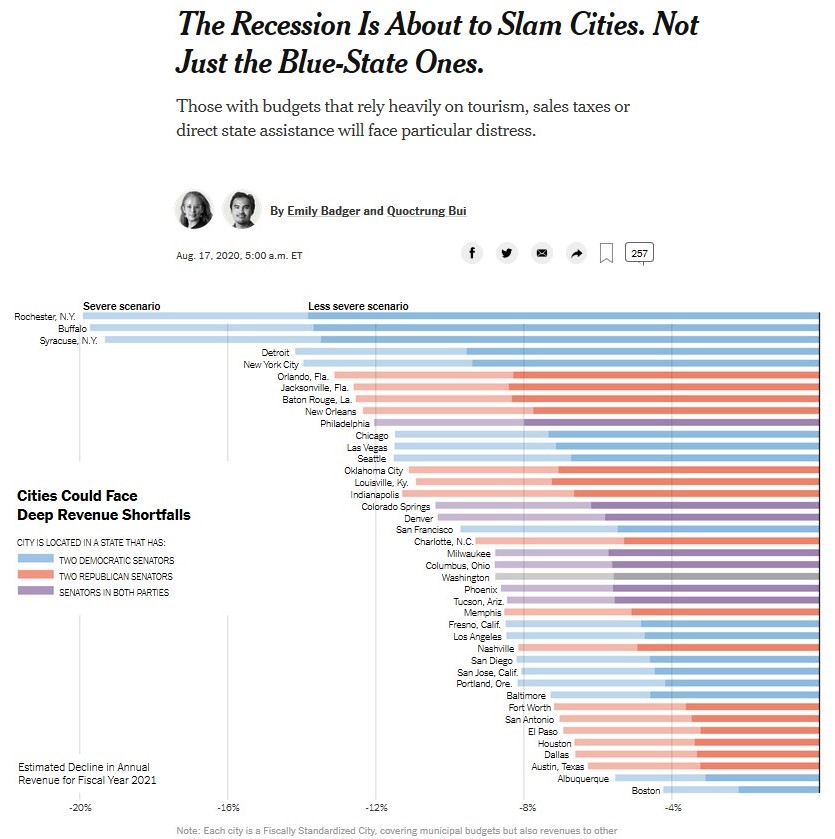
A new analysis suggests particular big cities will suffer losses in tax revenues due to COVID-19:

Describing the study results more:

What matters more in this pandemic moment is how a city generates money: Those highly dependent on tourism, on direct state aid or on volatile sales taxes will hurt the most. Cities like Boston, which rely heavily on the most stable revenue, property taxes, are in the strongest position — for now.

The estimates, to be published in the National Tax Journal by Mr. Chernick, David Copeland at Georgia State University and Andrew Reschovsky at the University of Wisconsin, are based on the mix of local revenue sources, the importance of state aid and the composition of jobs and wages in each city. The researchers predict average revenue shortfalls in the 2021 fiscal year of about 5.5 percent in a less severe scenario, or 9 percent in a more severe one.

Tax revenues can come from a variety of sources. Like recommendations for individual investors to diversify their portfolio, municipalities can benefit from a broad tax base that is not too reliant on any one sector. As the analysis suggests, relying on one single source can cause problems when that area experiences a downturn. (At the same time, creating such a robust and resilient local economy might be very difficult to do given historical patterns, current conditions, and competition in the future.)

The color coding of the graph above is interesting in that it implies that there are a number of cities that Republicans should care about helping. I wonder how this will play out: even as Republican senators would want more municipal tax revenues, it does not necessarily mean that they are pro-city or would want to go out of their way to provide funding. Are Republicans more in favor of seeing the fate of cities and suburbs as tied together when their cities are at risk?

Developing suburban tourist destinations along major highways

The suburb of Naperville is looking to develop entertainment and tourist destinations on undeveloped land in the northwest corner of the community:

In the works at the two properties both using the CityGate name are an apartment building with a rooftop event center on the east side of Route 59, along with an arena for hockey games, concerts and conventions; and on the west side, a brewery or winery with a restaurant and hotel, as well as residences and offices — all designed with public art as a focal point.

What CityGate as a whole aims to do, developers and city leaders say, is become a true entertainment destination, giving visitors and residents reasons to come, places to stay — even places to live…

Still, there is optimism for CityGate plans, which eventually could include a band shell, a pedestrian bridge over Route 59 and a connection to the Illinois Prairie Path.

“From what we’ve been able to gather, Naperville is gaining a number of people visiting because of tourist attractions outside of Naperville,” Halikias said. “We’re looking at it and saying, ‘You know what? We should have the tourist attractions in Naperville.'”

And all right off the interchange of Route 59 and I-88. Three thoughts in response:

1. Even though many Americans likely do not think “suburb” when they hear about tourism, more suburbs are pitching themselves as cultural or entertainment centers. Tourism can help bring in money from visitors, which helps grow the local tax base without further burdening local residents or property owners. Additionally, the right kind of tourism can be viewed as family-friendly, a vibe many suburbs would like to cultivate.

2. One of the draws of Naperville is its vibrant downtown. Would an entertainment center on the edge of the city compete with the downtown and its restaurants, stores, and other amenities? This connects to a broader question: how many entertainment centers can thrive in the suburbs of the same region, let alone within the same community?

3. The development is said to include apartments, nearly 300 of them. While this helps provide a base for the new amenities nearby, it does not completely alleviate a problem of this development: how accessible is it to nearby residences or communities and how car dependent will the new place be? Even with access to the Prairie Path, the majority of visitors will need to come by car. Two sides of the property will be bordered by very busy roads. The majority of people will drive, park, and leave. This is a very different kind of center than Naperville’s downtown – which can be said to help contribute to Naperville’s small town charm – because of transportation. Perhaps the development will have a full range of options that can keep people there for hours. But, creating a coherent space with its own feelings and around-the-clock vibe could be hard to develop.