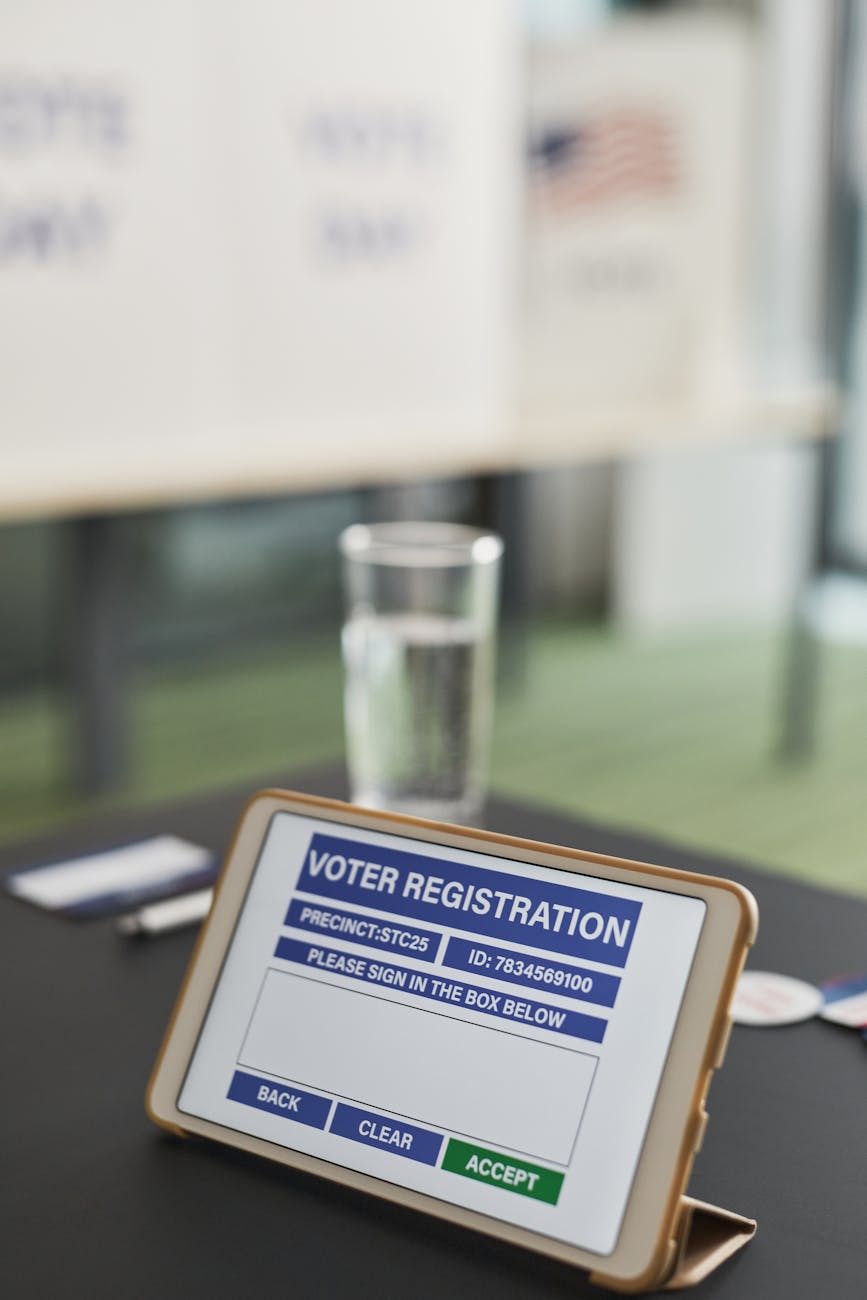
Voter turnout Tuesday was greater than 2022’s midterm primary in suburban Cook, DuPage and Kane counties, but lower than four years ago in Lake, McHenry and Will counties…
DuPage County is currently reporting the highest turnout level at 24.6%, which could increase when mail-in stragglers are eventually reported. In the 2022 midterm primary, DuPage was the only county with more than 20% turnout among the suburban collar counties…
Lake County had the lowest voter turnout in the suburbs at 17.7% Tuesday. That’s down from 18.4% in 2022…
McHenry County is currently reporting 18% voter turnout, down from 19.6% in 2022. In Will County, turnout was 19.1% Tuesday, down slightly from 19.5% in 2022.
Most of the article tries to explain why these numbers are what they are. The underlying question seems to be this: have Americans eligible to vote lost interest in voting? About a fifth of suburban voters do so. What, if anything, would really change that number?
The apathy of suburban voters also matters because candidates will want their votes in numerous elections in November and in 2028. In plenty of states, suburbanites will determine elections because of the number of people who live in such places and the presence of both Democrats and Republicans.
Of course, in later races that are not really contested, these low turnout primary votes then set who will win the November election. To not vote in some primaries means voters will have limited choices in November.
Dukakis’s suburban origins and issue-oriented style actually served as a major asset with the other constituency that many strategists recognized as key to his and the Democratic Party’s success in the general election. Political consultant and Dukakis adviser Hank Morris saw Dukakis’s upbringing and ethos as important in galvanizing postindustrial suburban professionals in battleground states such as California, Illinois, and New York. Suburban professionals responded favorably to Dukakis’s record about quality-of-life issues like traffic and air pollution, unregulated commercial growth and sprawl, declining schools, and rising drug and crime problems. Morris urged the campaign to further underscore that “he is the first presidential nominee to grow up in the suburbs and to stay there, commuting to work and mowing the lawn and knowing the concerns of suburbanites.” Taking the advice to heart, Dukakis made frequent references to his 1963 Sears snowblower as an emblem of his suburban sensibility and frugality. (275)
Of course, Dukakis lost the election. But Geismer argues that he represented a shift in the Democratic party toward the educated knowledge workers of suburbia. Whereas suburbs had been viewed as conservative and Republican in the immediate postwar era, by the 1980s there were pockets of suburban liberals and today there are numerous Democratic strongholds in suburban areas outside large cities.
At the same time, Geismer notes that these suburban liberals had particular notions about liberal causes. They tended to promote individual freedom, not addressing structural issues. When asked to transform their own suburban communities for the greater good of the Boston area, these suburban liberals resisted. It is one thing to advocate for liberal causes that might help you; it is another to promote affordable housing in your community.
I would venture that we see a number of these patterns still playing out today. What happened along Route 128 has happened to varying degree across American suburbs with pockets of high-tech, knowledge industry workers clustering in suburban parts of metropolitan areas. The American suburbs are more diverse than they were in the 1980s. Many of wealthy suburbs with white-collar jobs or workers are not fully open to change or to addressing metropolitan issues or regularly resist what they see as threats to the quality of life the enjoy. The choices suburbanites like to have still gives those with resources options to find communities that they like and then push back against change.
And when will the United States have its first suburban president, someone born in the suburbs and who identifies with the suburbs?
The realignments of recent years—the midwestern white working class toward Trump’s GOP and the suburbs toward the Democrats—can be understood as the process of ideological and education sorting coming for groups that were the most out of place in the new political realm: rich suburban Republicans and culturally conservative working-class Democrats. In 2020 and 2024, this realignment came for the nonwhite voters once at the center of Barack Obama’s coalition, especially working-class Hispanics, and most especially those in the rural outskirts of the Rio Grande Valley.
Starr County’s tradition of machine politics, manifest in an unusually strong preoccupation with local elections, marked a place ripe for a sudden political shift. Not unlike the Democratic majorities in the big cities of mid-century, which continue at some level into the present day, political dominance in the region was built not through allegiance to liberal ideals but through political machines that delivered tangible benefits and shaped the political identity of new immigrant groups. This is evident in polling today showing that nonwhite Democrats are much more moderate and conservative than their white counterparts. For a time, ideological differences were subsumed to the work of advancing group interests through machine politics. But in an era of declining party organization and an emptying out of majority-minority cities in favor of more integrated suburbs, the tide of ideological voting could be held at bay for only so long. Once it poured in, America shifted into a new era of politics, from one forged by social connections at the neighborhood level to today’s cultural and ideological polarization, where you vote Republican if you have conservative cultural beliefs, regardless of race.
Two claims here stand out:
“Rich suburban Republicans and culturally conservative working-class Democrats” shifted in recent decades. As the suburbs grew quickly after World War Two, those new suburbanites were assumed to be Republicans. Now, college-educated suburbanites tend to lean toward Democrats. And it also matters where in the suburbs someone lives; those closer to big cities tend to vote Democratic and those more on the metropolitan edge tend to vote Republicans.
The connection made between “more integrated suburbs” and increased polarization. Did the people moving to the suburbs lead to polarization – more residents of different racial, ethnic, and social class backgrounds living in suburbs – or did people moving out lead to polarization? What exactly changed and what led to what? How did suburbs over time become different social and political places?
The pattern seems well-established now: the political state of suburbia has changed. The reasons for it and the long-term consequences are still to be worked out.
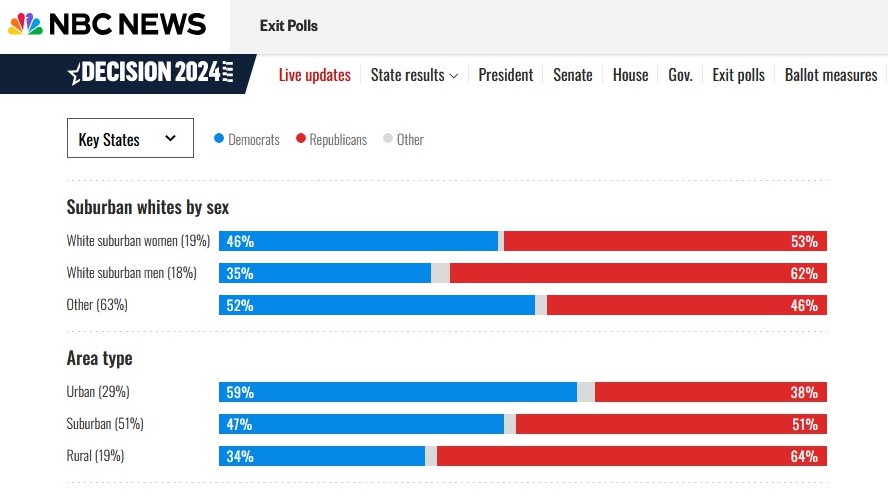
The suburbs have become increasingly diverse and populous. More than half of voters in 2024 were in suburban areas, according to exit polls. They have become swing areas, home to some of the most closely targeted House seats, and a good barometer of who will win the presidential election.
The winner in the suburbs has won 11 of the last 12 presidential elections, dating back to 1980. And this year that was Trump, 51%-47%, according to exit polls.
Vice President Harris was hoping she could turn out women in the suburbs in key swing states to get her across the finish line. But that didn’t happen. Trump, for example, won white suburban women by 7 points, as well as white suburban men — by 27. So there were some split kitchen tables, but not enough to help Harris win.
In multiple swing states, there were significant shifts in Trump’s direction in the suburbs, based on nearly final vote totals. That includes a net swing of almost 60,000 votes in the four counties that make up the Philadelphia suburbs and the two major ones north of Detroit, more than 10,000 in the “WOW” counties around Milwaukee (Waukesha, Ozaukee and Washington) and in the counties touching Fulton County, Ga., where Atlanta is.
This is the strongest declaration I have seen thus far about suburban voters in the 2024 election.
Two graphics in the story add to the text above:
A national map of counties shows many suburban counties shifted toward more raw votes for Trump between 2020 and 2024. Relatively few suburban counties shifted toward Harris.
There is an interactive graphic that shows shifts in suburban counties from 2016 to 2020 to 2024 and some suburban counties did move toward Harris in that span. This graphic shows there is significant variation in voting patterns across suburban counties.
On the whole, one candidate garnered more votes from the suburbs. Did that determine the election? This analysis does not say; it suggests suburban voters contributed to the outcome.
Let’s start with geography. Urban counties showed a bigger swing toward Trump than suburban and exurban counties, smaller metros, and rural areas. Of course, Harris did best — as did Biden four years earlier — in urban counties, but the 10-point swing toward Trump in urban counties was larger than swings in other places.
A more refined county classification from the American Communities Project, which groups counties based on their demographic, economic, and other factors, confirmed that Trump did better in 2024 than in 2020 in all types of communities, with larger swings in some places than others. Big cities, Hispanic centers, and Native American lands swung most toward Trump in 2024. The reddest communities — aging farmlands, evangelical hubs, and working class country — swung less, as did still-blue college towns and LDS (i.e. Mormon) enclaves, where Trump has repeatedly gotten smaller margins than previous Republican presidential candidates.
Going one step more granular to individual metros, many swung more than 10 points toward Trump in 2024 versus 2020, including New York, Los Angeles, Chicago, San Francisco, and Miami, as well as heavily Hispanic/Latino metros in Texas, California, and the Southwest. Just a handful of metros swung a bit bluer in 2024, mostly in the Mountain West and Pacific Northwest, including Salt Lake City, Tucson, and Colorado Springs.
Looking across all counties that have reported election data, the geographic pattern of the 2024 vote was less polarized than in 2020 in some ways. Most notably, counties with a higher share of Hispanic residents were more likely to vote for Harris than for Trump, but by smaller margins than for Biden in 2020. Same with higher density counties: there was a very strong correlation between county density and Harris vote share, though not as strong as in 2020. In contrast, the correlation between county education level and Harris vote share strengthened further in 2024. Density and education are themselves highly correlated, with residents of more urban counties more likely to have a college degree than those of more rural counties, but higher-density counties swung toward Trump, while highly educated counties did not.
One question about this is whether the electoral college outcomes changed if one candidate picked up more votes in cities. If the election came down to key states, were these swings in urban areas enough to win the state? Or maybe they did prove consequential in purple states. Looking at these swings in particular places could help address this. In Pennsylvania, did changes in metropolitan Philadelphia and Pittsburgh decide this or in Wisconsin, changes in metropolitan Milwaukee and Madison?
Additionally, it is less clear what this all means for considering suburban voters. The American Communities Project typology includes multiple suburban settings, Urban Burbs, Middle Suburbs, and Exurbs, in addition to suburban areas that might fit into other categories because of unique traits (such as a college town in a suburban county). Just looking at the three with suburbs in their title in one form or another, the 2020 patterns held: exurbs leaned Republican, suburbs near cities leaned Democratic, and middle suburbs leaned Republican. But voters in each three categories moved toward Trump. Was this shift substantive? Did suburban voters decide the 2024 election?
I am sure there is more analysis to come on this subject and I will keep looking for it.
Based on these results, it looks like the Democratic candidate won large percentages in urban areas, the Republican candidate won a majority in rural areas, and suburban voters went slightly for the winning candidate.
If this pattern roughly held across the United States, it would be similar to patterns from previous presidential election cycles. If a candidate wants to win, they need to appeal to enough suburban voters.
What appealed to suburbanites specifically in 2024? If economic conditions was a top concern of voters, is this what drove suburban voters? The top table above suggests white suburbanites in these 10 states voted for the winning candidate. Were they driven by economic concerns or other issues?
And as attention turns to the next election cycle, how will parties and candidates seek to appeal to suburbanites? In addition to those thinking of presidential office, how will House districts involving suburbs speak to suburban residents?
“It is easy to forget this county, DuPage, was once one of the reddest counties in America not long ago,” Conroy said during Tuesday morning’s Illinois delegate breakfast.
She noted that DuPage was where “Republican presidents raised millions of dollars, produced a U.S. speaker of the House” and led both chambers in Springfield. “But 12 years ago, that tide began to turn,” said Conroy, who in 2012 became the first Democrat to win an Illinois House seat in a district entirely in DuPage.
In 2022, Conroy again made history as the first female elected to head the DuPage County Board and the first Democrat to hold that title in several decades. That same year, Democrats solidified a 12-6 majority on the county board. In 2018, Republicans held all but one seat on the county board.
Conroy said Democratic women also now make up an overwhelming majority of state representatives and senators representing DuPage in Springfield.
This is a change echoed in the other collar counties of the Chicago area: a shift from Republican bases to Democratic majorities. This is all part of the emerging complex suburbia.
At the same time, this is not the first time there was a major political shift in DuPage County. Local historical Leone Schmidt detailed political life in early decades in the county in the 1989 book When the Democrats Ruled DuPage. She describes the book this way:
It covers the impassioned and sophisticated political activities, the interplay of parties and personalities, and the heyday and fall of the Democrats as a force in Du Page County.
By 1860, the Democrats were the minority party in the county, and the Republicans successfully imposed the importance of party loyalty, regardless of local issues, on county politics.
The county has experienced at least two major shifts in political leadership and voting patterns. As politicians and parties fight for votes in DuPage County and other suburbs, there could be future shifts. What can look like solid majorities through multiple decades can change – they have before.
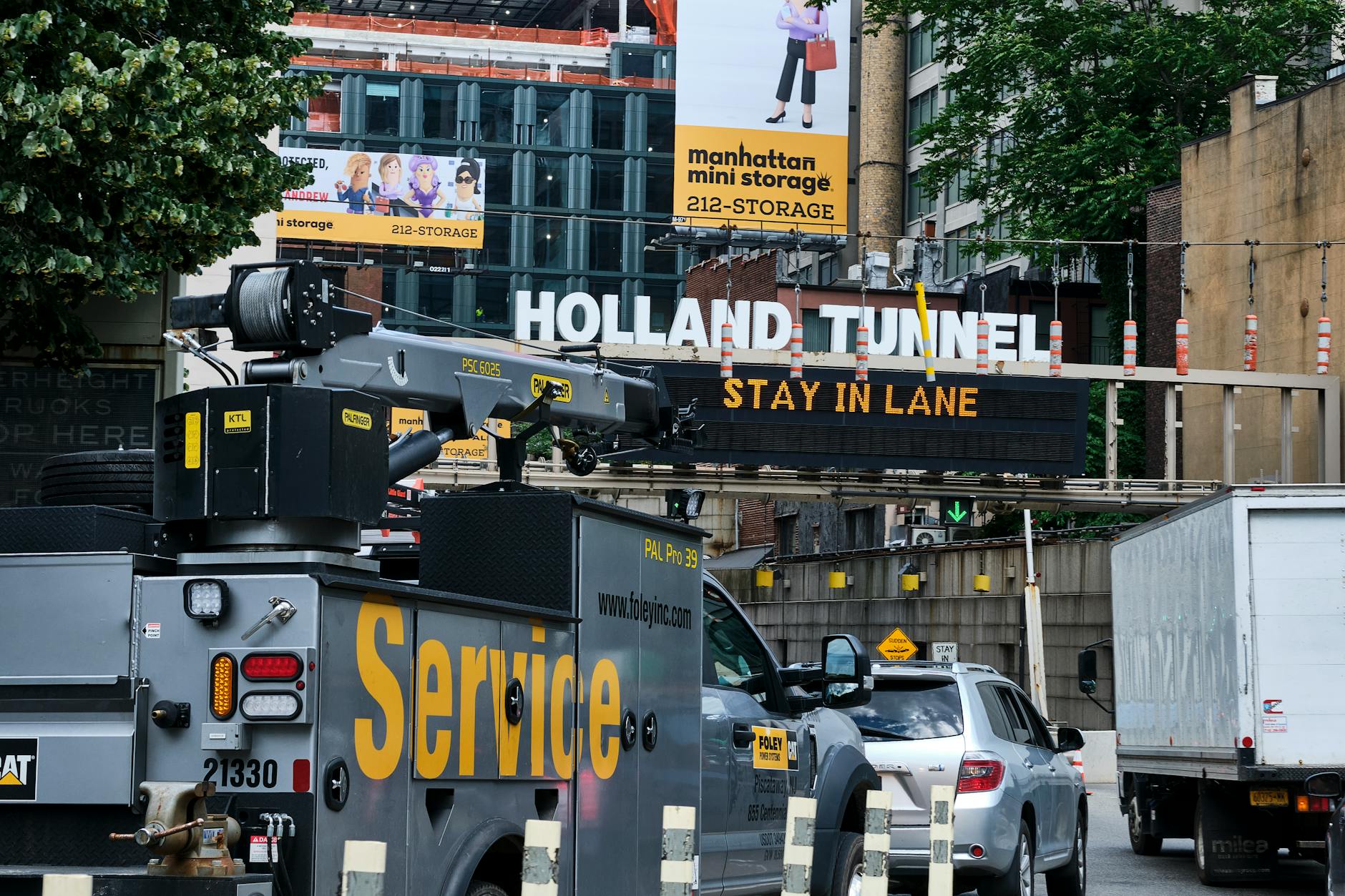
Hochul was just touting the benefits of congestion pricing two weeks ago, but she appears to no longer see things that way. According to a Tuesday night Politico report, House Minority Leader Hakeem Jeffries started raising his concerns with Hochul, claiming that if the plan were to go into effect during this election year, the ensuing buzz could make it harder for New York Democrats to win back the House of Representatives. The proposed $15 fee for drivers heading into lower and midtown Manhattan—whether from the outer boroughs or from the broader tri-state region—remains unpopular with the types of wealthy, swingy suburban voters national Democrats need on their side. And considering how badly New York Dems botched the 2022 midterms, losing House seats that could have cut into Republicans’ narrow majority in the chamber, Jeffries would like to do anything he can to regain those seats—including mollifying the New Yorkers who own cars only because they make it easier to flee to the Hamptons. Hochul herself says her decision is based on concern that congestion pricing might deter people from heading into Manhattan at a time when the city is still recovering from COVID-era business losses.
As politicians and political parties consider the 2024 elections, they are likely focusing a lot of attention on pockets of suburbanites who can be swayed to go different ways with their votes. This has been important for a number of election cycles now with a country that is majority suburban and more predictable voting results in big cities and more rural areas. Thus, the national parties fight over middle suburbia.
In this particular case, I would be interested in seeing more numbers. How many suburbanites are affected by the congestion tax? How many suburbanites might change their votes based on this issue? Is the fate of the US House in the hands of a congestion tax?
More broadly, how often does traffic and congestion decide local, state, or national elections? People generally do not like traffic or congestion but also may not like new or higher taxes or resist impediments to drive when or where they want.
The titanic Biden-Trump election likely will be decided by roughly 6% of voters in just six states, top strategists in both parties tell us.
Each side will spend billions to reach those voters over the next six months…
In which states?
Zoom in: Both campaigns are obsessed with six states — Arizona, Georgia, Michigan, Nevada, Pennsylvania and Wisconsin.
And which voters within these six states?
We perked up our ears when we heard a Biden insider use the “6% of six states” formulation as a proxy for how narrow a group of voters are considered truly in play — swing voters in swing states.
Republicans are making a similar calculation. A Trump insider told us that persuadable voters are below 10% in every battleground: “I think it’s probably 6% in Wisconsin but 8% in Michigan, and lower in Arizona.”
Given the way recent elections have gone regarding the importance of suburban voters, would a big proportion of those 6% live in suburbs? If so, these suburban voters can expect many appeals to come their direction from a variety of methods. Targeted ads online, TV and radio ads, mailers, campaign events, local gatherings, and door to door appeals. Lots of conversation about these voters and what they are thinking. Many media stories about them.
Does the average suburban voter in this 6% like that their vote matters or tire of lots of political attention?
Though thousands of properly postmarked mail-in ballots are still being tallied through April 2, state election officials believe it will be hard to crack 20%.
Unofficial results from the 20 most populated voting jurisdictions in Illinois — which represent more than 81% of all voters in the state — show less than 17% voter turnout combined.
Turnout tallies in the suburbs remain below 20% as well, with Lake County currently showing only 11.7% of registered voters cast a ballot.
Why so few voters?
“Most of the races were completely uncontested, with just one contested county board race on the Democratic side,” said Lake County Clerk Anthony Vega. “That lack of motivation could have resulted in voters not coming out.”
With that lack of choice, combined with the fact that Democratic President Joe Biden and former Republican President Donald Trump had all but secured their nominations ahead of Tuesday’s vote, low turnout was inevitable, experts said.
These are plausible reasons. Yet, I have heard little about significant solutions. Such options could come from multiple angles: local officials, voters, advocacy groups, the state government, employers, civic organizations, etc. Illinois may face serious problems in numerous areas but this strikes me as one that affects numerous others and is foundational for the supposed American system of government.
The one feature of this I think about is the ways that the suburbs grew, in part, because Americans like being closer to local government. Compared to big cities, states, and the federal government, a suburban resident can more easily interact with local officials and local government activity. But, if people do not even want to vote for those local measures – and there is a suggestion in this article that local referendums might have pushed voter turnout up a few percentage points – then this interest in or connection to local government may be severed.





 Legally Sociable