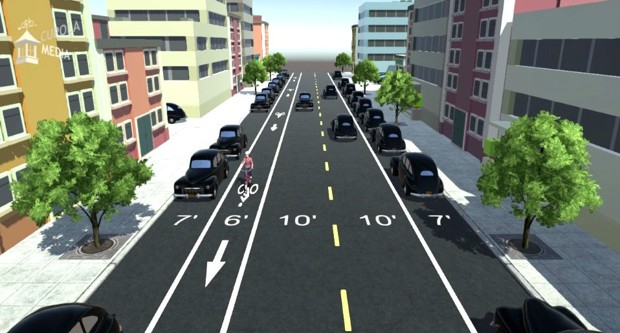
This time we focus on a 40-foot street with two 12-foot lanes of opposing traffic and two parking lanes at the curb. Many cities have adopted 12-foot lanes with the assumption that they move more traffic; in fact, as Speck has argued at CityLab before, they present a major safety hazard for cities by encouraging faster driving. He recommends slimming them down to 10 feet—a design configuration that leaves room for a bike lane and makes the street safer, even as it more or less preserves traffic flows.
This is a reminder of some of the paradoxes of road design. Provide bigger lanes and more lanes and cars tend to drive faster and traffic increases. Narrow the lanes and drivers have to slow down and pay more attention, leading to improved safety. And all of this might actually free up space for other uses – like bike lanes or more pedestrian space.
If you want more on such techniques, read Speck’s Walkable City.
The culture wars may have changed, but that doesn’t mean they’re over. Nowhere is this more clear than on the internet. Hartman’s culture wars were fought in national magazines, peer-reviewed journals, cable news shows, and in the halls of Congress: all venues with some degree of gatekeeping. Today, a broader swath of self-proclaimed culture warriors can engage in comment sections, on blogs, and on Twitter, where the #tcot hashtag is filled with echoes of earlier flashpoints. Whether the internet is simply a new, more broadly accessible forum for old debates about the meaning of America, or whether it is facilitating a new kind of culture war altogether, is not entirely clear. Nor are online spaces any less susceptible to the imperatives of capitalism than any other part of American culture. But if the culture wars are over, no one told their most energetic partisans: on this new frontier, the battle rages on.
If this is the case, it has altered the culture war landscape in multiple ways:
1. Increased the speed of battle. Now, new issues can pop up all over the place through text and videos on multiple platforms. Who can keep up with it all?
2. The old gatekeepers – traditional media like television, newspapers, and radio as well as politicians – have to scramble to keep up. This means they may race to the bottom or endlessly cycle through everything to stay relevant.
3. The culture wars don’t have to be about big issues but rather can be a larger series of micro battles. There may be no big “culture war” but rather an endless number of skirmishes involving small numbers of participants.
4. Anyone can participate with the possibility of being part of a larger conversation behind their smaller sphere. However, it is hard to know which of these skirmishes might blow up.
Traditional understandings of sex and gender found in social surveys – such as only allowing people to check one box when asked “male” or “female” – reflect neither academic theories about the difference between sex and gender nor how a growing number of people prefer to identify, Saperstein argues in a study she coauthored with Grand Valley State University sociology professor Laurel Westbrook.
In their analysis of four of the largest and longest-running social surveys in the United States, the sociologists found that the surveys not only used answer options that were binary and static, but also conflated sex and gender. These practices changed very little over the 60 years of surveys they examined.
“Beliefs about the world shape how surveys are designed and data are collected,” they wrote. “Survey research findings, in turn, shape beliefs about the world, and the cycle repeats.”…
“Characteristics from race to political affiliation are no longer counted as binary distinctions, and possible responses often include the category ‘other’ to acknowledge the difficulty of creating a preset list of survey responses,” they wrote…The researchers suggest the following changes to social surveys:
Surveys must consistently distinguish between sex and gender.
Surveys should rethink binary categories.
Surveys need to incorporate self-identified gender and acknowledge it can change over time.
Surveys have to change as social understandings change. Measurement of race and ethnicity has changed quite a bit in recent decades with the Census considering changes for 2020.
It sounds like the next step would be to do a pilot study of alternatives – have a major survey include standard questions as well as new options – and then (1) compare results and (2) see how the new information is related to other information collected by the survey.
Imagine if you could get from Midway to O’Hare in less than 40 minutes on public transit.
Currently, that trip takes well over an hour and involves transferring from the Orange to the Blue Line in the Loop before coming all the way back west towards O’Hare. Building the Airport Connector Express, one of 10 expansion projects in our Transit Future vision, could cut the travel time between Chicago’s two airports in half…
The benefit to business travelers and tourists looking to transfer flights is the most obvious benefit of the project, but definitely not the only one. Even more importantly, the line would connect communities across western Cook County to the two major job centers, greatly boosting job access and opportunities for many working class families. It could also reduce traffic congestion on highways and major arterial streets as more people choose to ride transit as it becomes a more convenient option…
These communities and many others like them are not well served by the current hub-and-spoke model of the region’s transit system. Some are connected to downtown by suburban Metra service but we know not all jobs are located downtown.
This should have happened years ago as these are two of the busiest airports in the United States. I can imagine three reasons why it has not happened:
1. Money. Who is going to pay for it? What would the revenues be from passengers using it? However, I don’t think this is the primary reason. Given the projections of economic growth that are sometimes trotted out for other projects, I bet this could be justified (particularly if you account for reduced traffic).
2. For various reasons, the Chicago area has been slow to build mass transit lines to connect the spokes of the hub-and-spoke train model that arose first with railroads in the mid-1800s and then was reinforced with the CTA lines that converge in the Loop. The mass transit in the region suggests people primarily want to head downtown even as job centers have developed throughout the region including Oak Brook, Naperville, Schaumburg, and Northbrook. The highways are a little better; the Tri-State Tollway was one of the first highways to open and I-355 became the next ring out. However, I-355 doesn’t go all the way around (even its extension was limited and covers an area that was not yet very dense) and the proposed Fox Valley Expressway was never constructed.
3. Perhaps there are some issues to work out across these suburban communities. The majority of this proposed track would be outside Chicago city limits and cooperation from nearby suburbs is needed. But, suburbs don’t always agree on projects like these that could bring changes.
“It’s as much psychology and sociology as it is technology.”
Zuckerberg went further in discussing the social aspects of Facebook:
“One thing that gets blown out of proportion is the emphasis on the individual,” he said. “The success of Facebook is really all about the team that we’ve built. In any company that’s going to be true. One of the things that we’ve focused on is keeping the company as small as possible … Facebook only has around 2,000 people. How do you do that? You make sure that every person you add to your company is really great.”…
On a more positive, social scale, Zuckerberg said the implications of Facebook stretch beyond simple local interactions and into fostering understanding between countries. One of Facebook’s engineers put together a website, peace.facebook.com, which tracks the online relationships between countries, including those that are historically at odds with one another.
Clearly, the sociological incentives are strong for joining Facebook as users are participating without being paid for their personal data. The social network site capitalizes on the human need to be social with the modern twist of having control of what one shares and with whom (though Zuckerberg has suggested in the past that he hopes Facebook opens people up to more sharing with new people).
I still haven’t seen much from sociologists on whether they think Facebook is a positive thing. Some scholars have made their position clear; for example, Sherry Turkle highlights how humans can become emotionally involved with robots and other devices. Given the explosion of new kinds of sociability in social networks, sociologists could be making more hay of Facebook, Twitter, Instagram, and all of the new possibilities. But, perhaps it is (1) difficult to asses these changes so close to their start and (2) the discipline sees much more pressing issues such as race, class, and gender in other areas.
One of the tragedies of Katrina was that so many of New Orleans’ residents were forced to move. But the severity of that tragedy is a function of where they were forced to move to. Was it somewhere on the Salt Lake City end of the continuum? Or was it a place like Fayetteville? The best answer we have is from the work of the sociologist Corina Graif, who tracked down the new addresses of seven hundred women displaced by Katrina—most of them lower-income and black. By virtually every measure, their new neighborhoods were better than the ones they had left behind in New Orleans. Median family income was forty-four hundred dollars higher. Ethnic diversity was greater. More people had jobs. Their exposure to “concentrated disadvantage”—an index that factors in several measures of poverty—fell by half a standard deviation.
The women weren’t going to Fayetteville but, rather, to places like Houston. “For low-income people in the South, Houston is a pretty darn great place,” Hendren said. “It’s not a beacon of phenomenal upward mobility like Salt Lake City. But it’s kind of the Salt Lake City of the South.” The odds of going from the bottom to the top in Houston are 9.3 per cent, which puts it fifteenth out of the top fifty U.S. metro areas.
“I think that what’s happening is that a whole new world is opening up to them,” Graif said. “If these people hadn’t moved out of the metro area, they would have done the regular move—cycling from one disadvantaged area to another. The fact that they were all of a sudden thrown out of that whirlpool gives them a chance to rethink what they do. It gives them a new option—a new metro area has more neighborhoods in better shape.”
That is, more neighborhoods in better shape than those of New Orleans, which is a crucial fact. For reasons of geography, politics, and fate, Katrina also happened to hit one of the most dysfunctional urban areas in the country: violent, corrupt, and desperately poor. A few years after the hurricane, researchers at the University of Texas interviewed a group of New Orleans drug addicts who had made the move to Houston, and they found that Katrina did not seem to have left the group with any discernible level of trauma. That’s because, the researchers concluded, “they had seen it all before: the indifferent authorities, loss, violence, and feelings of hopelessness and abandonment that followed in the wake of this disaster,” all of which amounted to “a microcosm of what many had experienced throughout their lives.”
Nearly ten years later, tracking the outcomes to this “natural experiment” is providing plenty of material for social scientists. Few major cities experience such catastrophes so there aren’t even many comparisons that can be made. Yet, Katrina helped spark interest in studying resilient cities as leaders and citizens think about ways that cities can bounce back from a broad range of major issues.
To see how that works in practice, de Blasio should spend a week commuting on the subway from various points in the city: taking the No. 7 train from Flushing, the L train from Greenpoint, the F train from Fort Hamilton Parkway.
Such an exercise may remind de Blasio that while a few rich people can bail out of mass transit by taking ever-cheaper black cars, most New Yorkers are stuck on a subway system that is creaking under record ridership.
The mayor should do some weekend, night and borough-to-borough commutes, too, so he can see how hard it is for lower-paid, off-hours workers to get around when the MTA cuts its service.
Then, the mayor should agree to Gov. Andrew Cuomo’s request to put $3 billion into investments in subways and buses over the next five years, helping to pay for the next few stops on the Second Avenue Subway, plus better technology on existing subway lines.
The mayor should think seriously, too, about funding his own transit project. He mentioned a subway on Utica Avenue, and then never talked about it again. With China’s economy cratering, it’s a good time to build — steel and concrete are cheaper.
Former Mayor Michael Bloomberg’s extension of the 7 train to Manhattan’s Far West Side will open soon — and New Yorkers will remember that Bloomberg did it.
What will they remember about de Blasio?
Powerful politicians often like to enhance their legacy through the construction of massive buildings or public works projects. And mass transit can easily become an issue tied up with social class and race as mass transit in theory is supposed to be more democratic. But, how many would like their legacy to be underground subways in a city that already has an extensive system? Such projects often take billions of dollars, cause all sorts of disruptions, and can be lengthy. This might only work in New York City, a place so dependent on daily subway usage (particularly compared to other large American cities).
If pushed by the mayor, can a new line be called the de Blasio line? I can’t help but think of the “Rod Blagojevich, Governor” signs every time I pass through the open road tolling facilities on Chicago area tollways…
The top communities on Money‘s Best Places to Live 2015 are not the wealthiest suburbs but they are fairly wealthy compared to national incomes. Only 7 have median household incomes less than $70,000 (the lowest is $57k) and 17 have median household incomes over $100,000. The median household income for the entire United States? $53,046 (data from 2009-2013).
Money’s methodology contributed to having communities with these income levels. Among other factors that went into creating these rankings:
-“[excluded] places with a median family income less than 80% of the state average”
-“Eliminate places with a median family income of more than 210% of the state average or a median home price over $1 million. Rank the rest on factors including job growth, diversity, and ease of living, giving the most weight to economic opportunity, housing affordability, education, and safety.”
In other words, the methods ensured that these communities couldn’t be too poor or too wealthy. Yet, the above-average incomes in these communities are connected to all sorts of other factors: not just jobs but higher-paying jobs (likely white collar), the money available in the tax base, the education level of residents, the kinds of available housing, and so on.
Could the average American live in these communities? Perhaps there would be some cheaper housing (that is a factor in these rankings though it is primarily about cost and not about having apartments and smaller and/or older houses) and the median household income suggests half of residents in these communities are below the figures posted here. However, these rankings are geared toward people of higher social classes.
Using police data from Newark, New Jersey, Zeoli and fellow MSU researchers Sue Grady, Jesenia Pizarro and Chris Melde were the first to show, in 2012, that homicide spreads like infectious disease. Similar to the flu, homicide needs a susceptible population, an infectious agent and a vector to spread. (The infectious agent could be the code of the street – i.e., guarding one’s respect at all cost, including by resorting to violence – while the vector could be word of mouth or other publicity, Zeoli said.)With the new study, the interdisciplinary team of researchers analyzed the Newark data to gauge whether specific types of homicide cluster and spread differently. In addition to gang-related murders, the researchers looked at homicide motives such as robbery, revenge, domestic violence and drugs. These other motive types were not directly connected to gang participation.
The study found that the various homicide types do, in fact, show different patterns. Homicides stemming from domestic violence and robberies, for example, show no signs of clustering or spreading out.
Gang-related killings were the only type of homicide that spread in a systematic pattern. Specifically, there were four contiguous clusters of gang-related homicides that started in central Newark and moved roughly clockwise from July 2002 through December 2005.
Two other things are interesting about this coverage:
1. The medical analogy – an infectious disease that needs to be cured – is likely to be appealing to a broad number of people. This might work better than the rhetoric of needing to find the killers and lock them up.
2. The headline of the story is “Can sociology predict gang killings?” and one quote in the story might provide evidence for this: “Taken together, this provides one piece of the puzzle that may allow us to start forecasting where homicide is going to be the worst – and that may be preceded in large part by changes in gang networks.” However, forecasting where homicides are more likely to happen is not exactly the same as predicting gang killings.
Not long ago, Zeynep Tufekci, a sociologist who studies social media, wrote that she wanted to pay for Facebook. More precisely, she wants the company to offer a cash option (about twenty cents a month, she calculates) for people who value their privacy, but also want a rough idea of what their friends’ children look like. In return for Facebook agreeing not to record what she does—and to not show her targeted ads—she would give them roughly the amount of money that they make selling the ads that she sees right now. Not surprisingly, her request seems to have been ignored. But the question remains: just why doesn’t Facebook want Tufekci’s money? One reason, I think, is that it would expose the arbitrage scheme at the core of Facebook’s business model and the ridiculous degree to which people undervalue their personal data…
The trick is that most people think they are getting a good deal out of Facebook; we think of Facebook to be “free,” and, as marketing professors explain, “consumers overreact to free.” Most people don’t feel like they are actually paying when the payment is personal data and when there is no specific sensation of having handed anything over. If you give each of your friends a hundred dollars, you might be out of money and will have a harder time buying dinner. But you can hand over your personal details or photos to one hundred merchants without feeling any poorer.
So what does it really mean, then, to pay with data? Something subtler is going on than with the more traditional means of payment. Jaron Lanier, the author of “Who Owns the Future,” sees our personal data not unlike labor—you don’t lose by giving it away, but if you don’t get anything back you’re not receiving what you deserve. Information, he points out, is inherently valuable. When billions of people hand data over to just a few companies, the effect is a giant wealth transfer from the many to the few…
Ultimately, Tufekci wants us to think harder about what it means when we pay with data or attention instead of money, which is what makes her proposition so interesting. While every business has slightly mixed motives, those companies that we pay live and die by how they serve the customer. In contrast, the businesses we are paying with attention or data are conflicted. We are their customers, but we are also their products, ultimately resold to others. We are unlikely to stop loving free stuff. But we always pay in the end—and it is worth asking how.
Perhaps we are headed toward a world where companies like Facebook would have to show customers (1) how much data they actually have about the person and (2) what that data is worth. But, I imagine the corporations would like to avoid this because it is better if the user is unaware and shares all sorts of things. And what would it take for customers to demand such transparency or do we simply like the allure of Facebook and credit cards and others products too much to pull back the curtain?
Is it going too far to suggest that personal data is the most important asset individuals will have in the future?

 Legally Sociable