Social network analysis is a way of conceptualizing, describing, and modeling society as sets of people or groups linked to one another by specific relationships, whether these relationships are as tangible as exchange networks or as intangible as perceptions of each other.
Visa argues that they connect people. Because people can use Visa at a wide range of stores, restaurants, and other settings, this brings people together. Imagine all of these organizations as different nodes in a network and Visa provides the connecting link. Without Visa, they would not connect.
Yet, is the social network sustained by Visa or used by Visa? Now that the network exists, Visa claims they are the network but similar things could be said for Mastercard or paper money. Without Visa, would many of these actors still connect, perhaps through other economic means?
It would be interesting to know whether and/or this economic network facilitates other kinds of network interactions. Does Visa use lead to new social networks? Is this not just about economic exchange but also exchange of information, experiences, and culture? This gets at larger processes, like globalization, that depend on familiar economic means across places.
In a Starbucks TV commercial, I noticed the company notes it was founded in 1971. Here is a logo from their website that highlights 50 years of business:
Our story begins in 1971 along the cobblestone streets of Seattle’s historic Pike Place Market. It was here where Starbucks opened its first store, offering fresh-roasted coffee beans, tea and spices from around the world for our customers to take home. Our name was inspired by the classic tale, “Moby-Dick,” evoking the seafaring tradition of the early coffee traders.
Ten years later, a young New Yorker named Howard Schultz would walk through these doors and become captivated with Starbucks coffee from his first sip. After joining the company in 1982, a different cobblestone road would lead him to another discovery. It was on a trip to Milan in 1983 that Howard first experienced Italy’s coffeehouses, and he returned to Seattle inspired to bring the warmth and artistry of its coffee culture to Starbucks. By 1987, we swapped our brown aprons for green ones and embarked on our next chapter as a coffeehouse.
Starbucks would soon expand to Chicago and Vancouver, Canada and then on to California, Washington, D.C. and New York. By 1996, we would cross the Pacific to open our first store in Japan, followed by Europe in 1998 and China in 1999. Over the next two decades, we would grow to welcome millions of customers each week and become a part of the fabric of tens of thousands of neighborhoods all around the world. In everything we do, we are always dedicated to Our Mission: to inspire and nurture the human spirit – one person, one cup, and one neighborhood at a time
Fifty years is likely a safe point to highlight a founding date as it is a nice round number, a half century. Sure, 49 or 51 years gets at the same idea but it does not have the gravity of 50. Yet, I could imagine two sides to whether promoting this date is helpful.
On one side, fifty years is a long time. Many businesses do not make it this far. Even fewer companies are so long for so many years. Highlighting the date implies permanence, tradition, stability. Starbucks is not just a passing trend; they are good at what they do, they have been around five decades, and hope to be around for many more.
On the other side, Americans tend to like upstarts and novelty. Does fifty years imply old age and lack of innovation? Starbucks is established while other successful companies are offering new models and products. There are Starbucks locations everywhere but once companies like Sears or Woolworths also thrived.
Even as the company celebrates 50 years, companies are not permanent. Perhaps there is a time when fast food in general no longer exists or people can get similar food products at home. Or, Starbucks does something internally that causes issues. Or who knows what. Does it reach 75 years or 100 years, other round milestones worth celebrating? It is hard to know now; Starbucks will keep going until it doesn’t.
Some 15 years after Facebook and Twitter opened their platforms to the public, social media is an established, mainstream career field. There are academic programs dedicated to its practice. Workers say it’s sometimes still treated as a job for rookies, both through pay grades and interpersonal dynamics from those who think it’s just not that serious. But that’s changing: Those in the field see more bargaining power and more full-time roles than ever before.
Many social-media specific jobs still offer lower salaries than comparable fields like marketing. The average annual salary for marketing managers is $102,496 and $109,607 for marketing directors on Glassdoor, according to a spokesperson for the jobs website. Meanwhile, the average annual salary is $67,892 for social-media directors and $47,908 for social-media assistants…
But Ms. Visconti notes that the field has become more professionalized in recent years. When she got her undergraduate degree at the Fashion Institute of Technology in 2015, she says, “It definitely wasn’t seen as a career path.” Today, following work for clients including Hyatt and Puma, she believes she can dedicate her whole career to social media. “What I love about it is that it’s the way to connect most directly with consumers,” she says…
“In the beginning, it was all about the need for businesses to create content specifically for social media, which was an insight that I had somewhat early,” he says. “Now it’s much more about understanding how algorithms work, and I just don’t understand things like what time of day to publish a TikTok video on a deep level.”
My colleague Peter Mundey and I found similar things in our 2019 study “Emerging SNS Use: The Importance of Social Network Sites for Older American Emerging Adults.” These 23 to 28 year olds found that social media could be part of their work life. We found: “Mentions of job-related activities from the Wave 4 respondents included corresponding with potential employers via Facebook, making professional connections through LinkedIn and showing work-related activities and progress through other SNS platforms, helping firms promote themselves via social media and responding to other users, and even working for social media companies.” We found that this work was not necessarily for everyone, even if older emerging adults were regular social media participants.
There could also be an interesting study in here about the development of a new career, role, and/or industry. Marketing, for example, is well known and emerged over decades in the twentieth century. Social media manager is new, utilizes newer technology, is more familiar to younger members of the workforce, and is developing its own professionalization processes. Will it firmly established in terms of status, pay, and training within a decade or two and how will that happen?
Certain numbers stick out in advertising. The Empire carpet jingle, 1-877-CARS-FOR-KIDS, and one local company I saw recently:
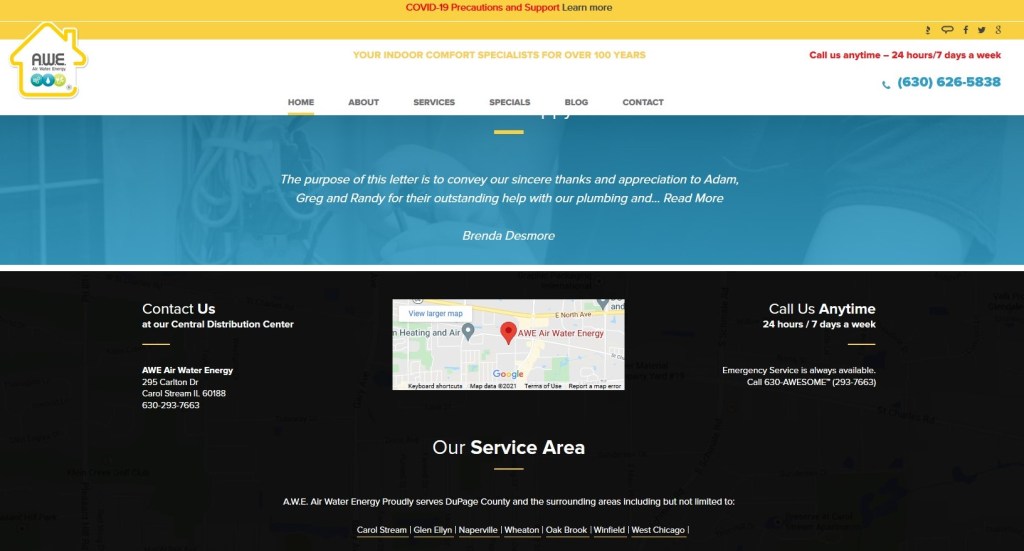
The phone number 630-293-7663 – or 630-AWESOME – works in two ways. First, it fits with the company name A.W.E. which stands for Air, Water, and Energy. Second, what company would not want to be known as awesome? Whether fitting the definition for inspiring awe or remarkable, this number will get remembered. All it needs now is a jingle that sticks in your head…
If you too want to make cool words out of phone numbers, here is a phone number to word generator.
Such gangbusters growth is unlikely to continue, with the pandemic easing. But the rush to the country that underpins it is less an anomaly than a speeding up of a long-tern trend, as more people – notably millennials yearning to become homeowners – look to adopt quasi-rural lifestyles. Being priced out of urban living is one driving factor; interest in healthier and more sustainable diets, including homegrown vegetables and home-harvested eggs, is another. Whatever is motivating them, Tractor Supply sees an opportunity in these “ruralpolitans” – and the COVID-driven shift toward remote work will help sustain their numbers.
Lawton, who became CEO in early 2020 after two years as the No. 2 at Macy’s, says millennials’ willingness to move farther from city centers is a “game changer”: “We seeing a new kind of shopper in our stores,” he tells Fortune. Now Tractor Supply is adapting to cater to both its established customer base and these younger space-seekers, following a strategic road map with the folksy title “Life Out Here.”…
The fast-growing cohort that Tractor Supply is cultivating, she says, are “beginning to learn how to garden. They have this passion for poultry.” Call them the “country suburban” customers.
The company is strategic about where it meets these customers. Its stores are almost all located in mid-size or small towns – communities that are often too small to support a Home Depot, Petco, or Walmart.
The economic impact of COVID-19 has hit some businesses very hard while others, like Tractor Supply, have found opportunities. From the sound of this article, they had locations in numerous places that received new residents during COVID-19 and had the right mix of products and service that appealed to them.
I wonder about the class dynamics of all of this. How do the new “ruralpolitans” who want to raise chickens or have a small farm and have moved from the city compare to the other shoppers at Tractor Supply or to long-term residents in the community?
Another question to ask is whether these newer residents with these interests in food and farming are in it for the long haul or not. On one hand, if remote work is more viable than ever, perhaps people will stay in smaller communities outside cities and pursue this. On the other hand, if companies ask more workers to return or if small-scale agriculture and animal husbandry is not appealing in the long run, this may be more of a flash in the pan. Industry-wide shifts in agriculture could have an impact as well.
Finally, the move to a more rural life has implications for private lives and community life. Many Americans say they like the idea of living in a small town but this is different than actually living in one. What is the tipping point where an influx of new residents changes the character of the community (or is change somewhat inevitable)? How involved will these new residents be in local organizations, religious congregations, local government, and in local social affairs?
Far worse than corporations taking a few thousand units off the market for owners are the governments and noisy NIMBYish residents taking millions of units off the market for owners and renters alike—by blocking construction projects in the past few decades. (California alone has an estimated shortage of 3 million housing units.) From New York to California, deep-blue cities and states have amassed a pitiful record of blocking housing construction and failing to meet rising demand with adequate supply. Many of the people tweeting about BlackRock are represented by city councils and state governments, or are surrounded by zoning laws and local ordinances that make home construction something between onerous and impossible.
One of the issues at play here is a numbers one: who exactly is acting within the US housing market and how much sway do they have. Concerns about corporations and housing can be placed in the larger context of how many housing units there are and how many are being built. Here are the numbers Thompson provides:
The U.S. has roughly 140 million housing units, a broad category that includes mansions, tiny townhouses, and apartments of all sizes. Of those 140 million units, about 80 million are stand-alone single-family homes. Of those 80 million, about 15 million are rental properties. Of those 15 million single-family rentals, institutional investors own about 300,000; most of the rest are owned by individual landlords. Of that 300,000, BlackRock—largely through its investment in the real-estate rental company Invitation Homes—owns about 80,000. (To clear up a common confusion: The investment firm Blackstone established Invitation Homes, in which BlackRock, a separate investment firm, is now an investor. Don’t yell at me; I didn’t name them.)
If I am calculating correctly, institutional investors currently own 2% of the single-family rentals. Of course, this number could grow if these firms find this to be a good investment.
Thompson settles on local actors – governments and residents – as holding back housing construction. In this numbers game, restrictions on a local level collectively are holding back the construction of single-family housing. If these restrictions were lifted or lessened, concerns about institutional investors would presumably diminish because there is a larger supply of houses to choose from.
One problem I see with this among the larger numbers: while local actors might in the aggregate have oversight over millions of units, they individually have control over relatively few units. Let’s say a particular suburb in the Bay Area (and this NIMBY argument often comes back to California) is against building new single-family homes. Depending on the size of the community and the availability of land, this might affect just a few homes to several thousand. This is not many. Zoom out to the whole region and many suburbs doing this adds up to tens of thousands of potential homes. Do this across all of California’s metro areas and the numbers add up. Similarly, you could do this across all the metro areas in the United States.
All of this does not necessarily mean Thompson is wrong. Yet, to get to the numbers of new homes constructed that would make a significant difference – whether in reducing the need many metro areas have for more affordable housing or outweighing the actions of investment firms – would require a lot of change across many communities. State or federal legislation may or may not be successful and would be unpopular in many places without a significant public groundswell of support that this is an issue that all or even most communities need to address.
Together, municipal changes regarding zoning and NIMBY could add up. But, changes would need to come across communities to make a big difference.
Loucks, a mechanic at Super Truck Service in west suburban Addison, didn’t think anything of the call. But when he got to the semi, he found 14,000 live chickens in the trailer…
He couldn’t tow the truck the nearly 30 miles back to the shop because tipping the trailer up could be even more dangerous for the chickens, Loucks said, so his team chained up an axle and had the semi drive back to Super Truck Service on eight wheels instead of 10. That meant driving 35 to 40 mph down I-90, which wasn’t a very safe option either, Loucks said.
After returning to the shop at 562 S. Vista Ave. in Addison, and with the temperatures rising, Loucks said the first thing he did was grab a garden hose as he started to “water the chickens,” despite being afraid of birds.
Three things stand out to me in this short story that might be easy to ignore since vehicles break down all the time:
The number of chickens on one truck is astounding. Ask people on the street how many chickens would fit on a truck and I wonder how many would be close to this number.
While this is a large number of chickens, this is just one truck. Therefore, this is just a drop in the bucket in the number of chickens in the United States. According to Statista, there are over 1 billion chickens in the United States.
There are numerous ways to ship goods and animals. Moving all of this requires a lot of infrastructure behind the scenes that helps get eggs and chicken to grocery shelves. Put #1 and #2 together and you need a lot of ways to transport everything.
Flamin’ Hots were created by a team of hotshot snack food professionals starting in 1989, in the corporate offices of Frito-Lay’s headquarters in Plano, Texas. The new product was designed to compete with spicy snacks sold in the inner-city mini-marts of the Midwest. A junior employee with a freshly minted MBA named Lynne Greenfeld got the assignment to develop the brand — she came up with the Flamin’ Hot name and shepherded the line into existence…
Six of the former employees remember inspiration coming from the corner stores of Chicago and Detroit. One of the earliest newspaper articles about the product corroborates that detail: A Frito-Lay spokesperson told the Dallas Morning News in March 1992 that “our sales group in the northern United States asked for them.”…
Over the next few months, Greenfeld went on market tours of small stores in Chicago, Detroit and Houston to get a better feel for what consumers craved. She worked with Frito-Lay’s packaging and product design teams to come up with the right flavor mix and branding for the bags. She went with a chubby devil holding, a Cheeto, Frito or chip on a pitchfork, depending on the bag’s contents, she recalls, a memory independently corroborated by newspaper archives…
“In response, Frito-Lay launched a test market of spicy Lay’s, Cheetos, Fritos and Bakenets in Chicago, Detroit and Houston” beginning in August 1990, the company wrote in a statement.
The article focuses more on the controversy of exactly how Flamin’ Hot Cheetos came about but I think the geography is pretty fascinating. Here is why I think the geography matters:
The impetus were existing products in urban stores. Even as more Americans lived in the suburbs than cities by the 1980s, a large company like Frito-Lay cannot ignore consumers in the city.
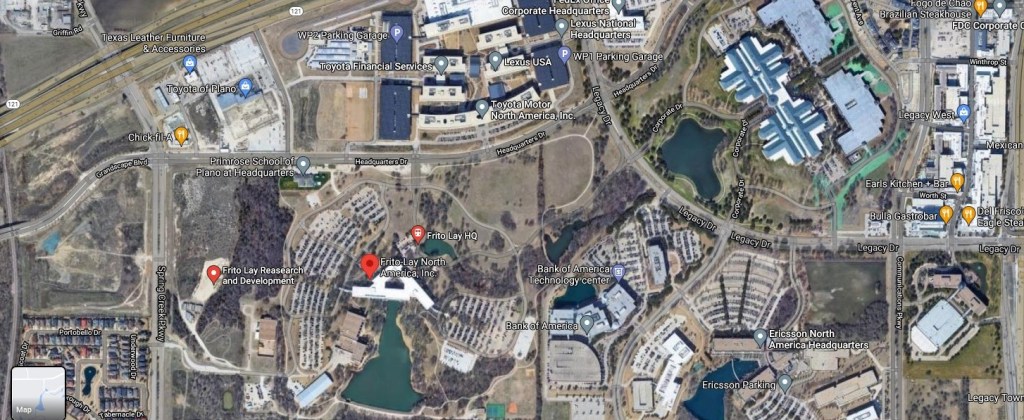
The product was developed in the Dallas suburbs. Plano is a notable suburb because of its growth and wealth (and McMansions). But, there are plenty of suburban office parks where ideas are discussed. Who knew the snacking fate of America was decided in a relatively anonymous suburban facility by business professionals? (And how many other products have a similar story?) Across the street is Toyota American Headquarters and then each direction on major roads leads to strip malls, fast food, and highways.
The product was tested in cities and the idea developed in the suburbs took flight. Now, Flamin’ Hot Cheetos are widely available (though it would be interesting to see the sales breakdown by geography).
Modern capitalism was able to span these disparate locations and churn out a product loved by many. From a suburban office park to snack aisles everywhere…
After a year of working from home, most workers feel the same way. Vaccinated or not, more than half of employees said that, given the option, they would want to keep working from home even after the Covid crisis subsides, according to a survey by the Pew Research Center. Far fewer look forward to returning to the office full time…
And yet, in a survey of more than 350 CEOs and human resources and finance leaders, 70% said they plan to have employees back in the office by the fall of this year — if not sooner — according to a report by staffing firm LaSalle Network…
Ultimately, however, “nothing will change,” said Peter Cappelli, director of the Center for Human Resources at the University of Pennsylvania’s Wharton School. “Employers have virtually unlimited power,” he said.
Both sides can justify changes. Employers want to recreate office culture and conversation plus see people face to face. Employees want flexibility, no commute, and assurances of safety.
The quote at the end above suggests workers do not have much leverage. They can complain about changes. They can say the world has changed significantly. They can say that the prior system did not provide benefits long-term.
But, what if large numbers of workers in significant companies refused to go back to the old office-based systems? Could leading firms afford to have large numbers of workers quit? Could these workers afford to quit and know there is work elsewhere? Not all workers could do this and it might not matter at a lot of companies. If something started in the tech industry where more workers work from home for the long-term, would this spread? Or, if some business saw this as an advantage – get better employees by letting them work from home – this might encourage some others.
A mass labor movement over working from home may not materialize. Yet, COVID-19 could at least change the thinking about offices and doing work from home. Under conditions of a pandemic, at least some work got done. Perhaps such arrangements will continue for some but it could also extend to many more workers.
Próspera is the first project to gain approval from Honduras to start a privately governed charter city, under a national program started in 2013. It has its own constitution of sorts and a 3,500-page legal code with frameworks for political representation and the resolution of legal disputes, as well as minimum wage (higher than Honduras’s) and income taxes (lower in most cases). After nearly half a decade of development, the settlement will announce next week that it will begin considering applications from potential residents this summer.
The first colonists will be e-residents. Próspera doesn’t yet have housing ready to be occupied. But even after the site is built out, most constituents will never set foot on local soil, says Erick Brimen, its main proprietor. Instead, Brimen expects about two-thirds of Prósperans to sign up for residency in order to incorporate businesses there or take jobs with local employers while living elsewhere…
The idea behind charter cities, along with their predecessor seasteading, which sought to create independent nations floating in the ocean, is to compete for citizens through innovative, business-friendly governing systems. For some reason, the idea has long been linked to Honduras, an impoverished country whose governing system is classified as “partly free” by the human rights organization Freedom House. Paul Romer, an American economist who pioneered the idea of charter cities, tried to start one in the country a decade ago. It failed, but Honduras has spent much of the time since then writing a law to enable such cities, which are known in the country as Zedes, short for zonas de empleo y dessarollo económicos (employment and economic development zones).
But the prospect of creating pockets of prosperity that play by their own rules is controversial for obvious reasons. Próspera has drawn protests from local residents who see a lack of transparency and little to gain from its existence, and a group of local political leaders signed a letter of opposition in October. This month, an arm of the Technical University of Munich said it’s reevaluating its relationship with Próspera and that it generally withdraws from projects if there are indications of human rights violations. Representatives for TUM didn’t respond to requests to elaborate. A spokeswoman for Próspera says it has had a “great working relationship with TUM over the years.”
Although this city has been in the works for years, it seems appropriate that is will open for remote businesses in the COVID-19 era. Even without a physical presence in the city, corporations will be able to incorporate there and enjoy the benefits.
Down the road, it is interesting to imagine what a thriving or beleagured charter city could be like. For some reason, I am thinking of some of the more colorful communities from Star Wars where all sorts of characters come together to conduct their activities. How many people would come to live and work versus how many will access the city’s benefits from afar? What kinds of alterations to the regulations might be necessary? How many free market cities might this inspire elsewhere?









 Legally Sociable