Perhaps celebrity-led affordable housing is not the answer

Actor Brad Pitt created a foundation that built 109 affordable housing units in New Orleans after Hurricane Katrina. According to one observer, the project has not gone well:

Photo by Ave Calvar Martinez on Pexels.com

Brad Pitt’s Make It Right Foundation built 109 eye-catching and affordable homes in New Orleans for a community where many people were displaced by damage wrought by Hurricane Katrina in 2005. Now this housing development is in disarray. The vast majority of the recently constructed homes are riddled with construction-related problems that have led to mold, termites, rotting wood, flooding and other woes.

At least six are boarded up and abandoned. Many residents have filed lawsuits that are still pending. That is, a nonprofit that built houses with input from Frank Gehry and other prominent architects amid much fanfare for survivors of one disaster then ushered in another disaster…

Brad Pitt, who took credit for launching this organization in 2007 and often served as its public face in subsequent years, was still listed as a board member as of 2018.

Pitt’s lawyers argued that he could not be sued over the housing development’s failings, but a judge ruled in 2019 that the movie star would remain a defendant because of his role as Make It Right’s founder and chief fundraiser.

Housing, plus the decades of policies and history undergirding it in particular locations and in the broader sense, is difficult to address.

This proposed solution is one employed in many American sectors. A celebrity comes in and lends their name and resources to a project. I think I showed a class a documentary Pitt narrated about efforts to rebuild in the Lower Ninth Ward.

What happens in the end because of the efforts of the celebrity? Here, the outcome does not sound good: the homes are in disrepair and court cases are pending. The homes that were intended to help are their own problem.

To repeat, tackling affordable housing, even with the help of a megastar, is no easy task.

Alternative cultural histories, Dvořák and American music

I have always enjoyed the music of composer Antonín Dvořák. I am familiar with most of his compositions, starting as a kid listening to Symphony #9 over and over to finding many favorites later.

Photo by Any Lane on Pexels.com

What if American music had followed his lead in weaving American songs, particularly Black music, into classical compositions? I am finishing up the recent book Dvorak’s Prophecy: And the Vexed Fate of Black Classical Music. The publisher’s description:

In 1893 the composer Antonin Dvorák prophesied a “great and noble” school of American classical music based on the searing “negro melodies” he had excitedly discovered since arriving in the United States a year before. But while Black music would found popular genres known the world over, it never gained a foothold in the concert hall.

Joseph Horowitz ranges throughout American cultural history, from Frederick Douglass and Huckleberry Finn to Gershwin’s Porgy and Bess and the work of Ralph Ellison, searching for explanations. Challenging the standard narrative for American classical music fashioned by Leonard Bernstein and Aaron Copland, he looks back to literary figures—Emerson, Melville, and Twain—to ponder how American music can connect with a “usable past.” The result is a “new paradigm” that makes room for Black composers including Harry Burleigh, Nathaniel Dett, William Dawson, and Florence Price to redefine the classical canon.

Horowitz argues American classical music ignored and sidelined Black composers and music. Is there an alternative history that could have occurred?

While this falls out of bounds of typical academic research, it can be useful at times to think about ways events and narratives could have gone. In “”Objectivity” in Social Science and Social Policy,” Max Weber said sociology is interested in “on the one hand the relationships and the cultural significance of individual events in their contemporary manifestations and on the other the causes of their being historically so and not otherwise.

Horowitz hints at least three ways an alternative timeline could have gone: (1) more classical musicians attuned to American songs and culture rather than turning to European forms and/or modernism; (1) more recognition and knowledge about Black composers; (2) the inclusion of jazz in classical music and American culture more broadly; and (3) more classical music attuned to and drawing on American songs and culture rather than turning to European forms and/or modernism.

If these things had happened, what might be different? As a big fan of the Beatles, I think of ways that their music was directly influenced by numerous American Black rock ‘n’ roll artists. And they were not alone; so did Elvis and the Rolling Stones and others. Yet, when they presented their music as white artists, would the reception have been different if Black music had a more prominent role in the classical world starting in the late 1800s?

There is a lot to consider here and I look forward to finishing the book and exploring more of the music Horowitz write about.

Making clear where HGTV shows are filmed

Some HGTV shows are very clear about where they are located. As two examples, Chip and Joanna Gaines are based in Waco and have built a local empire through Fixer Upper while House Hunters shows multiple shots of the local community and region.

Photo by RODNAE Productions on Pexels.com

But, other shows say less about their filming location. One such show is Love It or List It. While this is old news to regular viewers, this article discusses the switch in filming locations:

Like Renovation Island, Love It or List It actually began as a Canadian series, and filming took place in Ontario. Despite where it was shot, the home renovation series became a popular franchise on HGTV in the United States. As such, in 2014, after filming in Ontario for six years, hosts Hilary Farr and David Visentin, along with the crew, picked up and headed to North Carolina to start fresh in a new city…

And, if in doing so you find that you love the area as much as the homes being showcased, know that you can experience it for yourself by booking a trip to the Tar Heel state — specifically the Triangle and greater Raleigh-Durham area.

One could argue this does not matter: the real show involves Hilary, David, and the interior of individual properties. The show tends to provide a few aerial views of the properties in question and there might be some discussion of the location of the home in relation to workplaces or destinations. Does it matter if the homes are in Ontario or in North Carolina? Most of the action and filming takes place inside.

On the other hand, the community context matters a lot. Even if the show focuses on individual properties, the place matters for at least a few reasons:

  1. House architecture and style depends on what happens in particular places. The design of homes in North Carolina is quite different from Ontario. Different builders and developers operate in each place.
  2. Different logics apply in different places regarding where people want to locate. Do people in older Toronto and suburban neighborhoods see locations in the same way as Americans in sprawling contexts? Maybe, maybe not.
  3. What looks like normal life differs by place. In years of showing the same kinds of places on a TV show, do viewers accept it as how life works? Any TV show can project stability with consistent characters and story lines. But, see enough single-family homes in tree-lined neighborhoods only accessible by cars – and this is the primary dwelling on HGTV – and it can appear to be the default.

While not all HGTV shows ignore the community or region, I would be interested in more of their shows seriously incorporating place into their narratives about homes.

Celebrities as symbols for different social and political positions

There is a new cultural history of Johnny Cash out this week and I quickly read several reviews. Reading this review, it struck me that one of the important roles celebrities play in American society is they become symbols for particular causes, positions, and groups. But, what exactly they stand for or represent might be hard to pin down as Johnny Cash exemplified:

Photo by Brett Sayles on Pexels.com

In a sense, the paradox lives to see yet another day in Citizen Cash: The Political Life and Times of Johnny Cash, which sets Cash’s contrariness in a new light. Cash, the cultural historian Michael Stewart Foley argues, was not just a country-music icon, but a rare kind of political figure. He was seldom a partisan in any traditional sense, and unlike Woody Guthrie and Pete Seeger, he rarely aligned his music with a progressive agenda. Nonetheless, “Cash, without really intending it, fashioned a new model of public citizenship, based on a politics of empathy.”…

Some readers may walk away convinced that Cash was a Whitmanesque giant, containing multitudes. I often found myself wondering if he wasn’t a two-faced equivocator. The book is a welcome corrective to the tendency to treat the man as so internally contrary as to be a complete enigma. But the cost of rescuing Cash from the metaphysical fog has been to turn him into a plaster saint. Neither does justice to the actual extent of his weirdness…

Drawing on his own experience, Cash might have broken up the central falsity of the archipelago of glass and steel known as the New South: its equation of whiteness with self-sufficiency and Blackness with dependency. What did he do instead? He smiled grimly and talked out of both sides of his mouth. When Nixon asked Cash to play the White House, he accepted the invite, but politely refused the White House’s request to cover “Welfare Cadillac,” a racist novelty song…

Thanks in no small part to Rubin, Cash has been a blue-state hero ever since. Citizen Cash pulls, in a salutary way, a reverse Rubin and reminds us that the hipster-acceptable Cash, who hung with Bono and premiered his American Recordings songs at the Viper Room on the Sunset Strip, represents less than half the man. But Foley amasses exactly the right facts, only to draw exactly the wrong conclusion.

Who was Johnny Cash? There are multiple ways to approach this but since he was a celebrity, a well-known figure for decades, it may not matter who he really was but rather what the larger public made him to be and continues to make him to be. The celebrities have agency and can make particular decisions but to be famous or well-known means that narrative might be out of their hands. Any new commentary or writing about Cash contributes to an ongoing narrative that could continue to change.

More broadly, celebrities can become representations of particular points of view or experiences. Whether in music, sports, entertainment, politics, or other arenas, the celebrities can have individual experiences – and this is part of why they are intriguing to the celebrity industry and the public as they follow their latest moves – but they also connect to larger patterns of interest in society. Where do celebrities fall in terms of COVID-19 and vaccines? Which celebrities align with which political parties and candidates? What do they think about the latest hot topic?

This often means that celebrities become part of ongoing political and cultural struggles because they represent something. They become proxy figures for larger societal questions. Who was Johnny Cash? We are still figuring that out and the social forces and conditions around the conversation influence our answer to this question.

The shrinking lifespan of popular worship music

Earlier in the week, I read about the likelihood that Adele’s new album will fade more quickly from the public consciousness because music today does not last as long. This may also be the case for popular worship songs sung in churches:

Photo by Luis Quintero on Pexels.com

Worship songs don’t last as long as they used to. The average lifespan of a widely sung worship song is about a third of what it was 30 years ago, according to a study that will be published in the magazine Worship Leader in January.

For the study, Mike Tapper, a religion professor at Southern Wesleyan University, brought together two data analysts and two worship ministers to look at decades of records from Christian Copyright Licensing International (CCLI). The licensing organization provides copyright coverage for about 160,000 churches in North America and receives rotating reports on the worship music that is sung in those churches, tracking about 10,000 congregations at a time.

Looking at the top songs at those churches from 1988 to 2020, the researchers were able to identify a common life cycle for popular worship music, Tapper told CT. A song typically appears on the charts, rises, peaks, and then fades away as worship teams drop it from their Sunday morning set lists.

But the average arc of a worship song’s popularity has dramatically shortened, from 10 to 12 years to a mere 3 or 4. The researchers don’t know why.

Along with the possible reasons listed in the article for this change (social media, pressure to incorporate new music faster. remote church), this might also go along with an increased speed of social change more broadly. There are more cultural works accessible to more people at a quicker speed. Any cultural work may struggle today to stand out and endure in such a flood of possibilities. I could imagine it would be fruitful to bring a sociological of culture lens to the same data and research question to get at what factors have led to these changes.

Additionally, this hints at the cultural speed at which congregations feel they may have to operate. Is religious faith and practice timeless or must it keep up with the times? American evangelicals are distinctive in part because of their interest in engaging with culture while attempting to retain what they see as traditional and important beliefs. How does the speed of new music affect this tension?

The academic rabbit trails to watching a particular TV show for fun/analysis

In a recent trip to the campus library, I checked out the first season of a television show. I briefly interacted with the checkout clerk who remarked that I was in for a good viewing experience. My path to this show was not a straightforward one; rather, it involved reading, my own research, and a lot of time. Here is the path to this one TV show:

Photo by Jean van der Meulen on Pexels.com
  1. I develop an interest in the sociology of culture as an undergraduate studying both sociology and anthropology. The study of the “processes of meaning-making” becomes one of my primary graduate school interests and I continue to work within this subfield today. In my daily life, any cultural product or expression can then be both experienced and analyzed. This can be applied both to cultural activity as well as places, connected to my interest in suburbs and cities.
  2. Even as I continue with the sociology of culture, I also run into media studies, a field that combines insights from multiple fields and tackles all sorts of media. I teach a class titled “Culture, Media, and Society” where we consider multiple media and cultural forms including documentaries, films, television, comics, theater, music, art, news coverage, social media, and other phenomena. In conducting research on social media (several studies here, here, and here), I also encounter media studies research and journals.
  3. Several years later, I combine an interest in places and media by publishing two studies: one considers television shows set in suburbs and one examines the role of McMansion on The Sopranos. These works straddle the lines between sociology and media studies.
  4. In the summer of 2021, I read the book Divine Programming by television studies scholar Charlotte Howell. I watch one television shows Howell points out treats religion seriously (see posts here and here).
  5. With a little more flexibility in my schedule as we reach the holidays and approach the end of the semester, I decide to watch a second show featured in Howell’s book to continue to explore and enjoy how religion is depicted in television.

There are certainly other ways to come to a television show, including receiving recommendations from friends and family, reading a review, browsing or receiving a recommendation on a streaming service, and more. My path is probably not a typical one. But, I am also reminded of the ways that knowledge and studies develop as an academic: there is not necessarily a linear path toward a predetermined goal and a guaranteed outcome plus there can be a lot of time involved as ideas and projects wax and wane.

Divine Programming and the last two seasons of a critically acclaimed TV show that takes religion seriously

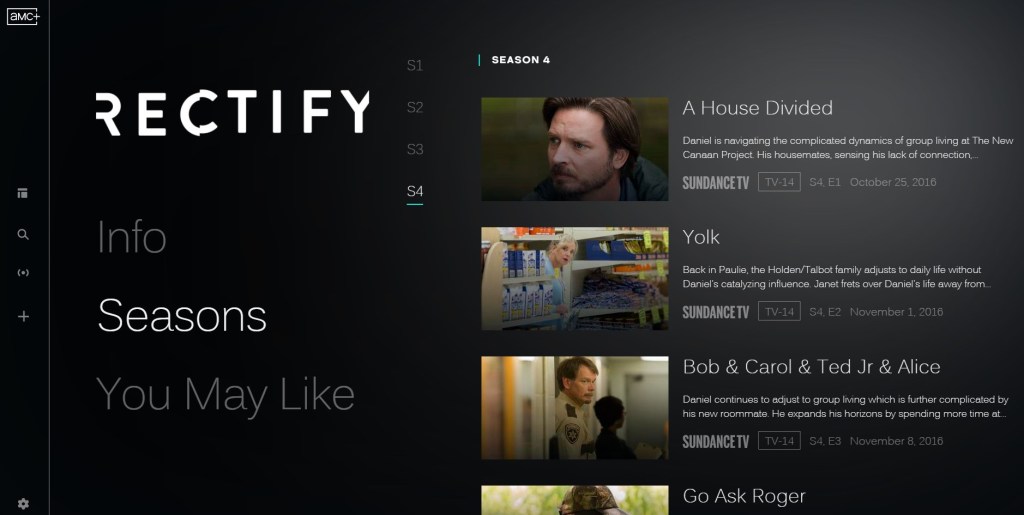
In September, I wrote about reading the academic study Divine Programming and watching seasons one and two of the TV show Rectify. I have now watched the final two seasons of the show, seasons three and four, and was interested to see the role religion played. Here are some thoughts.

  1. Religion is certainly not as important to the plot as it was in the first season. The number of times it is mentioned decreases. There is no presence of organized or institutional religion; it is all personal or individual.
  2. The primary religious character has a return to their faith in the final season. This does not mean everything turns out correctly for them or religion helps solve big issues. It appears that their privatized faith emerges again after going through some personal trials.
  3. The final episodes interact with the themes of hope and disappointment. Arguably, these themes run throughout the entire series; when Daniel is released from prison at the beginning, this does not necessarily lead to long-term consequences for the characters as they engage with what happened in the past and their current circumstances. These are themes that certainly fit with a religious theme. Why do bad things happen? Why are we disappointed? What gives us hope? In the end, the themes of hope and disappointment are left more to the individual characters and immediate family to address, not to religion.

Considering the full show, religion did matter in the narrative arc of the show but it was not a primary force, one that even a majority of the characters engaged with, and did not provide hope or disappointment in the end. Other forces and actors were more influential and the show, like many American narratives, puts a lot of hope in individuals and close relationships among family.

Lacking studio space with all of the TV and film production going on

With a lot of demand for new streaming content, production is moving to different places:

Photo by Ju00c9SHOOTS on Pexels.com

A show the size of The Wheel of Time has to hunt for a part of the world large enough to contain it—especially at a moment when the boom in streaming television has overwhelmed studios from Los Angeles to Atlanta to London to Prague. “We are, as a worldwide industry, quite close to capacity because of this demand for content by our friends at Amazon and all the other streamers,” David Brown, the producer of Wheel of Time, told me. Los Angeles is booked out, and too expensive, anyway. Ditto Atlanta, where Marvel Studios regularly shoots. Ditto London, a longtime production hub that is currently oversubscribed—and, once again, too expensive. So Brown thought: maybe Budapest.

Central and Eastern Europe have traditionally been accommodating places to make movies and television. The locations are suitably grand and variable and ancient; the local expertise, honed by decades of Hollywood productions coming and going, is high-level and relatively affordable. So Brown initially looked at Hungary. But, he said, “I spoke to friends in Budapest who’d worked there, and they just said, ‘You won’t get in.’ ” Then he tried Prague, and found that the waiting list for production space was just as long. So, after some consideration, Brown and his production partners decided to create their own studio from scratch. “You know, we are a big company,” Brown, who is exacting and English and who has worked on everything from The Phantom Menace to Outlander, said. “The show is hugely ambitious creatively. So how do we fill that? That’s why we’re in this building that is 350,000 square feet.”

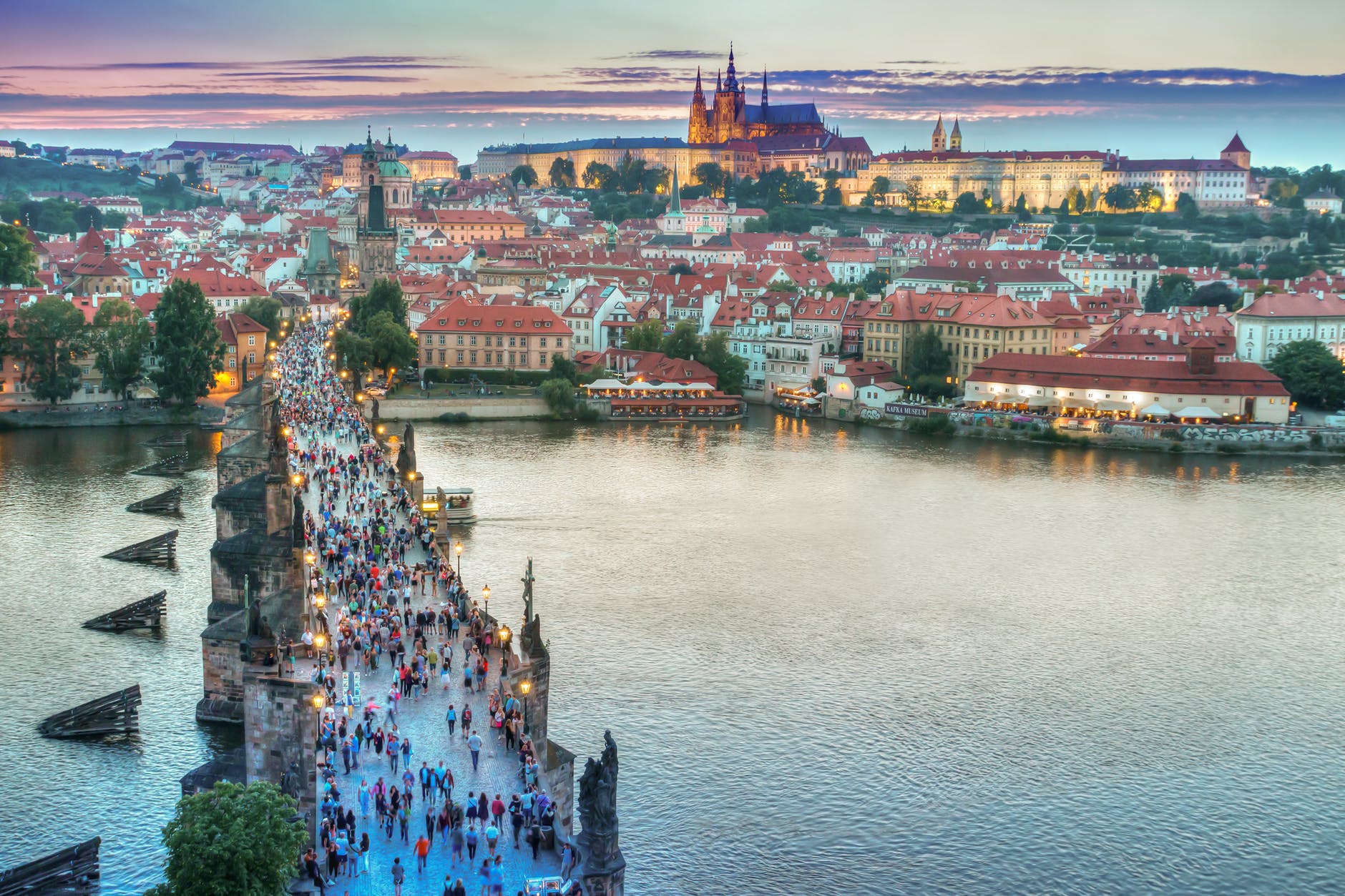
And so Jordan Studios, where the Wheel of Time production is headquartered, ended up in a remote corner of Prague, in a giant pale-blue complex of industrial buildings that used to be the warehouse of a trucking company.

This caught my attention as I have been working in recent years on research involving the locations of television shows. When you look into television production, it takes place in a number of predictable locations. There are centers of production where all of the space, workers, and synergy is present. In the story above, these typical centers were booked and/or expensive. So, they moved to Prague and put together what they needed in a context where Hollywood production is known and possible.

At least for this particular show, the filming in and around Prague may not matter as much because it is a work of fiction. All sorts of landscapes, inside and outside buildings, could work. At the same time, for many other TV shows and films, they claim to be in a particular location. But, would someone watching know whether if it was filmed in that said location or somewhere else? Through the work of studio filming, editing, and implication, how many stories are filmed on location and how many are filmed elsewhere? The viewer may not know. The filming location might be all sorts of places.

All that to say, the geography of production can continue to change with changing conditions and new content. And would the viewer know any different?

“Halfheartedly” air a first episode at 1:30 AM on FXX to keep the TV rights

An overview of a potential blockbuster Amazon TV show includes this paragraph about how the television rights continued:

Photo by Anete Lusina on Pexels.com

At the time of Judkins’s pitch, the screen rights to The Wheel of Time were just coming out of a byzantine and uniquely Hollywood maze—the books had been optioned by two former tech guys, who in turn licensed the rights to Universal, which developed the series as a feature and then shelved it. Then the tech guys enlisted two new producers, Mike Weber and Ted Field. In time, they noticed an obscure provision in the contract, as Weber recalled. It turned out, he said, that “if you aired an episode of television, the rights will vest in perpetuity.” As in, any episode of television at all. And so one mysterious night in 2015—just before the rights to the books were scheduled to return to Jordan’s widow—an episode aired on FXX at 1:30 a.m., halfheartedly adapting the first book’s prologue and starring, for some reason, Billy Zane. The show, such as it was, aired only once and was never seen again. “That’s not the prettiest way to do it,” Weber admitted. “But it cleaned up the rights.” (McDougal Rigney, who released an unhappy statement about this gambit at the time, has since come back into the fold as a consulting producer.)

This is one way to hold on to the rights. It sounds like it all was legal via an “obscure provision.” It would be interesting to hear more about why the provision was in the contract (was it considered a deterrent since it required a television episode to be made?), what was in the 1:30 AM episode, and how all the involved actors responded.

And if The Wheel of Time becomes a megahit in the vein of Game of Thrones, this will look like a necessary and genius move.

Do we live in a Ted Lasso or a Squid Game world?

Two popular shows present very different approaches to the world. Is the world full of redemptive possibilities and sharp conversation or is it a fight-to-the-death game under unfair conditions? Ted Lasso vs. Squid Game.

Take Ted Lasso. After an age of television anti-heroes and heavy themes on television, the lead character brings an upbeat approach to his new coaching position in London. While the second season hints that Ted’s good cheer may hide some life issues, the show’s arcs thus far suggest people can overcome challenges with friendship and good will.

In contrast, Squid Game presents people either facing significant issues or drunk on control and power. Opportunities for good outcomes are unthinkable as even winners survive more than they achieve a warm ending. The bleakness of urban and artificial landscapes add to the trauma that the main characters face.

Given today’s context, Squid Game may match many viewer’s moods. The dystopia may not seem that far away from a world troubled by inequality, lack of trust, and abuses of power. Ted Lasso may seem pleasant but it is just a pleasant or a mocking story when so many are struggling.

Yet, humans often embrace hope in difficult circumstances. Many stories throughout time feature virtuous characters overcoming obstacles and less hopeful people around them. Many want to believe that people will do the right thing when given the opportunity.

If people watch one show, I hope they also get a chance to see the other. Perhaps together they present important parts of human experience and how we might tell very different yet important stories.