Designing your own Peytonville, Part 4

The new Peytonville commercial from Nationwide includes shots of a football stadium on a college campus:

Peytonville4

From exterior appearances, this might be the fanciest stadium in college football. Yesterday, I wondered if people would more likely place Peyton Manning in his college days or in his long NFL days. The stadium in this commercial is an NFL stadium with its shiny exterior, almost complete roof, and scale. This stadium does not fit on the traditional looking college campus featured earlier in the commercial; this stadium belongs among the gleaming offices and condos in an urban center.

Is this a hidden prediction about where college stadiums will go next? Imagine JerryWorld in Texas but instead for Alabama football or Michigan football. Would the big football schools realize some extra revenue or value in being the first stadium to mimic the big pro stadiums?

Designing your own Peytonville, Part 3

A new Peytonville commercial from Nationwide is on television. This one focuses on the college campus:

Peytonville3

For all of the big images from the first commercial – the wide shots of a metropolitan region – the focus here is on a traditional looking college campus. In the image above, there is the impressive brick building, likely home to administrative offices. There is the gate marking the main entrance. Students and other people are walking and biking in and around campus. The lawns are well-manicured, the sidewalks wide.

And lurking in the back left is the football stadium. I should have known that with Peyton Manning in the commercials that the emphasis would not remain solely on small town life outside the big city. In the wide shots from the original commercial, it appears the college campus is on the top left:

Peytonville1

The campus is a good distance away from downtown and might even exist on its own platform.

One concern: do viewers associate Peyton Manning more with college football or pro football? He had successful years at Tennessee. But, he really stood out in the professional ranks where he won two Super Bowls, one season MVP, went to the Pro Bowl numerous times, and set multiple passing records. Peyton is on campus in the commercial but wouldn’t he be better set outside of the Colts stadium in downtown Indianapolis or the Broncos stadium in Denver? Such a scene would not lend itself to the green, bucolic college campus.

Building stadiums and arenas – but not for sports

Concerts are lucrative, lucrative enough to construct buildings with 10,000-18,000 seats primarily for shows:

Los Angeles-based Oak View Group, an entertainment and sports-facilities company backed by private-equity giant Silver Lake, is slated to develop eight new arenas over the next three years, six of which will forgo major-league teams, largely to keep their calendars clear for concerts.

An arena can generate twice as much net income from hosting a concert than a National Basketball Association or National Hockey League game, according to Oak View. Live music is expected to balloon to $38 billion industry by 2030, from about $28 billion currently, according to PricewaterhouseCoopers. Oak View said being able to schedule twice as many concerts as it would otherwise with a professional team in house is an attractive prospect in markets including Palm Springs, Calif., and Austin, Texas. And as streaming is helping artists develop larger international audiences, markets including Manchester, U.K., and Milan are ripe for more arena shows, too…

The company said the arenas are being designed with music as the primary focus, from acoustics to VIP amenities. They will include fewer suites – a pet peeve of musical performers, who typically aren’t able to sell tickets for those seats – and add more clubs within the venue to entice concertgoers to linger before or after a show.

Multiple thoughts in response:

1. The ability to tweak the venue for music in multiple ways seems like a big win for artists and audience members. Instead of being in cavernous arenas that need enough floor space for a playing surface, everything can focus on a stage. It will be interesting to see how sound quality in new arenas like this compares to multi-use facilities.

2. This is a reminder that the big money in sports is not necessarily in attendance to games but rather in television rights and other revenue sources. Could this lead to a future with smaller sports arenas that provide an upgraded experience (it is already difficult to compete with large HD televisions) and more emphasis on what is built around the stadium?

3. Sports teams often ask for public money for facilities. And many communities seem willing to provide it, even when the evidence suggests it is not a good investment. Will music arenas also be funded with public money?

4. Since many larger cities already have arenas or stadiums, it will be interesting to see what mid-sized markets get music-only facilities. Some of the locations mentioned above are places without major sports teams (like Austin). But, I could imagine some of these facilities within large metropolitan markets in order to cater to musicians (imagine such a facility in the southwest or northern suburbs of Chicago taking away business from the United Center, Allstate Arena, and the Sears Centre).

5. Just as sports stadiums and arenas have limited games, these facilities will have a limited number of concerts each year. What else could the arenas be used for?

Designing your own Peytonville, Part 2

The Nationwide commercial featuring Peyton Manning and Peytonville also includes broad shots of his layout. Here it is again:

Peytonville1

While the close-up shows a small town (emphasis on single-family homes and a water tower), the big layout gives a different impression: Peytonville is actually part of a large metropolitan region with at least a few different areas. Here are a few of the things I can see:

1. At the top right, there is a typical urban downtown complete with skyscrapers and office buildings. What is the name of the central city – Peyton City?

2. At the top left, there appears to be a large domed football stadium. This seems appropriate given the star of the commercial.

3. The far left has wind turbines. These are usually located away from residential areas.

4. The bottom left is mostly single-family homes. This is likely where the Peytonville water tower is.

5. Located between the single-family homes and the urban center are mid-rise apartment and office buildings.

6. The bottom right has at least one farm. The food has to come from soemwhere.

Is the implication that when Peyton Manning has all the time and resources to create the landscape of his dreams, he recreates a typical looking sprawing American metropolitan region?

Designing your own Peytonville, Part 1

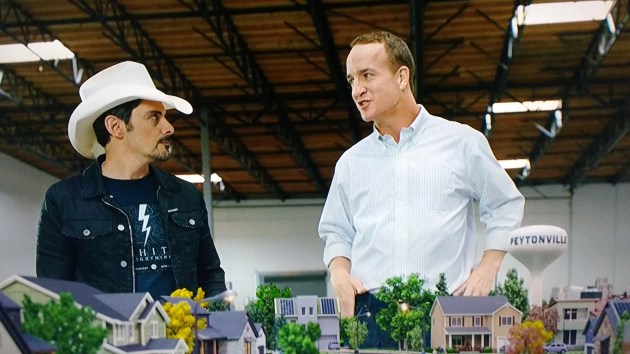
A recent Nationwide commercial has former NFL star Peyton Manning walking within Peytonville, a town set up on a large layout in a warehouse:

Peytonville2

What makes attending such layouts attractive to people? Three quick guesses:

  1. The ability to craft and build an entire community. In real life, no one person could do this on their own. Even a fabulously wealthy person would likely have to rely on a lot of help – think construction workers and others – to put a community together. This sort of layout is possible with a lot of time, materials, and skill (particularly given the size of it all).
  2. The birds-eye/God-like view (and control in #1) possible with such a layout. It is one thing to walk within an interesting place; it is another to consider it from above.
  3. The chance to attach one’s name to a community. This is an honor often given to a founder or a prominent early member of the community. If you control the construction and have a birds-eye view, you can add your own name to it all. The community in the commercial is Peytonville but it could be Peytonton, Peyton Corner, Peyton Park, and other variations.

Peytonville1

It would take a long time to put this together but it could be very fun to maintain, play with, and show off to others.

Three backlot settings I cannot forget

Vacationing in southern California a few years back, we decided to go on some tours of Hollywood studios. After doing these tours, I started looking more into the different backlots for different studios. Then it hit me: I have seen these settings at least dozens of times. In commercials, television shows, and films. Over and over again. Here are a few of these backlot settings I cannot forget:

1. Colonial Street on the Universal Studios lot. There are so many houses here that have been used. Plus it served as Wisteria Lane in Desperate Housewives. (And also an Ace Hardware advertisement.)

2. The city streets on the Warner Bros. lot, particularly the New York Street set. The street corner featuring a storefront with a subway entrance right in front that is used all the time.

3. Wall Street at the Universal Studios lot. The key is seeing the large building with columns at the end of a shot down a long street.

Once you know what these settings look like, it is easy to recognize them.

Did Central Perk make Friends or did Friends make Central Perk?

Amidst the 25th anniversary of the start of Friends, numerous commentators pointed out the iconic Central Perk coffee shop and hinted at how it helped make the show. Architectural Digest called it an “iconic TV interior.”

But, this raises a chicken and egg problem for television shows: do the settings help make shows popular or critically acclaimed or do people celebrate the settings because other parts of the show are good?

In the case of Friends, much is made of its setting in New York. With six young adults living in apartments, Friends helped make urban living look fun. Would the show have worked if it had been set in San Francisco or Chicago or less dense locations? More specifically, does the coffee shop truly make it feel like New York or more homey?

Or, on the other hand, did the show really not need to involve New York because what really mattered were the interesting relationships between the six young adults plus the situations they got themselves into. If the characters and writing are good enough, could the show succeed even with a lousy or less interesting setting?

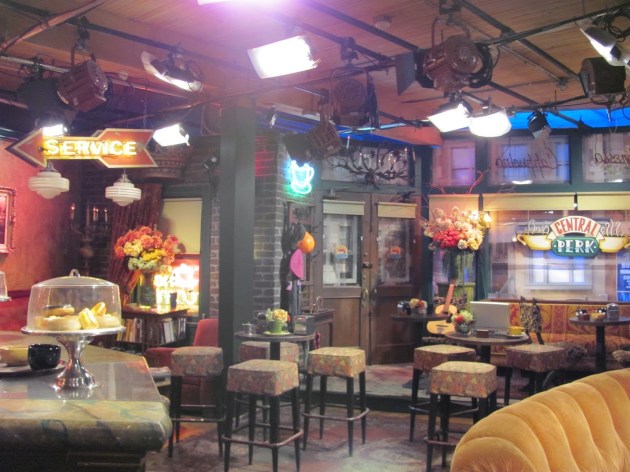
For the record, I saw the Central Perk set with my own eyes on a tour of a Hollywood backlot some years ago.

CentralPerk2

Seeing iconic settings like this is an interesting experience: they are both recognizable and not. Because you can see all that is right around the set but hidden on TV (such as the lights, the fake facades) the scenes seem very sterile. On the other hand, it looks like a very familiar place.

At least two McMansions on the list of “26 most Iconic TV Interiors”

Architectural Digest has a list of the “26 most Iconic TV Interiors” and it includes at least two McMansions:

The Sopranos memorialized early-2000s New Jersey in all its gritty glory. Perhaps most memorable among fans was the Soprano family kitchen, with its light wood palette, where Tony was often seen in his robe, rummaging for cold cuts. But the show’s production designer Bob Shaw has said he found the office of Tony’s therapist Dr. Melfi the most interesting, because it was round. For a mobster confronting his own mind, there was nowhere to hide…

The rich and beautiful but down-to-earth Cohen family was the family every O.C. fan wished would adopt them—but only Ryan was so lucky! The Italianate McMansion in Newport Beach, California, was actually built on a soundstage—so, that breathtaking ocean view from Ryan’s poolhouse? That was a photo backdrop made by production designer Thomas Fichter, who was also responsible for all the “weather” you ever saw on the show.

I have a lot to say about the Soprano McMansions here.

The home from The O.C. has some similarities to the Soprano’s McMansion: it is in the suburbs and was built (and aired) in the same time period. Yet, the inhabitants of Orange County on the show faced more conventional suburban problems – teenagers stuck in a world of largely successful adults with big houses – compared to the twist of a gangster family living in a well-kept New Jersey McMansion.

Two other thoughts on this list:

-There are at least a few outright  mansions on here, including the impressive setting for Downtown Abbey.

-The brief descriptions do not provide that many insights as the list contains mostly very popular shows. Did the interesting setting help make the shows popular or did the settings become interesting because the shows took off? The list does not really have any failed shows though I imagine some short-lived television shows had some very interesting interiors.

Houses and locations from TV shows can draw visitors

To follow up on yesterday’s post regarding the importance of the English manor to Downton Abbey, some more on the popularity of the home:

When the Downton Abbey producers first approached Highclere in 2009, the family faced a near £12m repair bill, with urgent work priced at £1.8m. But by 2012 the Downton effect had begun to take the pressure off. Lord Carnarvon said then: “It was just after the banking crisis and it was gloom in all directions. We had been doing corporate functions, but it all became pretty sparse after that. Then Downton came along and it became a major tourist attraction.”

Visitor numbers doubled, to 1,200 a day, as Downton Abbey, scripted by Julian Fellowes, came to be screened around the world after becoming a hit in the UK in 2010 and then in the US. It is now broadcast in 250 countries…

VisitBritain’s director, Patricia Yates, said: “The links between tourism, films and TV are potent ones.” She added that period dramas have also raised the popularity of regions outside of London.

Keeping an older house maintained and running is an expensive task. Tourism spurred by television or film can help some locations stay afloat even as dozens of other homes languish. More broadly, when I studied the primary home on The Sopranos, I ran into stories of Sopranos tours and merchandise that utilized the show’s New Jersey locations. A Simpsons home outside Las Vegas has attracted visitors even as the home has remained as a private residence. Fixer Upper helped bring people to Waco, Texas. Some shows do indeed seem to spur tourism.

On the other hand, visiting the locations and homes of other shows would prove disappointing. Many television homes, such as the residence of the Brady family on The Brady Bunch, do not match the actual home even if the exterior is recognizable. Numerous shows use establishing shots of real locations and then the filming takes place on soundstages and backlots. For example, a tour of New York City based on Friends makes little sense since most of the action took place inside fictional locations (though the 25th anniversary pop-up location in New York City is sure to attract visitors). On a tour of the Warner Brothers backlot, I saw Wisteria Lane and part of Stars Hollow; in both cases, knowing that this was not a real place changed how I later perceived the shows.

In a world where cities and places chase tourists, television shows that use that location and become popular can be a boon because there is little a community has to do with it. What exactly those tourists expect to get – perhaps a little closer to the on-screen characters? to drink in the mystique of the entertainment industry? – is another matter entirely.

Argument: the star of Downton Abbey is the house

All television shows have settings and locations but few are as important as the large home on Downton Abbey:

The main character in Downton Abbey is not a person at all. It’s a building. Downton Abbey.

There it is in the opening credits of the new film and, despite a whole raft of new changes that I am trying not to give away, there it stands at the end, towering over all of the humans who enter and exit its doors, more custodians than owners, really.
The domestic edifice is this hugely successful franchise’s reason for being, the explanation for the movie, the lodestar for the show’s fans. Individual characters can die — and, God knows, they have. But if “Downtown Abbey” itself were ever to fall, then the story would be over.

This is unusual. Most long-running TV shows are centered on either an individual or a family. “Mad Men” could not survive past the death of Don Draper. “Dexter” needed Dexter. “Breaking Bad” tells the story of Walter White. “Game of Thrones” (73 episodes!) had numerous story arcs, heaven knows, but it still remained the story of communities, not unlike “The Wire” or “The Deuce.” “Star Wars” is a generational saga at its core. And, of course, superhero franchises need their superheroes. (Or their close relations.)

In many television shows, the setting functions more as a backdrop than anything else. The opening credits may show a city and/or home. The show itself may feature a few main sets, typically a place of residence and a workplace. But, swap one city or suburb for another or home for another home and the show could go on.

Would the same be true for Downton Abbey? If the show took place in a different English manor – which are occasionally seen on the show and in the movie – would it be a different show or a weaker show? Is the show popular because of the house or is the house popular because of the show?

It seems like a step too far to suggest that a bad or mediocre television show could be rescued by or solely built on a unique and interesting setting. Good characters encountering interesting situations is a necessary ingredient, even in a show that depends on an unusual and/or popular location. Yet, we could study the degree to which a setting or location or building figures in the plot and popularity of a show. For example, would The Sopranos be the same show without the suburban McMansion the family lives in?