Recurring issues with teardown McMansions

What if a suburban community continues to face the same issue of teardown McMansions angering neighbors? The case of Arlington Heights, Illinois:

Elgas called the home dimension differences “a form of gentrification” and asked the board to consider changing the building codes to prevent the number of larger homes being erected in Arlington Heights…

“This is not the first time it has come up as a phenomenon in Arlington Heights,” said Mayor Tom Hayes. “It’s probably 10 to 15 years ago this phenomenon first showed itself, not just in the village of Arlington Heights, many neighboring municipalities experienced the same issue with tear downs. We were sensitive to the issue at the time; we did a number of different things from legal, building, zoning and design, we addressed it at that point.”…

Charles Perkins, director of planning and community development, said the village had a task force that studied this issue with members from the Zoning Board of Appeals, the Plan Commission and village trustees. The leaders took bus tours around neighborhoods to view the tear downs and changes. As a result, he said, there were a number of changes made to village codes.

“We reduced the number of square footage you could put on a home, minimized impervious surface, and in the R3 district, which is this particular neighborhood, there was a 10 percent reduction on the ability of square footage of a home built on the lot,” Perkins said. “Those in single-story neighborhoods, typically go to the design commission for the architectural component of the home as well.”

This is not an issue facing just Arlington Heights: wealthier suburbs with older housing stocks can often be attractive to residents who have the means and desire to tear down older homes and construct new and often larger homes. And the teardowns can move in cycles, depending on changes in the housing market, what neighborhoods or communities are desirable, and how communities – including local leaders and neighbors – respond to such moves.

Three additional thoughts:

  1. The term McMansion is not used the article but this is the sort of home that is at issue here. A teardown home with a large footprint constructed in a neighborhood of smaller homes fits clearly within an understanding of McMansions.
  2. The community has some guidelines for new teardowns but not all neighbors think these go far enough. This is a common point of tension: should the property owners have say over their plot of land or should the community and neighbors be able to put in significant restrictions? Who gets more say can become a long local political process with the possibility for long-term bitterness.
  3. While neighbors might generally not like this development, this could be taken as a sign by leaders of a community that their community is desirable. Particularly in communities with limited opportunities for greenfield development, teardowns and infill development can represent a significant portion of change.
What a McMansion looks like to an insurer

I find McMansions to be fascinating but rarely have I thought how an insurer might view a Large Tract Home (LTH):

While they might look grand, LTHs are different from high value homes in a few key ways. Their location and design is similar across an entire subdivision, the construction materials are lower in quality, LTH construction practices are focused on efficiency, and other LTH construction costs are more predictable and less expensive. Despite those differences, insurers can run into problems when assessing the reconstruction bill for an LTH.

“A lot of times, the sheer size of them [means] a lot of carriers classify them with a much higher reconstruction cost when it comes time to rebuild,” said Benjamin Abbott, product manager for CoreLogic Insurance Solutions group, adding that the latest RCT Express release “allows carriers to visually see whether a home is classified as a large tract home or not. And if it is, then we turn down the reconstruction costs a little bit with our assumptions and allow the tool to more accurately price [the property].”

The valuation distinctions between McMansions and high value properties becomes important as natural catastrophes bear down on many parts of the US, at the same time as a lot of new homes are being built in the LTH model…

“It’s important for the insurance carriers to accurately value the reconstruction costs of any property they have because their client, the homeowner, is going to see the impact of that reconstruction cost directly in the premiums that they pay,” Abbott told Insurance Business. “Prior to this update and with other tools out there, they are potentially over-insuring, meaning that premiums may be inflated, which hurts the homeowners directly.”

Interesting assessment: the size of McMansions would lead to a higher reconstruction cost until the insurer considers the quality of the construction and the reconstruction cost drops. I assume this then means it could be cheaper to insure a McMansion than a different kind of home of a similar size?

More broadly, I wonder if insurance companies could provide data on McMansions:

  1. Just how many McMansions/Large Tract Homes are there in the United States?
  2. What is the worth of all such homes?
  3. How many and/or what percent of McMansions are located in areas more prone to natural catastrophes (such as coastal areas where beachfront McMansions can be popular)?
  4. Because of the lower-quality construction of McMansions (as noted above), do McMansions have an above average number of claims on the home insurance over time? The lower-quality construction claim is a common one but we have not necessarily had enough years pass before we can easily see more issues with the longevity of McMansions.

At least 12 reasons Americans have the biggest houses in the world

Why do Americans have the largest houses in the world? A lengthy list of reasons:

  1. Americans like private homes. This often means they desire detached single-family homes in the suburbs. So why not have a lot of private space? Similarly, Americans place a lower priority on pleasant public spaces or spending time in public.
  2. The trend toward larger homes really took off in the postwar suburban era. At the time, this could be linked to growing family size with the Baby Boomer generation. (Interestingly, as household sizes decreased in recent years, homes continued to get bigger.)
  3. Americans like to consume. With relatively large amounts of disposable income, Americans need space to store their stuff, ranging from clothes to media to new technological devices to cars. The answer is not to get rid of stuff but rather to have a big house to store bulk goods. Garages are important parts of homes since driving is so important.
  4. Americans have increasingly viewed housing as an investment rather than just a place to live and enjoy. If the goal is to get a big financial windfall later in selling the home, it could pay off now to buy as much as possible.
  5. Compared to some countries, Americans have a lot of land to build and sprawl. Americans have also made different land use decisions to prioritize lower densities and sprawl.
  6. There are regional differences regarding large homes. McMansions are everywhere in the United States but more culturally acceptable in Dallas than in New York City. Many metropolitan regions have housing prices that make having a big house possible (compared to New York, San Francisco, LA, and Seattle).
  7. Developers and builders are less interested in constructing starter houses as there are more profits in bigger homes.
  8. A number of communities will only allow homes of a certain size in order to maintain their character and status.
  9. The government has provided funding and support for mortgages, suburbanization, and driving over the last century.
  10. Americans have a bigger is better mentality as well as believe that growth is good. This applies to population growth and also applies to houses.
  11. McMansions are popular with some but America has plenty of large homes that would not qualify as McMansions. From large urban condos and homes to large rural properties, Americans can find plenty of big homes to purchase.
  12. The space in homes does not have to be used to be desirable. For some owners, the space itself is just worth having.

(This post was inspired by this recent article. Also, see this earlier post “Explaining why Americans desire larger homes.”)

Rebuilding beachfront McMansions

A journalist argues the construction and reconstruction of large homes near Atlantic beaches is a losing proposition in the long run:

Through federally funded flood insurance, huge appropriations for beach nourishment projects, and generous, well-intended relief aid, government policy allows developers and wealthy investors to build huge houses and hotels on beachfronts and low-lying barrier islands at high risk from coastal flooding as well as hurricanes. Uncle Sam’s generosity makes it all possible…

Writing just as the extensive damage from Hurricane Florence became apparent, Gaul covers the waterfront, so to speak — from Hurricane Katrina to South Florida, to the halls of Congress. In North Carolina, he stops Down East in Columbia, Creswell and other towns of North Carolina’s “Inner Banks,” where rising water levels and flooding are washing away entire communities…

According to Gaul, things began to tip in the 1980s, when multistory “McMansions” began to supplant the simple Cape Cods. (A similar trend has transpired on the north end of our state’s Outer Banks). Disasters such as the Ash Wednesday flood of 1962 did little to discourage development. On the contrary, real estate dealers saw storms as “clearing the market,” blowing down older, ramshackle structures and making way for the new, bigger units that buyers seemed to want.

Real estate prices went up, and increasingly retirees and residents with modest incomes were squeezed out. But there were always more customers in line for resort property.

I wonder if the primary objection is that big homes are being built and someone is profiting from the government money or should there be no homes on these properties? If the goal is to protect the beach and taxpayer dollars, less development in these areas is better. If the problem is profiting with the government’s money, there could be restrictions on the size of the new home or how the money is used.

It would be an interesting thought experiment to consider what this would look like without any government intervention. The argument here is that the government’s funding for rebuilding simply encourages the cycle of building larger and larger homes. If there were no regulations, what would the market bear? Or, as the author seems to suggest, would different regulations be better for the long-term fate of the beach and tese communities?

Celebrating the labor of those who build McMansions?

The construction of single-family homes employs many Americans. When demand for homes drops, such as in the late 2000s with the burst housing bubble, many are out of work until the housing market heats up again.

Critics of McMansions would argue such homes should not be built. Instead, the land could be put to better use or developers and communities should focus on building other kinds of housing units that do not suffer from the same flaws.

But, the construction of McMansions employs people. Developers may build them to make more money than they could by building starter homes and communities may approve them in order to keep property values higher. And these homes provide work. Is this the case where a job is not worth it if the outcome is an undesirable product (in the eyes of McMansion critics)?

On this Labor Day, it would be interesting to consider how those who construct McMansions might be employed constructing other buildings. For many who construct McMansions, it could be hard to turn down the work if other opportunities are not present or the job pays okay. Should part of the fight against McMansions also include efforts to address labor issues?

Quick Review: “Square-Footed Monster” episode of King of the Hill

Few television episodes tackle the topic of McMansions. Thus, here is a review of Season 13 Episode 3 of King of the Hill titled “Square-Footed Monster.”

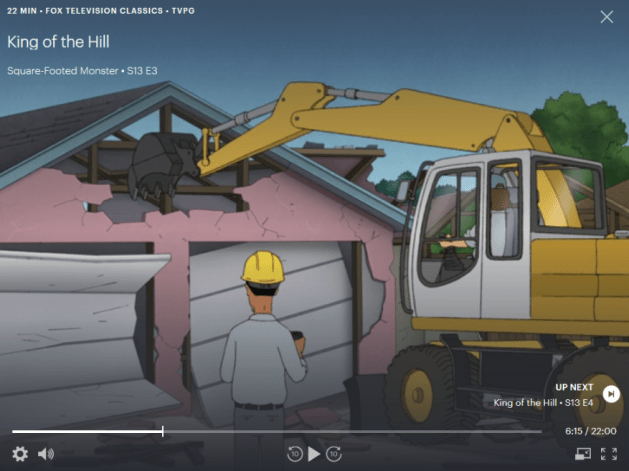
First, a quick synopsis of the plot and relevant dialogue from the main characters. The issues begin when an older neighbor lady dies and her nephew comes to fix up the ranch home to sell it. The men, led by Hank, help fix up the house. It sells in one day. The next day, the house is torn down by a large excavator and the local developer says he is breaking ground on a “dream home.”

SquareFootedMonster1Amid scenes of constructing a large balloon frame, the builder brings the guys peach chardonnay (clearly indicating his different status) and shows them a rendering of the new home. Hank’s response: “Looks like a bank. No, a church. Wait, A casino? I don’t know what the hell I’m looking at.” The developer says it is a speculation house.
SquareFootedMonster2

Hank and the guys decide to fight back. They go to City Hall and show images of the modest homes in their neighborhood compared to the new home with “4,600 square feet of obnoxiousness” (Hank’s description). The leaders say the home is by the books so construction continues. The guys consult the local legal loophole expert as Hank says, “someone is building a jackass McMansion that’s going to destroy our neighborhood.” There are no loopholes to help them.

SquareFootedMonster3

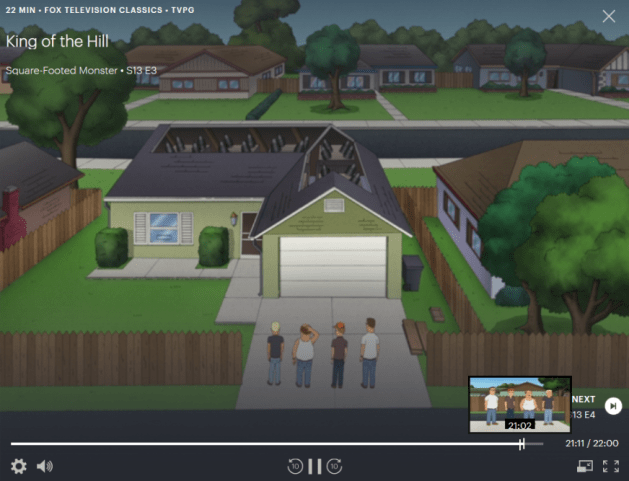
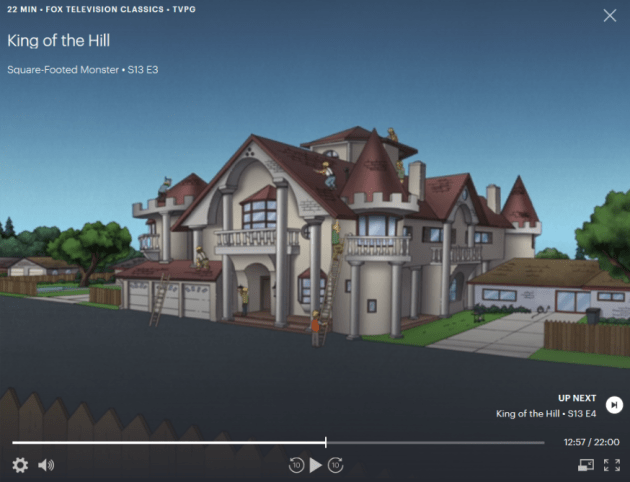
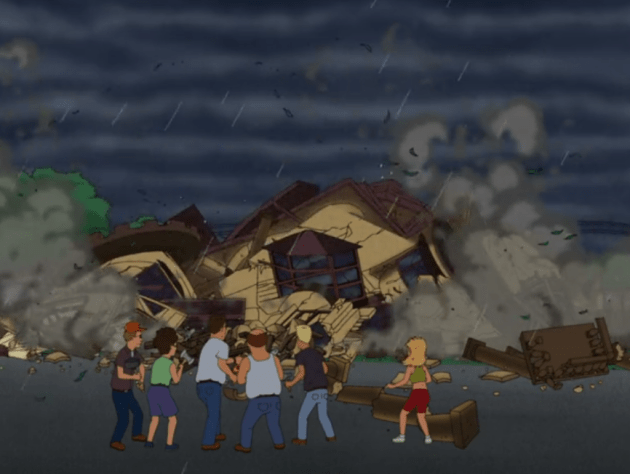
The next scenes show a massive McMansion blocking out the sun and going right up to its property lines. Hank notes, “Ted’s using cheap building materials too. It’s all spackle and chicken-wire.” In the subsequent big wind, the house starts falling apart. Wanting to protect their own homes, the neighbors take chainsaws, axes, and other implements to help the home collapse.

SquareFootedMonster4edit

The next day, the developer looks at the damage done by the neighbors and accuses them taking down the home. Hank responds: “We don’t have anything to hide. The only one who did something wrong here was you. Your shoddy McMansion was going to destroy our homes. We only took it down in self-defense.”

The case goes in front of a local judge who with some prompting by the local legal loophole expert rules in favor of the neighbors. The developer tries to get the last laugh by selling the property to the city to use as a power substation.

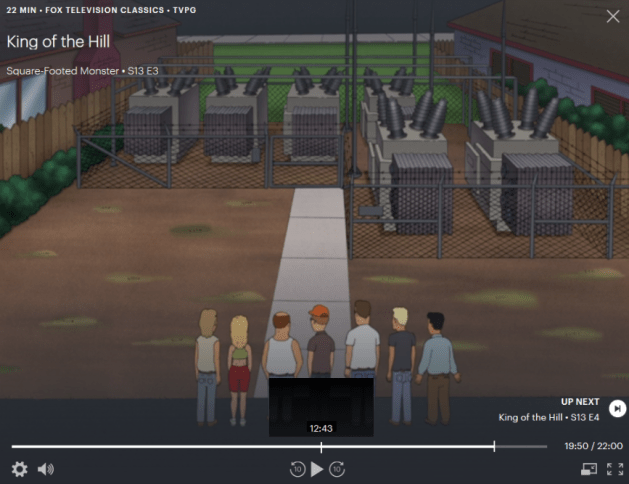
SquareFootedMonster5

After lamenting the new land use, the men construct a fake house around the substation. Hank says, “I’ll take a fake house over a big ugly one any day.”

SquareFootedMonster6

This episode contains several themes common to narratives about McMansions:

  1. The developer simply wants to make money without regard for the existing character of the community.
  2. A teardown McMansion can be very invasive: it looks out of place compared to nearby homes, it encroaches on lot lines and the street, it blocks the sun, and its construction is disruptive to neighbors.
  3. The new large home is poorly constructed – it starts falling apart in heavy winds – and has dubious architectural features including turrets, pillars, and balconies.
  4. Neighbors resent the intrusion of the new home but there is little they can do to stop it (hence the need to find obscure legal loopholes and attack the homes themselves). There is one neighbor who appreciates the new home for what it could bring to the neighborhood but he is in the minority.

In the end, the neighbors do win out: instead of a dilapidated ranch home next door, they have a substation that looks like a well-maintained ranch home.

In twenty-two minutes, this is a decent summary of how teardown McMansions could go. The episode does not provide much perspective from the view of the developer of the home or local officials outside of quick references to making money and an interest in large new homes. Some lingering questions remain including why construct such a large new home on a street of ranch homes of working-class residents. The neighborhood may have been saved but the episode also hints at how fragile a set of homes and the associated community might be if just one property falls into the hands of a developer.

(All screenshots of the episode are from Hulu.)

Novel suggests McMansions gentrify small suburbs

A new novel suggests McMansions can upset small suburbs:

Novels about small houses in small towns can feel cramped. But in Julie Langsdorf’s White Elephant, the locals fight to keep things that way in their property battle with a builder who puts up McMansions. Set in the suburban Maryland town of Willard Park, the story depicts a married couple’s struggle with their defunct sex life, middle school kids and their awkward, back-stabbing drama, a pot-head attorney whose marriage is in trouble, and numerous sketches of other denizens. White Elephant has a long, slow start, but once it gets going, it bolts straight to the end...

White Elephant is a gentrification story which focuses on suburbs and small towns. This tale will feel familiar to anyone who has lived in an inner suburb and woken up one morning to the shock of McMansions going up nearby. Suddenly all the talk is of assessments, property values, equity, and second mortgages. The new houses tower over neighbors. Or, if a block of expensive townhouses has been installed, suddenly the local school is too small. It’s not as pernicious as urban gentrification, booting out locals to make way for wealthy hipsters and their $10 latte watering holes, but it’s a menacing cousin. Costly houses and townhouses open the door for luxury apartments, and once those appear, all the old affordable ones raise their rents. A person working full-time on minimum wage can hardly afford a one-bedroom apartment in any American city, and this is the next step, as the blight of gentrification seeps out into formerly cheap suburbs.

I believe that McMansions can upset residents’ conceptions of their neighborhood or community. There are plenty of cases in the last 10-20 years that suggest some believe McMansions, whether in new subdivisions or as teardowns, ruin locations they like.

On the other hand, the description above of how all this works seems a bit odd to me. A few questions:

  1. How many inner suburbs become home to many teardown McMansions? Inner suburbs can be wealthy, working-class to poor, or somewhere in-between.
  2. My guess is that McMansions and more expensive housing do not just pop up in a community: there are precipitating qualities of the community that lead developers and local officials to think that the more expensive housing would take off. In other words, wealthier communities beget more housing for wealthier residents.
  3. Cheap suburbs, if just going by cost of housing, can be located throughout a metropolitan region. If gentrification is simply more expensive redevelopment, it could happen in many places throughout a region.
  4. Why is this gentrifiation not as pernicious if new development makes it harder for locals to stay? It may be happening in a suburban area but not all suburbs are that well-off.
  5. Is there a small-town suburban life worth defending? Decades of suburban critiques suggested suburbanites and their communities have all sorts of deficiencies. Are suburbs now to be saved from McMansions?

The McMansion is a monster to invoke in today’s fictional tales as its size and lack of good taste relegate it to at least shady, if not menacing, status.

Win the lottery and build a home – but just not a McMansion

From the court of public opinion: imagine winning a big lottery payout, wanting to construct a new home, and then facing backlash for choosing a McMansion:

I’d rather buy an existing home, but some people want to put their own fingerprints on the place they call home.

I respect that, as long as they don’t build one of those gaudy McMansions that are a blight on our urban landscapes. The last thing we need is another generic McMansion with giant white columns erected in front of the entrance and marble lions at the front of the driveway.

This above is, of course, all just opinion but imagine some wacky scenarios where this could be a problem:

  1. Lottery winners are often publicly named so the smiling face and the floor plans of the new McMansion are splashed across local news websites and print media accompanied by negative headlines and insinuations.
  2. The proposal to build the new home is immediately met with angry neighbors and/or public officials who will drag their feet as long as possible before approving the home that is within local guidelines. (Going further, a community could immediately enact new building regulations.)
  3. A protestor shows up to silently mark the construction and presence of the McMansion lottery home.
  4. The home becomes ostracized in the community, known by some derogatory label, the target of egging, TPing, and random junk mailings, and held up as an example of what the community does not want in the future.

Any of these might be enough for a lottery winner to go construct a McMansion in a more McMansion-friendly community (and they do exist even if they likely do not advertise themselves as such).

The (illustrated) story of one man’s quiet protest in front of a 12 home McMansion subdivision

The New York Times recently featured one man opposed to McMansions on Bainbridge Island, Washington. Here is the start:

McMansionProtestStoryStart

Protesting does not have to be complicated and persistence goes a long ways.

Limiting teardown McMansions with ordinances requiring demolitions reuse and recycle materials?

Palo Alto, California will soon require the reuse or recycling of the majority of materials for demolished buildings:

[W]orkers will now be required to systematically disassemble structures, with the goal of reusing or recycling the bulk of the material on the site. Based on experiences in Portland, Oregon, which has a similar law in place, staff believes that up to 95% of the construction debris can be salvaged — either reused or recycled — through “deconstruction.”…

Construction and demolition materials represent more than 40% of Palo Alto debris that gets disposed in landfills, according to an estimate from the city’s Public Works Department. As such, it represents a prime opportunity for diversion and recovery, staff told the City Council at the June 10 meeting, shortly before the council voted unanimously to adopt the new ordinance…

The new model calls for buildings to be systematically disassembled, typically in the reverse order in which they were constructed. Based on two recent pilot projects, deconstruction work using this method would take about 10 to 15 days to complete and require a crew of four to eight people, with the cost ranging from $22 to $34 per square foot….

The new deconstruction ordinance is expected to help the city divert 7,930 tons of waste annually (by contrast, the disposable-foodware ordinance that the council adopted at the same meeting would divert 290 tons). The deconstruction ordinance is also expected to reduce the city’s greenhouse-gas emissions by 22,300 metric tons annually (for the foodware ordinance, the number is 470 tons).

This would be an interesting way for communities to limit teardown McMansions without having to explicitly mention big houses. When there are public discussions about ordinances regarding residential teardowns, it often comes down to a discussion of property rights versus neighborhood or community character. These can get ugly. But, an ordinance like this does not have to explicitly mention residential properties or single-family homes in order to affect them. Going through the reuse/recycle mode would require more time and labor and this might either constrict what is built on the site or stop the teardown process before it begins. Of course, those pursuing teardowns might simply pay more to deal with the new requirements. People who have the money to buy a lot and house (sometimes a perfectly functioning or not very old house) and just tear it down and build a new one might just be able to easily pay these new costs.

With this ordinance in mind, I imagine there are other ways local governments could restrict residential teardowns without necessarily targeting them. Why set up a battle about property rights, aesthetics, and community if it can be avoided by regulations that nudge people certain directions?